
Participant recruitment methods: 5 ways to find people
Participant recruitment methods compared by who you need: your own list, panels, referrals, networks and recruiters, plus a check before you set a date.
Multi-market participant recruitment: define the same person in every country, set numbers per market, adapt screeners and incentives, then compare.

The first screener results came back from two countries, and they don't line up. You're on the research team at a music streaming service, recruiting family plan listeners before the company picks where to launch a new feature. One country sent heavy listeners and the other sent light ones. So how do you recruit the same kind of person in every country?
That job is called multi-market participant recruitment, and it decides whether your countries can be compared at all.
Describe the person by what they do, not by local labels. Give each market its own minimum. Adapt the screener, the thank-you payment and the consent form for each country. Then check each market's sample before you compare.
Do those things in order and a difference between two countries comes from listeners, not from how each country was recruited.
Multi-market participant recruitment starts with the decision, because the decision tells you which countries need a voice. A market belongs in the study when its answer could change what the company does. Then you describe the person by what they do, so a "family plan listener" in one country is the same person in the next.
Say the company sells in many countries but the launch choice is between a market where shared playlists are common and one where they are rare. Those two markets belong in the study. A third market where the feature is already live does not, because nothing there is being decided.
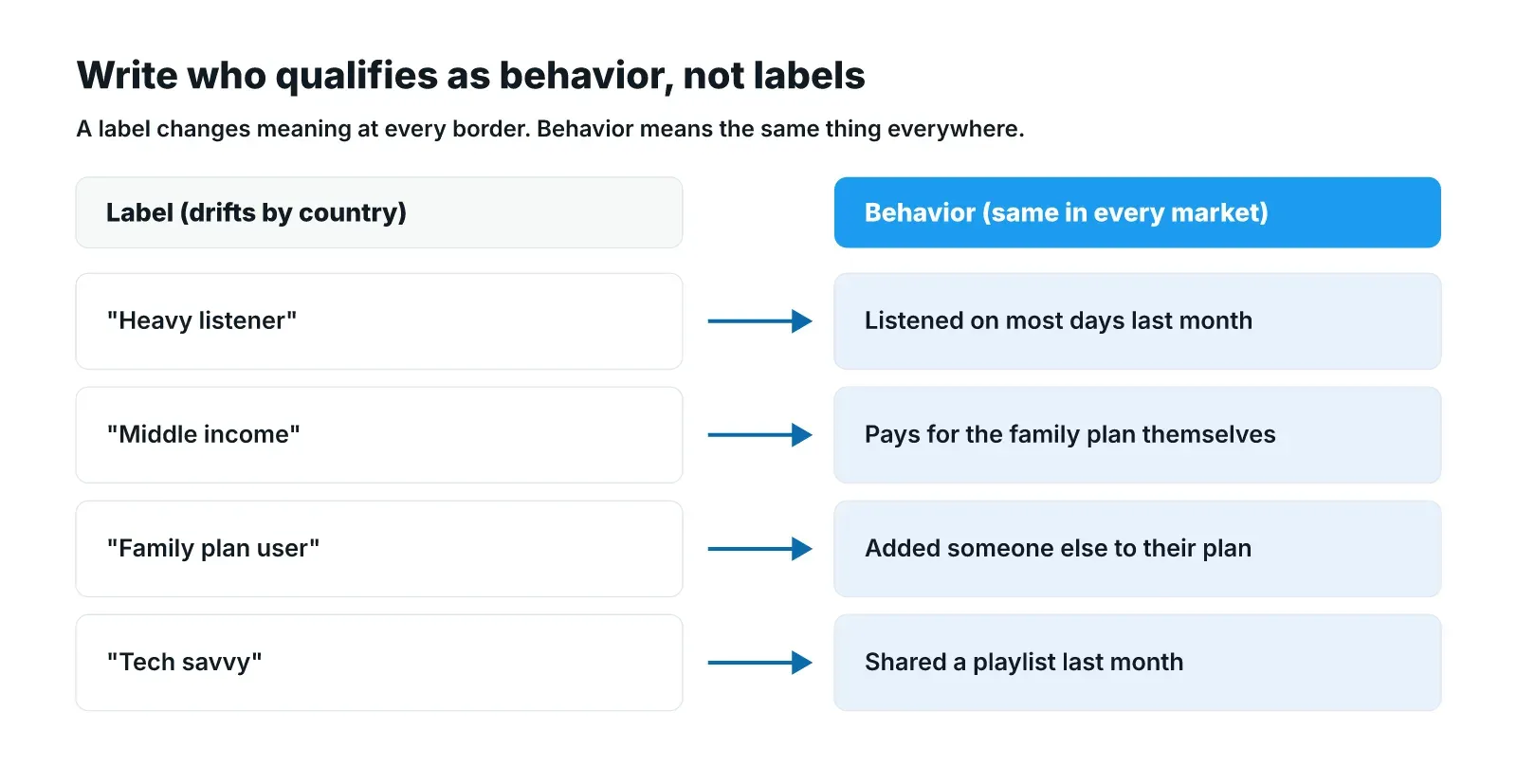
Labels are where samples drift apart. A job title, an income band or a store name changes meaning at every border. What people do travels much better, as each row of the table shows.
| Criterion written as a label | Why it drifts | Written as behavior |
|---|---|---|
| "Heavy listener" | Each country's team pictures a different amount | Listened on most days in the last month |
| "Middle income" | Income bands differ by country and currency | Pays for the family plan from their own account |
| "Family plan user" | Plan names and prices vary by market | Added at least one other person to their plan |
| "Tech savvy" | Means different things to different screeners | Created a playlist and shared it in the last month |
Write exclusions the same way, such as "works for a music or streaming company", so they screen out the same people in every country.
Then translate the meaning, not the words. A screener is the short set of questions that decides who gets in. An income band or a school level needs a local version that someone in that country picks. Before it opens, ask a colleague in each market to read it back in their own language. If what they hear differs from what you meant, the answers will too.
Each market needs its own minimum number of people, agreed before recruiting starts. That way its reasons can be heard on their own. If you split one total by each market's share of sales, a small market gets so few people that its reasons get lost.
If your report needs to say "listeners in this country share playlists for different reasons", that country needs enough interviews to show it. That's why the minimum comes per market, before anything else.
Keep the splits inside a market to one trait. Two markets with three listener types each is already six groups to fill, and every extra trait multiplies the groups again. The post on how many interviews each group needs helps you set the minimum.
Agree now what happens when one market is slow to fill. You can extend that market's recruiting dates, widen the source, or report the market as thinner. What you never do is top it up with people from another country.
A missing market reported honestly is still a finding. A borrowed one isn't.
Where people come from, what they are paid, what they agree to and when they take part all need a plan for each country. Each one can tilt a market without anyone noticing. If one market comes only from loyal customers and another only from a panel, the two differ before anyone says a word.
Where you can, use the same blend everywhere, such as part from your own customer list and part recruited to the profile. A panel is a pool of people who have signed up to take part in research. If one country can't use your customer list, note it, because its sample will lean differently. For the customer list itself, start with recruiting from your own customers and agree contact rules with account teams.
An incentive is the thank-you payment a person gets for taking part. Set it at a level that feels fair in each country. Pay it in a form people there can use, such as a local gift card or a bank transfer. One global amount can feel generous in one market and small in another, and that changes who says yes.
Consent is a person's informed agreement to take part and to how their answers are used. Ask your privacy team to check the consent wording and data handling for each market, such as GDPR for people in the EU. This post is not legal advice, so that check belongs to them.
List the public holidays and busy seasons in each country across your recruiting dates. A national holiday can empty one market for a week. Watch progress by market every day. Send reminders in each market's daytime, and track who drops out after saying yes. Pause any market that is filling from one source only.
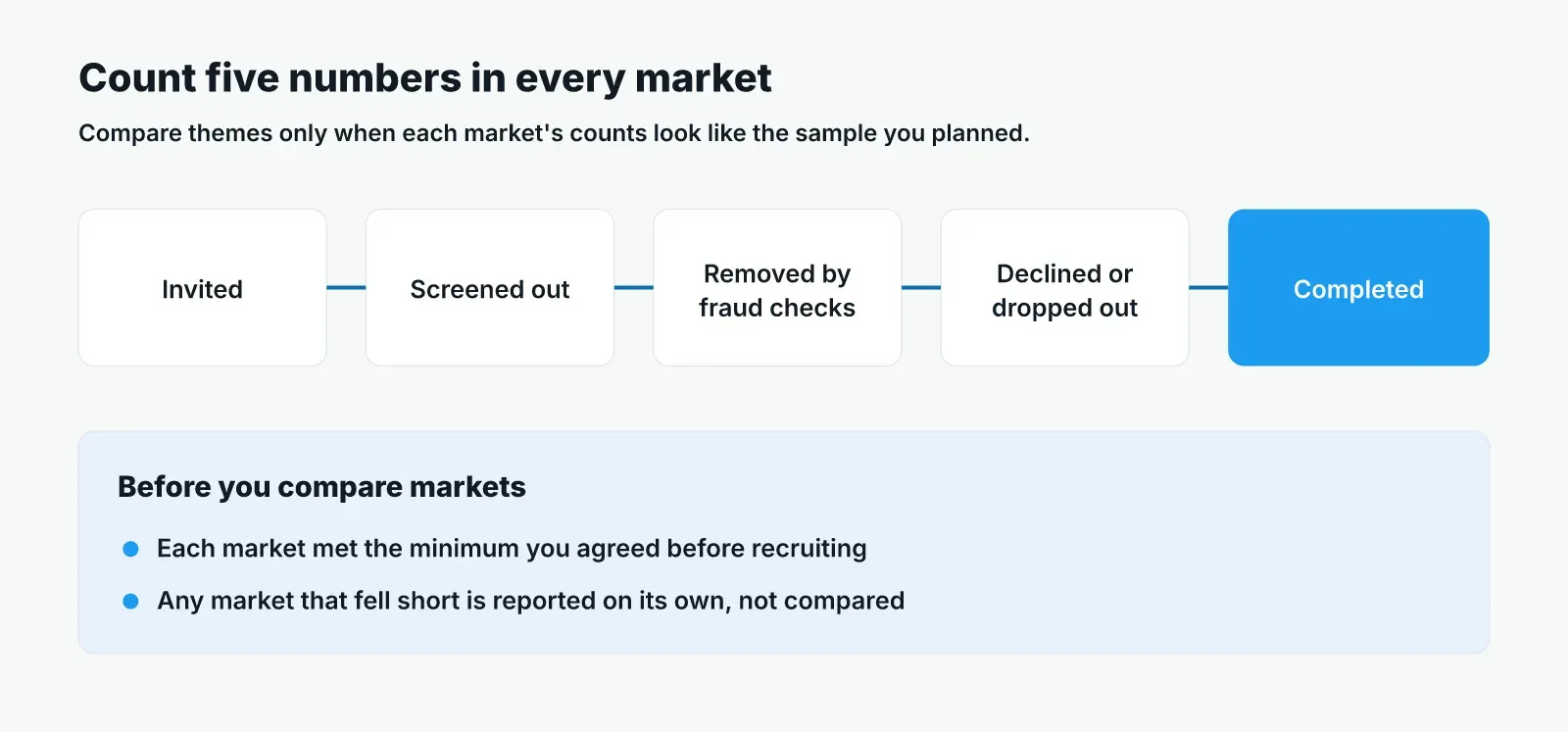
Before you compare themes across countries, check that each market's sample is the one you planned. If it isn't, a difference in the findings might come from who was recruited. Count the same five numbers for every market: invited, screened out, removed by fraud checks, declined or dropped out, and completed.
Fraud checks are tests that catch people who fake answers to qualify, and they can hit one market harder than another. The post on participant fraud covers the checks themselves.
Then read the open answers in each market's screener. If many people in one country answered a question in a strange way, the translation probably asked something else.
For example, if the shared-playlist market shows far more drop-outs among older listeners, your completed group there skews young. Report that next to the finding, so the people deciding know which listeners the result describes.
Compare themes only after each market meets its minimum, and name any market that fell short. If a market missed its minimum, report it on its own and keep it out of the comparison.
The hard part of multi-market participant recruitment is keeping one definition, one guide and one standard of checks across countries. Pulse recruits participants to the profile your brief describes, from more than 200 million people globally, or invites your own customers from a list you upload, and every participant goes through fraud checks.
One study can run across several markets at once from one brief and one discussion guide, so differences reflect listeners rather than how each market ran. AI-moderated interviews run in 240+ languages, enabled on request. Participants open a link on a phone or laptop, so there are no calls to schedule across time zones.
The research team still chooses the markets, sets each minimum and reads the counts. Pulse runs the interviews and groups what people said into themes, with the quotes behind each, so the team's time goes to the decision. To see it on your own study, book a demo, or start with a free trial and a free study.
It depends on how rare the people you need are, how many markets you run and which holidays fall in your dates. The slowest market sets the pace, so plan around it. Agree in advance what you will do if one country is slow, such as giving it more days, so you aren't deciding in a rush.
Every market you want to compare needs at least its own minimum, but the numbers don't have to match. A market where the decision is closest can get more people. What matters is that no market sits below the minimum you agreed, because its reasons would then be too thin to compare.
There is no single right amount. Set each country's incentive at a level people there see as fair for the time asked, and pay it in a form they can use. Check the amount with someone in that market, because a figure that feels fair in one country can feel too small or oddly large in another.
One screener can work if every question describes behavior and someone in each market checks the translation. Questions about income, job titles or store names usually need a local version. Keep the meaning of each question the same, even when the words and answer options change from country to country.
In most studies the steps are: define who qualifies, choose where to find them, screen them, get consent, schedule or send the interview, remind them and track who completes. Across several countries, each step happens once per market, so you also compare the counts per market before reading the findings together.
Participant recruitment methods compared by who you need: your own list, panels, referrals, networks and recruiters, plus a check before you set a date.
Semantic vs latent themes, from Braun and Clarke's paper "Using thematic analysis in psychology", shown on real-life quotes, with when to use each.
How to choose a transcription service for research interviews: test each option on your own audio with five simple checks, from accuracy to data safety.