Participant recruitment methods: 5 ways to find people
Participant recruitment methods compared by who you need: your own list, panels, referrals, networks and recruiters, plus a check before you set a date.
How to recruit B2B research participants from your own accounts: agree rules with account teams, set opt-outs and contact caps, and close the loop.
You work on the research team at a company that makes school uniforms and sells them to schools. You want to interview some of those schools. But first the account director stops you: "Which of my schools, and what will you ask them?" So how do you get a yes?
That question is where you learn how to recruit B2B research participants from your own customers. B2B means business to business, so your customers are schools, not single shoppers. Each school is looked after by the account director's team, called the account team. They decide who you can reach.
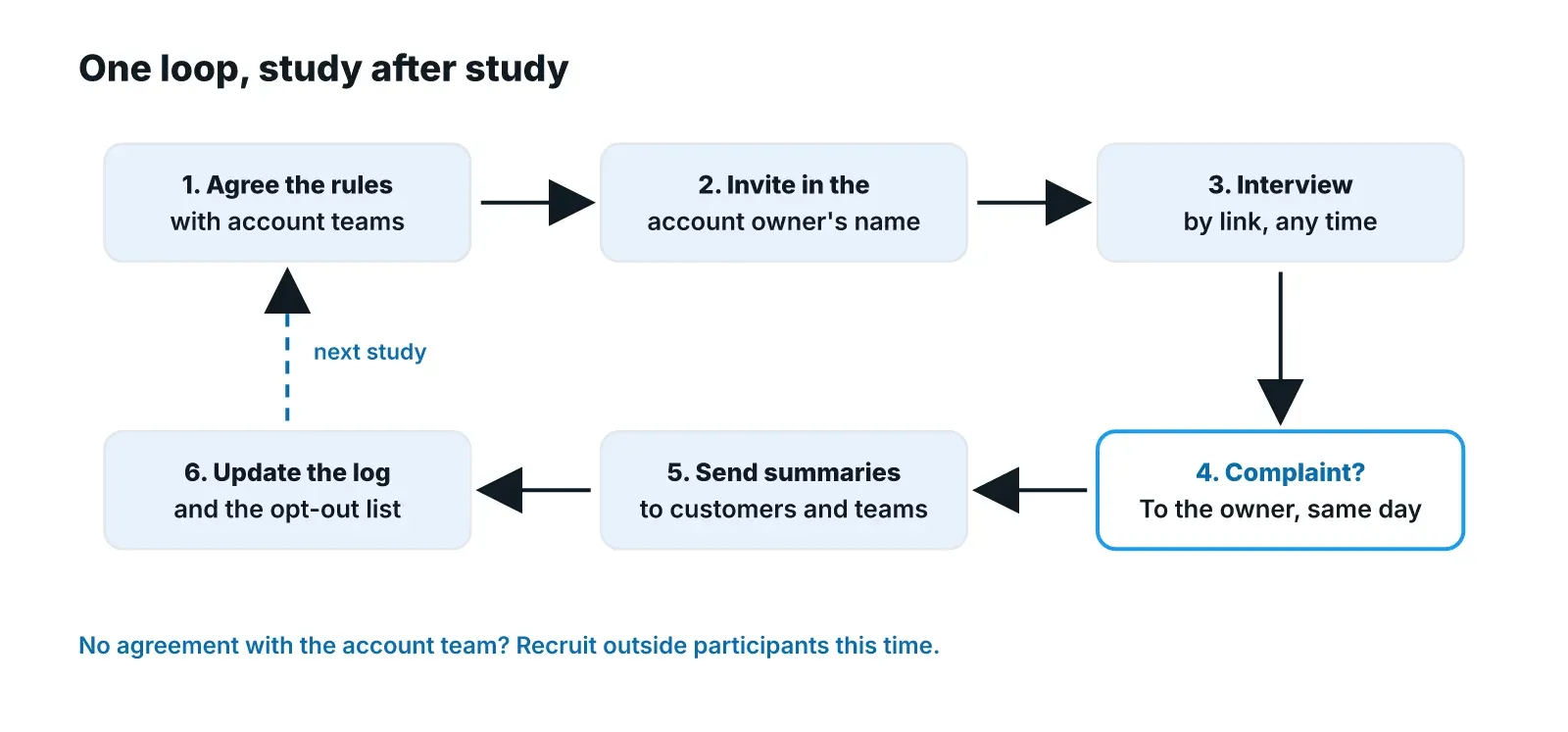
So agree the rules with the account team before you pick anyone: who is off limits, how often a school can be asked, who sends the invite and what happens if a school complains. Then send a short invite in the account owner's name, and share what you learn.
Each of those rules answers a worry the account director already has, so the worries come first.
Account teams say no because a surprise call can harm years of work with a customer. Their job is to keep each school happy and get the next order signed. A stranger from research asking "How do you feel about our uniforms?" in the wrong week can undo a lot of that.
The worries tend to be the same few. A school is about to sign next year's order. A school has an open complaint. A head teacher only talks to one person at your company. The last research project took their time and nothing came back. Or the school already hears from sales, support and marketing, and one more email feels like too much.
Say one of the company's biggest schools is about to sign next year's order. Last month it got a box of jumpers in the wrong sizes, and that complaint is still open. The account director doesn't want a stranger asking that school what it thinks. From where she sits, that's a fair worry.
Every one of those worries can become a rule you agree in advance.
Before you choose any schools, write a one-page plan and agree it with the heads of the account teams. It says what you want to learn and who you want to hear from. It also says how many people, what you'll ask, when, and what the account teams get back. One page is short enough that a busy account lead will read it.
Then turn each worry into a rule, and give each rule an owner. The account owner is the person at your company who looks after that school. This table shows how the uniform company might set it up.
| Account team worry | The rule you agree | Who owns it |
|---|---|---|
| School about to sign next year's order | Skip schools within an agreed time before they sign | Account owner |
| Open complaint | Skip until it's fixed, or the account owner decides | Account owner |
| Head teachers and other senior contacts | Reach them only through the account owner | Account owner |
| Too many emails | A contact limit per school, shared across every study | Research team |
| Surprise complaints | Pass them to the account owner the same day | Research team |
The time before signing and the contact limit are numbers your company agrees. There's no researched right answer, so pick numbers the account teams can live with, and write them down.
Keep an opt-out list too. It names the schools that asked not to be contacted, or that the account team has ruled out for now. Let account owners add a school to it, but only with a stated reason. Without that rule, the list of schools you can ask slowly fills with the friendliest ones, and you only hear from schools that were already happy. For more on this, see how to draw a fair list from your own customers.
Keep one shared contact log, so every team can see which school was asked, when, and for which study. That log is what makes the contact limit work.
An email from a researcher the school has never heard of tends to get ignored. Or it gets forwarded to the account manager with a question mark. So let the account owner send the invite, or sign it with you. The school sees a name it trusts, and the account owner knows what was sent.
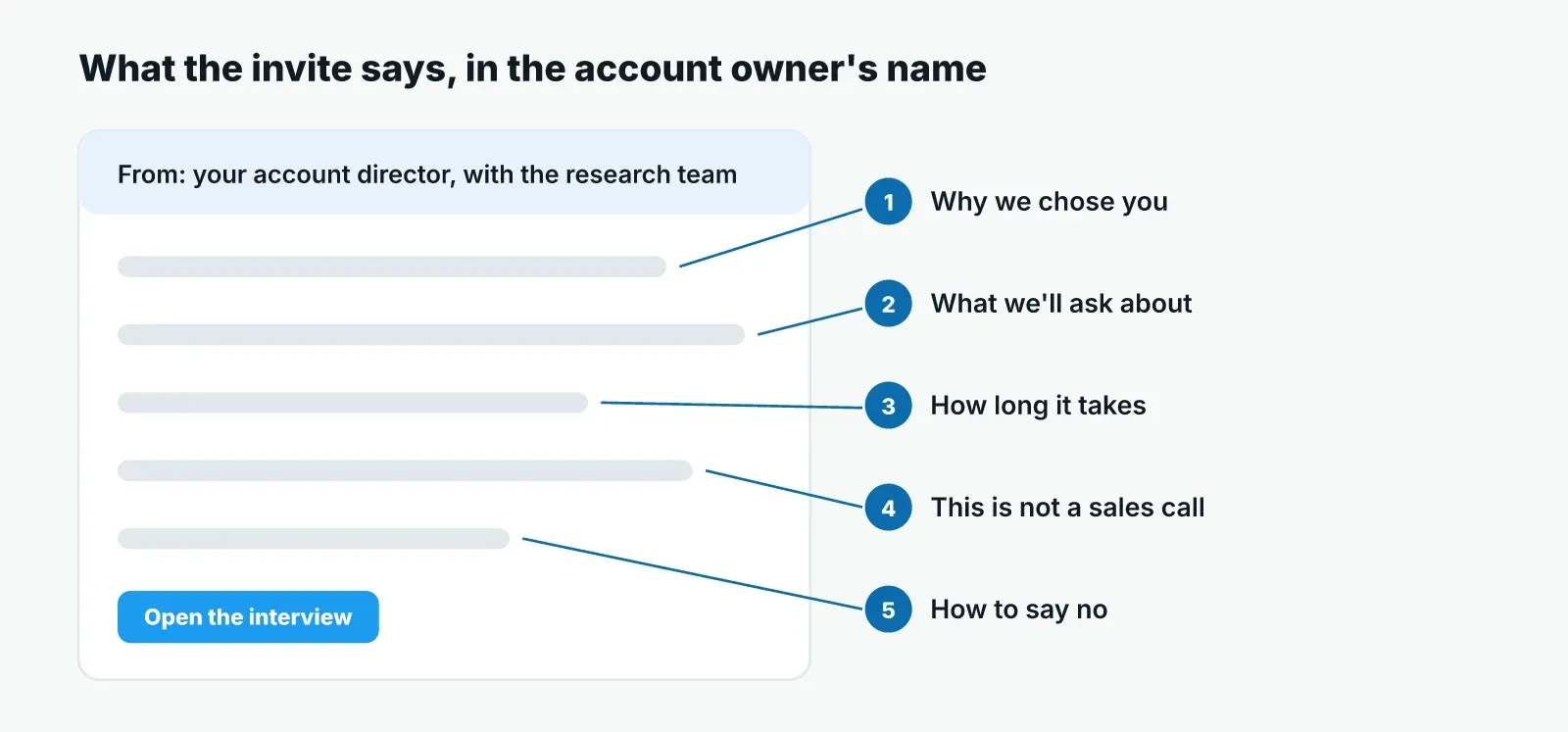
A good invite says five things in plain words. It says why you chose this school, what you'll ask about and how long it takes. It says this isn't a sales call, and it says how to say no. For senior contacts like head teachers, the post on getting senior buyers to say yes covers what changes.
Make taking part easy. An interview the person can take by opening a link, at a time that suits them, saves a week of emails about a time slot.
Thank-you gifts, which researchers call incentives, need care in B2B research. Some schools don't let staff accept gifts. So offer a choice, such as a gift to a charity, a summary of what other schools said, or a payment where it's allowed. Check before you send anything.
Then make sure you reach the right person at each school. The office manager who orders uniforms every term and the head teacher who signed off the budget will tell you different things. A short screener survey asks a few questions first, so you know you're talking to the person your question needs.
Schools will raise problems in interviews, and the account team needs to hear them fast. So agree in advance that any complaint, threat to leave or call for help goes to the account owner the same day, with the school's permission. Then, after the study, send short summaries to the schools and to the account teams.
Say that halfway through an interview, a school's office manager says the wrong sizes nearly made them switch to another supplier. The interview isn't the place to fix it. But the account director must hear it that afternoon, so she can call before the school signs next year's order.
Never pass on anything the school asked you to keep private. Say in the invite that answers are used for research, so nobody is surprised later.
When the study ends, send two summaries. Schools get what you heard and what the company will do about it. Account teams get the themes from their own schools. At the uniform company, the schools hear that size labels are being made clearer. The account director gets the main themes her schools raised, a week before their orders are due.
Then update the contact log and the opt-out list, so the next study starts where this one ended.
If you can't agree the rules with the account team, recruit outside people for this study, and keep your own customers for later.
Account teams say yes faster when the ask is short, the invite is easy to answer and nothing private goes where it shouldn't. You can invite your own customers from a list you upload to Pulse, or share a link. People take the AI-moderated interview on a phone or laptop, so there are no calls to schedule.
Every participant goes through fraud checks, and Pulse handles participant incentives. Personal details are removed from transcripts, which makes the findings easier to share with account teams. For people your own records don't hold, Pulse offers B2B and expert recruitment.
The research team and the account teams still agree who is asked, how often, and where complaints go. To see how a study with your own customers runs, book a demo.
Start with your own customers, through the account teams, because they know the right people and can vouch for you. Agree the rules once and keep them for every study, so the second study moves faster than the first. For roles your records don't hold, add outside recruitment.
Usually not. Customers speak more freely about problems when the person who manages their orders isn't listening. Offer the account manager a summary of their customers and a same-day call on any complaint instead. If the customer asks for the account manager to join, that's their choice.
Renewing means signing up again for another year. You can interview a customer at that point if the account owner agrees, and the customer knows the interview is separate from the contract talks. Your rules may skip these customers by default. Make an exception when the renewal is the thing you need to understand, such as why a customer is unsure about signing again.
Check with your privacy or legal team before the first study. They'll want to know what you collect, how long you keep it, who can see it and how customers can say no. Agree it once in writing, then reuse that agreement for later studies with the same setup.
Participant recruitment methods compared by who you need: your own list, panels, referrals, networks and recruiters, plus a check before you set a date.
Semantic vs latent themes, from Braun and Clarke's paper "Using thematic analysis in psychology", shown on real-life quotes, with when to use each.
How to choose a transcription service for research interviews: test each option on your own audio with five simple checks, from accuracy to data safety.