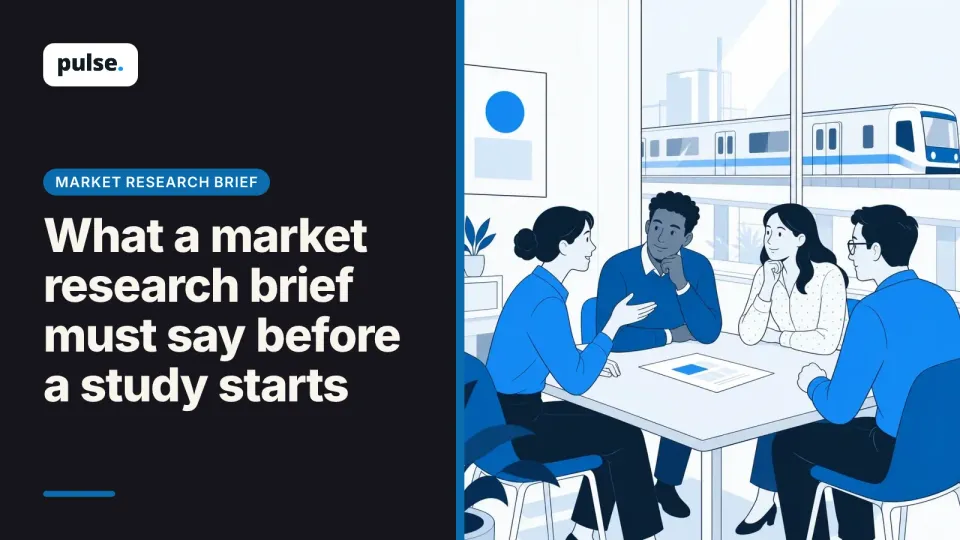
What a market research brief must say before a study starts
What a market research brief must say before the study starts, so everyone who asked for it agrees on the decision, the audience and the result.
Research participant fraud explained: seven ways fake or dishonest participants get into a study, and the checks at each stage that catch them.
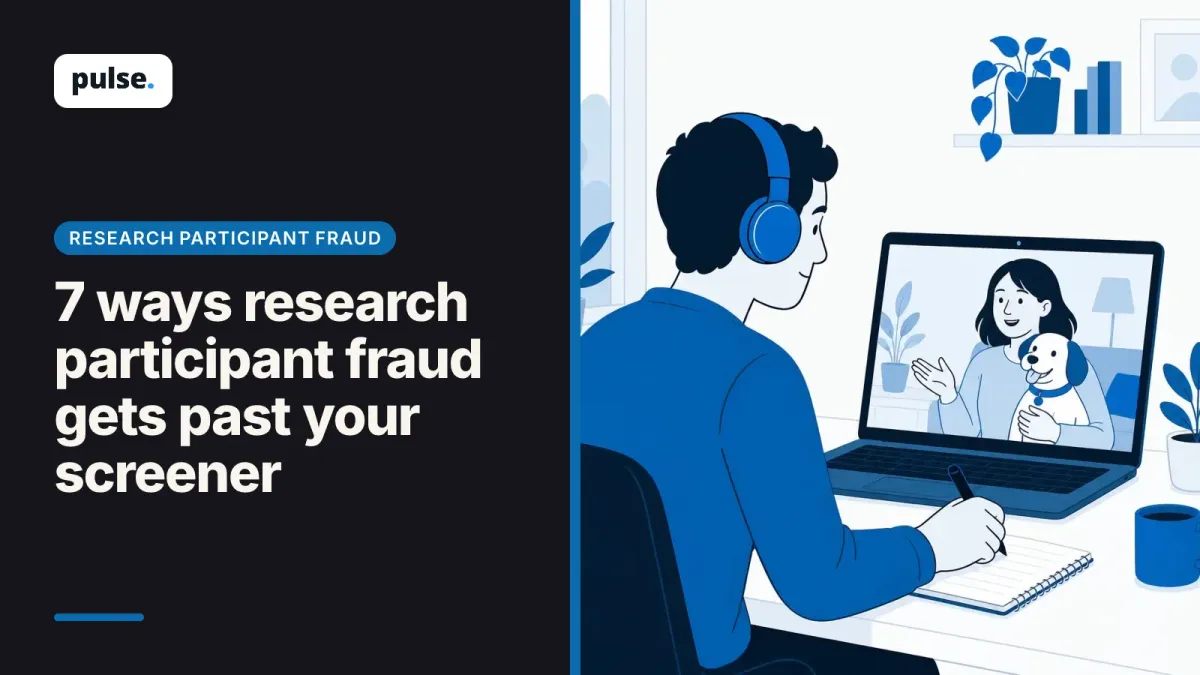
Something feels off about this week's interviews. You're on the research team at a pet food company, and a panel found you dog owners to talk to. One of them couldn't name the food they buy every week. So which people were real, and how do you keep fakes out next time?
When people lie their way into a study to get the incentive, that's research participant fraud.
To find out who was real, compare each person's screener answers with what they said in the interview. To keep fakes out, add a light check at every stage instead of one strict filter.
Fraudulent participants tend to get in through one of seven routes, and each route has a check that catches it.
The pet food study paid a fair incentive and let people sign up online. That mix is what invites fraud. When money is on offer and nobody meets face to face, it's easy to pose as someone else or apply twice. It's also easy to say whatever the screener seems to want.
It helps to split fraud into three kinds, because each one needs a different check:
Catching all three is part of fraud detection, the set of checks a research team runs to keep fake or dishonest people out of its findings.
Fraudulent participants get past a screener in seven main ways. Each one leaves a different trace in the pet food study, and each has its own check. Most of these checks take an honest person a few seconds, so you can stack them without making the study harder for real dog owners.
A professional participant is someone who joins many paid studies and learns what screeners look for. They tick "dog owner" because the screener seems to want dog owners. To catch them, hide the qualifying answer among real options, and ask how many studies they've joined lately.
Some applicants own a cat, or had a dog years ago, and decide that's close enough. To catch them, ask an open question only a real owner can answer, such as what they fed their dog this morning and where they bought it. Then ask it again early in the interview. A real owner gives the same answer twice.
Someone signs up three times under different names to collect three incentives. Their answers can look alike, down to the spelling slips. To catch them, check applicants for shared phone numbers, email patterns, payment details or near-identical open answers before you book anyone.
A VPN is a tool that makes a computer look like it's in another country. Someone outside your market can use one to pass a location question. To catch them, ask about local things a resident would know, such as which nearby shops sell the company's food. Ask the recruiter what location checks they run, too.
Some applicants paste open answers from an AI tool. These read as polished and generic, with no personal detail: "My dog is a beloved family member." To catch them, look for one specific moment in every open answer. In the interview, ask for one out loud: "Tell me about the last time your dog refused its food."
Sometimes the person who joins the interview isn't the one who passed the screener. To catch this, start with a short confirmation question that repeats a screener answer, such as the dog's breed and age. If the study records video, compare it with any recording taken at sign-up.
A speeder races through a screener without reading it, and a bot is software that does the same thing automatically. To catch them, look at how long each person took and add an attention question that asks for one specific action. Flag anyone who picks the same option on every question.
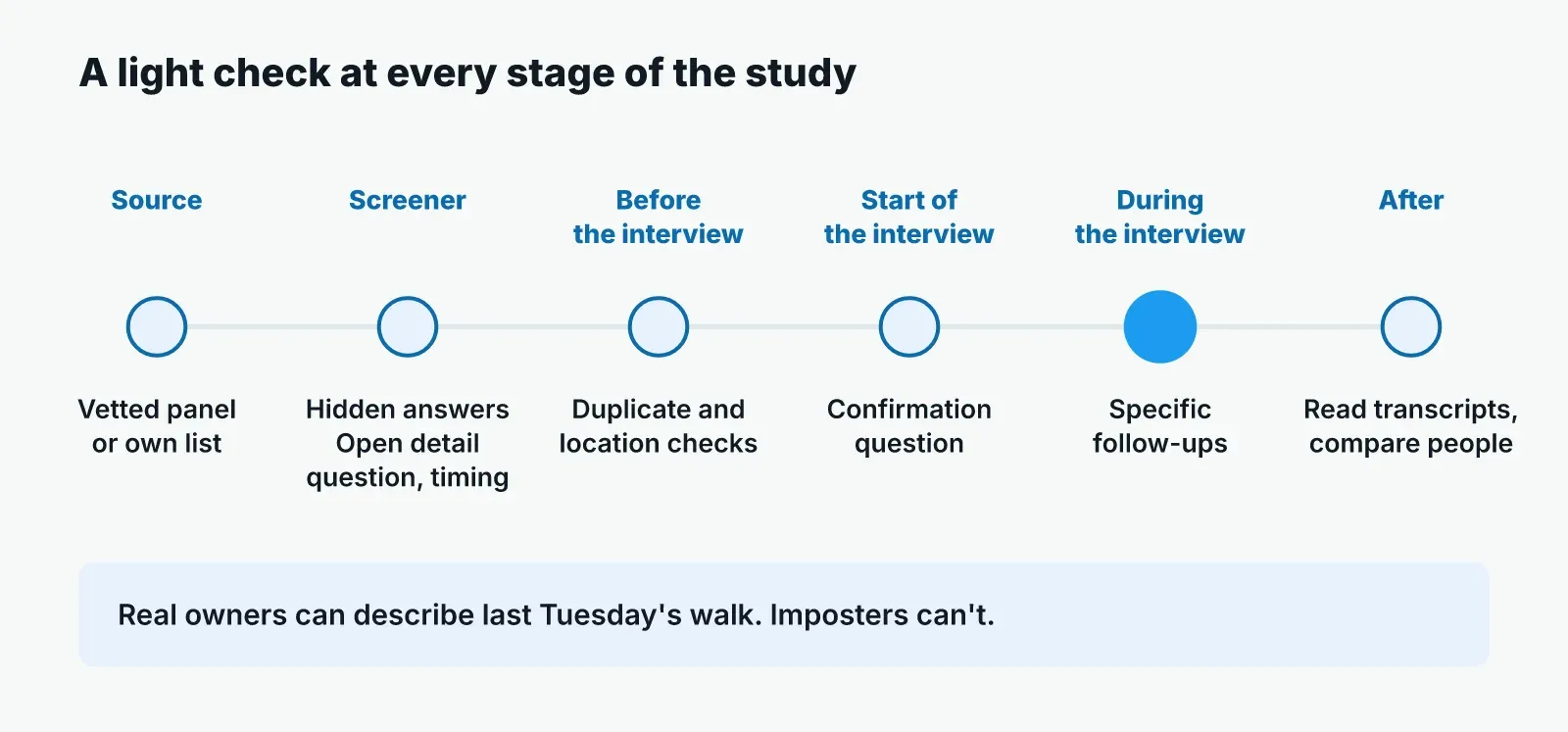
The pet food team can't run every check on every person, so it needs to know where each one fits. Checks at the start are cheap and stop the obvious cases. Checks during and after the interview take more time, but they catch the routes a screener can't see.
This plan matches each stage of the study to its checks, the routes they catch and what they cost a real dog owner:
| Stage | Check | Catches routes | Cost to honest people |
|---|---|---|---|
| Where people come from | A vetted panel or your own customer list | 1, 3, 4 | None |
| The screener | Hidden answers, an open detail question, timing, an attention question | 1, 2, 5, 7 | Low |
| Before the interview | Duplicate review, location and contact checks | 3, 4 | None |
| Start of the interview | A confirmation question | 6 | Low |
| During the interview | Specific follow-ups, checked against screener answers | 2, 5, 6 | None |
| After the interview | Reading transcripts and recordings, comparing answers across people | 3, 5 | None |
The interview is the hardest check to fake, because a real owner can describe last Tuesday's walk and an imposter can't.
Say the team reruns the study next quarter. It keeps the panel, adds the open feeding question and a confirmation question, and reads every transcript before analysis. That adds a minute or two for honest dog owners and puts a check at four stages.
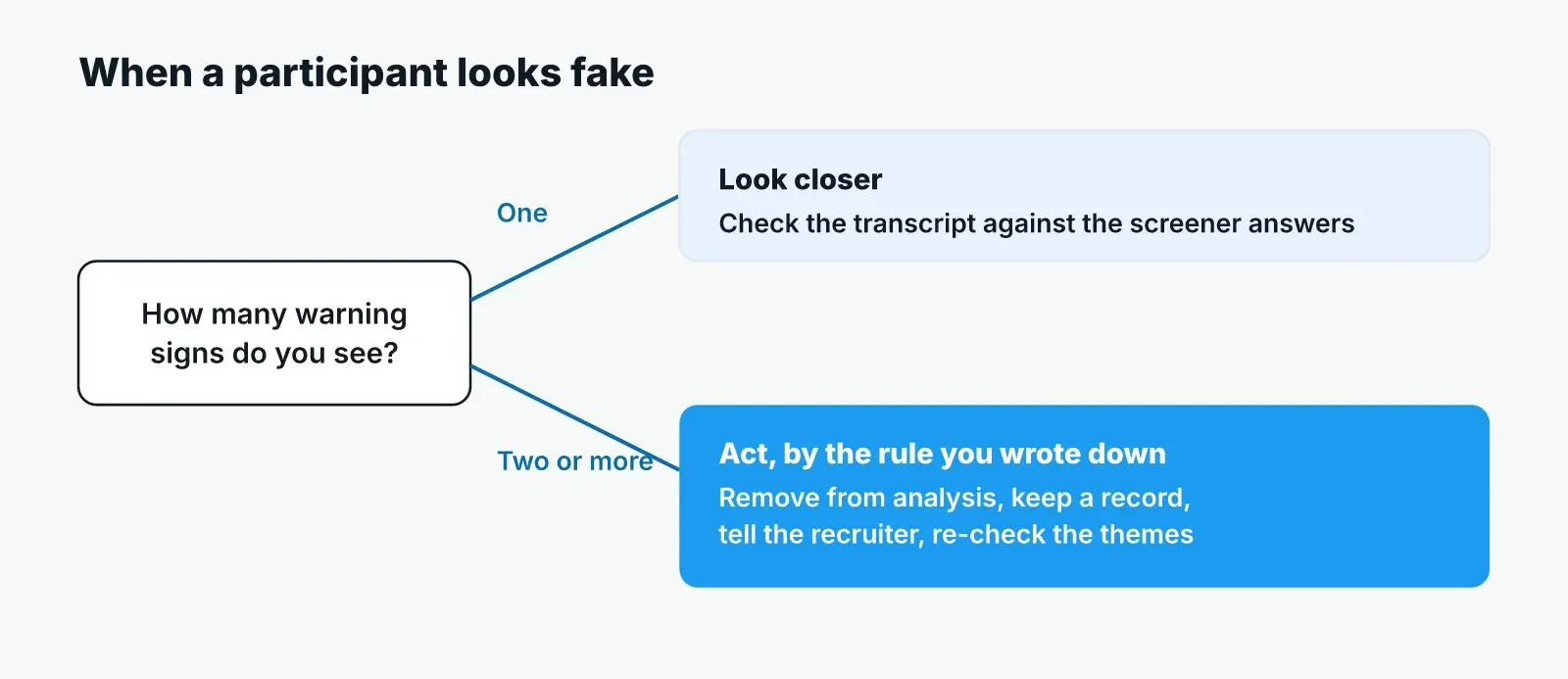
A nervous participant gives short answers, and someone writing in a second language can sound stiff and formal. Neither is fraud. So treat one warning sign as a reason to look closer, and two or three together as a reason to act. Strict automatic filters remove real people along with the fakes, which narrows who you hear from.
Write that rule down before the study starts, and apply it to everyone the same way. Then the decision doesn't depend on who happens to read the transcript. If you do act, don't accuse anyone. Thank the person, explain the study's terms and follow the incentive policy you set at the start.
Now say the pet food team is fairly sure two interviews were fakes, and the report is due. Five steps keep the findings honest.
Remove both interviews from the themes and quotes, but keep the files.
Note which warning signs you saw, where they appear in the screener or transcript, and who reviewed them.
Share the record so they can check those accounts and stop them joining other studies.
If a finding came mostly from those two people, it's no longer a finding. Go back to the remaining interviews and see what they support.
If both fakes slipped past the feeding question, write a sharper one, and add matching follow-up questions to your interview guide.
In the pet food study, the hardest part was proving who was real after the interviews. Pulse is built to make that check easier. Every participant goes through fraud checks, whether you invite your own customers from an uploaded list or have people recruited to the profile your brief describes. Every interview arrives as a full transcript alongside its recording, so a researcher can check a doubtful participant against what they said.
The AI moderator asks every participant the same well-formed questions from one guide. Its follow-ups build on what the person said earlier, and a vague answer gets a second question. That makes answers easy to compare across people, so one that doesn't fit stands out.
To see a study with fraud checks run from brief to transcript, book a demo.
Many studies pay participants with cash, a gift card or a voucher, because their time has value. A fair payment also helps you reach busy people who wouldn't give up an hour for free. Payment also draws some people who only want the money. So keep the incentive fair and add light checks, rather than cutting the payment.
Data fabrication means making up information that isn't true. For a participant, that can mean inventing a pet, a purchase or a whole routine to qualify, or making up experiences during the interview. It differs from a mistake, because the person knows the answer is false.
Keep the screener answers, the passages that raised doubt and a note of the warning signs. Store them under the same privacy rules as the rest of the study data, because they hold personal details. That way someone else can check the decision later.
Moderated interviews, run live or by an AI moderator, give you the best chance, because someone can ask a follow-up the participant didn't expect. In an unmoderated study, people answer recorded prompts alone, so you rely more on reading answers afterwards. This guide to moderated and unmoderated studies explains the trade-offs.
What a market research brief must say before the study starts, so everyone who asked for it agrees on the decision, the audience and the result.
A brand awareness survey shows who remembers a brand and who only recognizes it. Learn who to ask, how to order questions and how to read the results.
Why a user research repository goes unused after launch, and six habits that bring product teams back to check it before new research.