Participant recruitment methods: 5 ways to find people
Participant recruitment methods compared by who you need: your own list, panels, referrals, networks and recruiters, plus a check before you set a date.
Semantic vs latent themes, from Braun and Clarke's paper "Using thematic analysis in psychology", shown on real-life quotes, with when to use each.
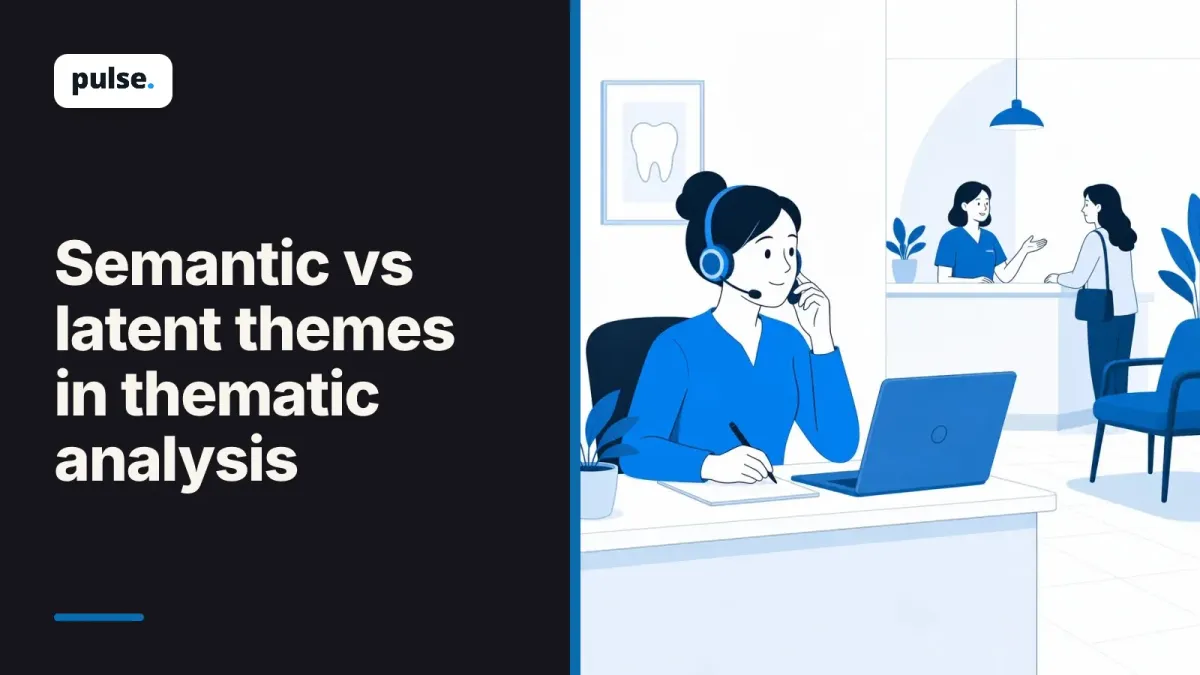
The calls are done at the dental clinic group where you work. Your team rang patients who stopped booking check-ups and asked why. Almost all of them gave the same answer: they're too busy. So is that the real reason, or is something under it?
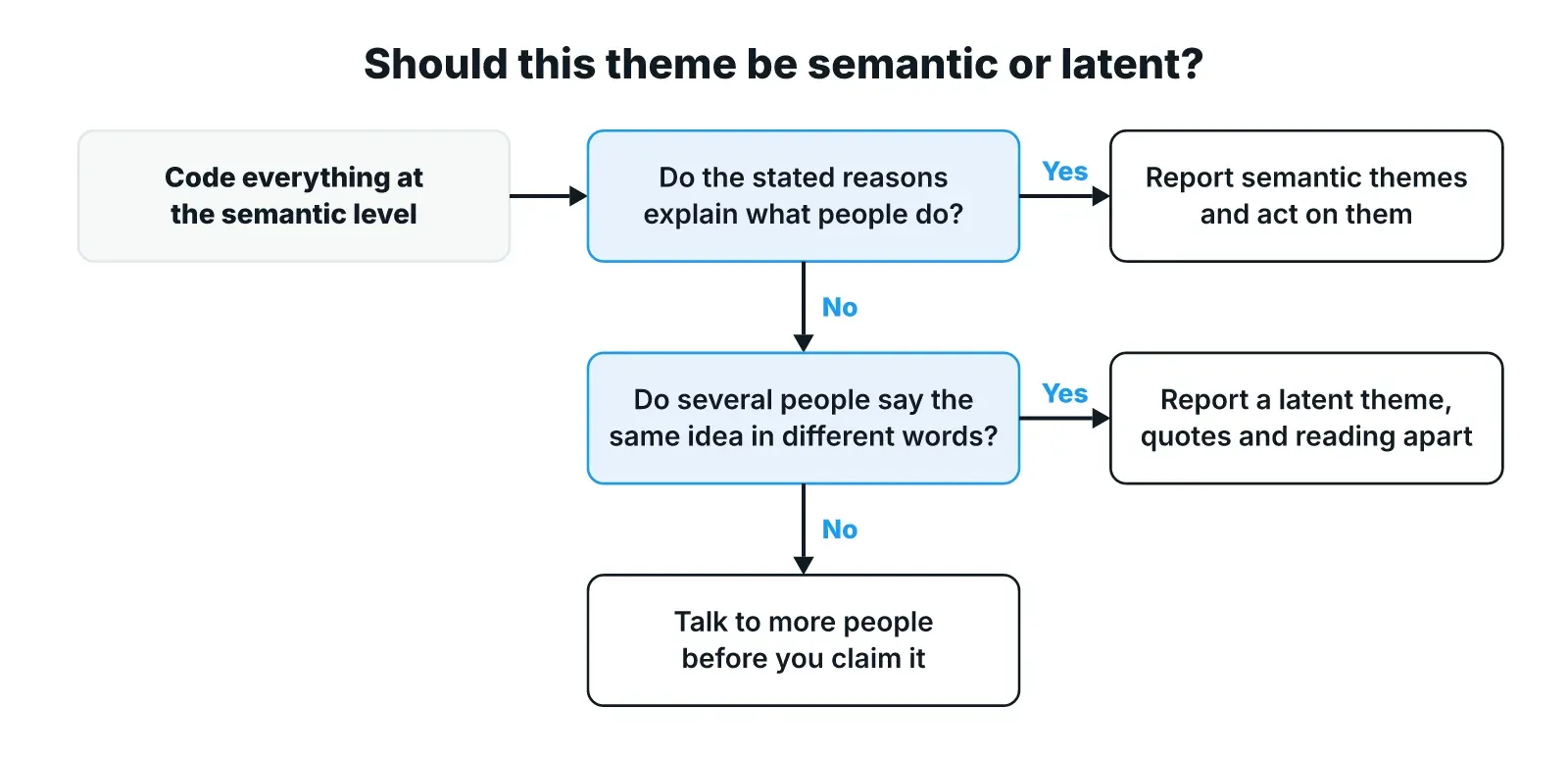
Thematic analysis gives you two ways to read those answers. A semantic theme stays with what people said, like "no time." A latent theme names the idea under the words, like dread of the dentist's chair. Start with semantic themes. Look for latent ones when the stated reason doesn't explain what people do.
This choice comes from a famous paper, "Using thematic analysis in psychology." And it changes what your team decides to fix.
Semantic and latent are two levels you can code at in thematic analysis. Thematic analysis means reading interviews, tagging what people say, and grouping those tags into themes. A semantic theme stays with the surface meaning of the words. A latent theme names the ideas, beliefs or feelings that sit under the words.
The two terms come from Virginia Braun and Victoria Clarke's 2006 paper, "Using thematic analysis in psychology." You'll see it cited almost everywhere. A 2025 review of thematic analysis studies in Frontiers found the paper is cited by over a third of all the articles it looked at. And in a 2025 count by the journal Nature, it ranked third among the most cited papers of this century.
The paper sets out six phases for the whole method, from getting to know the data to writing the report. This post sticks to one choice inside it: how deep you read.
That choice sits beside another one. You can let themes come from the data, called inductive coding. Or you can start from a theory or a list, called deductive coding. Braun and Clarke call this the inductive vs theoretical choice. Either way, you still decide whether to read at the semantic or the latent level.
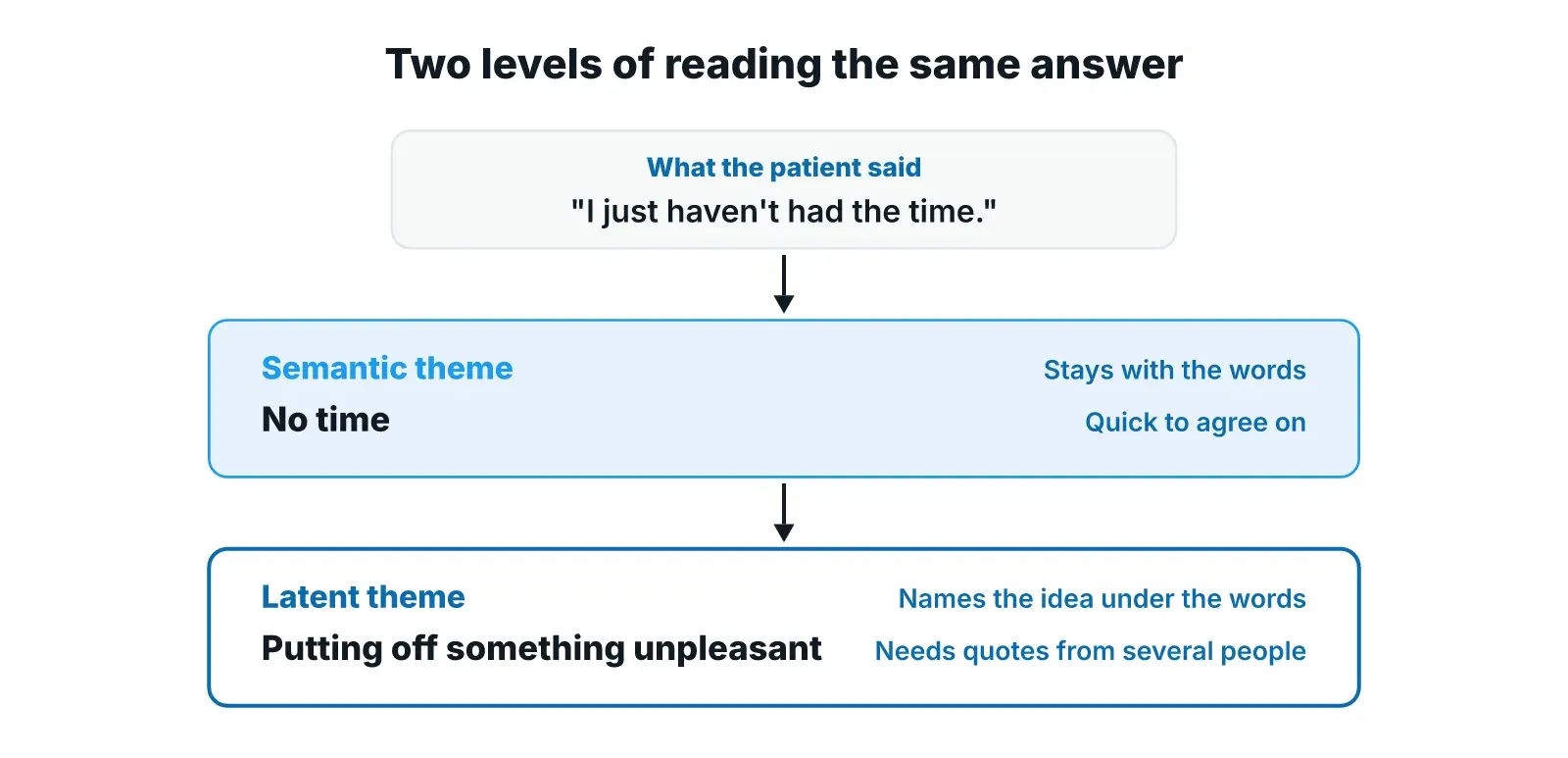
The easiest way to see the difference is to code the same quotes both ways. Say three patients from the calls said these things. The semantic code repeats the point in plain words. The latent reading asks what idea could explain it.
| What the patient said | Semantic code | Latent reading |
|---|---|---|
| "I just haven't had the time." | No time | Putting off something unpleasant |
| "I'll book once things calm down." | Plans to come back | Waiting feels safer than going |
| "My teeth are probably a mess by now." | Worried about their teeth | Fear of being judged by the dentist |
Read the semantic column, and the fix looks clear. Open the clinics in the evening, and send more reminders.
Read the latent column, and you get a different fix. People may stay away because the visit feels like a telling-off. Then the clinic should change how it welcomes people back, so a long gap doesn't feel like a failure.
Both readings could be true. But they lead to different decisions. And the latent reading needs more proof. One quote can't carry it. You need the same idea, in different words, from several patients.
Use semantic themes when your team needs to decide what to change, and use latent themes when the stated reasons don't explain what people do. Most studies at work start semantic. They go latent only on the few themes where the "why behind the why" changes the decision.
Semantic themes fit best in these cases:
Latent themes are worth the extra work in these cases:
Latent reading depends more on the person doing it, because your own views shape what you see under the words. Braun and Clarke later named their approach reflexive thematic analysis. In reflexive thematic analysis, the researcher's view is part of the method, so you write that view down before you start. You can read more about reflexivity in the glossary.
To report a latent theme, split it into two parts: what people said, with quotes, and what your team thinks it means. Then say how many people the reading rests on. That way, anyone reading your report can check the evidence and judge the reading for themselves.
Show quotes from several patients, in their own words. Pick quotes that say the same idea in different ways. In the dental example, that might be "too busy," "once things calm down" and "probably a mess by now."
Use plain words that show it's your view. "We think patients avoid the visit because it feels like a telling-off." Don't write it as a fact the patients said.
Write "eight of the patients we called," not a percentage. A percentage suggests the reading holds for all your patients. You haven't tested that yet.
Say what else you considered and why you dropped it. Maybe you wondered about cost, but no one mentioned money. This shows you looked for other answers.
A reviewer should be able to read each quote in its full context. The post on building a codebook from transcripts shows how to keep codes and quotes linked as you go.
Latent themes need rich answers, and a first reply like "too busy" is rarely enough. Pulse runs AI-moderated voice interviews. The AI moderator builds its follow-up questions on what each person said earlier. When an answer is vague, it asks a second question. That gives you more to read under the first reason.
Pulse then groups what people said into themes, each with the quotes behind it. Every quote links to the transcript it came from. So your team can check a latent reading against the full conversation.
The researcher still decides what a theme means, most of all at the latent level. Pulse runs the interviews and the first grouping, so the researcher's time goes to that reading. To see it on your own study, book a demo, start on the $0 Explorer plan, or ask for a free study.
A theme is a pattern you see across several interviews, built around one central idea. It's more than a topic people mentioned. "Booking" is a topic. "Patients put off booking because a long gap feels embarrassing" is a theme. A good theme tells your team something it can act on.
Yes. Many studies code everything at the semantic level first. Then they go latent on the two or three themes that matter most for the decision. Just label each theme clearly, so readers know which ones report what people said and which ones are your reading.
AI tools can suggest codes and themes quickly. A latent reading needs more care, because it goes beyond the words. So a person should check every suggested theme against the transcripts. The post on AI in qualitative analysis covers where it helps.
Thematic analysis finds patterns in what people said. Grounded theory goes further and builds a new theory from the data, step by step. Most teams at work need patterns they can act on, so thematic analysis usually fits better.
Participant recruitment methods compared by who you need: your own list, panels, referrals, networks and recruiters, plus a check before you set a date.
How to choose a transcription service for research interviews: test each option on your own audio with five simple checks, from accuracy to data safety.
How AI thematic analysis turns transcripts into themes, what research says it does well, where people still decide, and what to ask in a tool demo.