Semantic vs latent themes in thematic analysis
Semantic vs latent themes, from Braun and Clarke's paper "Using thematic analysis in psychology", shown on real-life quotes, with when to use each.
Participant recruitment methods compared by who you need: your own list, panels, referrals, networks and recruiters, plus a check before you set a date.
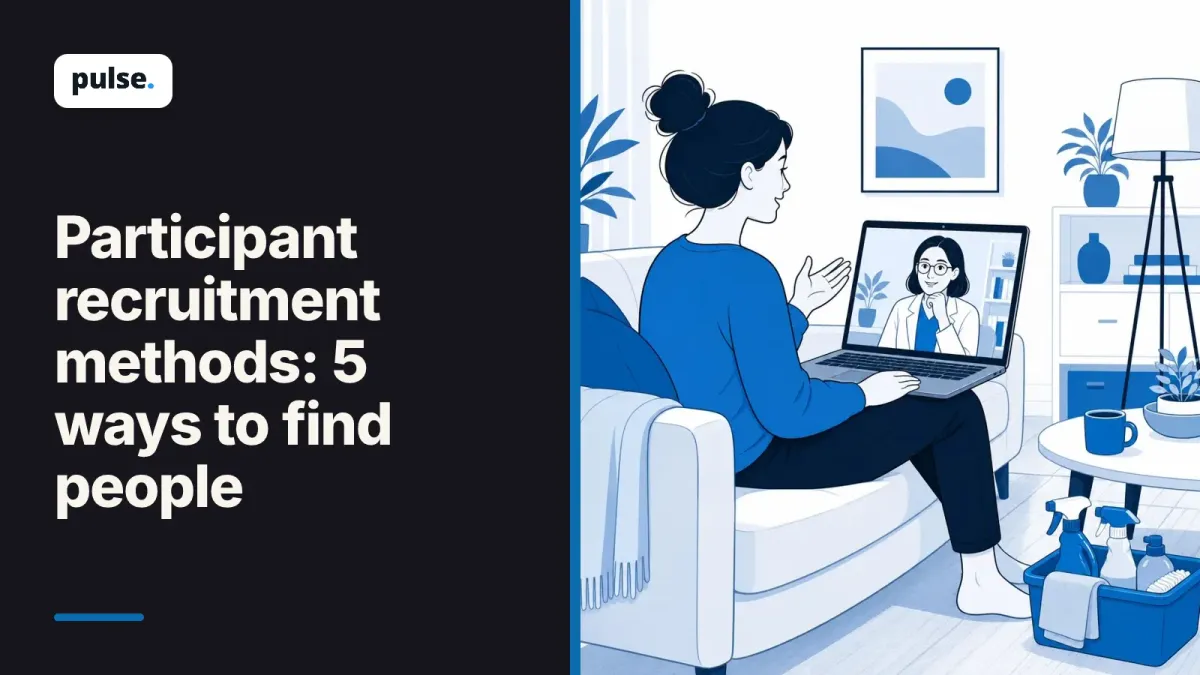
Say you work on the research team at a home cleaning service. You want to know why households cancel their regular plan. So you need three groups: current customers, people who cancelled recently, and people who use a rival service. Where do you find each one?
Those choices are your participant recruitment methods. They're the ways you find and invite the people a study needs.
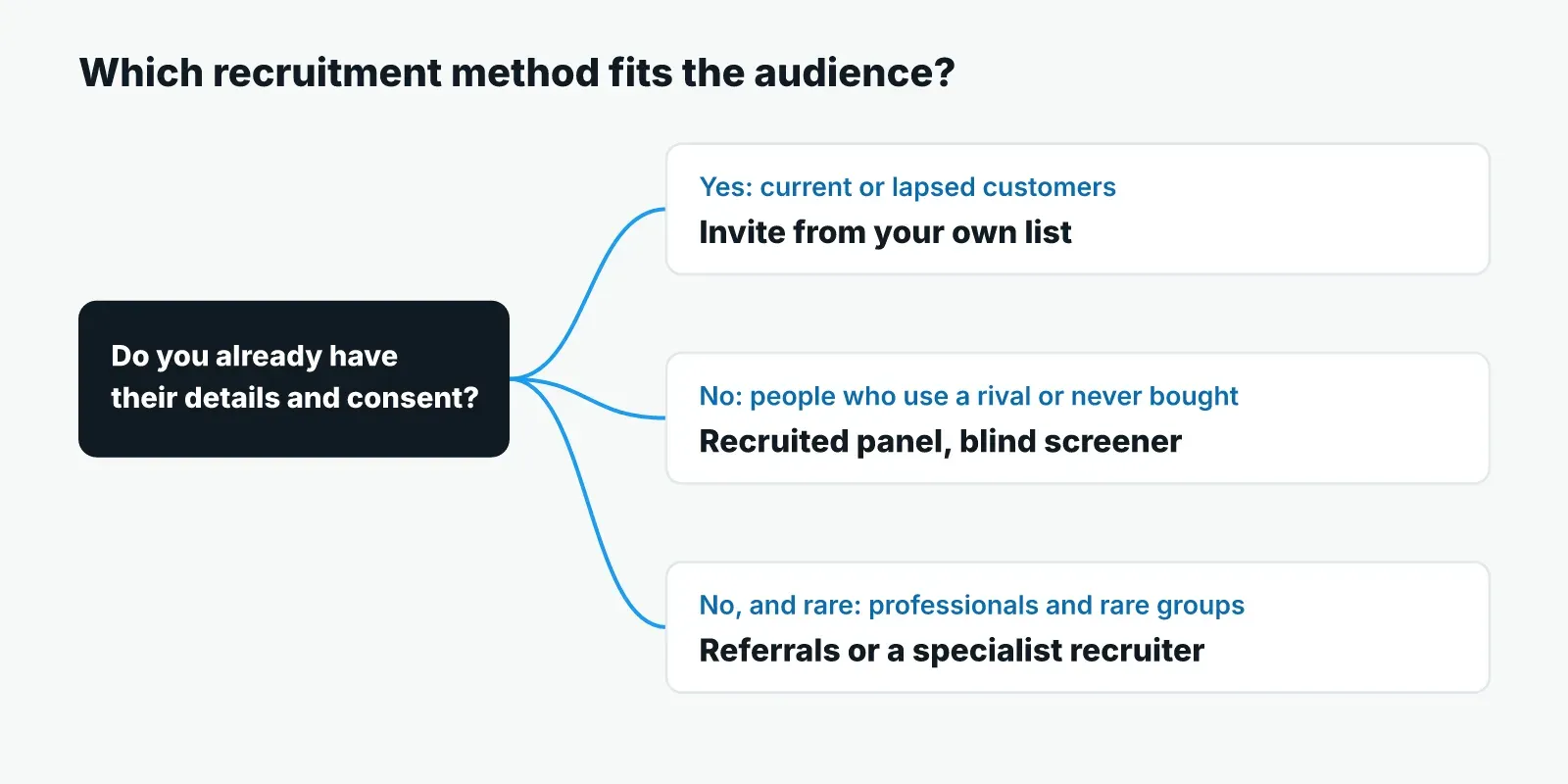
The answer depends on who you need. If they're your customers, invite them from your own list. If they've never bought from you, use a research panel. If they're rare, use referrals, professional networks or a specialist recruiter.
So start from who you need. Then check that each group can be found in time.
Pick the method from where your audience is. Most company studies need one of five kinds of people. Each kind lives in a different place. So first ask: do you already have their contact details and permission to use them? If yes, start with your own list. If not, you need a panel, referrals or a recruiter.
The table shows where each kind of person is and the method that reaches them.
| Audience | Where they are | Method that reaches them | What slows it down |
|---|---|---|---|
| Current customers | Your customer database | Invite from your own list | Contact rules and consent |
| Past customers | Your customer database | Invite from your own list | Fewer of them reply |
| People who use a rival | Outside your records | A research panel with a screener | Narrow profiles take longer to fill |
| People who have never bought | Outside your records | A research panel | It's hard to screen for something people don't do |
| Professionals and rare groups | Spread out, often busy | Referrals, professional networks, specialist recruiters | Time and higher rewards |
Those rows add up to five recruitment methods.
Your own customers are the fastest group to reach, because you already know who they are. Pick them from your customer database and product data, by what they did. That could be their plan, how long they stayed and when they last booked. Don't pick by who opens your emails, because the people who reply fastest may not be typical.
Past customers reply less often, so invite more of them and keep the ask short. Check consent and contact rules before the first invite. Contact rules say who may be contacted, how often and by whom. The guide on recruiting research participants from your own customers covers this step in detail.
You don't have the details of people who use a rival or have never bought. So someone else has to find them. A panel provider keeps a big pool of people who agreed to take part in research. It screens them for you.
The screener matters most here. A screener is a short quiz that checks whether someone fits the study. Ask about what people do, such as which cleaning service they used last and how often. And use a blind screener, which means it doesn't name the company running the study. If people know who is asking, the ones who dislike you may drop out. The ones who like you may stretch the truth.
Some people are hard to find on any panel, such as building managers who hire cleaning firms. For them, ask each person you talk to for the name of someone like them. That's called snowball sampling, because each person you find points you to the next. Referrals bring people who are alike, so cap how many come from one person.
Some people are defined by their job, such as office managers at large firms. Professional networks reach them. These are trade groups, online groups and people you know in the field.
A specialist recruiter is a firm that finds hard-to-reach people for you. Use one when the group is rare and time is short. For referrals, networks and recruiters alike, plan more time and a higher reward. Write the reason into the plan, so the date holds.
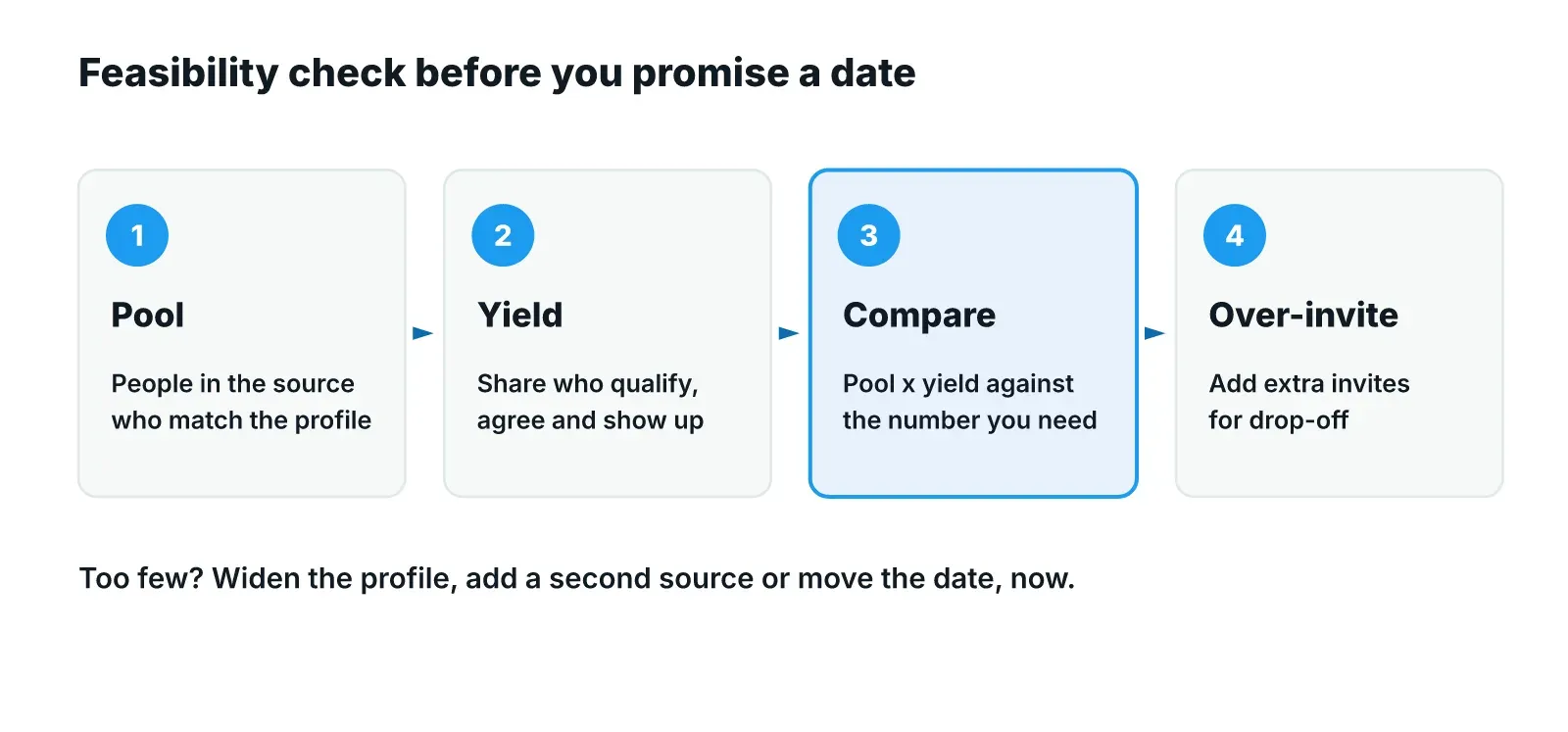
Invite enough people to fill every place, plus extra for the ones who drop out. To find that number, multiply the people who match in each source by the share who take part. Working this out is called a feasibility check. Run it in the first days of planning, because the answer may change your method. Changing it later costs the most time.
Count how many people in each source match your profile. For your own list, that's a search of the customer database. For a panel, ask the provider how many members fit your screener.
Yield is the share of people you invite who qualify, agree and show up. Use the numbers from your own past studies with a similar group. An industry average won't match your customers, your reward or the way your team writes invites. The incentive, the thank-you payment, also shapes the yield. The incentive calculator helps you set a fair one.
Multiply the pool by the yield. If the result is below what you need, change something now. Widen the profile, add a second source or move the date. Waiting until halfway through only leaves you fewer options.
Drop-off is when people agree and then don't show up. So over-invite: ask more people than you need, based on how many dropped out in your past studies. Keep a short waiting list for the gaps. And time the invites so the interviews fall in the weeks you planned.
Yes. Many studies mix methods, as long as the setup stays the same. The cleaning company wants to know why households cancel their regular plan. So the study compares three groups with one set of questions. The research team picks a method for each group by where those people are.
| Group | Method | What it can tell the team | What to watch |
|---|---|---|---|
| Current plan customers | Own list, picked by plan length | What keeps people on the plan | Long-time customers may be more loyal than most |
| Customers who cancelled recently | Own list, picked by cancel date | Why people leave, while they still remember | Fewer reply, so invite more |
| Households that use a rival | A research panel with a blind screener | What the rival offers that the company doesn't | A narrow profile can take longer to fill |
The feasibility check shows that the two own-list groups are big enough. The rival group isn't in the company's records at all, so it goes to a panel. That makes it a study with two recruitment methods.
To keep the groups fair to compare, use one interview guide and one screener for every source. Then any gaps come from the people, and not from how you asked. Tag each person with the source they came from. Read the results by source before you compare groups.
Run the same fraud detection and quality checks on every source, your own list included. A fake participant from your own list does as much damage as one from a panel.
So the rule is simple. If you already hold people's details, recruit from your list. If you don't, use a panel. If the group is rare, use referrals, networks or a recruiter. Then add time to the plan before anyone sees a date.
The hard part of the cleaning company's study is reaching two kinds of people. Some are customers and some are not, and both need the same questions. Pulse covers both routes into a study.
You can invite your own customers from a list you upload. Or you can have people recruited to the profile your brief describes, from more than 200 million people globally. Every participant goes through fraud checks. People take the interview on a phone or laptop by opening a link, so there are no calls to schedule.
Pulse runs AI-moderated interviews where every person gets the same clear questions from one interview guide. Themes link back to the transcripts behind them. To see a study with mixed recruitment set up, book a demo, start on the $0 Explorer plan, or ask for a free study.
Start with your own customers, because you already hold their details and permission. Keep the invite short. Say how long the interview takes and what people get for it. Letting people join by link, at a time that suits them, removes the back-and-forth of booking a call.
It depends most on the source. Your own customer list is usually fastest, because you already know who to invite. A panel takes longer when the profile is narrow. Rare groups, found through referrals or recruiters, take the longest. Your own past studies give the best guide for your next one.
Yes. Some teams use field recruitment, which means stopping people at a store or an event and inviting them on the spot. It helps when the moment matters, such as right after a purchase. Use the same screener and checks as for any other source.
Semantic vs latent themes, from Braun and Clarke's paper "Using thematic analysis in psychology", shown on real-life quotes, with when to use each.
How to choose a transcription service for research interviews: test each option on your own audio with five simple checks, from accuracy to data safety.
How AI thematic analysis turns transcripts into themes, what research says it does well, where people still decide, and what to ask in a tool demo.