Questionnaire question types and when to use each
Questionnaire question types compared: closed, scaled, ranking and open, what each lets you analyze, and how to pick one per decision.
Research participant recruitment from your customer base: build a fair CRM list, settle consent and incentives, and rotate past the loud accounts.
When account managers pick the customers for a research study, they tend to pick the ones who like them. Research participant recruitment from your own base works when the researcher draws the list: choose customers by what they did, at random within each segment, and log every contact so the same accounts do not answer every study.
A study built on friendly accounts tells a steering committee that customers are happier than they are, and a churn study then puts the retention budget on the wrong fix.
The steps below tell you when your own customers are the right people to interview, and give you a list you can defend in the readout.
Recruit from your own customers when the question is about their experience with you: why they canceled, where onboarding stalls, how they use a feature. Your records already show who did each of those things. Use an outside panel or a recruitment agency when you need people your records do not hold, such as prospects, non-customers or customers who left long ago.
| Source | Who you reach | What you know before the interview | Main bias to watch |
|---|---|---|---|
| Your own customers | People with a recorded relationship with you | What they did, how long they have been with you, what they hold | Engaged customers reply more; account owners steer the list |
| An outside panel | Prospects, non-customers, other providers' customers | What they report in a screener | Careless or fake respondents |
| A recruitment agency | Hard-to-find roles and specialist profiles | What the agency checks against your brief | Recruits drawn from the agency's own networks |
For illustration, a payments company asking why merchants stopped using its card terminals can interview those merchants from its own records. The same company asking why merchants chose another provider's terminal in the first place needs a panel, because those merchants were never in its CRM. Many enterprise studies need both. The guide to customer research methods covers when to interview and when to survey.
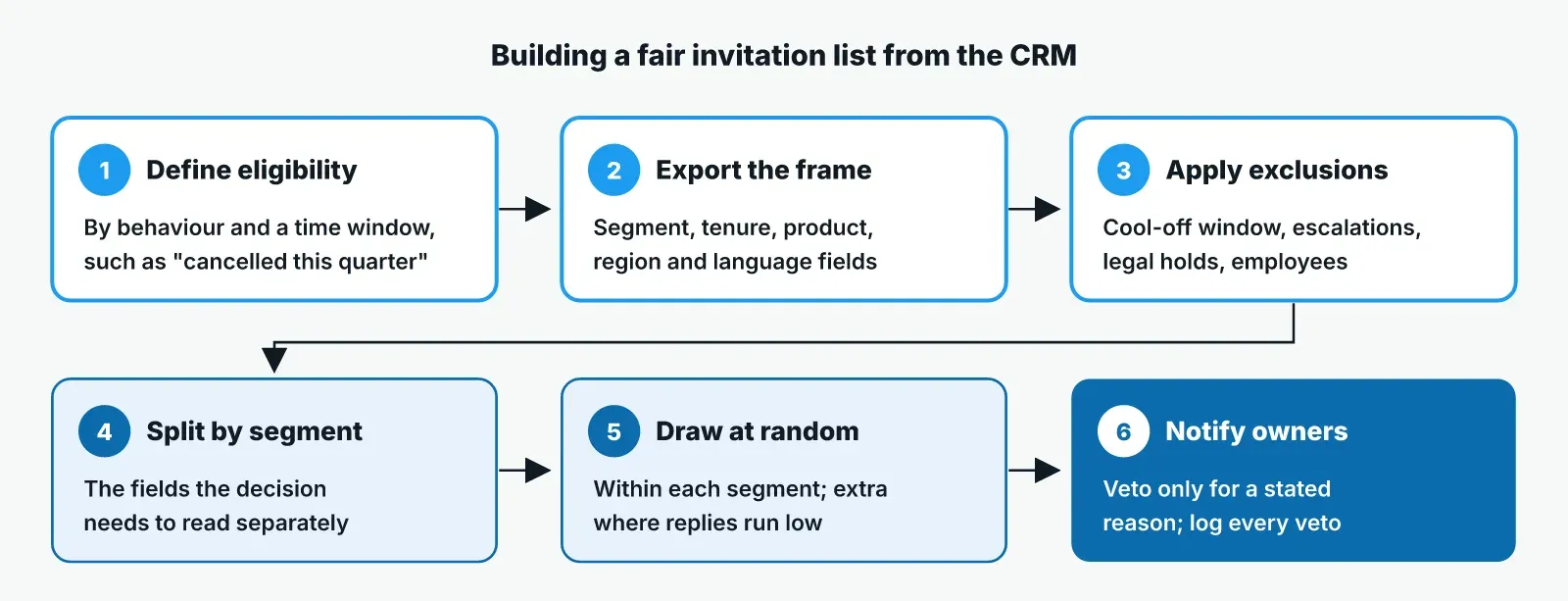
A fair customer list is drawn by the researcher from CRM or product data, at random inside each segment, after exclusions and before any account owner sees it. The last three steps get the people on that list to say yes: clearing consent, briefing account owners and sending a plain invitation.
Write the rule as a behavior with a time window: closed a card this quarter, used the export feature this month, opened a ticket about payment limits. Your data can confirm behavior, so the screener only has to check it. Demographics and company size come second, as fields you balance the list on.
Weak: "Small business customers who are unhappy with us." Strong: "Small business customers who called support more than once this quarter." Only the second can be pulled from a CRM.
Export everyone who meets the rule, with the fields you plan to balance on: segment, tenure, product, region and language. This export is your sample frame, the full list you draw from. Anyone missing from it cannot be invited, so ask how it was built. A frame pulled from the app's user table, for example, leaves out customers who only bank in a branch.
Take out customers invited to research within your cool-off window, accounts with a live complaint or legal hold, and employees or partners who also hold accounts. Write these rules down so the next team applies the same ones.
Split the frame by the fields that matter to the decision, such as tenure and channel. Splitting first and then drawing inside each group is called stratified sampling. It stops a small group from being crowded out by a large one.
Pick invitations at random inside each group. Send extra invitations to groups that replied less in past studies. A random draw stops the list from filling up with the customers who open every email.
Before the first invitation, ask your privacy or legal team to confirm that the permissions you hold cover contacting customers for research, and whether marketing opt-outs apply. This review does the job an ethics board does in academic research, so put it in the project plan. At the start of each interview, run a separate consent step. It covers recording, how quotes will be used and who inside the company will see them.
In B2B and private banking, relationship managers control access to customers. Send them the drawn list before invitations go out. They can remove an account for a reason on an agreed list, such as a renewal under negotiation or a live escalation. They do not add or swap accounts.
Log every veto with its reason and the account's segment. If vetoes cluster in at-risk accounts, the sample is drifting toward happy customers, and the readout should say so. Ask owners to stay out of the interviews, because a customer talks differently with their account manager listening.
The invitation comes from a named researcher. It states the purpose in one sentence, says how long the interview takes, names the incentive and says it is not a sales call. Keep the screener to the behavior you drew on, plus one open question such as "What were you trying to do the last time you contacted us?" A careless or copied answer is easier to spot there than in a tick box.
Offer an incentive even to loyal customers. In a 2010 experiment, Gallup sent a four-page mail survey to 29,980 randomly selected households, some with a $1 bill in the envelope and some with nothing. In Gallup's report on cash incentives, households that received no cash incentive ($0) had a response rate of 11.8%, compared with a 26.3% response rate for the group that received a $1 incentive. It was a household mail survey, so it shows that a small token can raise replies. It does not predict the rate for a customer interview.
Some B2B participants cannot accept personal payments under their employer's gifts policy, so offer a charity donation as an option. Then drop the scheduling step where you can: each round of proposed times is another chance for a busy customer to drop out.
Illustrative example: a retail bank's insights team needs to know why card customers closed their accounts last quarter. The decision on the table is whether to fund a retention offer or fix the card dispute process first. The team has four ways to find people to interview, and each one can establish something different.
| Option | What it can establish | What it cannot establish |
|---|---|---|
| Relationship managers nominate customers | Reasons from customers the staff know well | Reasons from customers who left quietly or never had a relationship manager |
| Email everyone who closed and interview the first to reply | Reasons from customers keen to talk | Whether those reasons hold for the quieter majority |
| Random draw within six groups from the CRM | Reasons across tenure and channel, with any gaps visible | Why people never opened a card with the bank |
| An outside panel of people who closed a card at any bank | Why people leave card providers in general | Anything about this bank's own process |
The question is about this bank's customers and this bank's process, so the panel answers a different question. Nominations and first replies both fill the list with people who chose to engage. The team takes the random draw.
It splits everyone who closed a card that quarter by tenure (under two years, two years or more) and channel (branch, app, phone), and draws at random in each of the six groups. Its contact log shows that app-only customers replied least in earlier studies, so that group gets extra invitations.
The readout shows, for each group, how many customers were invited, took part and declined. If one reason appears in all six groups, it makes the case for the wider fix. If a reason appears in one group only, the fix can be aimed at that group. Either way, the steering committee can see whose experience the findings describe.
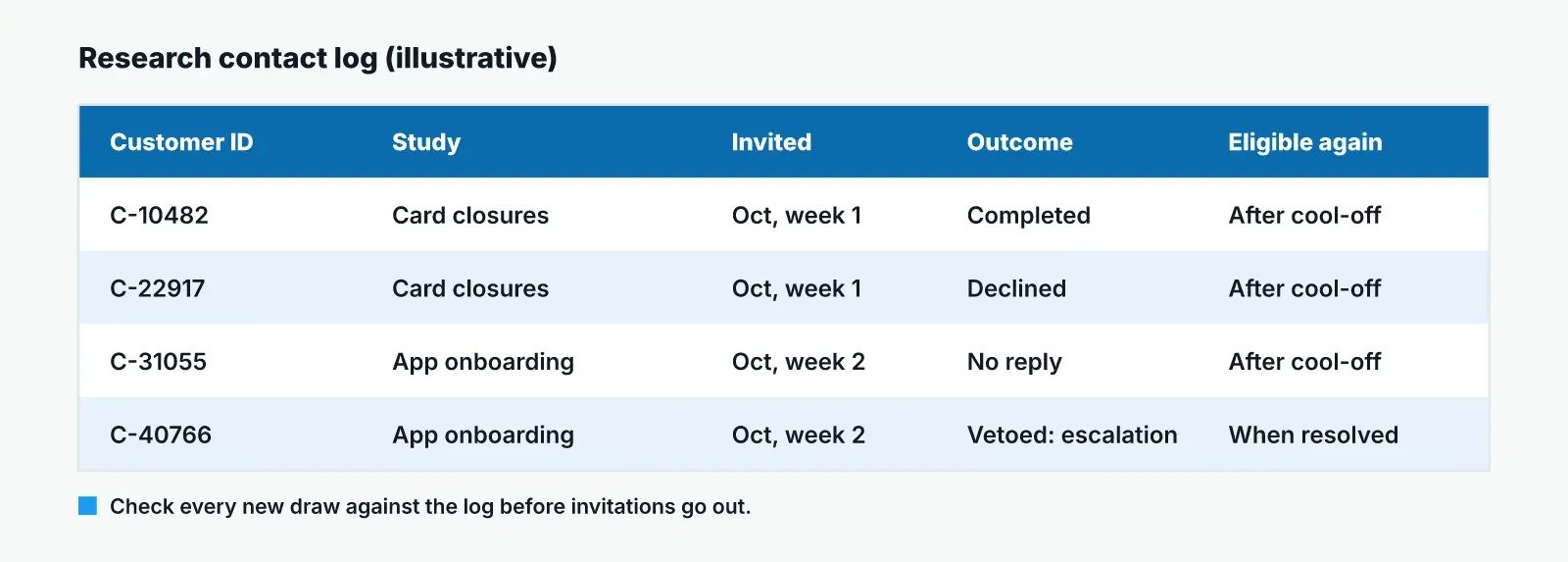
A contact log records every invitation, acceptance, completed interview and decline, by customer ID, study and date. Check each new draw against it before launch. The log is how you enforce a cool-off period, and how you spot the moment a few accounts have become the voice of your whole customer base.
Redraw when accounts, segments or regions appear far more often than their share of the base. For illustration, if one enterprise account has been in four of the last five studies, take it out of this draw, however keen its contact is.
Track non-response by segment too, because the customers who never reply are the ones your themes are missing. The post on the quiet customers focus groups miss covers one way to reach them.
The steps above leave two slow jobs: getting invitations to the right people, and finding a time each person can talk. Pulse handles both. You upload a list of customers or share a study link in an email, a message or your product. Participants then take the AI-moderated voice interview on a phone or laptop, when it suits them.
For people outside your list, such as prospects, Pulse recruits participants to the profile your brief describes. Every participant goes through fraud checks. Your time goes to the parts that make the list fair: the eligibility rule, the random draw, the account-owner rule and the contact log.
If the question is about what customers did with you, recruit from your own base. Draw the list yourself, at random within segments, and check it against the log before launch. If the question is about people who never bought or have gone, recruit to a profile. To see an own-customer study run from list upload to transcript, book a demo.
There is no single rate. The amount depends on the participant's seniority, how long the interview runs and your company's incentive policy. Agree the amount with finance before fieldwork, so every participant in a segment gets the same offer. The incentive calculator gives a starting figure to check against your policy.
Set the cool-off from the size of each segment and how many studies draw on it each year. A small B2B base needs a longer gap than a large consumer base, because the same accounts come up in every draw. Write the rule down and apply it from the contact log.
Invite in waves. Size the first wave from the reply rates your contact log shows for each segment, then send a second wave to the segments that fall short. Never top up a slow segment with volunteers from a fast one, because the segments exist to keep the balance.
Usually not. Customers invited from your own list know who holds their details, and the invitation should say who is asking and why. If you need answers not shaped by knowing the sponsor, such as how customers compare you with other providers, recruit through a panel or agency that can run the study without naming you.
Agree the route before fieldwork. The consent step should say that research is separate from support, and offer to pass a complaint on only if the customer wants that. With their agreement, send it to the support team. Without it, the complaint stays in the research record.
Questionnaire question types compared: closed, scaled, ranking and open, what each lets you analyze, and how to pick one per decision.
Types of bias in research, grouped by the stage where each enters a study, with how it shows up in a customer interview and how to check for it.
Voice of customer programs that stop at survey scores miss the why. Set the cadence, owners and interview waves that explain each score.