Build a qualitative interview guide that works: structure, probe examples, a full annotated template, and tips for AI-moderated interviews.
Qualitative Interview Guide: A Fully Annotated Example You Can Copy
You have a study to run next week and a blank doc titled "interview guide." You know to ask open-ended questions. What you lack is a worked example showing how each question earns its place. A qualitative interview guide is a short, structured plan that ties every question to a research objective, budgets time per section, and tells the interviewer when to probe and when to move on. This article walks through a complete 45-minute guide for a fintech onboarding study, with notes on why each line exists. It also covers bad-to-better question rewrites, a pilot checklist, and how to adapt the guide so an AI moderator can run it. By the end, you can draft, test and revise your own guide.
What a qualitative interview guide is (and what it isn't)
A qualitative interview guide is a flexible plan of topics, questions and probes that keeps a semi-structured interview on track without turning it into a survey. It sets the order and the intent of the conversation. It does not fix every word you say.
The guide sits in the middle of three interview formats:
Structured interviews follow a script. Every participant hears the same questions in the same order, which makes answers easy to compare but leaves no room to follow a surprise.
Semi-structured interviews follow a guide. Core questions are fixed, while follow-ups and order adapt to what the participant says. Most product and UX research uses this format.
Unstructured interviews use a short topic list. The interviewer steers by instinct, which works for early exploration and for experienced researchers. Two interviewers will run very different sessions from the same list.
A good qualitative interview guide does three jobs. It links every question to a research objective, so you can defend each one when time runs short. It sets timing per section, so you reach the topics that matter most before the hour ends. It also gives the interviewer explicit permission to go off-guide when a participant raises something more useful than the next question.
A guide is not a questionnaire. If you find yourself writing 40 questions with tick-box answers, you need a survey.
Before you write a single question: from research question to topic map
Start with one research question, break it into three to five objectives, and only then write questions. Teams that skip this step produce guides that wander, because nothing tells them which questions to cut.
Take a fintech example. The research question is "Why do users abandon KYC during onboarding?" (KYC means "know your customer," the identity checks regulated firms must run.) Break it into objectives:
Understand what users expected the signup process to involve.
Identify the moments in verification where users hesitate or quit.
Learn what users did instead after abandoning.
Each objective becomes a topic area. Each topic area gets two to four core questions, never more. If an objective needs six questions, it is really two objectives, or you are asking about things you already know.
Word those core questions so they are open-ended and don't hint at the answer you expect. "Was uploading your ID confusing?" invites a yes or no and plants the idea of confusion. "Walk me through what happened when you reached the ID step" lets the participant tell you what mattered, so start with "how," "what" or "tell me about" and keep words like "easy" or "frustrating" out of the question.
Scope creep is the main threat at this stage. Stakeholders will ask you to "just add" questions about pricing, brand perception or a feature on next quarter's roadmap. Keep a separate "nice to know" list. Apply one cut rule: if a question doesn't serve a stated objective, it goes on that list, not in the guide. You can run a second study later.
Set the session length before writing questions, then budget minutes per topic area. Common lengths are 30, 45 and 60 minutes. A 45-minute session with three topic areas gives each area roughly ten minutes after the opening and close. If your draft can't fit, cut questions instead of hoping participants talk fast.
The anatomy of a qualitative interview guide
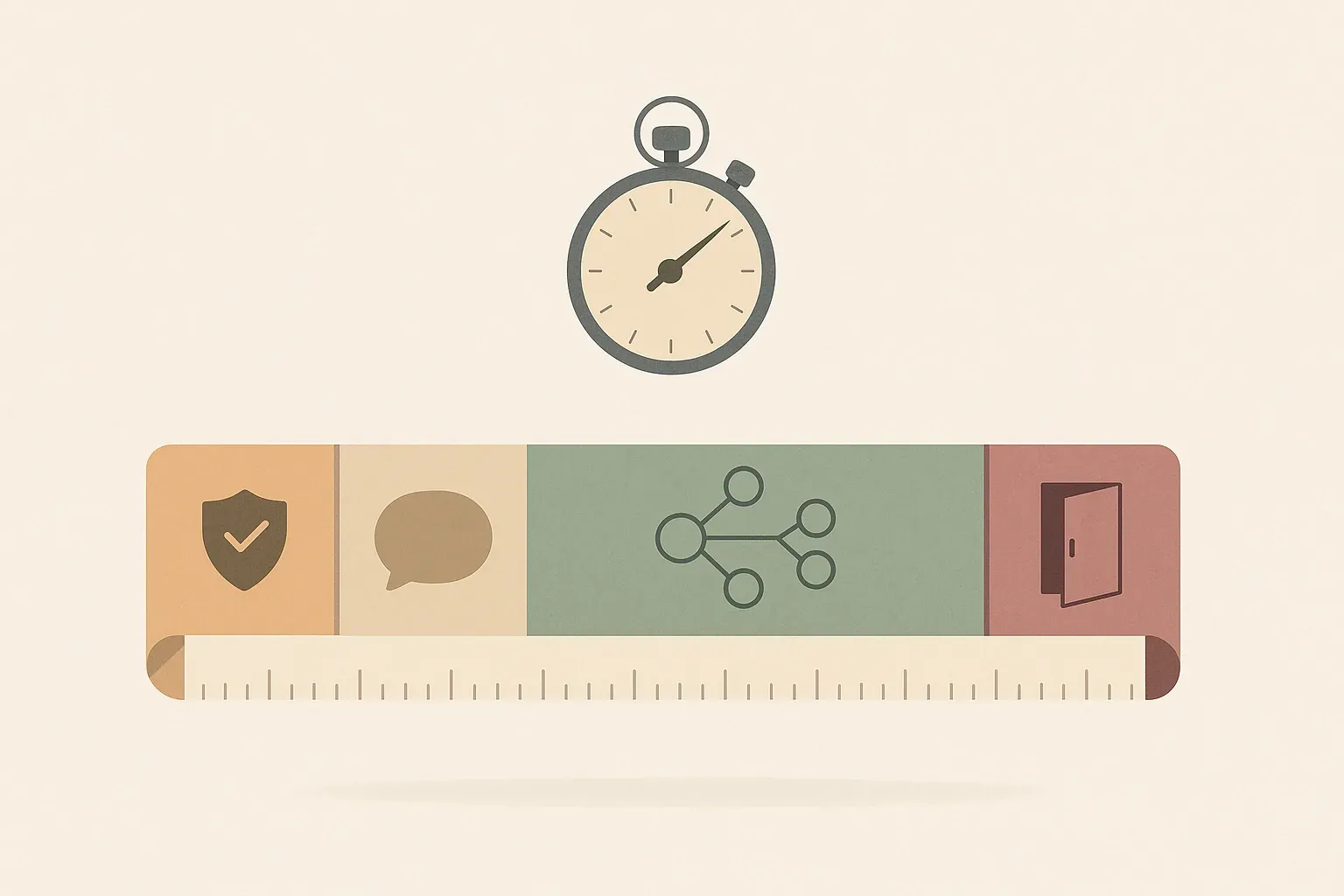
A 45-minute session split into four sections, with most of the time in the core topics.
Every qualitative interview guide has four sections: introduction and consent, warm-up, core topic areas with probes, and wrap-up. Here is how they break down in a 45-minute session.
Introduction and consent (about 3 minutes). Purpose: explain the session neutrally, confirm confidentiality, get permission to record. Example line: "We're talking to people who recently signed up, to learn how the process went. There are no right or wrong answers. Is it OK if I record so I can focus on listening?"
Warm-up (about 5 minutes). Purpose: build rapport with easy background questions about role, context and recent behaviour. Example line: "How do you manage your money day to day at the moment?"
Core topic areas (about 32 minutes). Purpose: gather evidence for each objective, moving from broad to specific, with probes under each question. Example line: "Walk me through the day you signed up."
Wrap-up (about 5 minutes). Purpose: catch anything missed, explain next steps, say thanks. Example line: "Is there anything we didn't ask that you think we should know?"
State the purpose neutrally in the introduction. "We want to understand why our onboarding is so frustrating" plants the answer before you start. Confidentiality and recording consent belong here too, and should be confirmed out loud even if the participant signed a form during recruitment.
Inside each topic area, order questions from broad to specific. Open with "Tell me about…" before narrowing to "What did you think when you saw the selfie step?" Asking the narrow question first anchors participants on your framing.
A full annotated example: 45-minute guide for a fintech onboarding study
This is a complete qualitative interview guide for the research question "Why do new users drop off before funding their account?" Copy it into your own doc and swap in your product details. Questions marked [MUST] are asked in every session. [OPTIONAL] questions are dropped first when time runs short.
Objectives: O1, expectations at signup. O2, friction during identity verification. O3, what stopped them from adding money.
Introduction and consent (3 min)
"Thanks for joining. I'm [name], a researcher at [company]. We're speaking with people who opened an account recently to understand how getting started went. There are no right answers, and nothing you say will affect your account. Your responses stay confidential and we'll remove your name from anything we share. Is it OK if I record this session? You can stop at any time."
Note: Read word for word. The phrase "nothing you say will affect your account" matters in fintech, where participants may worry about being flagged.
Warm-up (5 min)
[MUST] "How do you handle everyday money things at the moment: paying bills, saving, sending money?"
Probe: "Which apps or accounts do you use most?"
Note: Serves O3 indirectly by revealing the incumbent you're competing with. Skip the probe if they've already named their tools.
Topic 1: Expectations (O1, 10 min)
[MUST] "Tell me about what was going on when you decided to sign up."
Probe: "What made that the moment?"
Probe: "What were you hoping to do first?"
[OPTIONAL] "Before you started, how long did you expect setting up to take?"
Note: Q2 asks about a real moment, not opinions. Skip Q3 if the participant already mentioned time expectations.
Topic 2: Verification (O2, 12 min)
[MUST] "Walk me through signing up, from opening the app to the point you stopped."
Probe: "What happened next?"
Probe: "Where did you pause or go back?"
[MUST] "Tell me about the identity check. What did it ask you for?"
Probe: "How did that compare to other apps you've signed up for?"
[OPTIONAL] "Did you need anything you didn't have to hand?"
Note: Q4 is the most important question in the guide. Protect its time. Don't say "KYC" to participants; they call it "the ID bit."
Topic 3: Funding (O3, 10 min)
[MUST] "Tell me about the last time you thought about adding money to the account."
Probe: "What stopped you, or what would have needed to be different?"
Probe: "Why does that matter to you?"
[OPTIONAL] "What did you do instead?"
Note: If the participant did fund the account, flip Q7: "What made you comfortable enough to add money?"
Wrap-up (5 min)
[MUST] "Is there anything we didn't ask that you think we should know?"
"Thanks. Here's what happens next: [incentive, timing]."
Writing questions and probes that get real answers
Ask about past behaviour, not hypotheticals. "Tell me about the last time you moved money between accounts" gets you a story with details you can verify. "Would you use instant transfers?" gets you a polite guess, and people are poor forecasters of their own behaviour.
Five bad-to-better rewrites:
Leading. Bad: "How frustrating was the ID check?" Better: "Tell me about the ID check." The first assumes frustration and invites agreement.
Double-barrelled. Bad: "How did you find the signup and the funding steps?" Better: ask about each step separately. Combined questions get an answer to whichever half the participant remembers.
Yes/no. Bad: "Did you understand the fees?" Better: "What did you think you'd be charged?" The rewrite exposes the misunderstanding instead of a polite "yes."
Jargon-heavy. Bad: "Where did KYC friction occur?" Better: "Where did you get stuck when we asked for your details?"
Future-predicting. Bad: "Would you fund your account if we added Apple Pay?" Better: "How did you add money the last time you opened a new account somewhere?"
Probes matter as much as the questions above them. Use four types:
Clarifying: "When you say 'it got weird,' what happened on screen?"
Elaborating: "Tell me more about that."
Contrasting: "How did that compare to your bank's app?"
Laddering: "Why does that matter to you?" Ask it two or three times in a row to move from a feature complaint to the underlying motivation, such as fear of losing access to money.
Write two or three probes under every core question, but treat them as options, not a checklist. For more starting points, browse this bank of 50+ user interview questions.
Pilot, then revise: testing your guide before fieldwork
Run one or two pilot interviews before real fieldwork, and time each section with a stopwatch. A colleague outside the project or a friendly existing user is enough. The pilot tests the guide, not the participant.
During the pilot, watch for these problems:
Sections that overrun their budget. If Topic 2 takes 20 minutes instead of 12, cut an optional question or merge two.
Questions participants misread. If someone answers a different question than the one you asked, the wording is the problem.
Questions that keep producing yes/no answers. Rewrite them as "Tell me about…" or "Walk me through…"
Awkward transitions, where the jump between topics confuses the participant. Add a one-line bridge: "Now I'd like to talk about adding money."
After the pilot, map the notes back to your objectives. For each objective, ask whether the session produced at least one concrete story or example you could quote. If an objective came back empty, its questions need rewriting. If two questions produced the same evidence, keep the stronger one and cut the other.
Keep a version log at the top of the guide: date, version number, what changed and why. Guides often evolve between interview rounds as you learn which areas are rich and which are settled. Without a log, you'll struggle later to explain why participants in round two answered different questions from those in round one, and your analysis will be harder to defend.
Adapting your guide for AI-moderated interviews
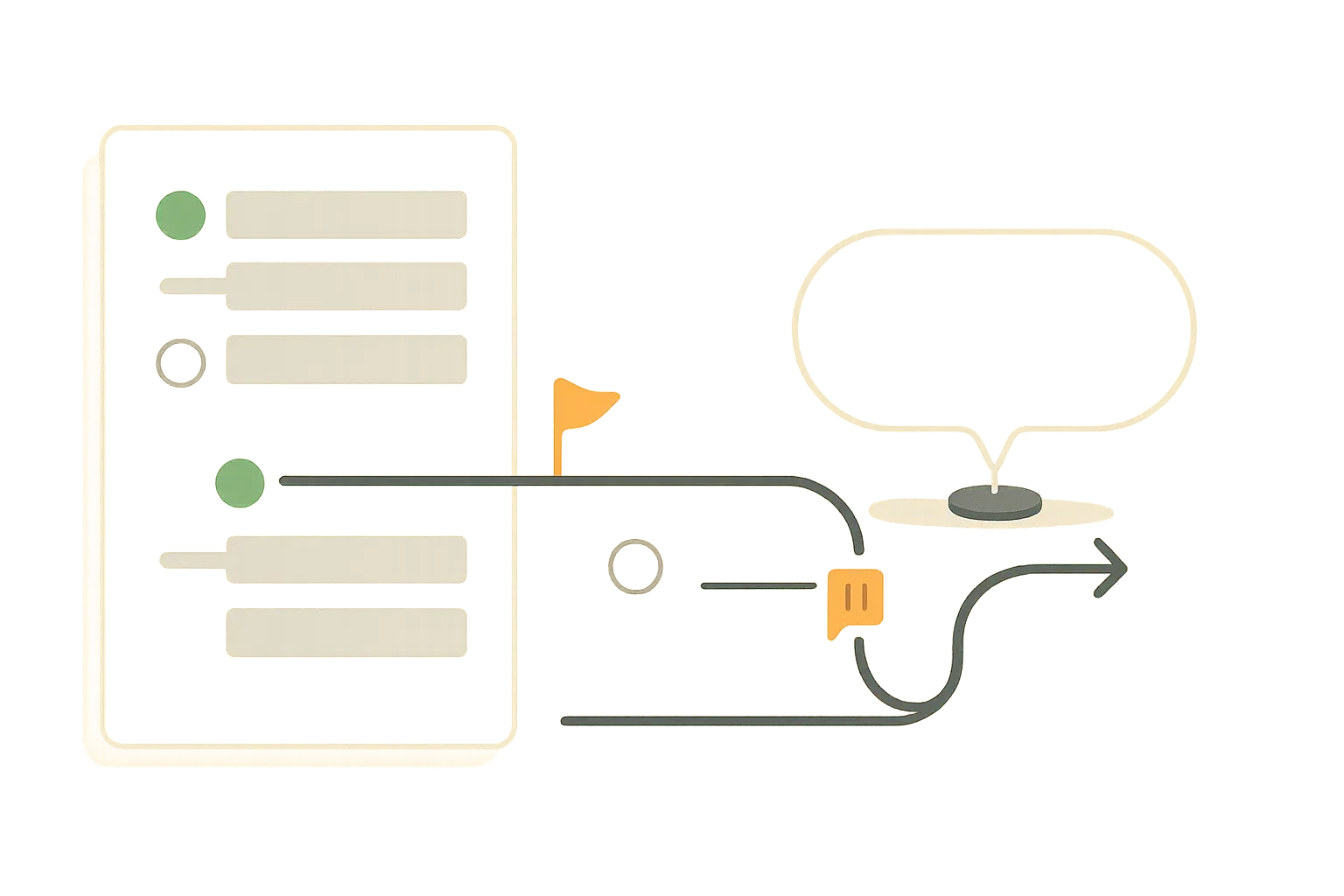
The AI follows only what is on the page, so rules must be explicit.
An AI moderator needs everything a human interviewer carries in their head, written down. A human knows why each section exists and when to dig deeper. An AI follows what's on the page, so the guide has to spell out intent, rules and limits.
Add these to the guide:
The objective for each section, stated in one sentence, so the moderator can judge whether an answer is on target.
Explicit probe rules, such as "probe up to twice if the answer is under two sentences" or "if the participant mentions a competitor, ask how it compared."
Stop conditions, such as "move on after two probes or once the participant has described a specific moment."
[MUST] and [OPTIONAL] labels, plus allowed deviations: "may reorder Topics 1 and 2 if the participant raises verification first."
Introduction and consent wording, written word for word and delivered unchanged.
Plan for sensitive moments before they happen. In an LLM-in-the-loop study of AI-generated follow-up questions, 17 interviewers raised five interlocking concerns, including privacy, disclosure and compliance risks when AI listens to, records or transcribes sensitive content. For a fintech study, list the topics the moderator must not probe, such as specific balances or debts. Write the exact response if a participant starts reading out an account number: "Please don't share account details. I don't need them for this conversation." Then move to the next question.
Pulse runs AI-moderated voice interviews from a research design, so a guide written this way can be used directly. For a closer look at the trade-offs, read this comparison of AI-moderated and human-moderated interviews.
The takeaway: a guide that's clear enough for an AI to follow is also a better guide for humans, because every question has a stated reason, a time budget and a rule for when to stop. If you want to see how your guide performs as an AI-moderated study, you can try it in Pulse.
Frequently asked questions
How many interviews do you need for qualitative research?
You need enough interviews that new sessions stop surfacing new reasons or themes, a point researchers call saturation. Plan a first round per user segment, review the findings, then decide whether to schedule more. Narrow questions with similar participants saturate sooner than broad ones. This guide on how many user interviews you really need explains how to size each round.
How long should a qualitative interview last?
Most qualitative interviews last 30 to 60 minutes, and 45 minutes suits a study with three topic areas. Shorter sessions work for one focused question. Longer ones risk fatigue, especially on video or voice calls. Set the length before writing questions, then budget minutes per section so the most important topics never get squeezed by an overrunning warm-up.
Are interviews qualitative or quantitative?
Interviews are usually qualitative, because they collect open-ended stories and explanations rather than counts. A structured interview with fixed, closed questions can produce quantitative data, but at that point it behaves like a spoken survey. Use qualitative interviews to learn why people behave as they do, and surveys to measure how many people do it.
What is the difference between a qualitative interview and a user interview?
A user interview is a qualitative interview with people who use, or might use, a product. The method and guide structure are the same. The difference is focus: user interviews centre on product behaviour and decisions, while qualitative interviews in academic or social research may explore any experience, from health to work, with stricter ethics review.
Can you use ChatGPT or AI for qualitative data analysis?
Yes, AI tools can help with first-pass coding, summarising transcripts and spotting candidate themes, but a researcher should verify every theme against the source quotes. Check your data agreements before uploading transcripts, since they may contain personal details. This guide on how to analyze qualitative data covers coding and synthesis methods step by step.
Fixed questionnaires trap research inside existing assumptions. Discover why static surveys miss critical customer realities and how dynamic voice probing fixes it.
High survey completion rates measure friction reduction rather than response validity. Here is why optimizing for completion conceals satisficing and bad data.