How to choose between online panel providers
How to choose between online panel providers: six checks before you buy, what drives the price, and how to test the first answers.
The three types of participant recruitment, active, passive and third-party, explained simply, with who each one reaches and who it misses.
You're on the research team at a dog walking company. Lots of people download its app and add their dog. Then they never book a walk. Your manager wants to know why. But how do you reach people who never open the app again?
That's a question about the types of participant recruitment. Here, the type means who makes the first contact.
There are three types. In active recruitment, you reach out to people you picked. In passive recruitment, you post a notice and people come to you. In third-party recruitment, someone else reaches out for you. For people who stopped using the app, active works best, because a banner inside the app never reaches them.
Each type changes who says yes, and that decides what you'll hear.
Active recruitment means you choose the people and contact them yourself. At the dog walking company, you pull the list of people who signed up and never booked. Then you email them, text them or call them. You reach the exact group you need, including quiet people who never answer an open call.
Active recruitment also works in person. A targeted intercept means stopping people who fit, where they are, and asking them right then. Say a staff member stands outside a busy dog park on a Saturday. She asks dog owners if they've tried the app, and invites those who signed up but never booked. This kind of in-person work is also called field recruitment.
The catch is that a direct ask can feel like pressure. So say who is asking, what the talk involves and how long it takes. And say plainly that saying no is fine.
People give more honest answers when they chose to be there.
If your customers are other companies, the same idea applies through introductions from account teams.
Passive recruitment means you post a notice and people choose to reply. At the dog walking company, that could be a banner in the app, a post on the company's social pages, a paid ad or a flyer at a pet shop. It takes little effort, and it can reach people you have no list for.
The risk is self-selection. Self-selection means people decide for themselves whether to take part, so the group picks itself. Those who reply to open calls are often the keenest users, the most regular ones, or the ones who want the reward. The post on self-selection and other biases shows where else this happens in a study.
Say you put a banner in the app. Only people who still open the app will ever see it. Most people who never booked a walk stopped opening it weeks ago. So the banner fills your study with happy weekly users, the opposite of who you need.
Flyers and ads work the same way. They're passive, because the reader decides whether to reply.
Third-party recruitment means someone else makes the first contact for you. That could be a research panel, which is a group of people who signed up to take part in studies. It could be a recruiting agency. Or it could be a gatekeeper, a person who holds a list you can't see, such as a partner or an account manager.
Say you want to hear from dog owners who use a rival walking service. You have no list of them. A panel can find people who fit, ask your screener and send you those who qualify. A screener is a short set of questions that checks someone fits before the study starts.
A gatekeeper works the same way on a smaller scale. Say the company partners with a vet clinic. The clinic sends a note about your study to its own clients. You never see the list, but the clients hear about you from someone they trust.
The catch is that you see people only through someone else's filter. So ask how people were found and how they were checked. Some people sign up for many studies to collect rewards, and some aren't who they say they are. The post on fake participants shows what to look for.
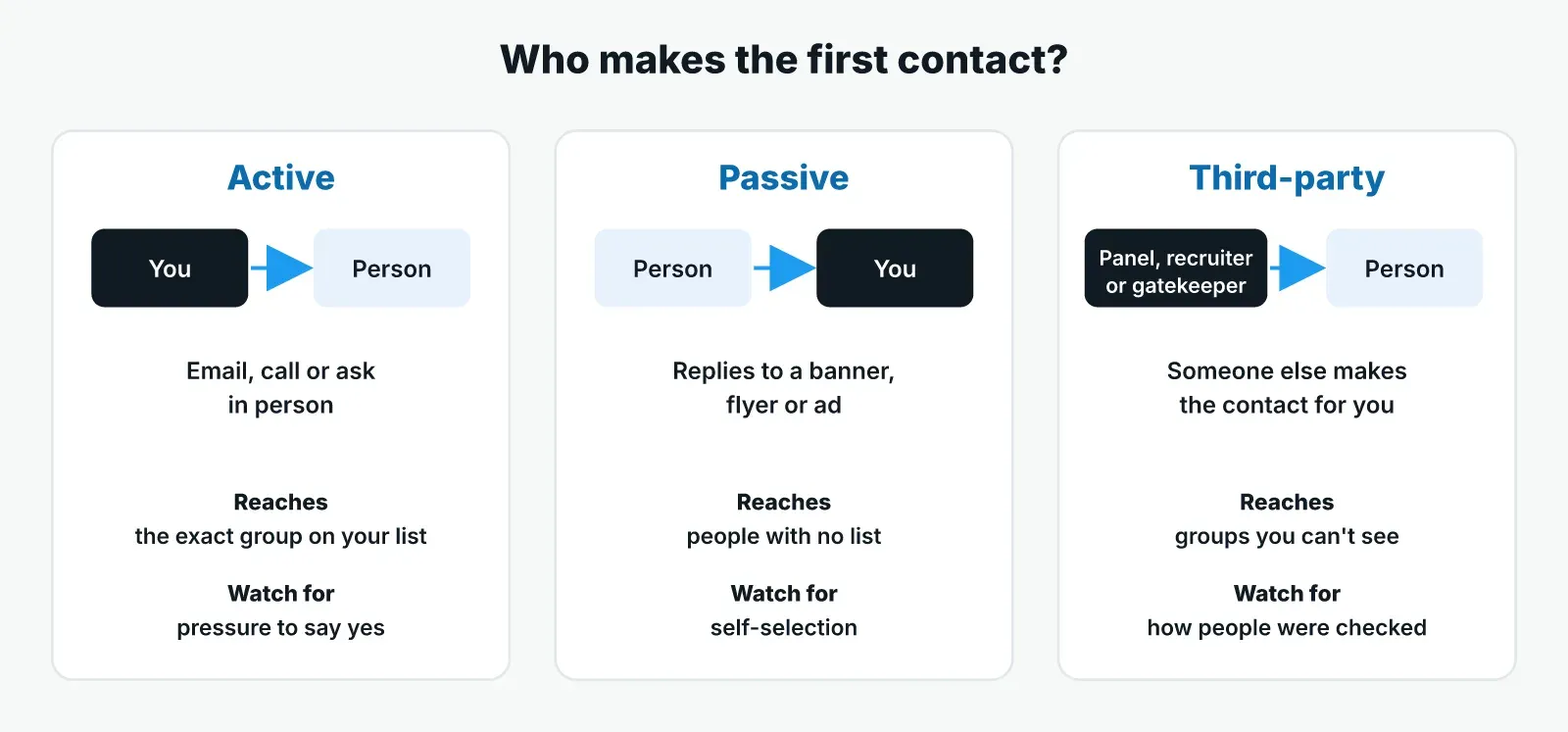
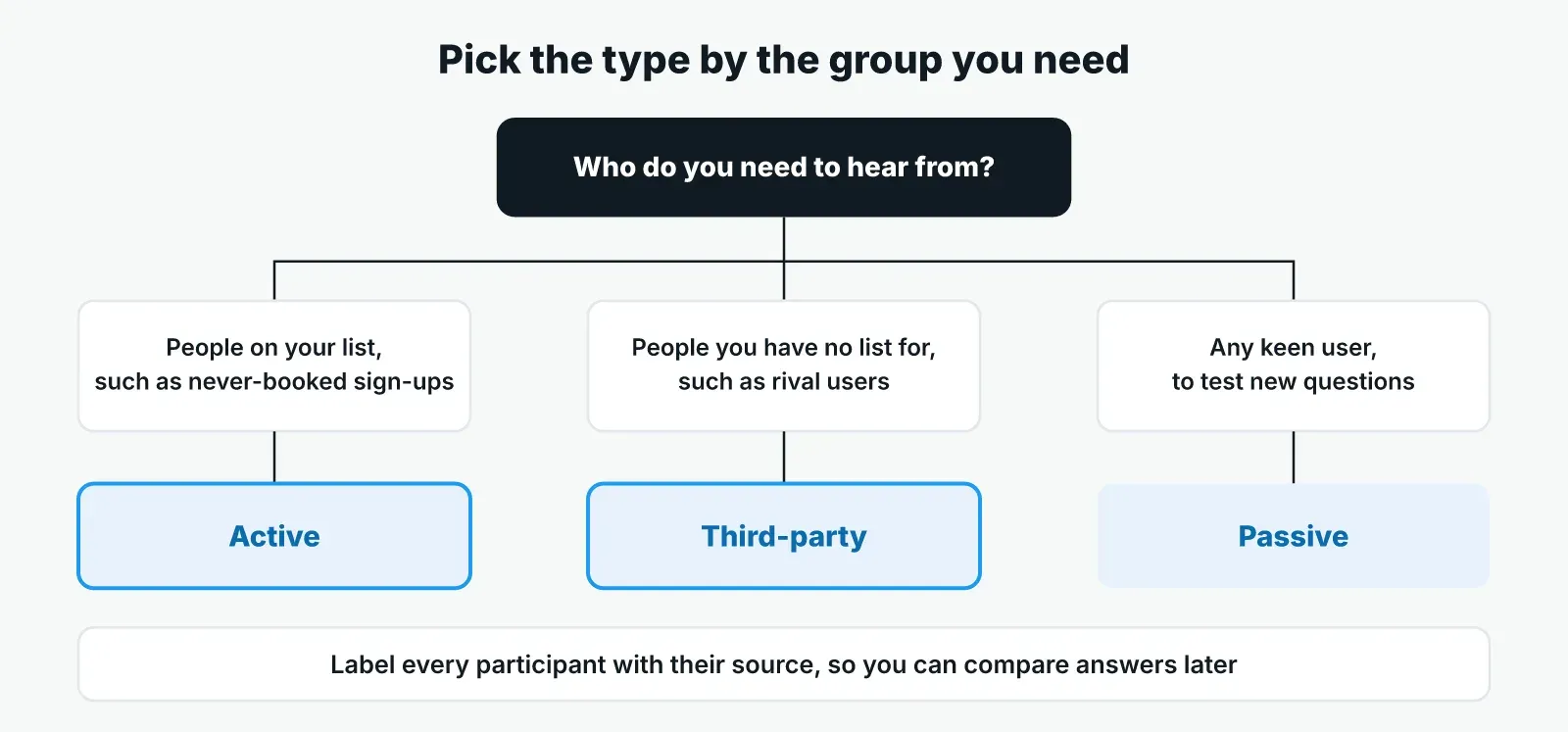
Neither type always wins. Pick by the group you need to hear from. If the group is on a list you hold, active recruitment reaches them directly. If the group is broad, or you have no list, passive or third-party recruitment can find them. Most good studies mix two of the three.
Each type reaches a different set of people and misses another:
| Type | Who makes first contact | Best for | Who it can miss | Watch for |
|---|---|---|---|---|
| Active | You | A known group on your list | People missing from your list | Pressure to say yes |
| Passive | The person who replies | Broad groups with no list | Quiet and less keen people | Self-selection |
| Third-party | A panel, recruiter or gatekeeper | Groups you can't see, such as rival users | People outside their reach | How people were found and checked |
Say the team emails people who signed up but never booked. That's active. It also asks a panel for dog owners who use a rival service. That's third-party. Now the study hears why some people drifted away, and why others never joined.
Write down which type each person came from. Then, when you read the results, compare the groups. If panel people say very different things from email people, you'll spot it, instead of blending two stories into one.
So the dog walking team can decide with one rule. Use active recruitment for anyone on the company's own list. Add third-party recruitment for people the company has no list for. Use passive recruitment only when any keen user will do, such as a quick test of new questions.
Active and third-party recruitment can both run from one study. With Pulse, you can invite your own customers from a list you upload, such as everyone who signed up and never booked. Or you can have participants recruited to your brief from more than 200 million people worldwide. Every participant goes through fraud checks.
People take the AI-moderated interview by opening a link on a phone or laptop, so there are no calls to schedule. That helps with people who drifted away, because they can answer when it suits them.
Your team still decides who to reach and how. To try it on your own study, book a demo, start on the $0 Explorer plan, or ask for a free study.
A flyer pinned on a wall is passive, because the reader decides whether to reply. But the same flyer becomes active when a staff member hands it to people they chose and asks them in person. What counts is who takes the first step.
Yes, and it often helps. Give each source its own target number, so one fast source can't fill the whole study. Then label every participant with their source. If two sources tell different stories, you can report them side by side.
A participant is anyone who takes part in your study. At the dog walking company, a participant might be someone who downloaded the app in spring, added their dog and never booked a walk. Before the study starts, people often call her a recruit. Once she answers your questions, she's a participant.
Keep the first message short and say why you picked them. Send one reminder at most. Make the "no thanks" option as easy to click as the "yes" option. And offer a way to take part at a time that suits them, so saying yes doesn't cost them their evening.
How to choose between online panel providers: six checks before you buy, what drives the price, and how to test the first answers.
Participant recruitment in qualitative research, made simple: find people who can explain what happened, screen them, get consent and check the list.
Participant recruitment methods compared by who you need: your own list, panels, referrals, networks and recruiters, plus a check before you set a date.