Questionnaire question types and when to use each
Questionnaire question types compared: closed, scaled, ranking and open, what each lets you analyze, and how to pick one per decision.
Types of bias in research, grouped by the stage where each enters a study, with how it shows up in a customer interview and how to check for it.
Research bias is systematic error that pushes findings away from what is true. The types of bias in research group by where they enter a study: who you hear from, how you ask, how people answer, and how you read and report the evidence. The stage tells you which check to run and when to run it.
The types of bias in research fall into four stages of a customer study. Selection biases distort who you hear from. Question and interviewer biases distort how you ask. Response biases distort how people answer. Analysis and reporting biases distort what the team concludes and shares. Each stage has its own check.
Bias is different from random error. Random error is noise, such as an unusual participant or a bad connection, and more interviews average it out. Bias pushes every answer the same way, so more interviews repeat it. A hundred interviews recruited from one invitation email share the blind spot of ten.
Epidemiology also names confounding: a third factor linked to both the thing you study and the outcome. The data can be accurate while the conclusion is wrong. A customer team meets it when heavy users of a feature also renew more often, and both follow from account size.
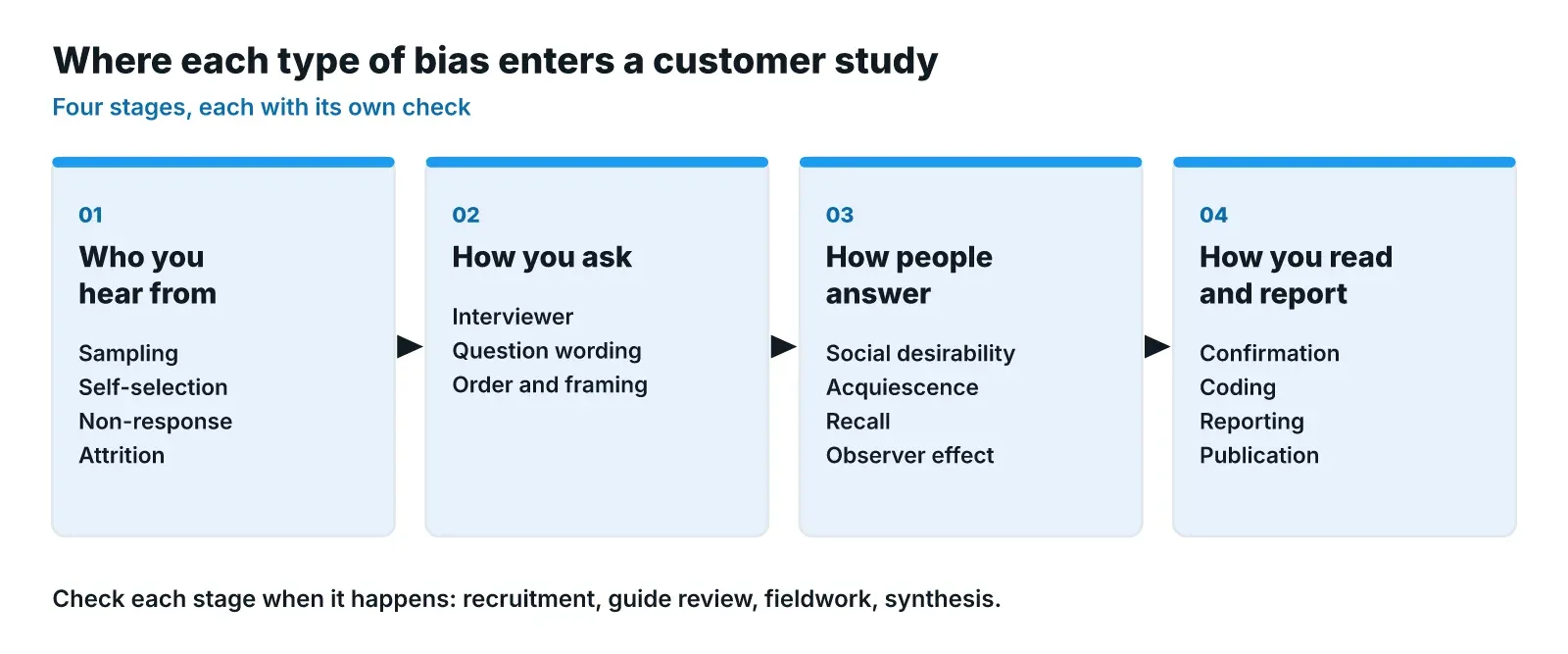
The table lists fifteen biases that affect customer interviews and surveys, the stage where each enters, how it shows up in an interview, and the check that catches it. For the step-by-step process, see how to reduce bias at each stage of a study.
| Bias | Stage | How it shows up in a customer interview | The check |
|---|---|---|---|
| Sampling bias | Who you hear from | Only customers on the active email list get invited | Compare the invited list with the whole customer base, by segment |
| Self-selection bias | Who you hear from | Customers with strong views accept; the indifferent ignore the invite | Compare acceptors with decliners on data you hold |
| Non-response bias | Who you hear from | Busy enterprise admins never reply, so their workflow goes unheard | Track response rates by segment and chase the gaps |
| Attrition bias | Who you hear from | In a multi-session study, the least satisfied drop out first | Compare finishers with dropouts |
| Interviewer bias | How you ask | A nod after the hoped-for answer; follow-ups only on praise | A second researcher reads transcripts for steering |
| Question wording bias | How you ask | "How much did the new dashboard help?" assumes it helped | Rewrite questions in neutral, open form |
| Order and framing effects | How you ask | Asking about price first colors the answer about value | Review question order before fieldwork |
| Social desirability bias | How people answer | Participants overstate how carefully they compare suppliers | Ask about the last specific instance |
| Acquiescence bias | How people answer | "Yes, that would be useful" to every proposed feature | Replace yes-or-no questions with open ones |
| Recall bias | How people answer | A tidy story about a purchase made last year | Anchor on a recent, specific event |
| Observer (Hawthorne) effect | How people answer | Customers edit what they tell the brand they pay | Compare stated behavior with product data |
| Confirmation bias | Reading the evidence | Coding toward the hypothesis the sponsor already holds | Look for quotes that contradict each theme |
| Observer bias in coding | Reading the evidence | Two analysts code the same answer differently | Double-code a sample and compare |
| Reporting bias | Reporting | Findings that contradict the roadmap stay out of the readout | Share the full theme list, inconvenient themes included |
| Publication bias | Reporting | Studies with a clear result circulate; null results stay in a folder | Store every study where others can find it |
Selection biases decide whose experience reaches the findings before anyone asks a question. Sampling, self-selection, non-response and attrition bias each leave out a group in a systematic way. Good moderation cannot recover a voice that was never in the study, so this stage is checked at recruitment.
Sampling bias happens when the way you choose participants makes some customers more likely to be included than others. The findings then describe the customers you could reach. Recruiting through one account team's contacts, for example, hears from accounts with an engaged champion and misses the ones drifting toward churn.
Self-selection bias follows from letting people opt in: customers with something to say accept, and the indifferent stay silent. Non-response bias is the mirror image: the people who never reply share a trait, such as a heavy workload, that also shapes their experience of the product.
Attrition bias appears in multi-session research: if the least satisfied leave first, the final sessions sound happier than the full group was.
The check for all four is the same: compare who completed with who was invited, segment by segment, using data you already hold.
Interviewer bias, question wording bias and order effects come from the research team, so they are the easiest to fix before fieldwork. They show up as answers that echo the question: a participant accepting a premise the question supplied, or dwelling on whatever the interviewer reacted to.
Tone, nods and the choice of which answers to follow up all steer a participant, and interviewers drift. Several sessions in, a moderator who has formed a view starts probing harder on answers that fit it.
A leading question suggests its answer, a loaded question carries an assumption, and a double-barreled question asks two things at once. Each one produces answers you cannot interpret. The guide on how to write an interview guide that does not steer works through it question by question.
| Leading or loaded version | Neutral version |
|---|---|
| How much did the new approval workflow speed things up? | Walk me through the last invoice you sent for approval. |
| Don't you find the old reports confusing? | Tell me about the last time you used the reports. |
| How happy are you with the price and the support? | Two questions: one on price, then one on support. |
What you ask first anchors what comes after. Asking about price before value changes the value answer. Fix the order on purpose and keep it the same for every participant.
Before fieldwork continues, have a second researcher read the guide and the first two transcripts, looking only for steering.
Response biases come from participants who are trying to be helpful, consistent or well regarded. Social desirability, acquiescence, recall bias and the observer effect all produce answers that are sincere and still inaccurate. The check is to ask about specific recent behavior and compare it with data you hold.
Participants give the answer that sounds responsible. A finance lead describes a careful supplier comparison that, in practice, was a renewal signed in a week.
Some participants agree with whatever is proposed, and the effect is strongest with yes-or-no questions. "Would this feature be useful?" collects yes answers. "When did you last need to do this, and what did you do?" collects evidence.
People reconstruct past decisions, and the reconstruction is tidier than the event. Anchor questions on a recent, specific event and ask who was involved and what else they considered.
People behave differently when they know they are observed. In enterprise research it has a particular form: customers are talking to the brand they pay, and B2B participants speak for their employer. Both edit what they say. Comparing stated behavior with product or CRM data shows where the edit happened.
Analysis and reporting biases enter after fieldwork, when the team decides what the evidence means and what to share. Confirmation bias pulls coding toward the existing hypothesis, and reporting bias keeps inconvenient findings out of the readout. The check is traceability: every theme links to its quotes, and a reviewer looks for quotes that contradict it.
Confirmation bias is the tendency to favor evidence that fits what you already believe. In synthesis it looks like a theme built from the quotes that support the sponsor's hypothesis, with the ones that complicate it left uncoded. Observer bias in coding is its cousin: two analysts reading the same answer differently. Double-coding a sample and comparing the results, a check on inter-rater reliability, shows how large the gap is.
Reporting bias inside a company means studies that contradict a roadmap get shelved or summarized selectively. Publication bias is the academic version, where studies with positive results are more likely to be published than null or contrary ones.
Bias also continues after the report reaches decision-makers. In a May to June 2024 survey of Medical Library Association leaders, published by Eldredge and Hill in the Journal of the Medical Library Association, 149 leaders submitted viable responses (a 32% response rate). The forms of cognitive bias they ranked highest in evidence-based decisions were status quo, sunk costs, novelty, professionology, authority, worst case scenario and group think. The sample is medical library leaders, so the ranking describes their decisions. Status quo and sunk costs are still worth naming in any readout that asks a team to change course.
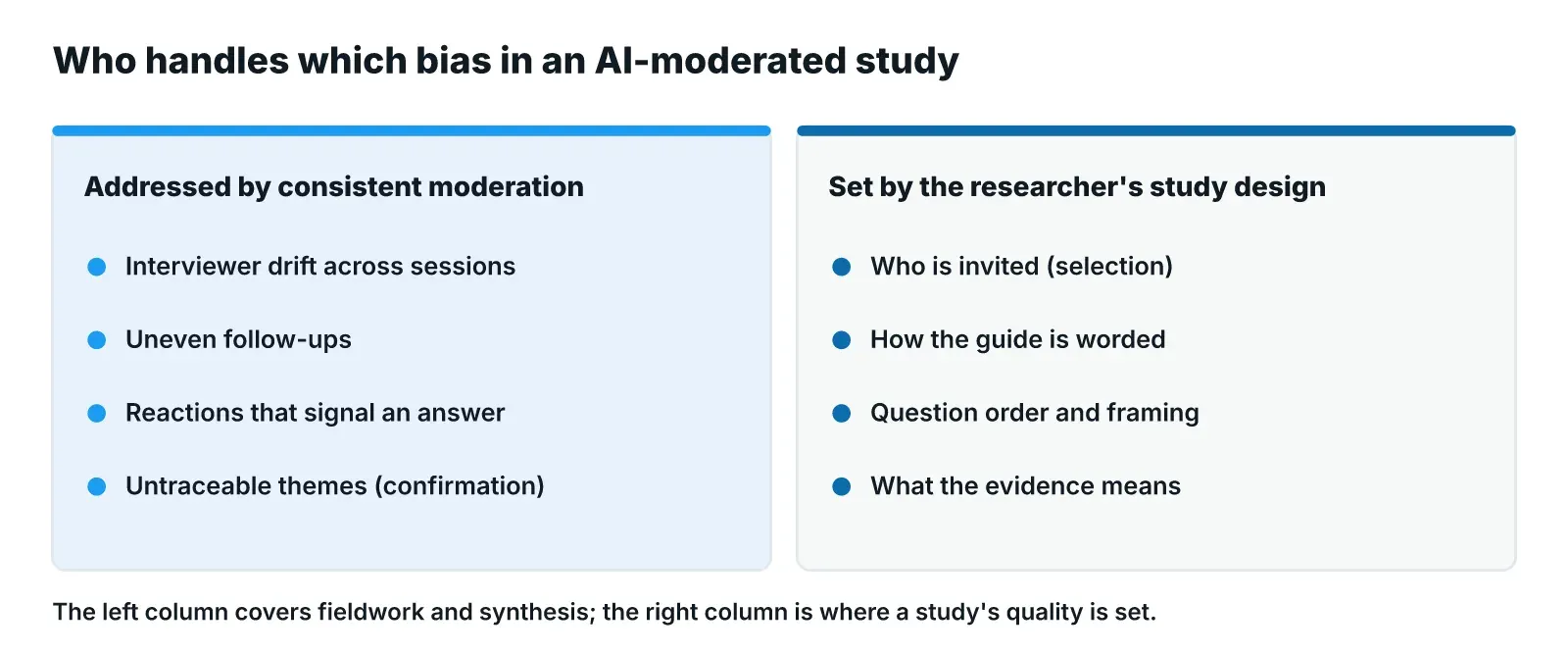
Consistent AI moderation addresses the biases that come from the interviewer: drift across sessions, uneven follow-ups and reactions that signal a preferred answer. Traceable synthesis lets anyone audit the findings for confirmation bias. Choosing who is invited, wording the guide and deciding what the evidence means remain the researcher's work, and that is where the study's quality is set.
When every interview gets the same well-formed questions in the same order, the eighth session sounds like the first, and differences between participants are differences in what they said.
Pulse runs AI-moderated research on that design: every participant gets the same well-formed questions, thin answers get a follow-up, and every theme traces back to the interview it came from. The researcher's time goes to the parts that set the study's quality: the sample, the wording of the guide, and what the organization should do with the evidence.
Epidemiology and statistics usually name three: selection bias, which distorts who ends up in the data; information or measurement bias, which distorts how data is recorded or measured; and confounding, where a third factor linked to both the cause and the outcome creates a relationship that is not there. Customer research meets all three.
Publication bias is the tendency for studies with positive or striking results to be published, cited or circulated more than studies with null or contrary results. Readers of the published record then see a stronger effect than the full body of research shows.
No single agreed list of twelve cognitive biases exists. For research teams, the biases that matter most are confirmation bias in analysis, anchoring in question order, status quo and sunk cost bias in decisions, and group think when a team reviews findings together.
No study is free of bias. The workable goal is to know which biases your design is exposed to, check for each one at the stage where it enters, and report the ones you could not rule out. The guide to reducing bias in user research sets out that process for each stage of a study.
Questionnaire question types compared: closed, scaled, ranking and open, what each lets you analyze, and how to pick one per decision.
Voice of customer programs that stop at survey scores miss the why. Set the cadence, owners and interview waves that explain each score.
Research participant recruitment from your customer base: build a fair CRM list, settle consent and incentives, and rotate past the loud accounts.