Types of participant recruitment: active vs passive
The three types of participant recruitment, active, passive and third-party, explained simply, with who each one reaches and who it misses.
How to choose between online panel providers: six checks before you buy, what drives the price, and how to test the first answers.
"Which panel are we buying from, and why that one?" Someone from the company's buying team asks you this.
You're on the research team at a school meal service. The company plans to launch in new countries. You need to hear from parents there who pack a lunch for their kids each day. But the company has no list of them. So who finds these parents for you, and how do you pick?
That's the job of online panel providers. A panel provider keeps a large group of people who agreed to take part in research. It invites the ones who fit your study.
To choose one, check three things first. Who is in its panel? How does it check people are real? Can it reach your exact parents in each country? Then compare prices on the same study, and test the first answers before the rest go live.
When you have no list of the people you need, someone outside has to find them. An online panel is a big group of people who signed up to take part in research. They also shared some facts about themselves. A panel provider runs one. It sends your study to members who pass your screener, the short quiz that checks someone fits. For full definitions, see the glossary pages for an online panel and a panel provider.
A recruitment agency works in a different way. It finds people one by one, often by phone, and mostly for interviews. Your own customer list is the third choice. It costs nothing to reach, but it only holds people who already buy from you.
This table compares a panel provider, a recruitment agency and your own customer list:
| Source | Who it reaches | Best for | Watch out for |
|---|---|---|---|
| Online panel provider | Many people who pass a short screener | Surveys and interviews with common people, fast | How people joined and how they're checked |
| Recruitment agency | A few hard-to-find people, one by one | Rare or senior people who need a call first | Slower to fill |
| Your own customer list | People who already buy from you | Questions about your own service | Everyone who isn't a customer yet |
The school meal team needs parents who pack lunches in two new countries. They aren't customers yet, so the company's list won't help. But lots of parents pack lunches, so a short screener can find them. That makes a panel a good fit.
If the team needed head teachers instead, an agency's phone calls would make more sense. The post on recruiting B2B participants covers that kind of search.
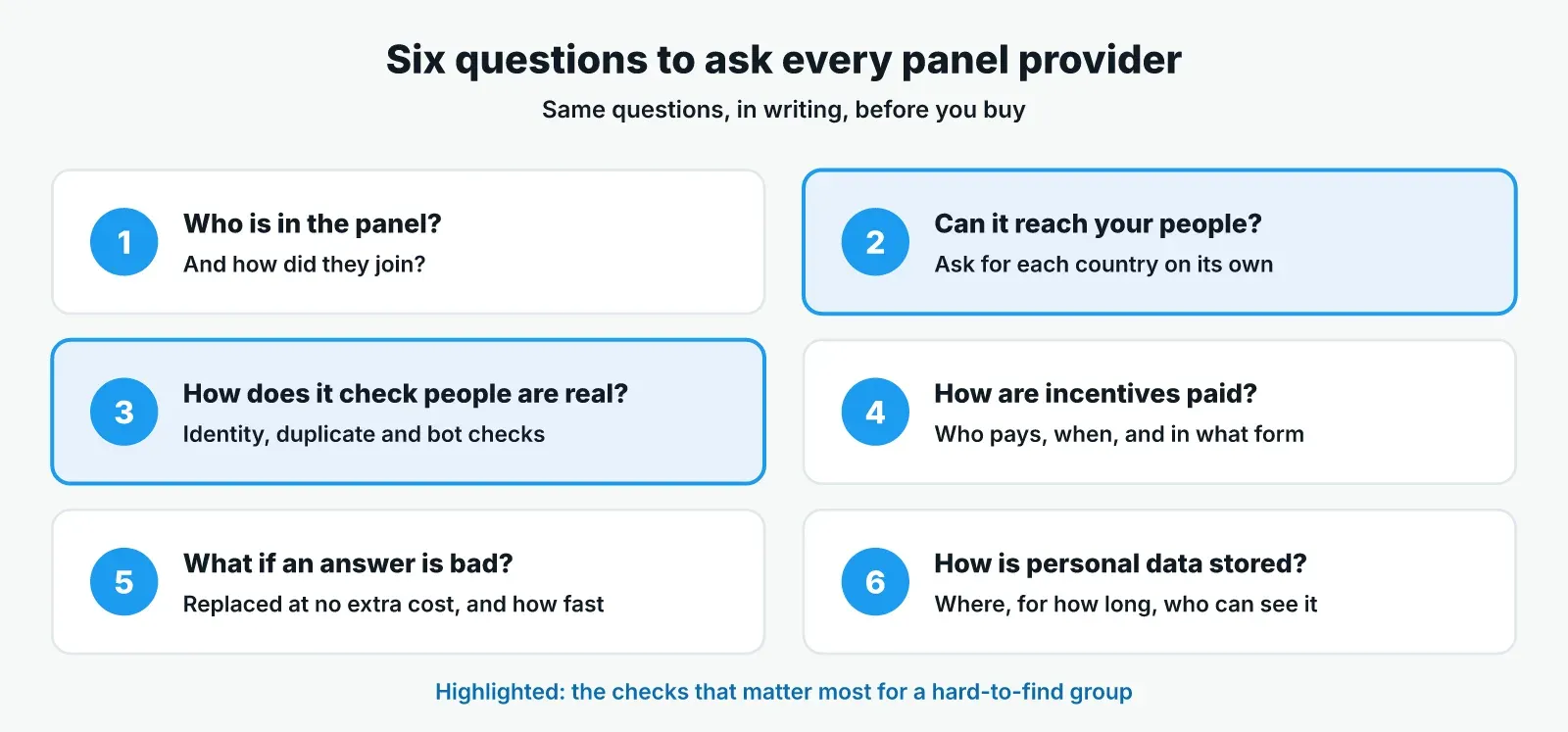
Comparing online panel providers comes down to six questions. Ask each one the same questions, in writing, before you buy. The answers show who will really take your study. That matters more than how big the panel is.
People join panels in different ways, such as through ads, partner sites or invites. Ask where members come from and how often they take studies. Someone who takes surveys every day may answer in a different way from someone who takes one a month.
A big total doesn't mean the panel has your parents. Send your screener and ask how many members in each country are likely to pass it. For the school meal study, ask about each country on its own. One may be easy and the other thin.
Ask how it checks who people are, and how it spots repeat sign-ups and bots. Ask if it uses attention checks too. These are questions that tell people exactly what to pick. The post on how fraud gets past a screener shows what these checks are up against.
The reward a person gets for taking part is called an incentive. Ask who pays it, when, and in what form. Late or confusing payments can drive good members away.
Some answers will fail your checks. Ask if the provider replaces them for free, and how fast. Agree on what counts as a bad answer before the study starts. Then nobody argues later.
Ask where the data is kept, for how long, and who can see it. Ask if people's names stay with the provider or come to you. Parents will expect their details to be handled with care.
The price of an online panel depends most on how hard your people are to find. There's no fixed price or standard range to plan on, because prices vary by provider, by who you need and by how the study is built. But if few members fit, the panel has to invite many people to find each one, and that costs more.
These five things drive the price of a panel:
Say the team asked for any parent with a child at school. Lots of panel members with kids would pass. But parents who pack a lunch every day, in two countries, are a smaller group. So each one costs more to find.
To compare quotes fairly, send every provider the same screener, the same length and the same countries. If you don't, you're comparing prices for different studies.
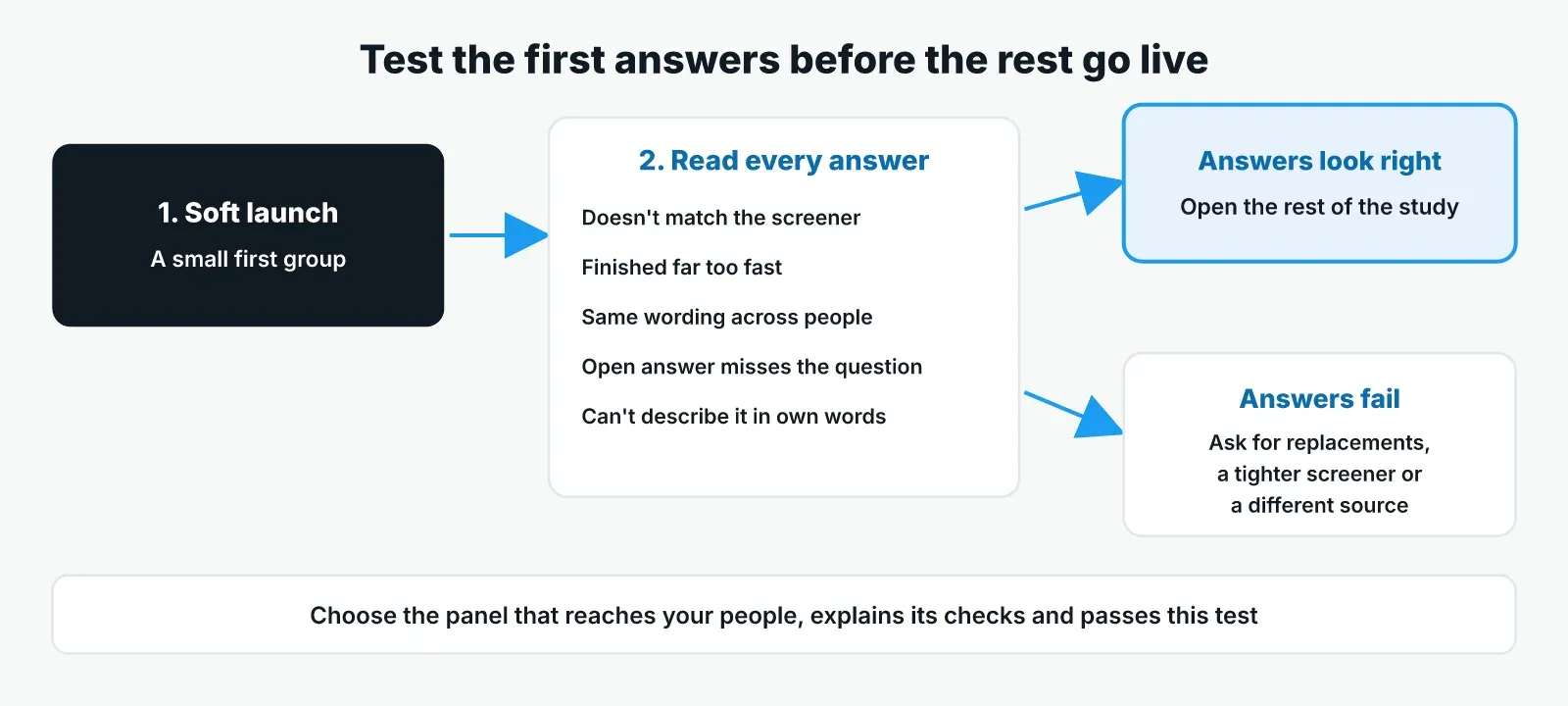
Even a good panel can send a few wrong people. So run a soft launch. That means you open the study to a small first group. Then you read every answer before the rest go live. It costs a day and can save the whole study.
In the first answers, look for these signs:
If the first answers fail, go back to the provider. Ask for new people, a tighter screener, or a new source for the country that's behind.
So the school meal team can choose with one rule. Pick the panel that can reach packed-lunch parents in both countries, explains how it checks them, and passes the soft launch. Size and price come after that.
Finding parents in two new countries, and checking they're real, often means juggling several suppliers. With Pulse, you can have participants recruited to the profile in your brief from more than 200 million people globally. Every participant goes through fraud checks, and Pulse handles participant incentives. You can also upload your own customers to the same study.
AI-moderated interviews and surveys run in the same study. And one study can run across several markets from one brief. So parents in both countries answer the same questions.
Your team still writes the screener and decides who counts. To try it on your own study, book a demo, start on the $0 Explorer plan, or ask for a free study.
Some panels supply people for interviews as well as surveys, so ask before you buy. Interviews need people who will talk for longer, and the reward is often higher. Use the same screener for both parts. Then the people in your interviews match the people in your survey.
If the people are your customers, invite them from your own list, because you can reach them today. If they aren't, a panel with a short screener is often the fastest route. Interviews that people take on their own time, by opening a link, also save the days spent booking calls.
It depends on the provider. Some put the reward in their price and pay members themselves. Others expect you to pay people. Ask each one to say which in writing. That way, two quotes that look alike don't hide different costs.
The three types of participant recruitment, active, passive and third-party, explained simply, with who each one reaches and who it misses.
Participant recruitment in qualitative research, made simple: find people who can explain what happened, screen them, get consent and check the list.
Participant recruitment methods compared by who you need: your own list, panels, referrals, networks and recruiters, plus a check before you set a date.