
How to use affinity mapping for user interviews
How to use affinity mapping for user interviews: one idea per note, sort by meaning, count people not notes, and check themes against quotes.
Persona research methods compared: what interviews, surveys, analytics and customer data each add to a persona, and how to pick the right mix.
Personas are on your list this week. You work at a fitness tracker maker company. The product team is planning a new tracker. Before they choose what goes in it, they want personas. You have website data, an old list of customer groups, and time for a bit of new research. So which research should you do?
Persona research methods are the ways you find out what goes into a persona. A persona is a short, made-up profile of a typical customer.
Each method fills only some parts of it. If you want to know what customers want and what gets in their way, talk to them in interviews. If you want to know how many customers fit each persona, count them with a survey.
So start with a plain list: the parts your persona needs, and the method that fills each one.
You can't fill a whole persona from one source. So it helps to know what each method is good at.
There are six common persona research methods. They are interviews, observation, diary studies, surveys, product analytics, and data your company already has. That last one means your support tickets and your customer records, often kept in a tool called a CRM.
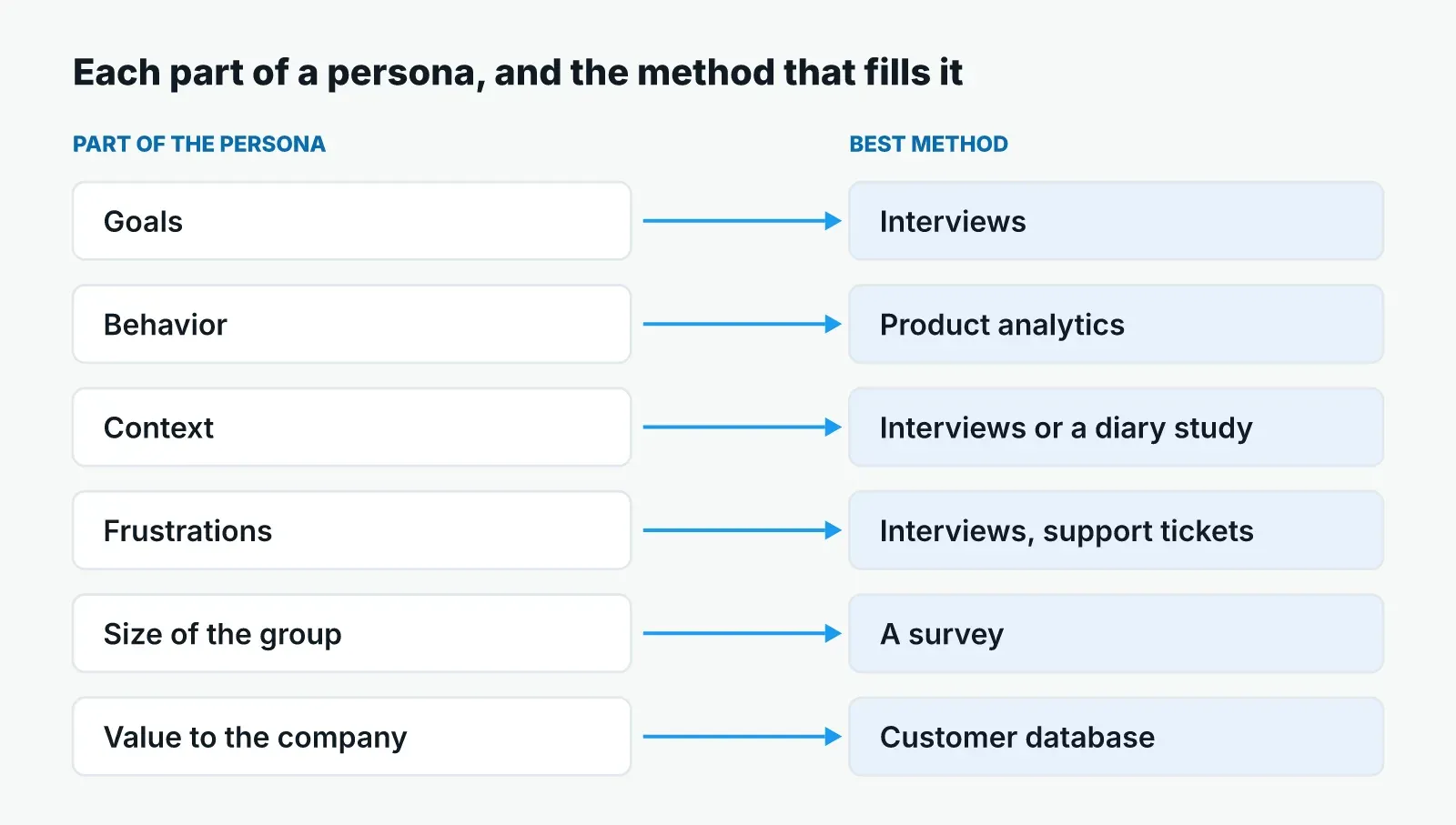
Most personas have the same few parts. They are goals, behavior, context, pain points, and the size of the group. This table matches each part to the method that fills it best, plus a backup.
Part of the persona | Best method | Backup method |
|---|---|---|
Goals: what the customer wants to get done | One-to-one interviews | Open questions in a survey |
Behavior: what they do and how often | Product analytics (usage data) | Usage questions in a survey |
Context: where, when and with whom | Interviews or watching people | A diary study |
Pain points and workarounds | Interviews | Support tickets and reviews |
Size: how many customers are like this | A survey | Counts from your customer records |
Value: what the group is worth to the company | Your customer records | Spending questions in a survey |
Personas should rest on research with real users. Nielsen Norman Group, a research company, says so in its guide to personas. Without that, a persona doesn't show a product's real users.
Say the old customer groups at the fitness tracker maker include one called "serious runners". It gives their age and how much they spend. But it says nothing about why they bought a tracker. And that's the part the product team cares about most.
A part with no method behind it is a guess, so label it as one.
Interviews tell you why people do things. Numbers tell you how many people do them. A good persona needs both.
Qualitative research uses words, like interviews and watching people. Quantitative research uses numbers, like usage data and surveys. Each kind makes the other sharper. So run them in this order.
Your usage data shows who wears the tracker every day. It shows who stopped after a few weeks, and who only opens the sleep screen. That tells you what people do, but not why. So use it to pick who to talk to.
Interviews fill the parts no chart can show. Ask about the last time something happened. A real story is easier to recall than a habit. For example: "Tell me about the last time you checked your sleep score. What did you hope to find out?"
Listen for the words people use and the tricks they come up with. Writing the interview guide first keeps each group's talks easy to compare. It also helps you avoid bias in persona interviews, such as talking only to fans.
How many talks each group needs is a judgment call. Keep going until new ones stop adding new goals or pain points. Check after each batch.
Some habits are hard to remember. A diary study asks people to note what they do over several days, close to the moment it happens. Someone may say they wear the tracker every night. But their diary shows it sits on the charger twice a week.
Sizing a persona means counting how many customers are like it. Once interviews suggest a few personas, send a short survey to lots of customers. It shows how big each persona is. It also shows if the traits really go together the way the talks said.
The old customer groups are a fine place to start. A group says who the customers are. A persona says how the people in it think and act.
Say the usage data shows that people who sync every day use the tracker most. But in interviews, they're the least happy. They worry the battery will die overnight. Keep both findings in the persona, and note which source said what. An average of the two would describe a customer who doesn't exist.
Research says AI-generated personas read well, but they can't stand in for real customers. An AI tool can write a persona in seconds. But reading well and matching your customers are two different things. So use an AI persona as a draft. Treat it as a list of guesses to check, or a start for your interview questions. Then let real customers fill each part.
In a January 2025 study, researchers compared ten personas written by experts with ten written by AI. People in the survey found the AI ones clearer and more informative. But they also saw that the AI ones leaned on stereotypes.
A 2025 analysis looked at 83 prompts from 27 research papers that used AI to write personas. It found that 74% of the prompts insert data into the request. So even researchers who use AI start from data. And that data still has to come from real customers.
The right mix depends on two things. One is the decision the personas must help with. The other is the time you have. Write the decision down first. Then fill the persona parts it needs. Parts the decision doesn't touch can wait, as long as the persona marks them as guesses.
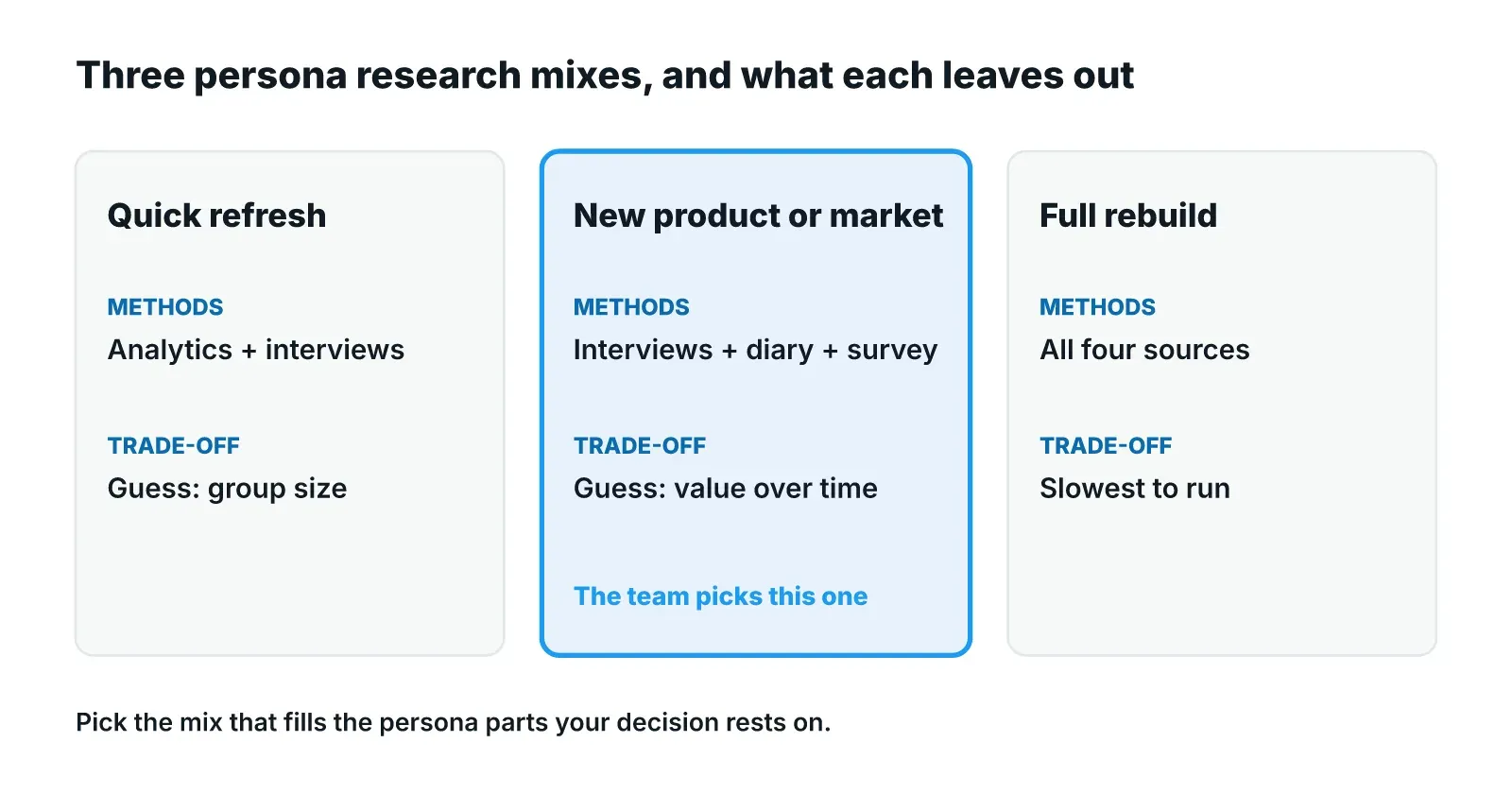
Say the product team must choose what to put first in the new tracker. The choices are a longer battery, better sleep tracking, or coaching in the phone app. So they need to know which customers matter for that choice, and what each group needs. This table shows three mixes they could run.
Mix | Methods | What it tells you | What stays a guess |
|---|---|---|---|
Quick refresh | Usage data and interviews with current customers | Goals and pain points of known groups | How big each group is |
New product or market | Interviews, a diary study and a survey | Reasons, routines and group size | What each group is worth over time |
Full rebuild | Usage data, interviews, a survey and the customer records | Every part of the persona | Little, but it takes the longest |
The battery or sleep choice depends on what customers do at night. It also depends on how many of them care. The quick refresh would leave group size as a guess, and the decision rests on it. So the team picks the middle mix. It reads value from the customer records it has.
A research plan the team agrees on records which methods you cut, and which parts stay guesses.
If your decision needs reasons, interview first. If it needs group sizes, add a survey. If it needs both, run both before anyone writes a persona.
Most personas get two parts wrong: the reasons behind what people do, and the size of each group. Teams often get them from two separate studies.
Pulse runs AI-moderated voice interviews and surveys in the same study, so the reasons and the numbers arrive together. The AI moderator asks a second question when an answer is vague. Themes come with the quotes behind them, and every quote links to its transcript. So each part of a persona can point at its proof.
Past studies stay searchable in the insight repository. So your team can check what customers already said first. To see a persona study set up this way, book a demo, start on the $0 Explorer plan, or ask for a free study.
Activating personas means getting everyone with a stake in the decision to use them. At the tracker maker, that's the product team, the designers and the support team. Share the personas in a short meeting. Say which parts rest on research and which are guesses. Then ask each person to test a real decision against them.
After that, keep the personas where the team plans its work, and bring them into each design review. A persona nobody opens can't change a choice.
Teams often sort personas by how much research is behind them. A proto-persona is a quick draft of what the team already thinks. A qualitative persona comes from interviews and watching people. A statistical persona is also checked against survey or customer data. That tells you how big each group is.
UX personas describe how people use a product: their goals, their routines, and the moments where they get stuck. Marketing personas are different. They describe how people buy: where they hear about products, what wins them over, and what they compare. Both can come from the same interviews. But each asks different questions of them.
Update them when something they rest on changes. That could be a new product, a new market, a price change, or a shift in who signs up. In between, check them against fresh usage data and support tickets. Then research again any part the numbers drift away from.
You can build part of one. Usage data and your customer records can fill behavior, size and value without a new study. They can't fill goals, context or pain points, because those live in what customers say. A persona built only from data you have is just a customer group with a name.
How to use affinity mapping for user interviews: one idea per note, sort by meaning, count people not notes, and check themes against quotes.
What synthetic data in market research is, how accurate synthetic answers are in published tests, and 7 questions to ask a vendor before you buy.
How to measure brand equity: the four parts to ask about, a price question, the same questions for two rivals, and interviews that explain the score.