How to use affinity mapping for user interviews
How to use affinity mapping for user interviews: one idea per note, sort by meaning, count people not notes, and check themes against quotes.
How to measure brand equity: the four parts to ask about, a price question, the same questions for two rivals, and interviews that explain the score.
"Would people still come to us if a coffee cost a bit more?" Your manager asks you this after a meeting with finance. You work on the marketing team at a coffee chain. The cost of beans and milk keeps going up, so the company wants to raise prices. But there's a café on almost every corner. So how much is your name worth to the people who buy from you?
That worth is called brand equity. Brand equity is the extra choice and the extra price a name earns over a plain product that does the same job.
To measure it, ask the same short questions about your brand and two rivals. Cover four parts: awareness, quality, what people link to the name, and loyalty. Then add one price question. Interviews tell you why people would or wouldn't pay more.
Six steps take you from your manager's question to an answer the company can use.
Brand equity measures how much more often people pick a product, and how much more they'll pay, because of its name. Most guides split it into four parts. Together they show whether people know the name, trust it, link good things to it and come back to it.
In the coffee study, a person might know your name, think the coffee is fine, link it to quick mornings and still drift to the café next door. Each part shows a different reason why.
There are two kinds of brand equity, and it helps to know which one you're measuring. Customer-based brand equity is what people think and do. Brand value is a money estimate of what a name is worth to the company that owns it.
Valuation firms publish brand value rankings every year. In its 2025 ranking, Kantar BrandZ put the total value of the world's top 100 brands at $10.7 trillion, up 29% in a year. The same report put Apple first for the fourth year, at $1.3 trillion.
Those numbers come from financial models, so your team can't copy them or compare against them. This guide covers the first kind, which you can measure with your own customers and your rivals' customers.
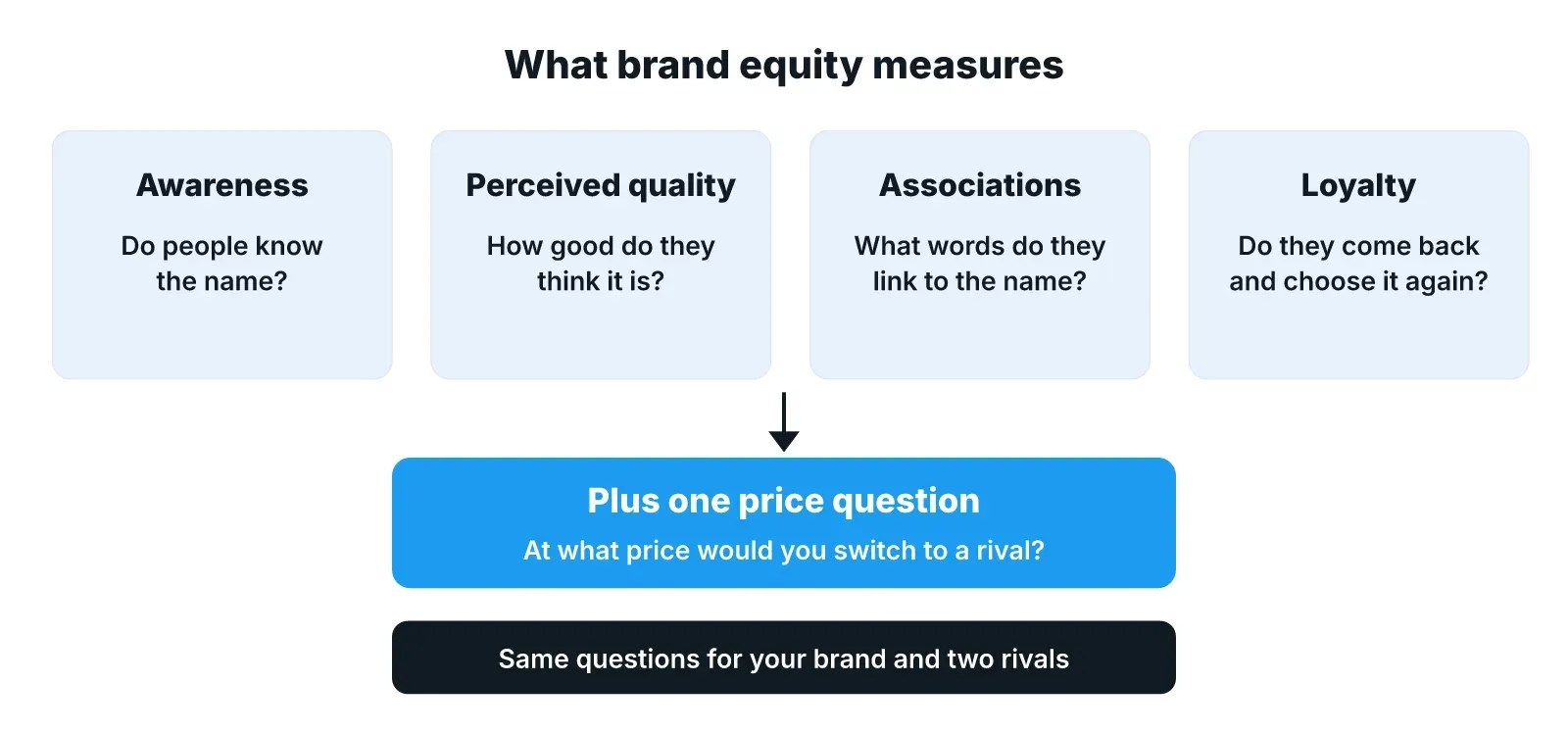
To measure brand equity, start from the decision the number must inform. Then ask people who buy in your category the same short questions about your brand and two rivals. Add a price question, explain the answers with interviews and repeat the questions later. That gives you a number and the reasons behind it.
Brand equity is only useful when it answers a real choice. In the coffee study, the choice is whether the name can carry a higher price. Other teams ask whether to spend more on ads, or whether a new product can use the same name. Write the decision at the top of the plan, so every question has to earn its place.
Ask people who buy coffee out, wherever they buy it. If you only ask your own customers, you'll mostly hear from fans. Your rivals' customers show what your name means to people who chose someone else. They're the people a price rise could win or lose.
Ask the same short questions about your brand and two rivals. A score on its own means little. A quality score only tells you something next to the score for the café down the street. Mix up the order of the brands, so yours doesn't always come first and get a boost.
The price question gives you the money answer. Ask people at what price they would switch from their usual coffee to a rival. The share of people who'd stay at a higher price shows how much price the name can carry. Multiply that share by the price gap, and you get a rough idea of what the name earns for that product.
A survey gives you the score. Interviews give you the words behind it. Talk with a smaller group of people from the survey. Ask what comes to mind when they think of the name, and why they would or wouldn't pay more.
One measurement is a snapshot. Repeat the same questions on a schedule, such as every few months or around a big launch. If you change the wording, you can't compare the results, so keep it the same. Then a drop or a rise shows up against your first result. The guide to brand health metrics covers which numbers to watch over time.
A brand equity survey asks a few short questions for each of the four parts, plus the price question. Ask every question about your brand and two rivals in the same way. Keep it short enough to finish on a phone in a few minutes, or people stop paying attention.
For awareness, there are two kinds of question. Unaided means you give no hint. Aided means you show a list of names. Here are plain questions for the coffee study:
For wider question sets, see these brand market research methods.
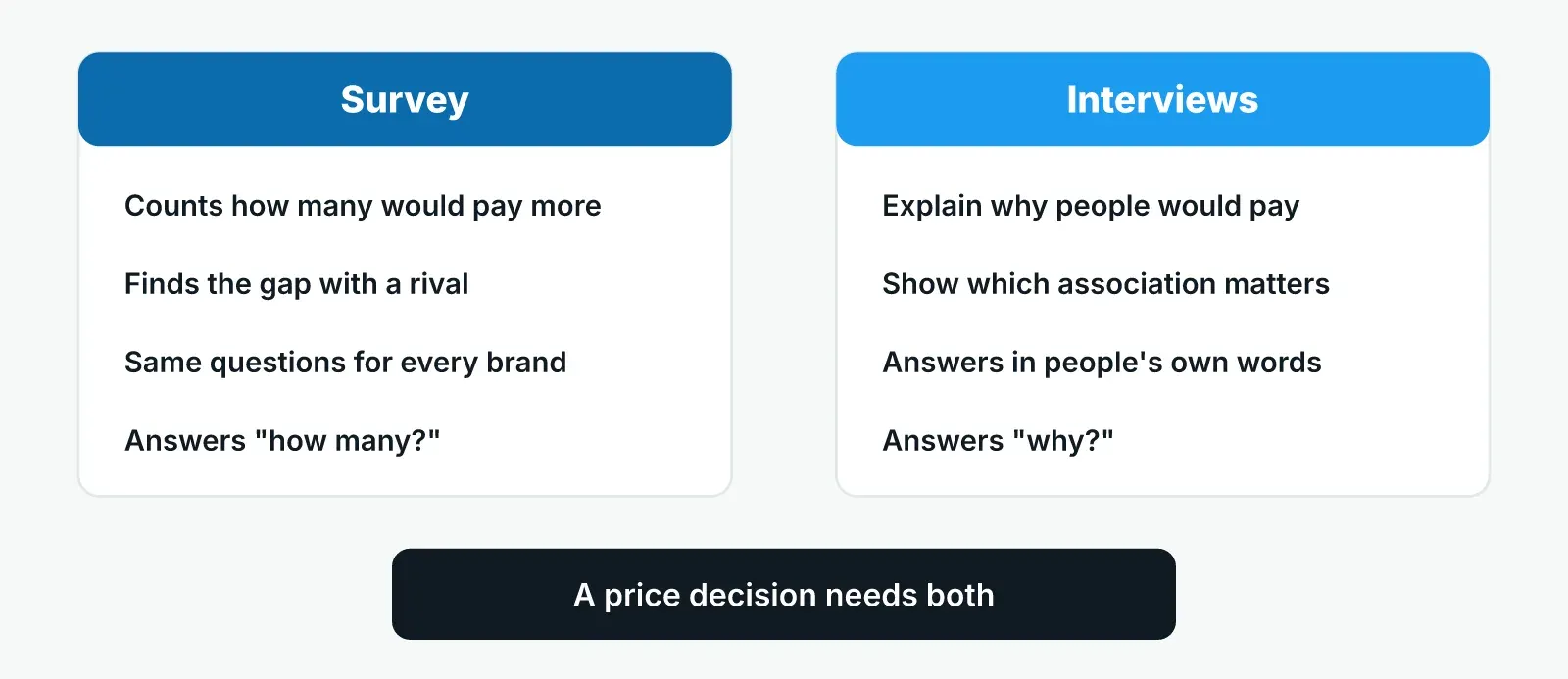
Use a survey to count how many people would pay more, and interviews to learn why. The survey finds the gap between you and a rival. Interviews show which association does the work. Run the survey first and the interviews second, or run both in one study.
Say the survey shows your regular customers would pay a bit more, while the café down the street's customers wouldn't. That's the gap. Interviews might then show the regulars come for staff who remember their order. If so, the ads should show the staff, and a new logo would change little.
A survey answer like "good quality" is hard to act on. In an interview, someone can say what good quality means to them: hot milk, a lid that doesn't leak, a short wait. Those are things your team can change.
So here is the rule. If you need to know how many, run the survey. If you need to know why, run interviews. For a price decision, you need both.
Pulse runs surveys alongside AI-moderated interviews in the same study. So the brand equity score and the reasons behind it arrive together. In the coffee study, the same people can answer the price question and then explain their answer out loud.
The AI moderator asks a second question when an answer is vague, such as "good coffee". Tone analysis on voice answers shows how strongly people feel about the name. Then Pulse groups what people said into themes, with the quotes behind each one and every quote linked to its transcript.
Trackers repeat a study's questions wave after wave, so a change shows against the first result.
To see it on your own study, book a demo, start on the $0 Explorer plan, or ask for a free study.
Brand loyalty is one part of brand equity. It's about people coming back and buying again. Brand equity is wider. It also covers whether people know the name, how good they think it is and what they link to it. A brand can have loyal fans and still be unknown to most buyers.
Pick a schedule that fits your decisions, such as every quarter, or before and after a launch or price change. What matters most is asking the same questions each time. Then the results compare, and you can tell a real change from a change in wording.
Yes. B2B means a business that sells to other businesses. The steps are the same: ask buyers in your category the same questions about your brand and two rivals. Business buyers can be harder to reach, so a few deep interviews can carry more of the weight.
No. Brand equity is what people think and do because of a name. Brand value is a money estimate of what the name is worth to its owner, made with financial models. The two are linked, but you measure them in different ways and with different data.
How to use affinity mapping for user interviews: one idea per note, sort by meaning, count people not notes, and check themes against quotes.
What synthetic data in market research is, how accurate synthetic answers are in published tests, and 7 questions to ask a vendor before you buy.
Persona research methods compared: what interviews, surveys, analytics and customer data each add to a persona, and how to pick the right mix.