
How to use affinity mapping for user interviews
How to use affinity mapping for user interviews: one idea per note, sort by meaning, count people not notes, and check themes against quotes.
What synthetic data in market research is, how accurate synthetic answers are in published tests, and 7 questions to ask a vendor before you buy.
Your brand director just watched a sales demo. You work on the research team at a pet food company. In the demo, made-up dog owners filled in a survey about a new treat. The answers came back in minutes. Now she asks you a fair question. Why does the team still need a longer study with real pet owners?
Those made-up dog owners are synthetic data. In market research, synthetic data means answers written by an AI model, not given by real people.
Synthetic answers can help you sort early ideas. But published tests show they often sound right without being right. So judge a vendor by the evidence behind its answers. Ask what the data was built from, what it was checked against, and how accurate it is for each question.
Seven questions will help you find out before the treat decision rests on it.
Synthetic data in market research is a set of answers written by an AI model instead of by people. The model is a large language model. That's the kind of AI behind chat tools. A vendor gives it a short profile, such as "a dog owner in her thirties". Then it asks the model to answer the way that person might.
Vendors sell this in three main forms:
All three come from the same kind of model. Some vendors tune the model on real survey answers first. Tuning means training the model a little more on one set of data, so it copies that data's patterns.
In the treat demo, the brand director saw synthetic respondents. Each one was a made-up dog owner filling in a concept test. A concept test shows people a new idea and asks how they feel about it. The synthetic shoppers finished it in about ten minutes. The real study with dog owners takes two weeks.
It depends on the question. Published studies point both ways. Synthetic answers can match real opinion closely on some questions. But they are easy to tell apart from real answers, and they are less spread out. So a good average can hide weak answers underneath.
Start with the bad news. In a 2026 audit posted on arXiv, researchers compared 37 AI models with real survey answers from 263 employees in Lithuania. A simple computer test could tell the AI answers apart from the human ones almost every time. Its typical score was 0.99, where 1 means it never got it wrong.
The same 2026 audit of 263 employees found the AI answers were squeezed together. Each real person's answers spread out by 1.19 points on average. The AI answers spread out by only 0.79 points. In plain words, the AI answers varied less than real people's did.
That 2026 audit also checked whether the answers hung together the way real ones do. The best AI model scored 0.81. A plain math formula, built only from other people's answers, scored 0.82. The real answers of the same 100 people scored 0.89. So the best AI did no better than a simple formula.
A second 2026 study on arXiv tested four AI models on two big public surveys. One was the General Social Survey of US attitudes. The other was the World Values Survey. It asks about values in many countries. In that 2026 study, on the World Values Survey, every model was 11 to 22 percentage points less accurate than a simple baseline. A baseline is a plain method built from real answers. You measure the AI against it.
Now the good news. A 2025 study from Chile created 189,696 synthetic profiles and compared them with a real public opinion survey. On questions about trust, the synthetic answers scored above 0.90 for accuracy, where 1 is perfect. But the same study found accuracy changed a lot from one question to the next.
So here is the honest answer for the brand director. Synthetic data can be close on some questions and far off on others. A demo won't show you which ones.
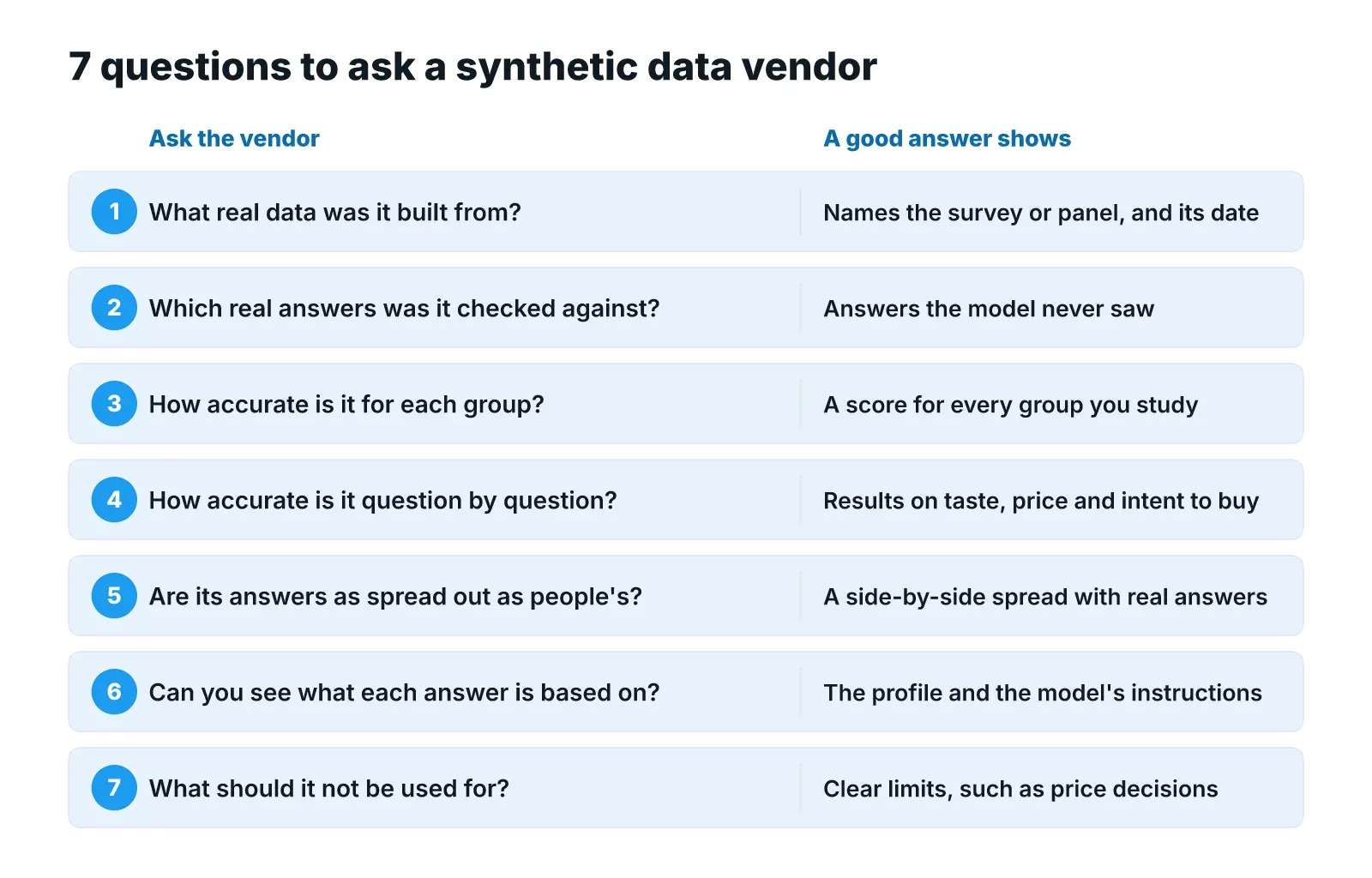
Ask questions that make the vendor show its evidence. A good vendor answers with test results on real people. A weak one answers with a polished demo. The seven questions below work with any vendor, so this guide names none. Each comes with what a good answer sounds like for the treat test.
A good answer names the real survey or panel behind the model, and how recent it is. A weak answer is "the model knows consumers", with no source and no date.
A good vendor tests its answers against real answers the model never saw. That is the only fair test, like a school exam with questions the student hasn't seen. A weak answer checks the model against the same data it learned from.
An average across everyone can look fine while one group is far off. Ask for accuracy for each group in your study, such as owners of puppies and owners of older dogs. If the vendor can only give one number, treat that as a warning.
The Chile study showed accuracy can swing from item to item. So ask for results on questions like yours: taste, price and intent to buy. A good vendor shows which kinds of questions it handles well and which it doesn't.
Real people disagree. Some love a treat and some hate it. Ask the vendor to show how spread out its answers are next to real ones. If every made-up owner lands near the middle, the data will hide the strong reactions you need to see.
You should be able to see the profile behind each answer and the instructions given to the model. Without that, nobody on your team can check why the panel said what it said.
A trustworthy vendor will tell you where its data is weak. Listen for clear limits, such as new groups or price decisions. A vendor that says "anything" hasn't tested its own limits.
Before you sign, ask for a side-by-side test. Pick five questions from your own treat concept test. Run them with the vendor's synthetic panel and with real dog owners. Then compare the answers question by question.
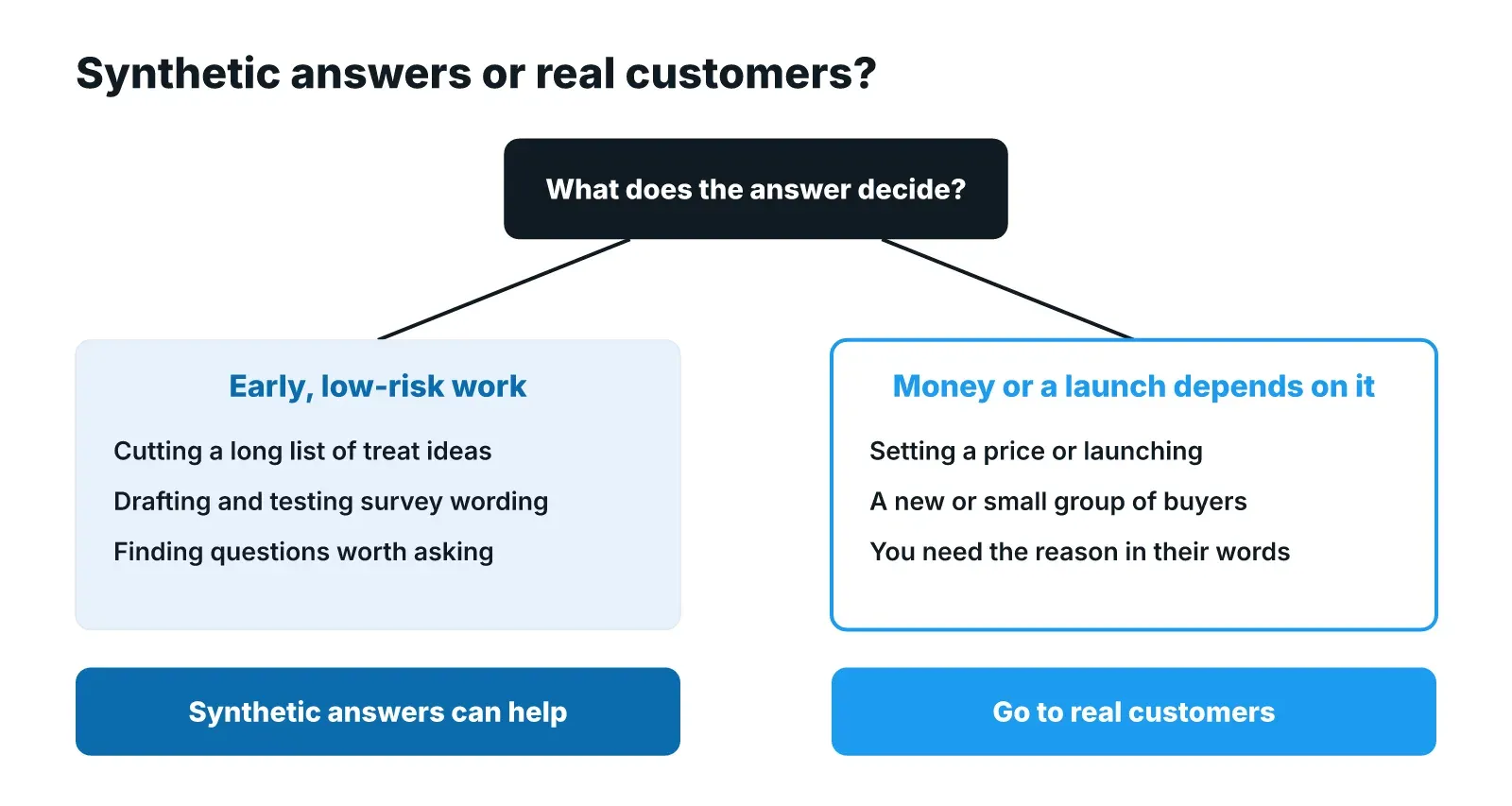
Use real customers when money, a launch or a new group of buyers depends on the answer. Synthetic answers are useful early on. They can help you cut a long list of ideas, draft a survey or find questions worth asking. But they can't tell you why a real person picked one treat over another.
Go to real customers in three cases:
You can also use the two together. Let synthetic answers suggest ideas. Then test those ideas with real interviews and surveys. The post on synthetic respondents vs real customers explains where AI personas help and where they mislead.
So the research team can give the brand director a plain rule. Use the synthetic panel to cut ten treat ideas down to three. Then run the study with real dog owners before anyone decides to launch.
That last step needs real customers, and that is where Pulse runs AI-moderated interviews. You write one interview guide, and many interviews run at the same time. The AI moderator asks follow-up questions that build on what each person said. When an answer is vague, it asks again.
You can recruit from more than 200 million people worldwide, or invite your own customers. Surveys can run in the same study, so the counts and the reasons come back together. Then the platform groups what people said into themes. Each theme shows its quotes, and every quote links to its transcript. Every answer in a Pulse study comes from a real person, never from a synthetic respondent or AI persona. So your team has real answers to set beside any synthetic panel.
To see it on your own question, book a demo, start on the $0 Explorer plan, or ask for a free study.
Synthetic data is the wider term. It covers any answers or records an AI model makes up. A synthetic persona is one kind of it: a made-up customer with a name, a background and opinions that you can question. So every persona is synthetic data, but not all synthetic data comes as a persona.
Not for decisions that matter. The 2026 Lithuanian audit concluded that AI answers are not a drop-in replacement for real survey data. A panel of real people still gives you the spread of opinions and the surprises.
Keep them apart. Label each chart and quote with where it came from: the synthetic panel or real customers. If you blend them into one number, nobody can tell how much of it real dog owners said.
How to use affinity mapping for user interviews: one idea per note, sort by meaning, count people not notes, and check themes against quotes.
How to measure brand equity: the four parts to ask about, a price question, the same questions for two rivals, and interviews that explain the score.
Persona research methods compared: what interviews, surveys, analytics and customer data each add to a persona, and how to pick the right mix.