When a concept test says yes and the launch still fails
Concept test results overstate demand when a yes costs the respondent nothing. How to read them, what to check before launch, and what to ask after.
B2B customer research stalls when senior buyers ignore the ask. How to get the introduction, what to offer, how long to ask for and what to ask.
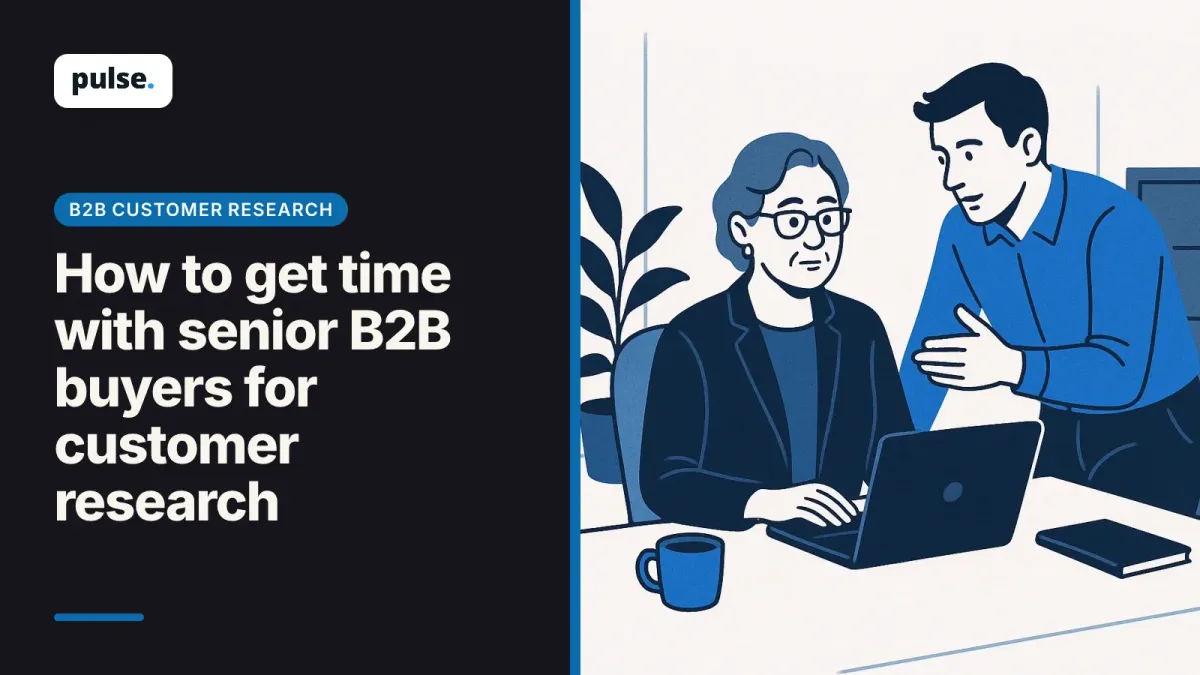
You email a senior buyer at one of your biggest customers. You're a stranger, you ask for an hour, and you offer a gift card. Then nothing happens.
B2B customer research gets a yes when you change the ask. Send it through someone the buyer trusts, keep the time short, and give back something they value.
A senior buyer is the executive who signed off the budget, such as a head of finance. Most customers have only one or two, so each no costs you the only first-hand account of why the money moved. Here's when they're worth chasing, how to ask, and what to ask once they agree.
Here's the short version:
Senior buyers ignore research requests because the ask costs them time, offers little back and comes from a stranger. You can fix each one before you hit send.
Think of an executive's inbox as a front desk with a polite but firm receptionist. Your email fails there in three ways:
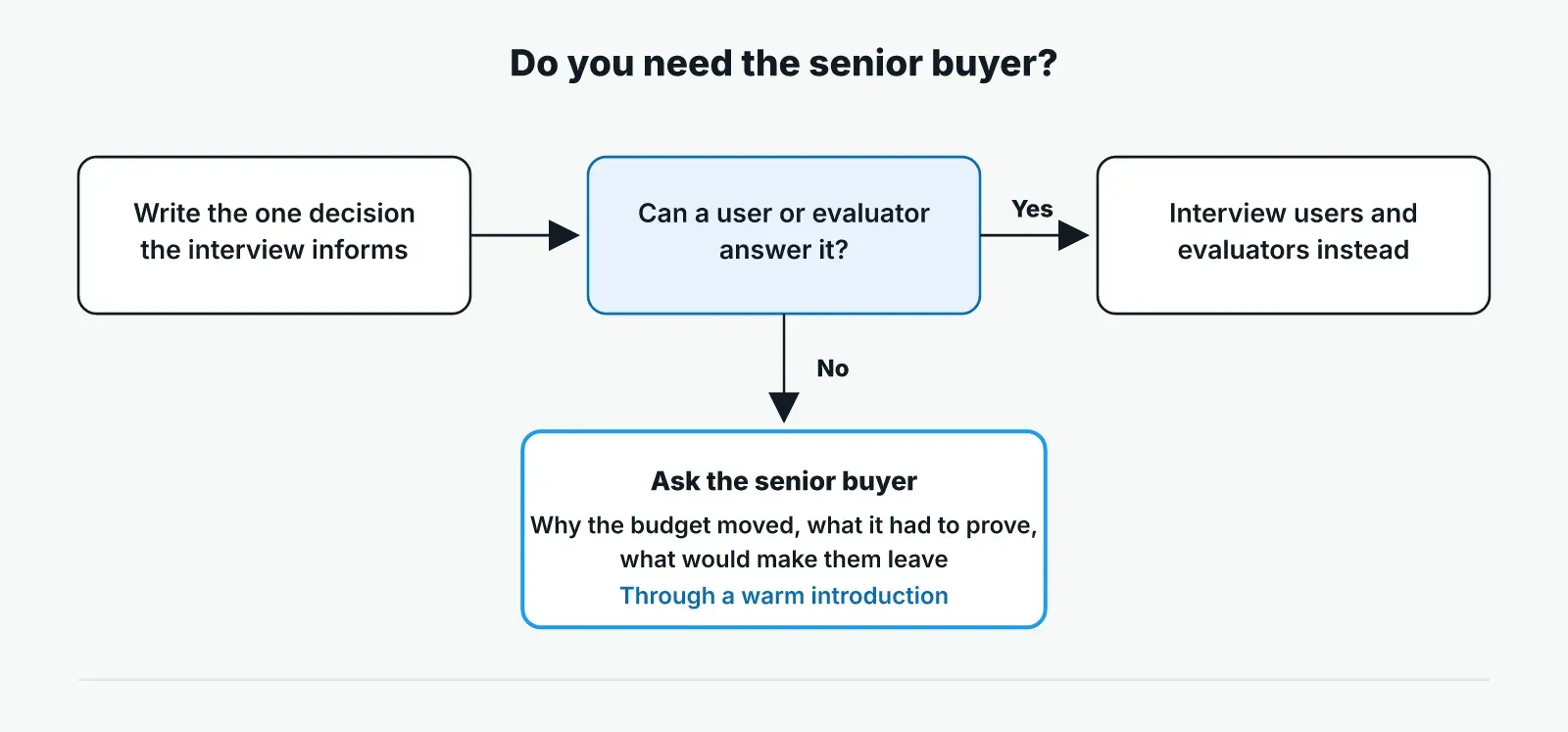
You need the senior buyer only for questions nobody else at the customer can answer. Why did the budget move? What did the purchase have to prove inside the company? What would make them leave? Daily work and ease of use belong to evaluators and users instead.
Evaluators tested the product before the purchase, and users work with it every day. Both are easier to reach and know the product better.
Try a quick test. Write down the one decision the interview has to inform, such as "whether to add reporting to the enterprise plan." If a team lead could answer it, talk to the team lead. If only the person who signed can, that sentence opens your request.
When you do need the senior buyer, these five questions walk through the purchase:
In the session, chase thin answers instead of racing down your list:
For more follow-ups like that, see these interview questions that open up a thin answer.
Getting a yes comes down to three changes: who sends the ask, how much time it takes and what the buyer gets back. Two more steps keep you out of trouble.
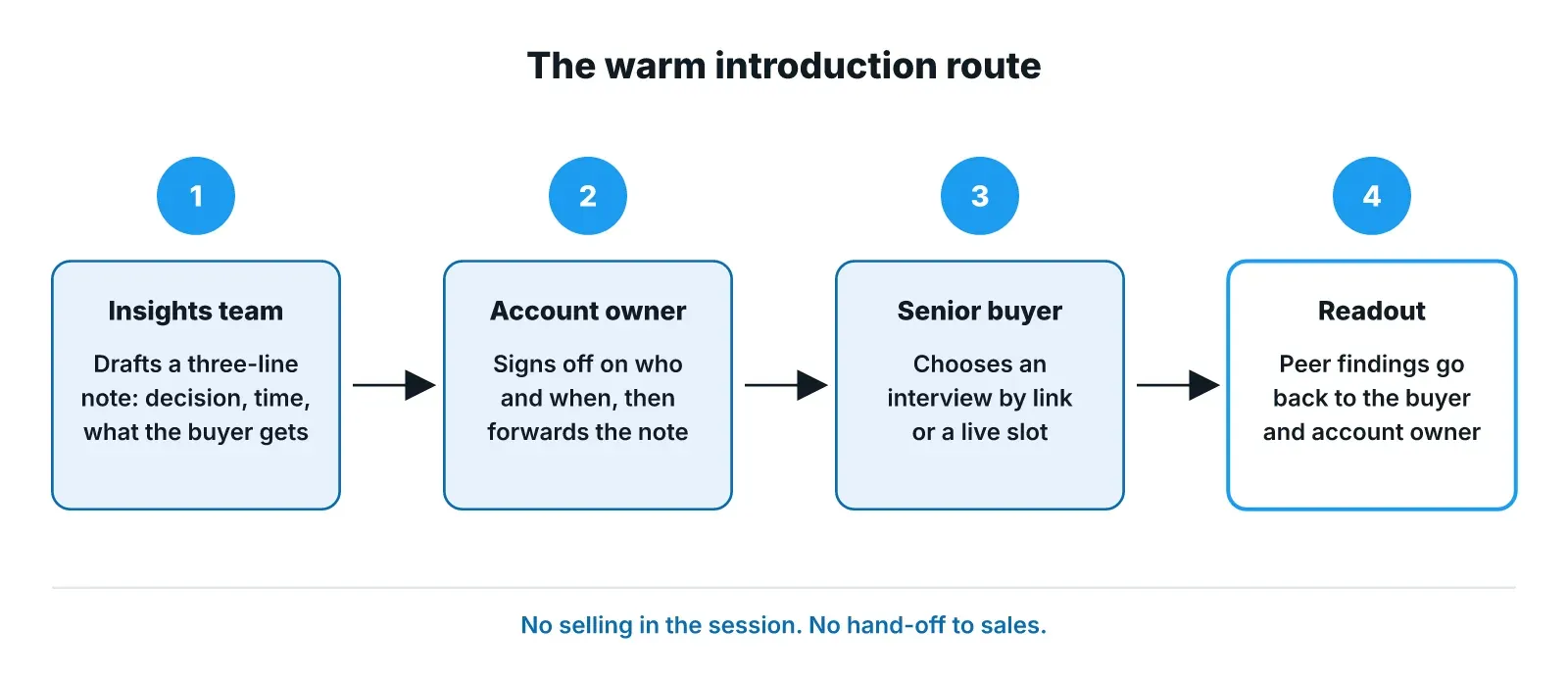
A note from someone the buyer already works with gets opened. A cold email from your research team usually doesn't. Think of a friend introducing you at a party versus a stranger with a clipboard.
That person is usually the account manager, the customer success lead or the executive sponsor, the senior leader on your side paired with that customer. They know what the buyer cares about now, and whether this is a bad month to ask.
Give them a three-line note they can forward as it is. Say what you're deciding, how much time you need, and what the buyer gets back. Here's the difference:
In a large company, several people own a piece of each customer relationship. Any of them can stop your study if they hear about it late. So settle these points before the first email:
Calendar time is the scarcest thing a senior buyer can give you. An interview that runs over makes the next one harder to get, so ask for a short, fixed slot and finish on time.
Better still, offer an asynchronous interview, one the buyer takes whenever suits them, with no call to book. An AI moderator, software that asks the questions by voice, can follow up when an answer is thin. The three formats compare like this:
| Live video call | AI-moderated interview by link | Short survey | |
|---|---|---|---|
| Cost to the buyer | A booked slot that moves with meetings | Their own time, when they choose | A few minutes |
| Follow-up on a thin answer | Yes, from the interviewer | Yes, from the AI moderator | None |
| Scheduling for your team | Assistants, time zones, rebooking | One link | One link |
| What you get back | Recording and notes | Transcript and recording | Counts and short typed answers |
Steer clear of quarter-end and budget season, when calendars are fullest. Offer a live slot beside the link, since some executives would rather talk to a person.
The best return is information the buyer can't get anywhere else. A readout works well: a short summary of what their peers said, sent by a date you promise up front.
A gift card means little at that level, and some company and public-sector rules ban cash outright. Check the policy first. Where cash is off the table, offer a charity donation in the buyer's name. Early sight of a decision they shaped also works, as does a seat on a customer advisory group, a small panel of customers the company consults.
Payment for taking part is called an incentive, and the right amount varies by audience, seniority and market. Where cash is allowed, the incentive calculator gives a starting figure to agree with procurement. Whatever you offer, promise that no quote carries their name without permission.
Prospects are companies you're still selling to, and lost deals are companies that chose someone else. With either, there's no relationship to borrow.
Look for their buyers in your CRM, the system where sales tracks accounts, and in your lost-deal lists. A B2B recruitment panel, a service that finds professionals for research, can help too. So can referrals from buyers you've interviewed.
Run every candidate through a screener, a short set of questions that checks they fit. Screen on their part in the purchase as well as their title. A "head of procurement" makes the call at one firm and does the paperwork at another.
Illustrative example: the insights team at a large payments company has a pricing question. Finance heads at its biggest merchant customers chose or turned down a new settlement product, the service that pays merchants for their sales. Before the next renewals, the team needs to know why, to decide whether to change the price.
Only the finance heads can answer, because they signed off the budget. The team weighs three ways to reach them.
| Cold request from research | Note forwarded by the account manager | Short survey | |
|---|---|---|---|
| Time asked | An hour, no fixed end | A short slot or an asynchronous interview | A few minutes |
| What the buyer gets | A gift card | A readout of what peers said | Nothing specific |
| What it can show | The full story, if they accept | The full story, with follow-ups | How common each reason is |
| What it can't show | Much, if few accept | How common each reason is | Why a reason mattered |
The team picks the forwarded note, since it's the only option with a trusted sender and room for follow-ups. It offers both an interview by link and a live call.
Once the interviews are analyzed, every participant gets a short readout of the main reasons merchants gave. Each reason carries a verbatim quote, the buyer's exact words, traced to its interview. No merchant is named.
The account managers get the readout too, which gives them a reason to call again. The pricing team now has reasons from the people who signed, and a survey can count how many merchants share them.
When a senior buyer gives you a few minutes, you can't afford to lose them to scheduling. Pulse is built for that. Participants take the interview by opening a link on a phone or laptop, so there are no calls to schedule.
Pulse can invite your own customers from a list you upload, or recruit participants to the profile your brief describes. Every participant goes through fraud checks. Each interview arrives as a full transcript alongside its recording, so your readout can quote buyers in their own words.
Here's the rule to take with you. If your question needs the senior buyer, change the sender, the time and the return before you touch a single question. If it doesn't, talk to the evaluator or user, and save the senior ask for something only they can answer.
If you'd like to see a study like this run, book a walkthrough.
B2B customer research draws on a much smaller pool of possible participants than consumer research. Several people share each purchase, and gatekeepers such as assistants sit between you and the buyer. A consumer study can often recruit from a large panel. A B2B study usually needs named people at named companies, so recruiting runs through account relationships.
B2B customer research means talking directly to the people who buy and use a business product, at customer and prospect companies. B2B market research is wider. It also covers market sizing, competitor analysis and published data. Customer research is where you hear the reasons in people's own words.
These customer research methods and examples cover the options.
No single number fits every study. Keep interviewing until new conversations stop changing the themes behind your decision. Researchers call this the saturation point, the moment extra interviews stop teaching you anything new. Also make sure every customer group the decision depends on is in the mix.
Ask why before you look for another way in. The reason is often timing, such as a renewal under way or an open complaint, and waiting a few weeks can fix it. If it's still no, try the executive sponsor on your side. Going around the account owner risks the relationship your study depends on.
Concept test results overstate demand when a yes costs the respondent nothing. How to read them, what to check before launch, and what to ask after.
How do AI interviews work in customer research? Follow one session from screener to follow-up question to a theme traced to its transcript.
Jobs to be done research gets harder when one account has many roles and business units. How to recruit, interview and merge jobs across them.