How to choose an AI assistant for research
Choosing an AI assistant for research? Match it to the evidence your question needs, then test whether every finding opens to the source behind it.
How to write a screener survey that lets the right B2B buyers into your interviews: role checks, hidden criteria, quotas and a test run.
You're on the research team at a company that makes tablets for classrooms. In an interview, a teacher tells you she never helped her school choose tablets. She only tried one at a teacher fair. So how do you keep people like her out of your next study?
You use a screener survey. A screener survey is a short quiz people answer before an interview, so you only talk to the right people.
Write it from your research brief, the plan that says who you need. Turn each rule into a question about what people did. Hide the answer you want among other choices. And ask about tasks at work instead of job titles.
That's how to write a screener survey for a B2B study, where one company sells to another. The first step comes before you write a single question.
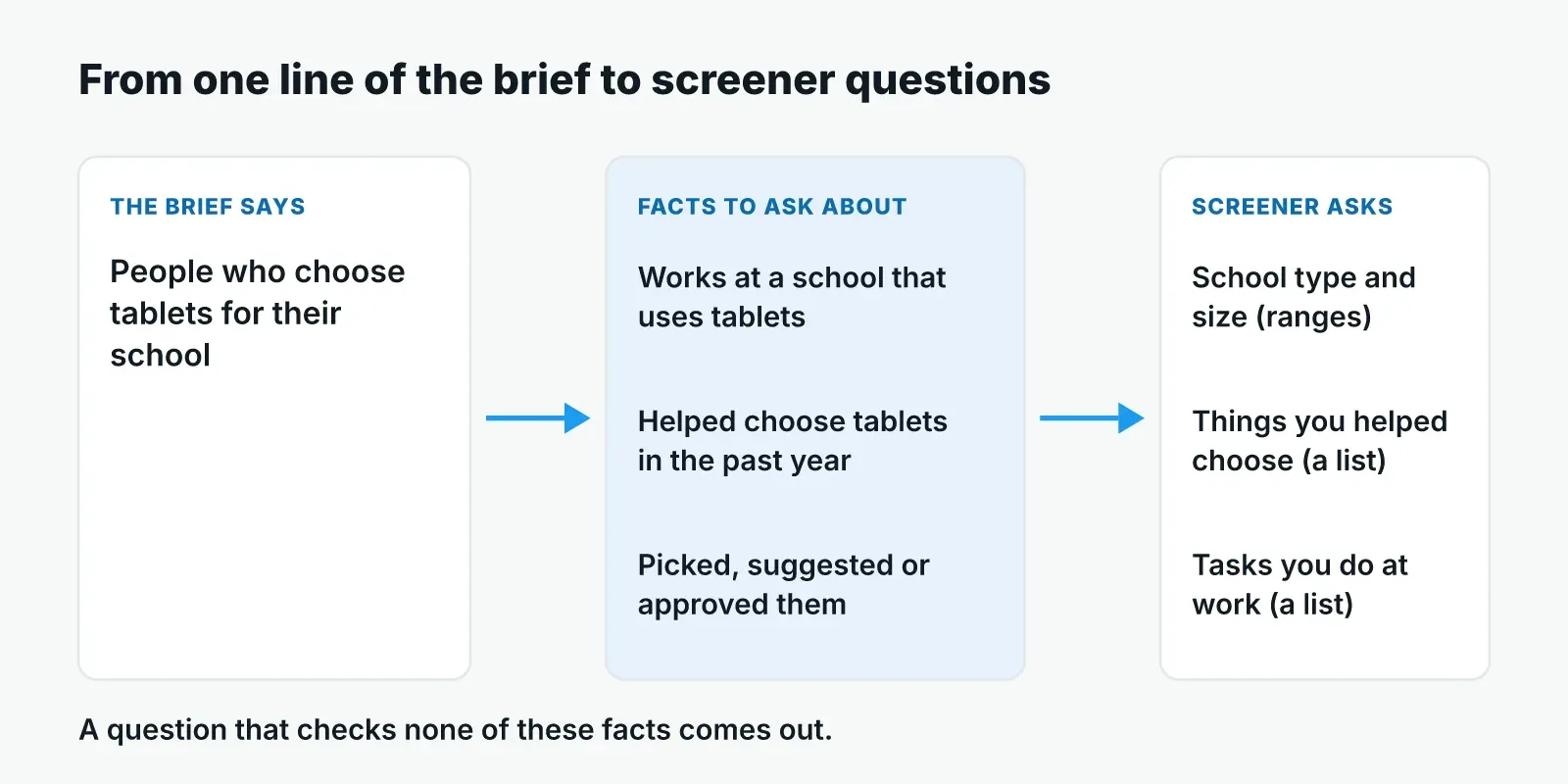
Your brief says you need "people who choose tablets for their school." That's a goal, and nobody can answer a goal. So your first job is to turn it into simple facts people can tell you about their own work.
Remember what a screener does. It decides who gets invited to your study. So each screener question should match one rule in the research brief. If a question doesn't check a rule, it doesn't belong.
For the tablet study, "people who choose tablets" breaks into three facts you can ask about:
If a draft question doesn't check one of these facts, cut it. That keeps the screener short. It also leaves fewer clues about the answer you want.
Say the sales team wants to hear from big schools. The product team wants small ones. And a team in another country wants schools from its own market. If these wishes show up after the screener is live, you get a few of each and not enough of any.
So agree the groups before you write. Then give each group a quota. A quota is the smallest number of interviews you need from one group.
Set a minimum for each group, instead of an exact share of the total. An interview study explains why people choose things. It doesn't measure how common each group is, so exact shares don't help.
In the tablet study, each group gets its own sorting question and its own minimum. That way, everyone who passes lands in one group.
| Group | Question that sorts them | Minimum interviews |
|---|---|---|
| Big schools | How many students are at your school? Asked in ranges | 6 |
| Small schools | The same question, smaller ranges | 6 |
| Current customers | Which tablet brand does your school use now? | 5 |
| Schools that chose another brand | The same question, a different answer | 5 |
| Schools in a second country | Which country is your school in? Asked early | 5 |
These numbers are made up for the example. Write your own minimum in each row before the screener goes live.
Choosing people because they fit what you need to learn is called purposive sampling. This guide to purposive sampling for B2B interviews shows how to explain those choices to your team.
At one school, the person who picks tablets is the head of IT. At another, it's a senior teacher. At a small school, it might be the principal. So a job title question lets the wrong people in. It also keeps some of the right ones out.
Ask what the person does at work instead. A task means the same thing at every school, but a title doesn't.
Say you give people a list of tasks and let them pick all that apply. The list might say teach classes, plan lessons, choose classroom equipment, approve the school's budget, or none of these. Only people who pick "choose classroom equipment" or "approve the school's budget" move on.
Ask about school size in ranges too. Then people can't guess which size you want.
Last, add one open question. An open question lets people answer in their own words. Pick one that only someone who did the job could answer well, like this one: "Think about the last time your school looked at new tablets. What made you start looking?"
A real buyer tells you a story with details. Maybe the old tablets kept breaking, or the batteries died before lunch. Someone who only tried a tablet at a fair gives a vague answer.
Researchers call this an articulation question. It checks that the person can talk about the topic in an interview.
Say your first question is "Do you choose tablets for your school?" Everyone who wants the gift card will say yes. A yes or no question about the thing you're looking for gives away the right answer.
So use multiple choice. Put the real answer among other real options, and let people pick all that apply. Here is the same question written both ways:
| Gives the answer away | Keeps it hidden |
|---|---|
| Do you choose classroom tablets for your school? Yes or no | Which of these have you helped choose for your school in the past year? Library books, classroom furniture, classroom tablets, sports gear, none of these |
The title and welcome message matter too. Don't name the study topic, and don't name the sponsor, which is the company paying for the study. If the title says "Classroom tablet study," people know what to say before the first question. A plain title like "A short survey about your work" gives nothing away.
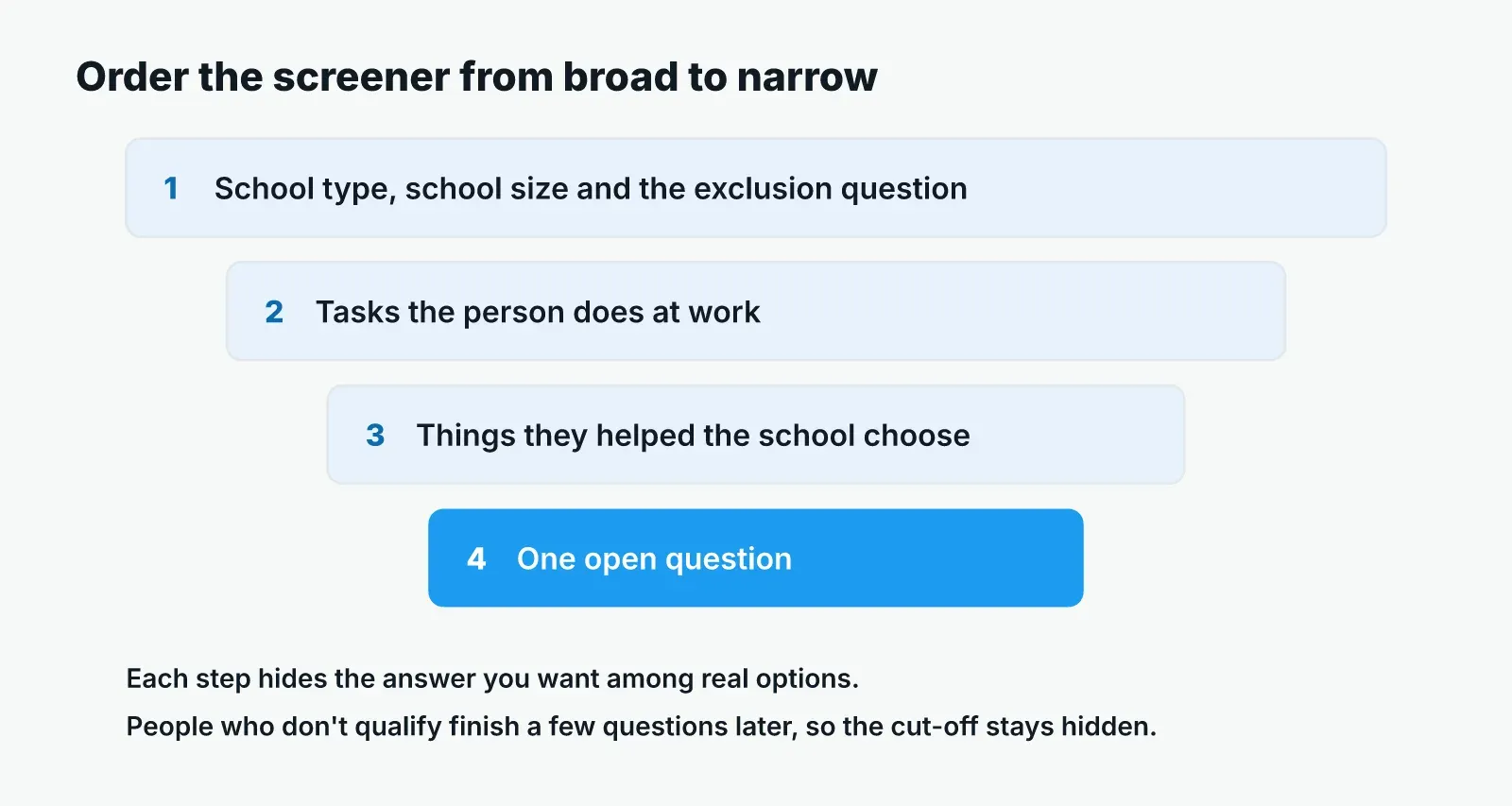
Order the questions from broad to narrow. Start with easy, general questions, like the type of school and its size. Then ask about tasks, then the things they helped choose. Save the open question for last.
Put the exclusion question near the start. It keeps out people who work in market research, in advertising or for a company that makes school tablets. Their answers come from their job, so they can't speak like a normal buyer.
If a question shows what you want, people will give it to you.
When someone doesn't qualify, end the screener politely a few questions later. If you stop them right after the obvious question, they learn which answer to give next time.
On paper, the screener looks fine. But you won't know which question leaks the answer until real people take it. So do a test run with a few people first, and read every answer yourself.
Ask a few people who don't know the study to take it. If they can guess who you're looking for, a question is giving it away.
Let a small group of real people through first. Then look at who passed.
The open question is where fake and careless people show up. Look for answers that sound alike, sound like an advert or don't answer the question. Spotting these is part of what researchers call fraud detection.
If far more people pass than you expected, a question is probably leaking the answer. If one person seems to sign up twice under different names, check that group closely.
No single check catches everyone. In a 2026 test, Pew Research Center tried three ways to remove bogus respondents. Bogus respondents are fake or careless people who take surveys. Pew ran the test on an online opt-in survey of 11,114 US adults in November 2024. Opt-in means people signed themselves up.
Pew found that no single check reliably removed bogus respondents. Removing flagged people lowered error on most measures, but there was no sure fix. One method, matching people to voter records, slightly raised error, because it removed mostly real people.
So for your screener, use several small checks plus a person reading the answers. One strict filter can throw out good people too.
Open the screener to everyone only when every question matches the brief and none gives away the answer. Your test group should also pass about as many people as you expected. If one of these fails, fix that question and test again.
In the tablet study, the screener was part of the brief. So when the brief changed, the screener had to change too. Pulse works the same way. You set the research question, the topics to cover, the audience and the screener, and Pulse builds the interview from that brief. You can check and edit the questions before the study starts.
One study can hold several groups, each with its own profile and screener. A profile is a short description of who belongs in a group. You can invite your own customers from an uploaded list. Or you can have people recruited to the profile your brief describes, including business buyers and experts. Every participant goes through fraud checks before the interview.
If you'd like to see a screener and brief turn into a real study, book a demo.
Screening questions come first in a survey or a study sign-up, and they decide who carries on. In a big survey, they make sure the results describe the right people. In an interview study, they decide who gets one of a few interview spots, so each wrong person costs more.
A screener decides who takes part. An interview guide is the list of topics and questions you cover once they do. The screener is short and mostly multiple choice, so you can score it fast. Write the screener first, then write the interview guide for the people who pass.
Yes, near the end, once the task questions have done the sorting. A title helps you describe who you spoke to. It also helps you spot odd answers, like a student who says they approve the school's budget. Just don't use it to decide who gets in.
Yes, when the brief needs people who chose another brand, like the tablet study did. Ask it as one choice in a list of brands. Never ask a yes or no question about one named rival. A list hides the answer you want and shows which brands each person knows.
Long enough for every question to check a rule from the brief, and no longer. There's no fixed number, because a study with several groups needs more sorting questions than a study with one. If a question doesn't decide who gets in, or which group they join, save it for the interview.
Choosing an AI assistant for research? Match it to the evidence your question needs, then test whether every finding opens to the source behind it.
Jobs to be done interviews at scale: how to keep hundreds of interviews on track, sort what buyers say and check each reason across groups.
Multi-market message testing: keep the people and questions the same, translate for meaning, and tell a translation slip from a real difference.