Participant recruitment methods: 5 ways to find people
Participant recruitment methods compared by who you need: your own list, panels, referrals, networks and recruiters, plus a check before you set a date.
When to use interviews instead of surveys: 11 signs in your own survey data that you need the reasons, and how to run the follow-up interviews.
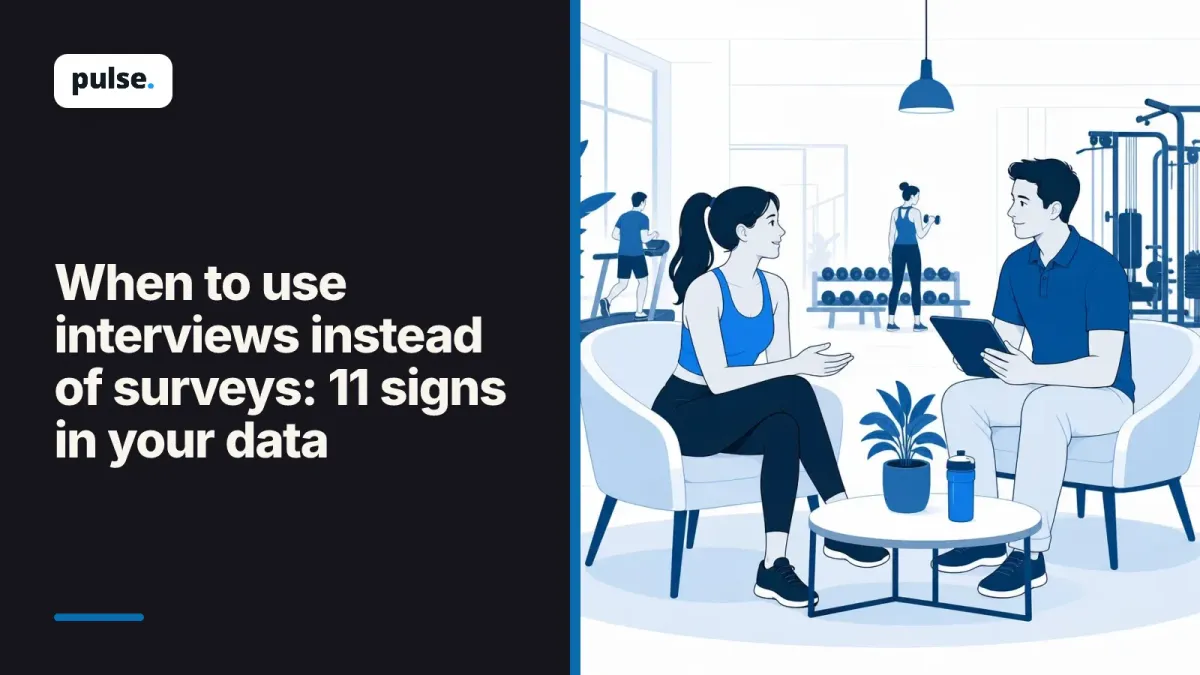
Say you work on the research team at a gym chain. The member survey says satisfaction is steady, yet more members cancel each month, and the comment box mostly says "fine". Do you add another question, or go and talk to people?
That choice is about when to use interviews instead of surveys.
If you need to count how many members feel a certain way, a survey is the right tool. If you need to know why they're leaving, run interviews, and pick the people from the survey you already have.
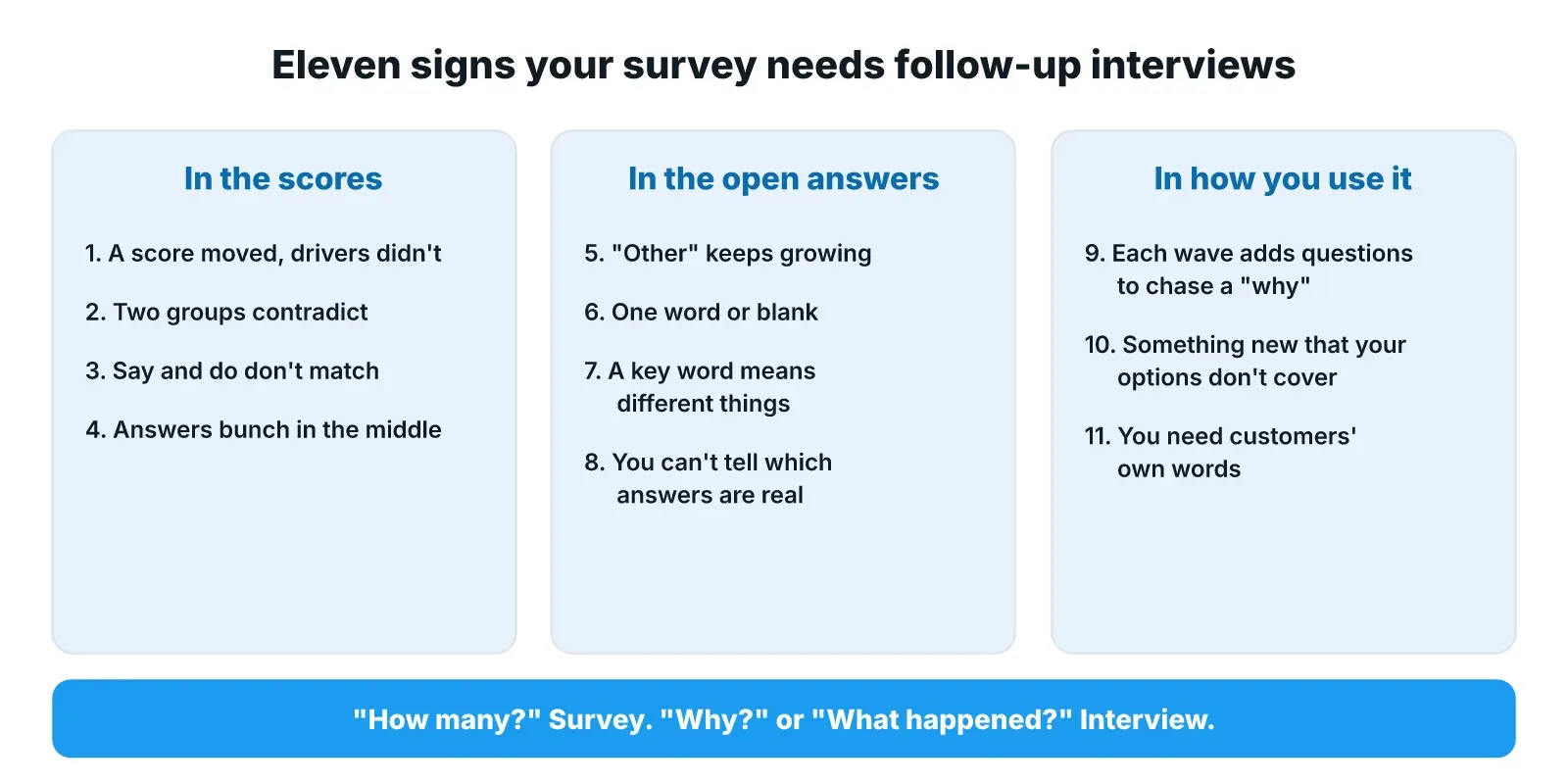
Your own survey data usually tells you when it's time to switch. Eleven signs show up in it, and the people to interview are often already in your results.
A survey stays the right tool while you know the possible answers and need to count them, compare groups or track a number over time. It stops being enough when the numbers move and nothing in the survey explains why. These four signs show up in the scores first, so check them each time results come in.
Driver questions are the ones you include to explain a main score, such as ratings for equipment, staff and class times. Say overall satisfaction drops, but every driver rating holds steady. The reason is something your list of drivers doesn't include, and only an open conversation can find it.
You'd expect members who rate satisfaction highly to renew. If many of them cancel anyway, the score is measuring something other than what makes people stay. An interview can ask a satisfied member who left what changed in the weeks before they canceled.
The survey says most members plan to renew, but the cancellation data says otherwise. That gap happens because people answer about their plans, while their real week decides what they do. Interviews ask about the last few weeks, which shows the moment the plan changed.
When most people pick "neither agree nor disagree", the middle can hide two opposite groups, or people who don't understand the question. A survey can't tell those apart. A short interview can, because you can ask what "neutral" meant to that person.
Typed comments are meant to explain the scores. When they stop doing that, the survey has reached the edge of what a form can learn. Four signs show up in the comment box and the answer lists, and each one has a follow-up interview that fills the gap.
When more people pick "other" each wave, your answer list is out of date. People have reasons you didn't write down. Interviews find those reasons in people's own words, so you can rewrite the list before the next survey.
"Fine." "Price." "OK." These answers tell you someone had a reason, but not what it was. "Price" could mean the fee went up, a cheaper gym opened nearby or the member uses the gym less than they pay for. A spoken follow-up asks "What about the price?" and gets the story. The post on why typed answers stop at the first layer shows the difference in detail.
Words like "value", "busy" or "clean" mean different things to different people. One member's "too busy" is a wait for the squat rack at 6 pm, while another's is a crowded changing room. If the same score hides different meanings, you can't act on it until you ask.
Some survey answers come from bogus respondents, people who answer without real attention or who aren't who they say they are. In an August 2026 report on bogus respondents, Pew Research Center says studies by its researchers and others found that standard quality checks fail to detect most of them in online opt-in polls. Those checks include looking for people who rush or pick the same answer every time. The same report notes that reading open-ended text answers has long been seen as a reliable way to spot low-quality respondents. A spoken follow-up gives you a fuller check, because a real member can tell you about their own gym.
Sometimes the clearest sign is what your team keeps doing with the data. When each wave raises a question the next wave can't answer, or the decision needs something a form can't hold, the survey has done its job. These three signs show the team has outgrown it for now.
Last quarter's drop led to three new questions this quarter, and this quarter raised two more. The survey gets longer, and people get tired of it, while the answer stays out of reach. One round of interviews often answers what three more questions couldn't.
Say members start using the gym's home workout videos instead of visiting. Your survey was written before that habit existed, so none of its options fit. Interviews let you learn the new behavior before you try to count it.
If you're writing a new message, naming a plan or explaining a price change, you need the words members use. A survey gives you your own words back, ranked. Interviews give you theirs.
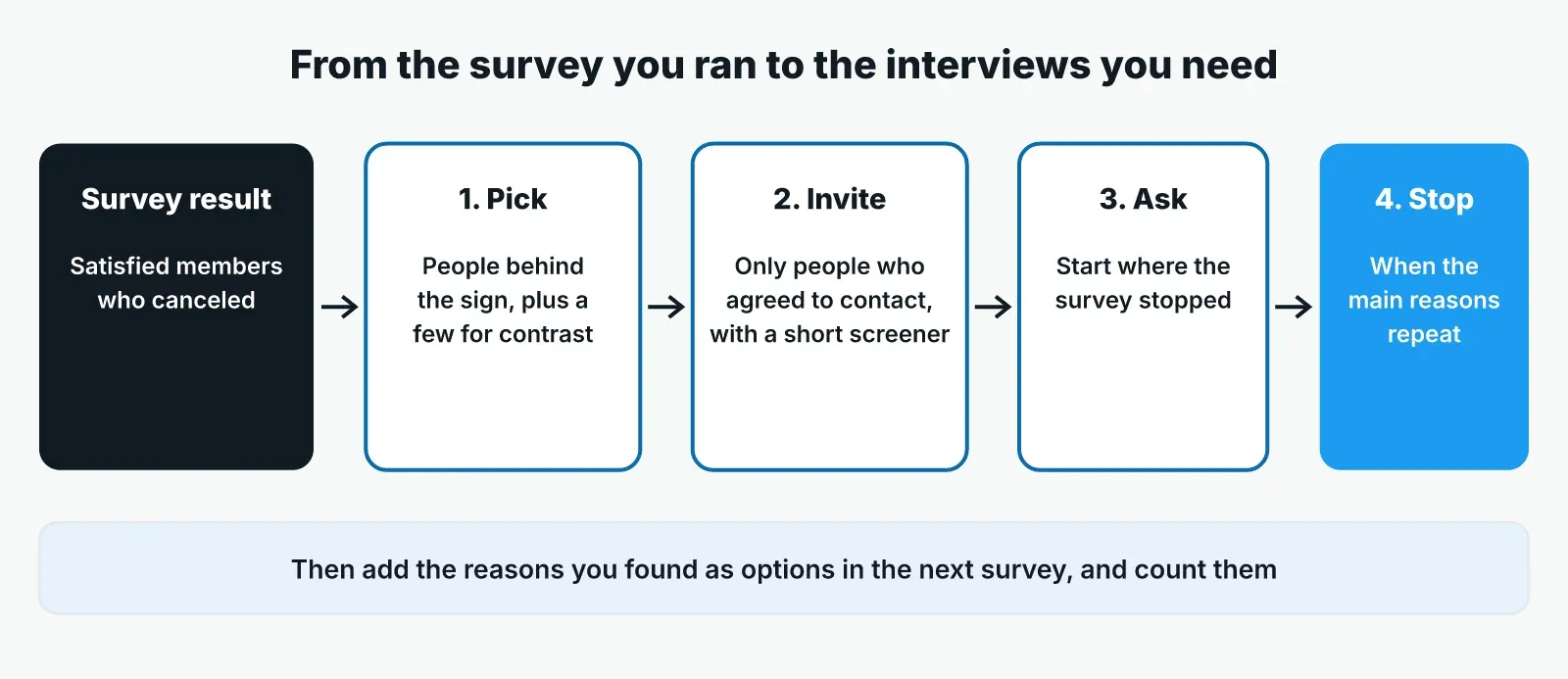
The best people to interview are often already in your survey results. You know how they answered, so you can pick the exact pattern you need to explain. Start where the survey stopped, and ask about real recent events, not opinions in general.
Say the gym chain's research team sees sign 2: members with high satisfaction scores who canceled anyway. They'd set up the follow-up in four steps.
Invite members behind the sign, here satisfied members who canceled. Add a few who answered the other way, such as satisfied members who renewed, as a contrast. The contrast shows what is different about the people who left.
Use the survey's consent question, and invite only people who said yes. Then ask two or three short questions to confirm each person fits, such as when they canceled. A short guide to writing a screener survey helps here.
Open on what the survey already told you: "You rated us highly, and you canceled in March. Tell me about the last few weeks before that." Ask about specific moments, follow a vague answer with a second question and keep every question neutral. The post on telling a good probe from a leading question has examples.
There's no fixed number that fits every study. Stop when new interviews keep giving you reasons you've already heard, and check that each group you care about has had its say.
Interviews take more time per person than a survey and reach fewer people, so they can't tell you how common each reason is. When you need that, add the reasons you found as options in the next survey and count them. So use this rule: if the question starts with "how many", survey; if it starts with "why" or "what happened", interview, then count what you learned.
Running both methods can mean two tools, two teams and a wait between the number and the reason. Pulse runs surveys alongside AI-moderated interviews in the same study, so the numbers and the reasons arrive together. You can invite your own survey respondents from a list you upload, which makes recruiting from the survey you already ran straightforward.
The AI moderator asks a second question when an answer is vague, building on what the person said earlier, so "fine" and "price" turn into reasons. Every theme comes with the quotes behind it, each linked to its transcript, and the report is ready minutes after the last interview. Read more about surveys that run alongside interviews.
To see how a follow-up study on your own survey would run, book a demo, or start with a free trial and a free study.
Neither is better; they answer different questions. A survey counts how many people hold a view or do something, across a large group. An interview explains why a person holds that view, in their own words. Most decisions about customers need both, so the useful question is which one your current gap needs.
A survey asks many people the same fixed questions, so you can count and compare the answers. An interview is a conversation with one person at a time, where the next question depends on the last answer. That's why a survey finds patterns and an interview finds the reasons behind them.
Interviews take more time per person, reach fewer people and are harder to compare side by side than survey answers. The way a question is asked can also shape the answer, so neutral wording matters. These limits are why interviews explain a pattern well but shouldn't be used alone to say how common it is.
Yes. A common way is to run the survey first, then interview a small group chosen by their answers, using the survey's consent question to invite them. You can also run them side by side, so each survey answer has a conversation behind it. Either way, plan the link between the two before you launch.
Participant recruitment methods compared by who you need: your own list, panels, referrals, networks and recruiters, plus a check before you set a date.
Semantic vs latent themes, from Braun and Clarke's paper "Using thematic analysis in psychology", shown on real-life quotes, with when to use each.
How to choose a transcription service for research interviews: test each option on your own audio with five simple checks, from accuracy to data safety.