From open-ended survey text to spoken follow-ups: why typed answers stop at the first layer
Typed answers to open-ended survey questions offer only surface-level feedback. Learn why this data is risky and how to use it to start deeper, spoken follow-ups.
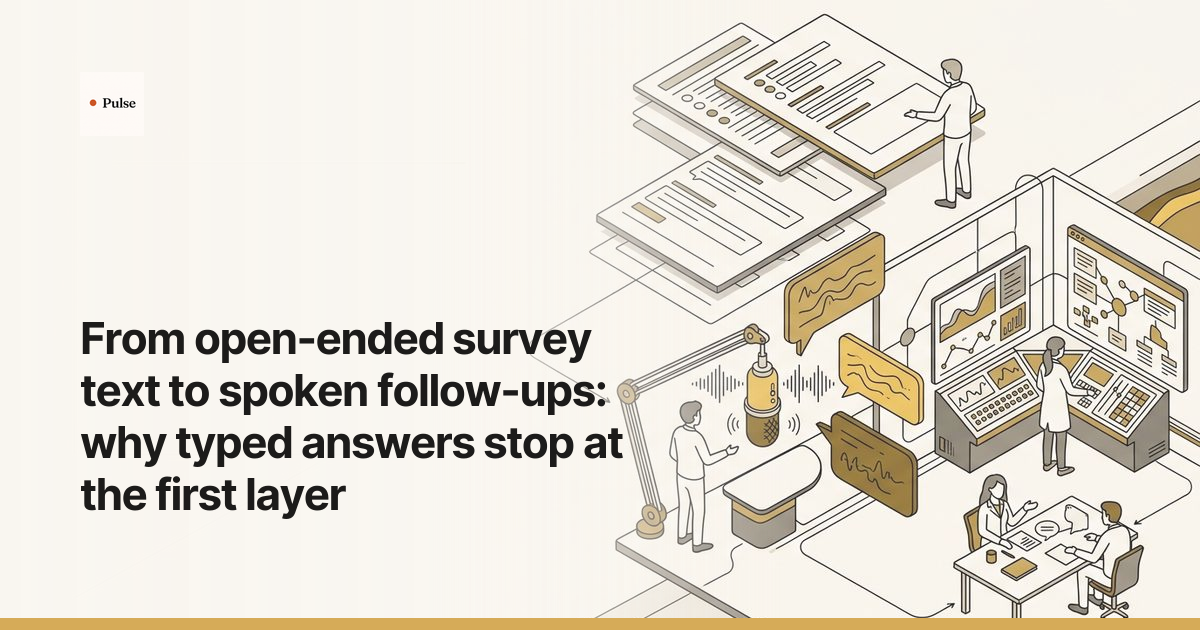
Open-ended survey questions promise a window into the customer’s mind, but often deliver a view of the front porch. The short, typed answers they produce represent only the first layer of feedback: the easiest thought to articulate, not the most considered one. Relying on this surface-level data for critical decisions is a significant risk. The key is to treat typed answers not as the final word, but as the starting point for a structured, spoken follow-up conversation.
The Problem: Why Typed Answers Are Only Skin Deep
Open-ended text boxes seem to offer qualitative depth, but they frequently collect short, top-of-mind responses like ‘It’s fine’ or ‘Too expensive.’ This is the ‘first layer’ of feedback. It’s an immediate reaction, filtered for brevity and effort, that rarely contains the context needed for a real decision. Teams then attempt to build product roadmaps and marketing strategies on this ambiguous data, mistaking a shallow signal for deep insight and leading to flawed conclusions.

Why We Get Surface-Level Responses in Text Boxes
The brevity of typed survey answers is not due to a lack of opinion, but to fundamental cognitive and contextual barriers. A static text box is simply the wrong instrument for excavation. It can record a surface impression, but it cannot dig for the reasoning underneath.
- Cognitive Load: Typing a structured thought is more demanding than speaking it. It requires simultaneous motor coordination, visual tracking, and the conscious application of grammar and spelling rules. Research confirms that this consumes significant working memory resources, encouraging respondents to default to brevity. Speaking, by contrast, is a more automatic process, freeing up cognitive capacity to focus on the content of the message. A 2016 Stanford University study found that speech input on a mobile device was three times faster than typing and had a lower error rate, highlighting the efficiency of spoken thought.
- Lack of Rapport: An anonymous text box does not build trust. Customers are unlikely to share candid, detailed, or vulnerable feedback without the rapport that a real conversation provides. They give an answer that is safe and quick, not one that is thoughtful and complete.
- No Dynamic Probing: A survey is static. It cannot ask, ‘Why do you say that?’ or ‘Can you give me an example?’ in response to an interesting but incomplete answer. This inability to probe in real time leaves the most valuable information—the context behind the initial statement—undiscovered.
- Context Collapse: Respondents are often multitasking or rushing. Nearly 6 in 10 surveys are now completed on mobile devices, often in distracting environments. This context prevents the focused reflection needed to provide a deep, considered answer.
What Doesn't Fix It: Common Flaws in Analyzing Survey Text
Many teams try to force depth from shallow data using flawed methods. Making the text box bigger or adding instructions like ‘Please be detailed’ fails to address the underlying cognitive barriers. Two other common approaches also fall short: running automated analysis and manual coding.
Automated sentiment analysis, for example, cannot create depth that was never there. While benchmarks place the accuracy of commercial tools between 75% and 92%, they struggle with the nuance of human language. A September 2026 benchmark found that even major Large Language Models (LLMs) top out at 75% accuracy on general sentiment classification. These tools routinely misinterpret sarcasm, irony, and mixed sentiments, labeling a comment like, “This update is perfect for breaking my entire workflow,” as positive.
Manually coding thousands of short, ambiguous responses is equally problematic. It is an enormous investment of time that results in the careful categorization of surface-level feedback. You end up with a very organized collection of first-layer thoughts, but no more insight into the customer’s actual needs or context.
The Solution: From Typed Answer to Spoken Conversation
The most effective way to get deeper insight is to change the method. Treat the open-ended survey response as a signal of what to investigate, not as the investigation itself. Use the typed answer as a starting point to identify the right people to engage in a spoken follow-up interview.
Speaking lowers the barrier to elaboration. In a conversation, customers can provide richer detail, emotional context, and spontaneous examples that would never make it into a text box. Probing techniques like the Laddering Technique or the 5 Whys allow a researcher to move from a surface statement to the root cause or underlying value driving a customer’s behavior.
This doesn't have to be a slow, manual process reserved for a handful of respondents. With platforms like Pulse, you can use AI-moderated interviews to conduct these follow-ups at scale, adding qualitative depth to large quantitative studies without creating a bottleneck for the research team. This hybrid approach combines the reach of a survey with the depth of an interview.
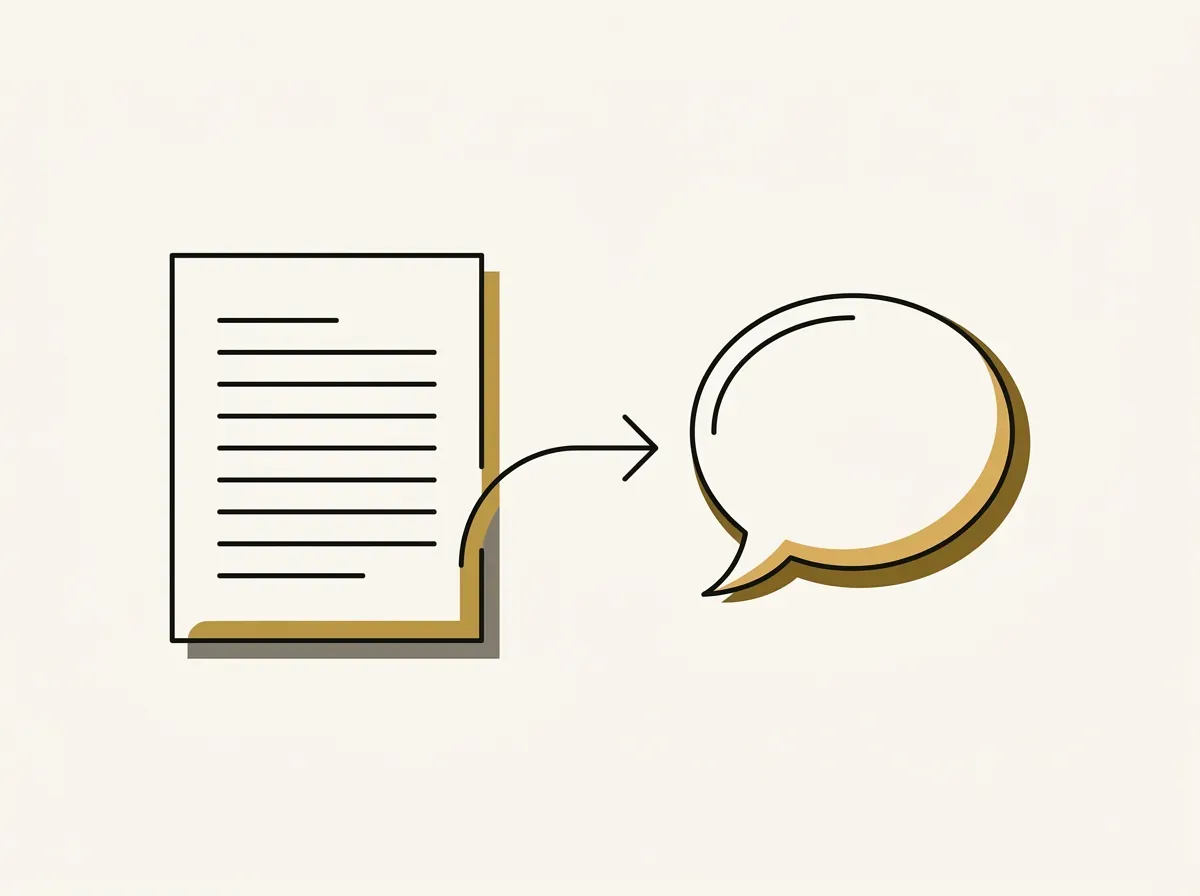
What Deeper Insight Looks Like: A Worked Example
The difference between a typed answer and a spoken follow-up is the difference between a symptom and a diagnosis. The first tells you something is wrong; the second tells you what it is and how to fix it.
- Before (Survey Text): ‘The new reporting feature is confusing.’
- This feedback is a dead end. What is confusing? Who is confused? What should be done?
- After (Spoken Follow-up): ‘I couldn't figure out how to filter by quarter. I expected the filter to be under ‘Date Range,’ but it was hidden in ‘Advanced Settings.’ It was frustrating because I was on a deadline and wasted ten minutes searching for it.’
- This feedback is specific, contextual, and actionable. It identifies a clear UI problem, explains the user’s expectation, and reveals the emotional impact.
The follow-up interview uncovers a specific, actionable insight that the original typed answer completely obscured. This is the level of detail required to de-risk a decision and build products customers actually value, a necessity in a B2B market where buyers use an average of ten channels in their purchasing journey.

Frequently Asked Questions
How do you decide which survey respondents to follow up with?
Focus on responses that are ambiguous, emotionally charged, or mention a critical part of the product or journey. A very low NPS score with a vague comment like "disappointed" is a prime candidate. The goal is to select for uncertainty, where a conversation can provide the most clarification.
Isn't conducting follow-up interviews too slow and expensive to do at scale?
Traditionally, yes. Manual moderation, scheduling, and analysis made it impractical to follow up on more than a few dozen survey responses. However, AI-moderated research platforms automate these logistical steps, making it feasible to run hundreds or even thousands of structured follow-up interviews quickly.
What's the best way to ask for a follow-up interview in the survey itself?
At the end of the survey, include an optional, explicit question: "Would you be open to a brief, 15-minute follow-up conversation to discuss your feedback in more detail? As a thank you, we'll provide a [specific incentive]." This sets expectations and gets consent upfront.
How can you combine quantitative survey data with qualitative follow-up insights?
Use the quantitative data to understand the scale of a problem (e.g., "25% of users rated this feature poorly"). Use the qualitative insights from follow-up interviews to understand the 'why' behind that number ("...and here are the three specific usability issues that drove that low score"). The numbers tell you what to measure; the stories tell you what to fix.