Types of bias in research and where each one enters a study
Types of bias in research, grouped by the stage where each enters a study, with how it shows up in a customer interview and how to check for it.
Questionnaire question types compared: closed, scaled, ranking and open, what each lets you analyze, and how to pick one per decision.
Imagine your bank runs a survey about its credit card, and the results show that customers are less happy with the rewards. Your manager asks why. But every question in the survey asked for a score, so you can't explain it. So, which kind of question should you have asked?
The answer depends on what you want to learn. If you want to know how many customers are unhappy with the rewards, a score works. If you want to know why they're unhappy, you need an open question that lets them explain in their own words.
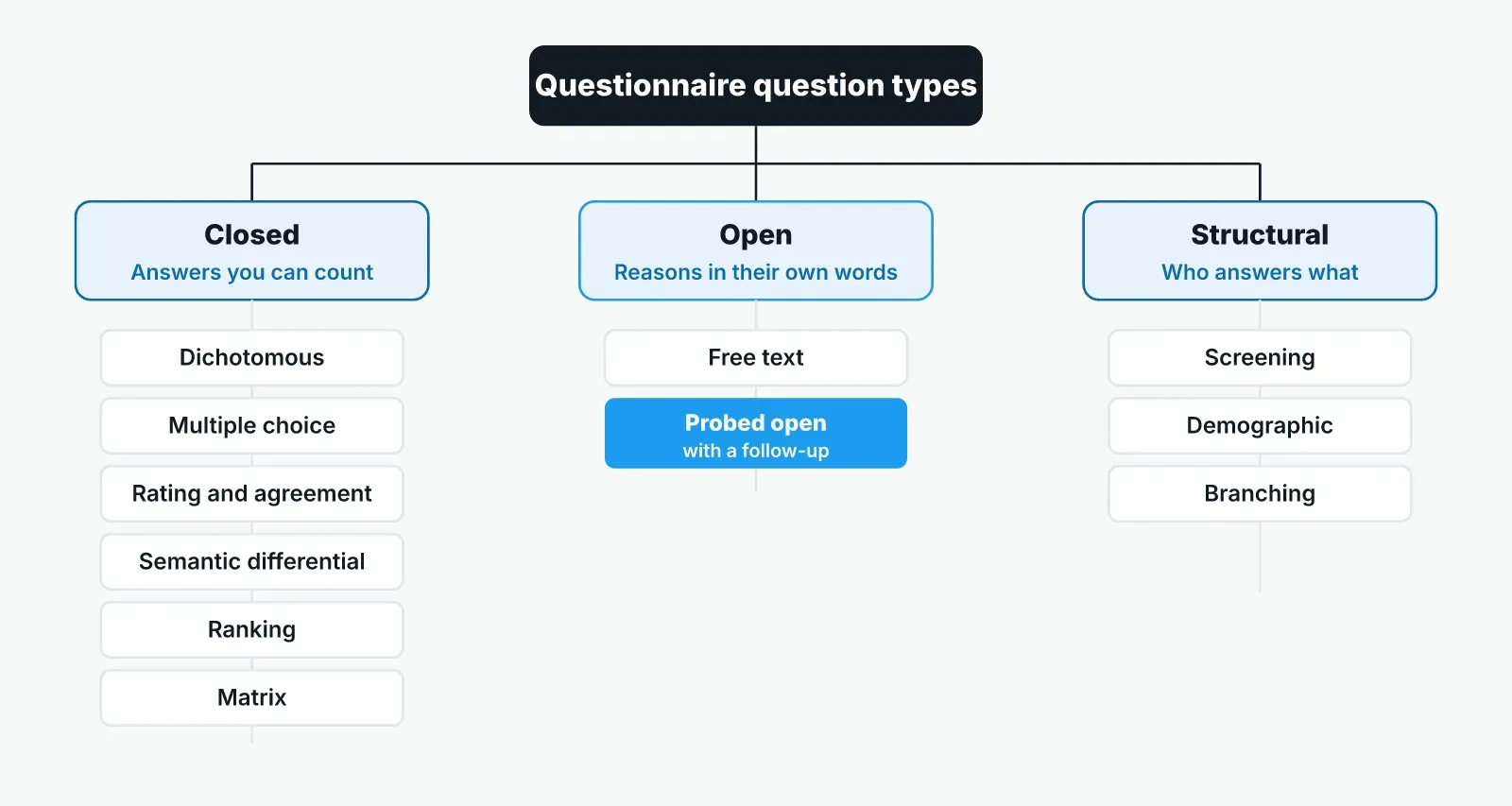
These different ways of asking are called questionnaire question types. Each type gives you a different kind of answer: a count, how strongly people feel, what matters most, or a reason.
When you write a survey, it's easy to pick question types out of habit. But the type decides what kind of answer comes back. So start from what the answer needs to help someone decide.
Answers come in four kinds: a count, how strongly people feel, what matters most, or a reason. A fifth group of questions doesn't collect answers for the report. Instead, screening, demographic and branching questions decide who answers what.
Here is each type with an example question, the answer you get back and the decision it suits.
| Type | Example question | What you get back | Use it when you need |
|---|---|---|---|
| Yes or no (dichotomous) | Did you renew this year? | The share giving each answer | A fact, or a check on who qualifies |
| Multiple choice, pick one | What was the main reason you called support? | How answers spread across a list | The top reason from a list you trust |
| Multiple choice, pick all that apply | Which of these did you use last month? | How many people pick each option | How widely each option is used |
| Rating or agreement scale | How happy are you with the rewards, from 1 to 5? | Averages and change over time | How strongly people feel |
| Semantic differential (two opposite words) | Place our support between slow and fast | How people see your product or brand | A picture of how you're seen |
| Ranking | Rank these five things by how much they matter to you | An order of priority | A choice about where to spend |
| Matrix (grid) | Rate each of these eight features | A score for each item | Many items on the same scale |
| Open, free text | What would make you recommend us? | Themes, once answers are sorted | Reasons you can't list yet |
| Open, with a follow-up | Tell me about the last time you used a different card, plus a follow-up question | Themes with the reasoning attached | Why a number moved |
Every type leaves something out. What it leaves out is what your survey will miss.
Closed questions give people a fixed set of answers. You get quick, clean numbers, but only for the answers you offered.
A yes-or-no question, also called a dichotomous question, has just two answers. It splits people cleanly but hides how strongly they feel. So it suits facts, like "Did you renew?", and checks on who qualifies.
A multiple choice question asks people to pick from a list. With pick one, people choose a single option. With pick all that apply, they tick every option that fits. Pick all that apply shows how many people choose each option. For the single biggest reason, use pick one or ranking instead.
Say the bank asks customers why they called support, and gives five options. "Billing error" isn't on the list, so people pick the nearest wrong option. The numbers look clean, and the bank works on the wrong problem.
A closed question can only count the answers you thought of.
That's why good option lists come from earlier interviews, past open answers or a pilot, which is a small test run before launch. Wording can push answers one way too, as the post on common types of bias in research questions explains.
Sometimes yes or no is too blunt, because you want to know how much people care. That's what a scale measures.
A rating scale asks for a score, such as how happy someone is from 1 to 5. An agreement scale gives a statement, such as "My monthly bill is easy to understand," and asks how far people agree. This kind of scale is usually called a Likert scale.
A semantic differential puts two opposite words at each end, such as slow and fast, and asks where your product sits between them.
All three show how strongly people feel. None of them shows why.
Two habits keep scales clean. First, keep the number of points and their direction the same. If 5 is best on one scale and 1 is best on the next, some people will answer backwards. Second, give each statement one idea only.
Before: "The bill is clear and arrives on time." That's two questions in one.
After: "The bill is clear" and "The bill arrives on time," asked one at a time.
A scale lets people call everything important. That doesn't help when you can only pay for one thing. A ranking question asks people to put items in order instead, so an item can only move up if another moves down.
Ranking works like packing a small suitcase. If one thing goes in, something else has to stay home, and that choice is the point.
So use ranking when you will fund the top item and drop the rest. Use a rating scale when each item needs its own score.
Rating many items one by one makes a survey long. A matrix question helps here. It lists the items down the side and the scale across the top, so one grid replaces many questions.
The risk is straight-lining, which means people give the same answer all the way down just to finish. To reduce it, split a long grid into smaller ones, or cut items no decision depends on.
Every type so far needs you to know the possible answers in advance. When you don't, you need an open question.
A free-text question gives people an empty box to type in. But typed answers often stop at the first reason, as the post on why typed answers stop at the first layer shows. They also take longer to analyze, because someone has to sort them into themes.
An open question with a follow-up, also called a probed open question, fixes that. When the first answer is vague, the interviewer, human or AI, asks for more. A fixed form can't do this, as the post on what a fixed questionnaire can't capture shows.
Say a customer answers, "It was too expensive." A follow-up such as "Compared with what?" gets them to name the comparison, and that's something you can act on.
The second answer is often the real finding.
The fifth group of questions makes sure the right people answer the rest. A screening question checks that someone belongs in the study. It only works when the right answer isn't obvious.
Before: "Do you have our card?" Anyone who wants the reward for taking part will say yes.
After: "Which of these cards do you have?" with your card in a list of several.
Demographic questions ask about the person, such as their age or job. Questions about their company ask about where they work, such as its size. Both let you see results for each group. So only ask the ones you will actually split results by.
Branching, also called skip logic, sends people down different paths based on their earlier answers. It keeps a long survey short for each person. But a broken path can quietly skip a whole group, so test every path before launch.
Back to the bank. Its research team needs to explain why active customers stopped using its credit card in the last three months. The managers will choose between changing the rewards, the app or the fees.
First, the team writes the same goal five ways. Here is what each question could tell them, and what it would miss.
| What the managers need | Question type | Question | What the answer shows | What it misses |
|---|---|---|---|---|
| How big is the problem? | Yes or no | In the last three months, did you use another card more? | The share who moved their spending | Why they moved |
| Which known reason is most common? | Multiple choice, pick one | What was the main reason? | How the listed reasons compare | Reasons not on the list |
| Are the rewards the problem? | Rating scale | How happy are you with our rewards, from 1 to 5? | How strongly people feel about the rewards | What better rewards would look like |
| Where should the money go first? | Ranking | Rank these five things by how much they matter when you choose a card | The order of the five | Anything outside the five |
| What haven't we thought of? | Open, with a follow-up | Tell me about the last time you used a different card, plus a follow-up | What happened and why | How common it is |
No single question settles the managers' choice.
The yes-or-no question shows how big the problem is. The rating and ranking questions only cover things the team already listed. Only the open question with a follow-up can turn up a reason outside that list.
So the real decision is about order. The team asks the open question first, with customers who moved their spending to another card. It builds the closed option lists from what it hears.
Then it asks the closed questions to many more customers, to measure how common each reason is. The managers get a number and a reason for each option.
Every question you add makes the survey longer for everyone, so each one needs a reason to be there. Run these checks before launch, ideally with the person who will make the decision. If a question fails the first check, cut it. If it fails any other, rewrite it.
Write the decision next to each question, such as "fund the app redesign or not." If you can't name a decision, cut the question. Watch out for questions kept because "it would be nice to know."
A choice about where to spend needs an order of priority, so use ranking. A question about how big something is needs a count, so use a closed question. Check each question against the first table, and look hardest at scales used where the managers really need a reason.
Read each option list the way a customer would. If two options fit the same answer, merge or reword them. If a likely answer has no option, add one.
In a pilot, read what people type into "Other." A crowded "Other" box means your list is missing something.
A score shows who is unhappy but not why. So put one open question after any score your manager will act on, such as "What's the main reason for that score?" Keep it to the scores that matter, so you get few enough answers to read.
When you're not sure which type to use, go back to what the answer must help someone decide.
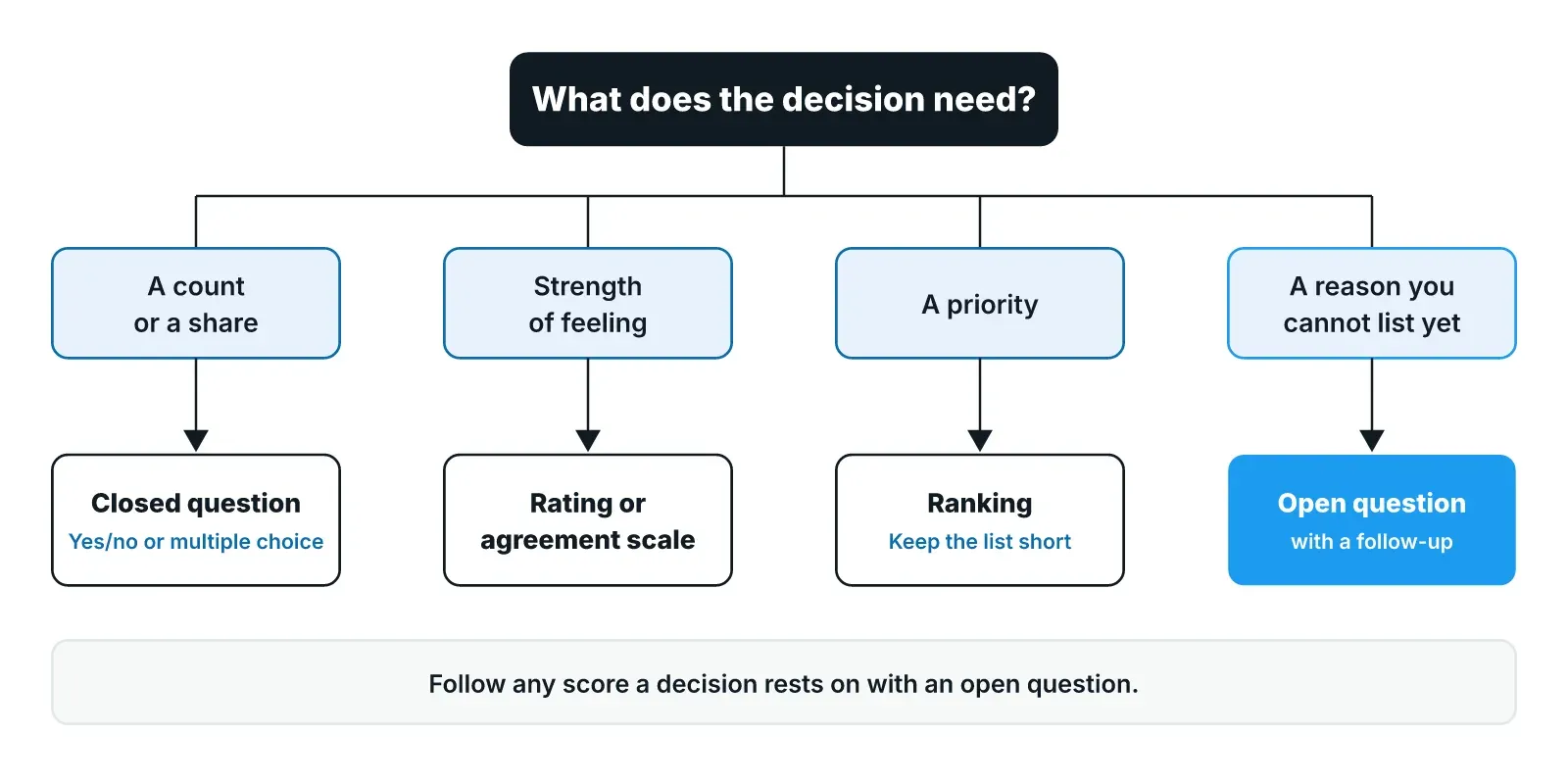
If your managers need the reason behind a score, the open question with a follow-up matters most. In Pulse's AI-moderated interviews, the moderator asks a follow-up when a reply is vague.
Every participant gets the same discussion guide, which is the shared list of questions for the interview. Each theme links back to the quotes in the transcript it came from, so your open questions come back with the reasoning attached.
Pulse also runs surveys alongside AI-moderated interviews. So the bank in the example could measure how common each reason is and hear the thinking behind it, in one study.
To see a study that pairs numbers with the reasons behind them, book a demo.
Once you start writing, most remaining questions are about names, scales and order.
Most questionnaires use five basic types: yes or no, multiple choice, rating or agreement scales, ranking, and open questions. Each gives a different kind of answer, from a simple count to a reason in the person's own words.
Matrix and semantic differential questions are versions of the rating scale. Screening, demographic and branching questions sit alongside the five, because they control who sees which question.
A Likert scale is one kind of rating scale. It asks how far you agree with a statement, from strongly disagree to strongly agree. Other rating scales ask for a score, such as how happy you are from 1 to 5.
Both show how strongly people feel. Neither shows the reason behind it.
Screening questions go first, so only the right people answer the rest. Simple closed questions come next, then scales.
Each open question works best right after the score it explains, while the reason is still fresh. Demographic questions can go at the end, unless a branch needs them earlier.
Types of bias in research, grouped by the stage where each enters a study, with how it shows up in a customer interview and how to check for it.
Voice of customer programs that stop at survey scores miss the why. Set the cadence, owners and interview waves that explain each score.
Research participant recruitment from your customer base: build a fair CRM list, settle consent and incentives, and rotate past the loud accounts.