Questionnaire question types and when to use each
Questionnaire question types compared: closed, scaled, ranking and open, what each lets you analyze, and how to pick one per decision.
Voice of customer programs that stop at survey scores miss the why. Set the cadence, owners and interview waves that explain each score.
Customer satisfaction drops for a second quarter, the survey comment box says only "fees", and nobody can tell the product team what to fix. Voice of customer programs can answer that by running customer interviews on a fixed schedule beside the surveys. Then every score that moves arrives with a reason, in the customer's own words.
A voice of customer (VoC) program collects what customers say and do, and sends it to the teams that can act on it. When a program runs on scores and support data alone, interviews happen once, after a score has fallen. The findings often land after the planning meeting has set the budget.
The schedule and owner table below tell you which customers to interview each month and who acts on what they say. The bank example shows when a theme is ready for the quarterly plan.
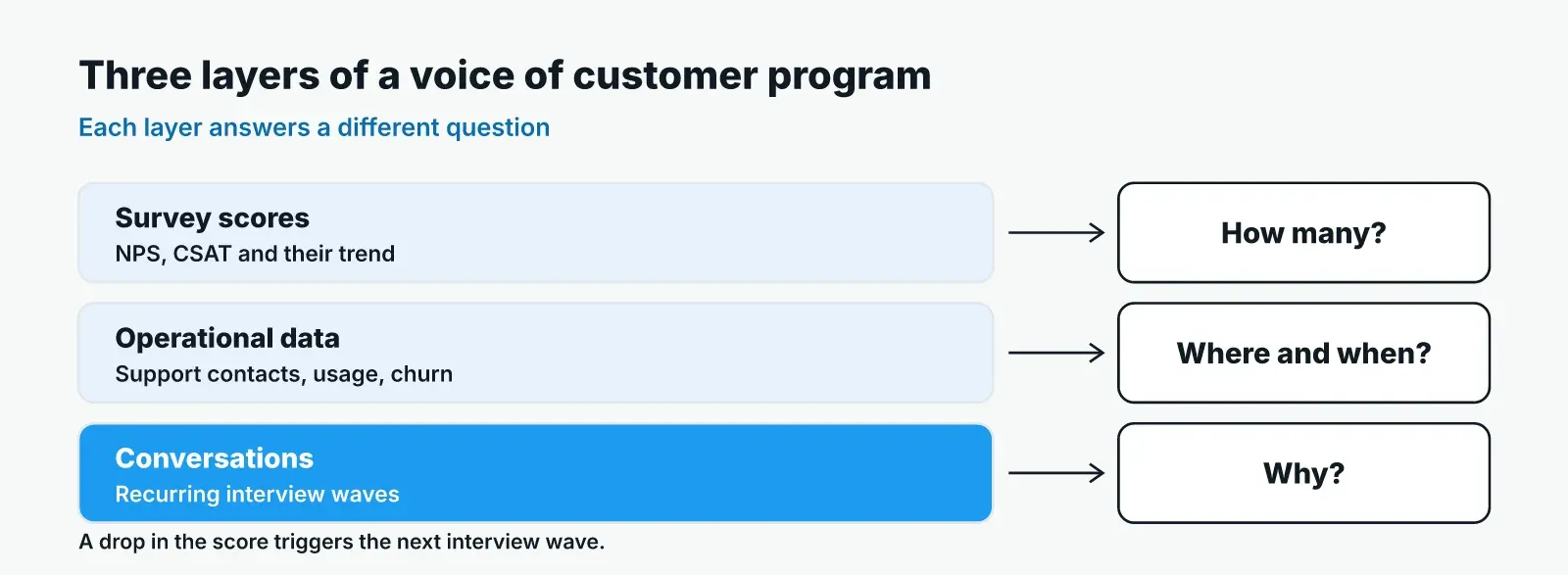
Survey scores tell you how many customers feel a certain way and whether that is changing. Support data tells you where the experience breaks. Usage data tells you what customers did. Interviews tell you why they did it. A program with only the first three can see a problem, and it cannot yet explain it.
| Input | Tells you | Leaves open | Usual owner |
|---|---|---|---|
| Survey scores (NPS, CSAT) | How many feel a certain way, and the trend | Why the score moved | CX or insights |
| Support contacts | Where the experience breaks | What the customer was trying to do | Service operations |
| Reviews | Issues customers raise unasked | Whether reviewers are typical | CX or marketing |
| Usage and churn data | What customers did, and when they left | Why they did it | Product analytics |
| Recurring interviews | Why customers acted, in their own words | How many share each reason | Insights |
NPS (net promoter score) and CSAT (customer satisfaction score) are the usual survey scores, and the post on what a score can and cannot tell you covers where NPS stops. Treat support, review and usage data as one operational layer and you get three layers: scores for how many, operational data for where and when, and conversations for why.
Scores stop at the trend because a comment box cannot ask a second question. A customer types "fees" and the program learns a topic. It does not learn which fee, when the customer saw it, or what they expected. In an interview, the next question can be "Which fee, and when did you first notice it?"
That one follow-up separates a pricing problem from a problem with how the fee was explained. The post on moving from open-ended survey text to spoken follow-ups shows this gap in more detail.
A survey-led program has two more limits. It hears only from customers who chose to answer, and the program cannot see how those customers differ from the silent ones. And the comments pile up faster than anyone can read them.
In a Gartner survey of 265 customer service and support leaders, reported by CX Dive in September 2025, the leaders said advanced voice-of-the-customer analytics will become increasingly important. Analytics sort the comments a program already has. Interviews ask the follow-up question those comments never got.
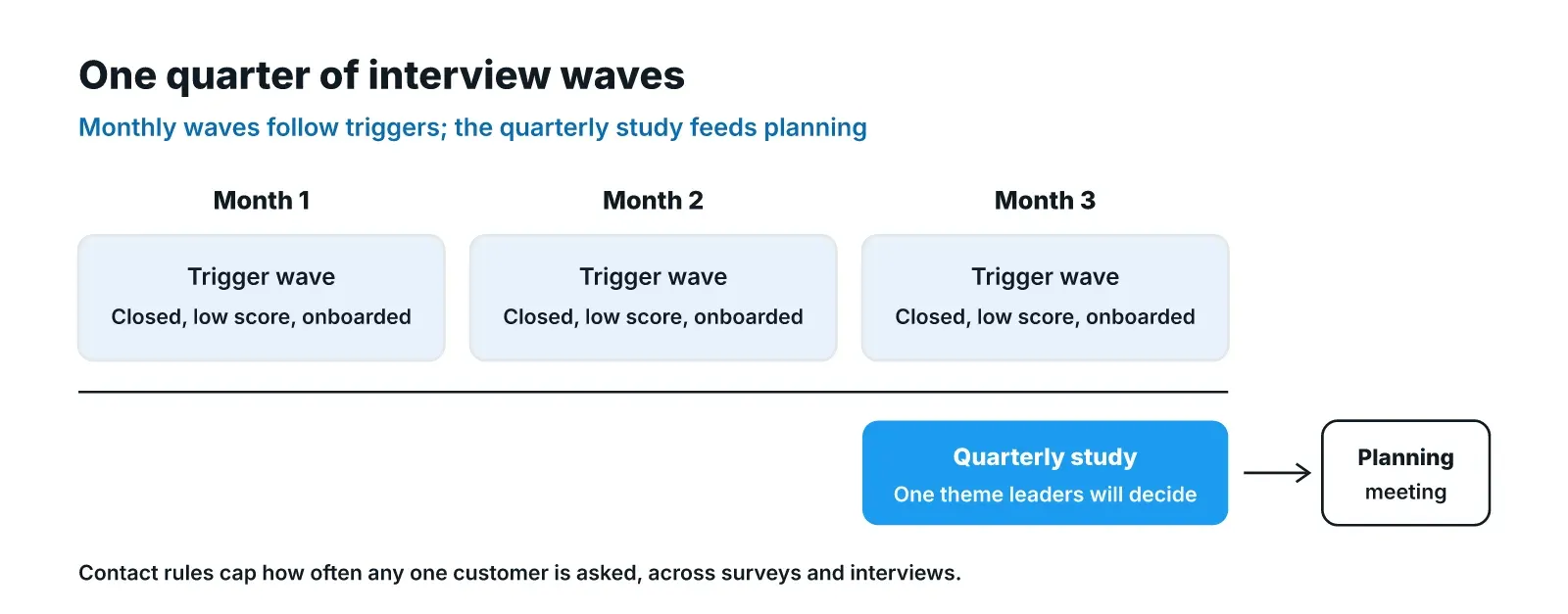
Run a small wave of interviews every month with customers who just did something the business cares about. Then run one deeper study each quarter on the theme leadership is about to decide. The monthly waves show what is changing. The quarterly study gives the planning meeting a reason it can act on, in time to use it.
A trigger is an event that puts a customer in the next wave. Common triggers are a closed or downgraded account, a low score, a finished onboarding, or a lost deal. Keep the same triggers each month, so this month's wave can be compared with last month's. The data team pulls the customers who hit each trigger. The post comparing interviews and surveys for finding churn reasons shows what a churn trigger can bring up.
If leadership reads results by region, product line or customer size, invite customers from each of those groups. Size each wave so you can see whether a theme repeats across segments, as well as whether it exists. No single interview count is enough for every program; it depends on how many segments you cover. Write down who was invited and who took part, so a reader can see who is missing.
A discussion guide is the list of questions and follow-ups each interview covers. In a company with several business units and markets, keep one core guide for every wave, so themes can be compared across units. Each unit adds a few questions of its own at the end. Market teams handle translation and check that the questions make sense locally.
Cap how often any one customer is asked for feedback, counting surveys and interviews together. A customer who answered a relationship survey last week should not get an interview invitation this week. Legal and privacy approve the consent wording and the contact rules, since the program is interviewing the company's own customers. Agree both once, at setup.
Work back from the planning meeting that will use the findings. Leave a few weeks to read the transcripts and agree the themes. Choose the quarterly theme from what the monthly waves keep raising and from what business units have put on the agenda. If the study lands after budgets are set, its findings wait a full quarter.
The program needs one owner for how interviews are run and read, and separate owners for what happens next. Insights or CX owns the guide, the schedule and the theme log. Business-unit sponsors own the decisions. Product, CX and operations partners own the fixes. Legal and the data team each own one gate.
| Role | Owns | Attends |
|---|---|---|
| Program owner (insights or CX) | The guide, the schedule, the theme log | Every readout |
| Business-unit sponsor | Decisions on that unit's themes | Quarterly readouts |
| Product, CX and operations | The fixes, and when each ships | Readouts on their area |
| Legal and privacy | Consent wording and contact rules | Setup, and rule changes |
| Data team | Matching triggers to segments | Setup, and monthly list pulls |
The table gives each step one name. Without it, a theme can sit between two teams that each assumed the other owned it. This is where silos form: the score sits with CX, the contact reasons with service operations, the interviews with insights, and nobody joins them. The post on pairing behavior data with interviews shows one way to join two of these inputs.
The theme log is how the program owner keeps the volume readable. Tag every theme with the segment, wave and date it came from, and keep it linked to the transcripts behind it. A theme that shows up in three waves in a row should carry more weight in planning than one that showed up once. Keep the log in a shared insight repository and start each new brief by searching it, so two business units do not pay for the same study twice. Telling customers what changed after a fix belongs to the team that made the fix.
For illustration, a credit card unit inside a large retail bank sees satisfaction fall among customers in their first few months. The survey comments say only "fees". The team must decide whether to change the fee, the sales script or the first statement, and each of those has a different owner and a different approval path.
The business question is narrow. Are new customers unhappy with how much the fee is, or with how and when it arrives? The team has three options. It can read more survey comments, pull support contact reasons, or run a monthly interview wave with customers who closed a card soon after opening it.
| Option | What it can establish | What it cannot establish |
|---|---|---|
| More survey comments | That fees are on customers' minds, and in which segments | Which fee, or what the customer expected |
| Support contact reasons | Whether fee calls rose, and how early in the customer's first months | What the customer believed before calling |
| Monthly interview wave | What the customer expected, when they saw the charge and what they did next | How many customers across the base share that reason |
No option answers the question alone. The team reads the interview themes against the transcripts. Then it checks whether the same reason appears across acquisition channels, such as branch, online and partner offers. Finally it sets the themes beside the contact reasons. The interviews explain the calls, and the call data shows whether the reason reaches beyond the people interviewed.
The evidence then points to one of two owners. If most customers describe the fee as too high for what the card gives them, that is a pricing question for the product committee, with a long approval path. If most say they did not expect the fee on their first statement, the fix sits with the acquisition lead: the sales script and the welcome pack. Either way, the next two monthly waves check whether the theme fades, and the score shows whether the fix reached customers.
The monthly wave is the part of the program that needs the most hands. Someone has to invite customers, hold the interviews and read every transcript before the next wave starts. Pulse runs that fieldwork with AI-moderated voice interviews, and asks a follow-up question when an answer is thin.
Starting each wave is simple. The data team pulls the customers who hit each trigger, and you invite your own customers from a list you upload. A tracker repeats the core guide's questions wave after wave, so a change shows against the baseline and the interviews can explore it.
Then comes the reading. Pulse groups the answers into themes, each with the quotes behind it. Each wave's themes, quotes and transcripts sit beside earlier waves in the searchable insight repository. That is what the theme log and the bank team's transcript check both need. The program owner still frames the question and decides what the business does next.
Start with one rule. If a score has moved for two waves and nobody can name the reason, add a trigger wave before you add another survey question. If the same reason then appears across segments, take it to the next planning meeting with the transcripts attached. To see how a monthly interview wave would run for your program, book a demo.
No. Scores measure how many customers feel a certain way and how that changes over time, and interviews do not count at that scale. Keep the surveys and use them twice: a drop or a low score is the trigger for an interview wave, and the next score is the check on whether a fix worked.
It gives a product manager the reason behind a usage or churn pattern before they commit roadmap time. A monthly wave triggered by churn shows which task customers struggled with. The theme log shows whether that struggle is new or has come up across several waves, so they can rank roadmap work by how often a reason recurs.
Ask about a recent, specific episode: the last time the customer tried the task, what happened and what they did next. A real event gives the team details it can check and fix, where a general opinion rarely does. Then follow up on vague words. When a customer says "confusing", ask what they were trying to do at that moment.
Show three things with every theme: how many interviews it appeared in and from which segments, two or three quotes linked to their transcripts, and whether it appeared in earlier waves. A theme that recurs across segments and waves is harder to dismiss than one strong quote. Add the matching score or contact data where you have it.
Questionnaire question types compared: closed, scaled, ranking and open, what each lets you analyze, and how to pick one per decision.
Types of bias in research, grouped by the stage where each enters a study, with how it shows up in a customer interview and how to check for it.
Research participant recruitment from your customer base: build a fair CRM list, settle consent and incentives, and rotate past the loud accounts.