Participant recruitment flyer: 6 steps to get sign-ups
A participant recruitment flyer works when it reaches the right people and sign-up takes one scan. Where to hand it out, what to write, how to track it.
A research participant recruitment flyer must pass review and still bring people in. What to include, what to leave out, and a before-and-after example.
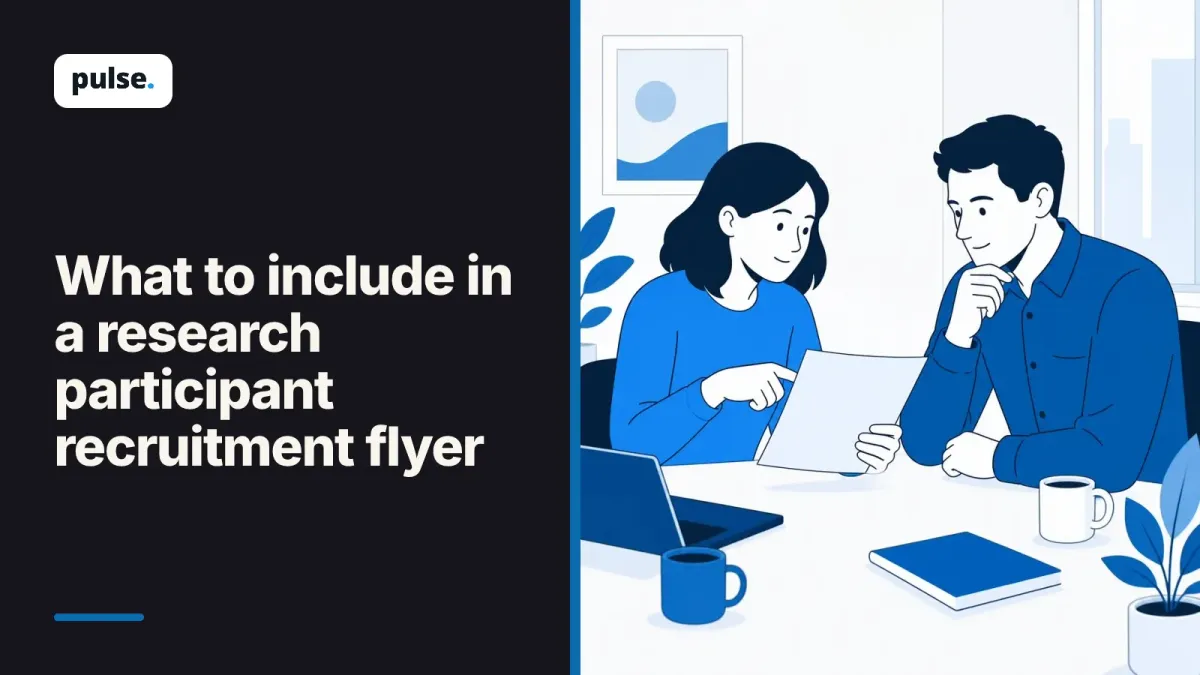
"Why is the reward bigger than the word research?" That's the only note on the flyer the legal team just sent back to you.
You work on the research team at a pharmacy chain. Your team wants to talk to people who shop in the evening, now that stores stay open later. The flyer will sit by the counter. But first it has to get past legal and privacy. So what does a flyer need to say to pass?
This is a research participant recruitment flyer. It's a short notice that asks people to take part in a study. It has two jobs: bring the right people in, and pass review.
Most flyers get sent back for the same few lines. So say plainly that it's research, who you want, what taking part involves, the reward in normal type, and a real person to contact. And promise nothing the study can't give.
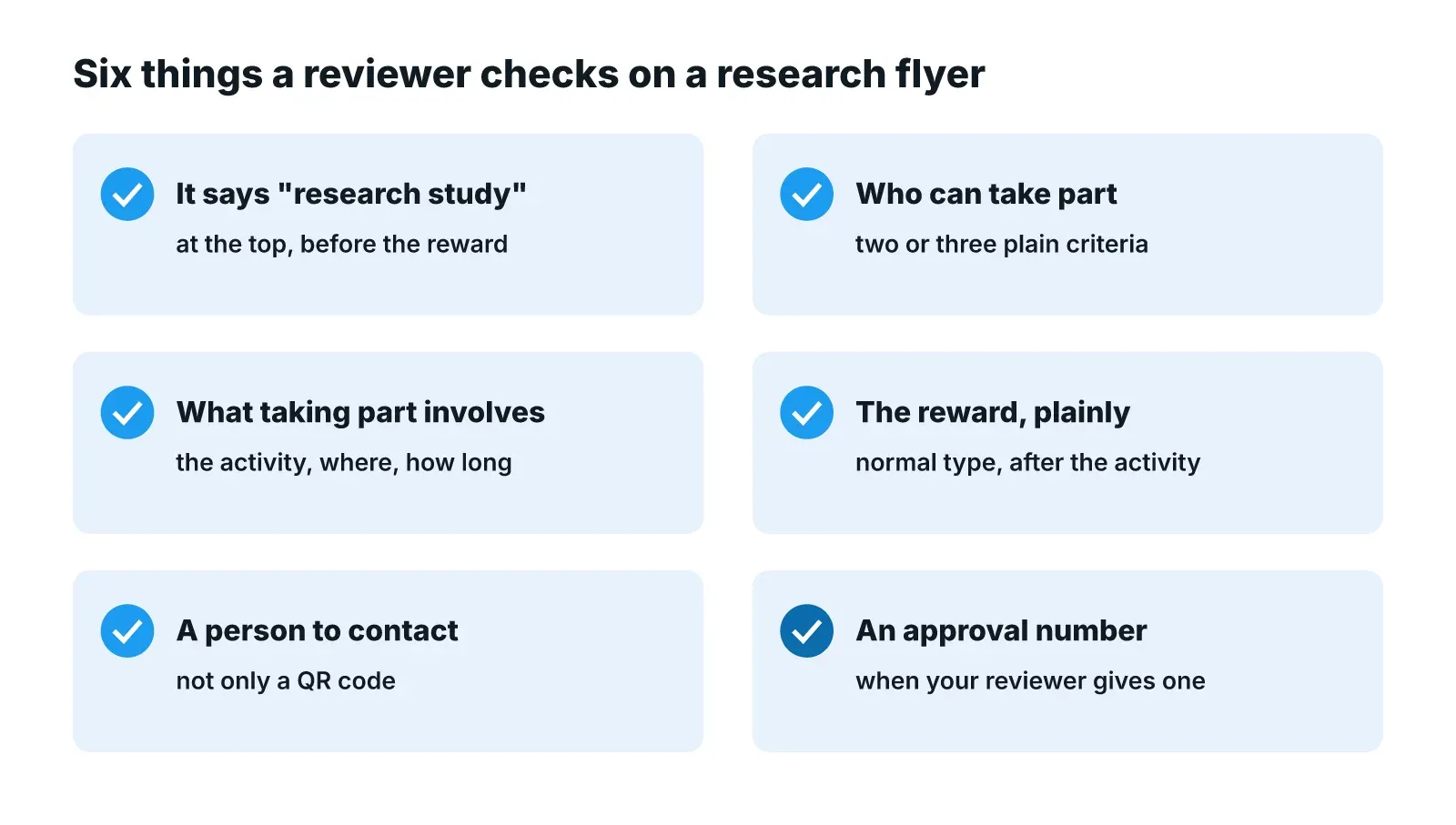
A research recruitment flyer needs six things. Say it's research. Say who can take part and what they'll do. Give the reward. Say who runs the study and how to reach them. And add an approval number when your reviewer asks for one. Reviewers check each of these, so a flyer missing one comes back.
People should know it's research before they read anything else. So the words "research study" go in the heading or the line right under it. A flyer that looks like an advert or a prize draw is the first thing a reviewer flags.
Give two or three criteria in plain words. For the pharmacy study, that could be "adults who shop with us after 7 pm". People should be able to tell in a second if the flyer is for them. Leave the detailed checks for the sign-up page.
Say what people will do, where and for how long. "A 20-minute interview on your phone, at a time that suits you" answers all three. A reviewer wants to see that nobody is surprised later.
Say what people get, in normal type, after the line about the activity. "As a thank-you, a $30 gift card when you finish" is clear. Your reviewer can see the reward isn't pressure, and readers still know what they'll get.
If you're not sure what amount is fair for the time you ask, the incentive calculator helps you work it out.
Say who is running the study, and give a way to reach a real person. A QR code alone isn't enough. Columbia University's Irving Institute advises that a QR code should not be the only way to get more information or sign up, and that flyers should give more than one way to contact the team. So add an email, a short link or a name to ask for at the counter.
An ethics board is a group that checks a study protects the people in it. In universities it's often called an IRB, short for institutional review board. If your board gives the study an approval or reference number, print it on the flyer. Inside a company, ask legal if they want a reference too.
A recruitment flyer shouldn't push, promise or hide. Reviewers send flyers back when the reward shouts or the flyer promises a benefit. They also object to vague words, and to flyers that collect personal details too early. Each one has a simple fix.
"EARN CASH!" as the biggest line makes the study look like a job offer. Fix it by moving the same amount into normal type, after the activity.
"Help improve your health" or "Get better service" promises something the study may not deliver. Fix it by saying what the study is for: "We want to understand how evening shoppers use our stores."
"An exciting opportunity" tells people nothing. Fix it by naming the topic and the activity.
A tear-off strip for names and phone numbers collects personal data before people know how it's used. Fix it by sending people to a sign-up page that explains this first.
Plain language helps everyone. Write so anyone walking past can follow it in a few seconds. Swap "remuneration" for "payment" and "participate" for "take part".
To pass review on the first try, know who reviews your flyer and send them everything at once. Academic, health and public studies usually go to an ethics board. Most company studies go to legal, privacy and sometimes the brand team. Each wants to see the same story from flyer to consent.
Send the flyer, the sign-up page, the screener and the consent text together. A screener is the few questions that check if someone fits your study. Reviewers compare the four, so the reward, time and topic must match across all of them.
Have your answers ready for three questions. What is the reward? How will people's answers be used and stored? And who will see them?
Plan for one round of changes. After approval, any new wording goes back for review. So settle the words before you print.
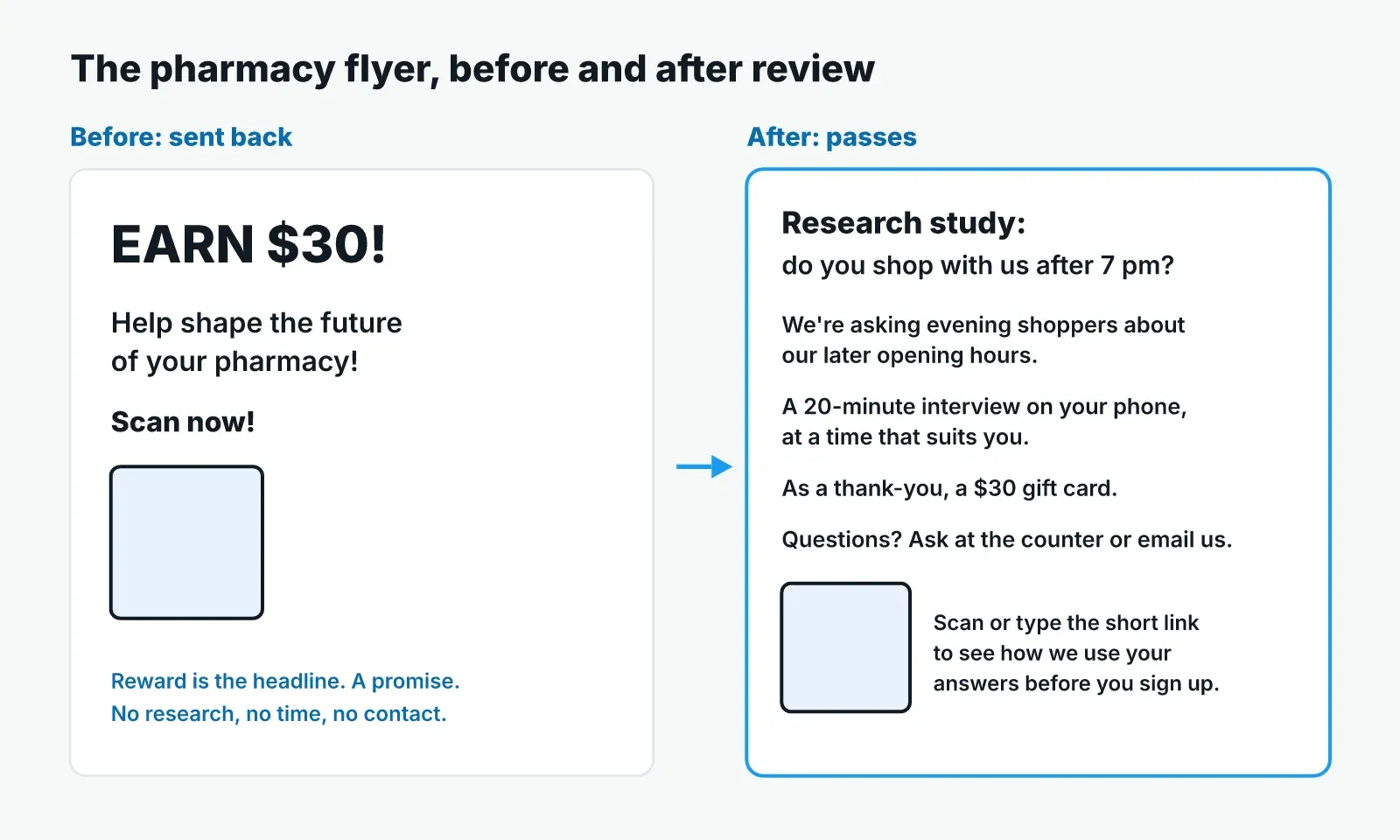
A good research participant recruitment flyer can change only a few words and still pass. Here's the pharmacy flyer before legal saw it, then after the fixes. The reward stays the same. Only the words and their order change.
Before:
EARN $30! Help shape the future of your pharmacy! Scan now! [QR code]
After:
Research study: do you shop with us after 7 pm? We're asking evening shoppers what they think of our later opening hours. A 20-minute interview on your phone, at a time that suits you. As a thank-you, a $30 gift card when you finish. Run by the pharmacy's research team. Questions? Ask at the counter or email us at the address below. Scan the code or type the short link to see how we use your answers before you sign up.
Each change fixes one reason flyers get sent back:
If your reviewer gives a reference number, it goes on the last line. If the flyer will go out more than once, change where it's placed rather than printing more of the same.
Once the flyer passes, the next question from privacy is what happens after sign-up. Pulse gives clear answers. You can invite people by QR code or a public link, so the approved flyer opens the study directly.
People take an AI-moderated interview on their phone or laptop, with no call to book. Personal data is redacted from transcripts, and customer data is never used to train AI models. Pulse is GDPR compliant, and fraud checks run on every participant. The privacy notice for interview participants is there for your reviewer to read.
To see it with your own study, book a demo, start on the $0 Explorer plan or ask for a free study.
For studies at universities, hospitals and many public bodies, yes. The ethics board usually reviews every piece of recruitment material, flyers included, before it goes out. Company studies don't go to an IRB. But legal and privacy teams often ask to see the flyer, so check your company's rules first.
Yes. Say it plainly and honestly: the amount, the form, such as a gift card, and when people get it. What reviewers object to is a reward used as the headline, or words like "easy money". Put it after the activity, in the same size as the other lines.
They can. A 2026 study by the Colorado School of Public Health enrolled 916 adults for a community health study. Of the ways that just announced the study, flyers and flyers sent with water bills did well at getting people enrolled. But replies fell after the first round of repeat mailings. So a fresh place often works better than more of the same flyer.
Participant recruitment means finding the people who will take part in a study and getting them to sign up. It covers where you look, how you invite them, how you check they fit and how you thank them. A flyer is one way to invite people. For other routes, see recruiting your own customers.
A participant recruitment flyer works when it reaches the right people and sign-up takes one scan. Where to hand it out, what to write, how to track it.
What quota sampling is, how to set quotas for 20 to 40 interviews, what to do when a group fills slowly, and why interview results aren't weighted.
Qualitative research sampling: 6 methods with examples, how to choose who to interview next, keep a sampling log, and know when to stop.