What to include in a research participant recruitment flyer
A research participant recruitment flyer must pass review and still bring people in. What to include, what to leave out, and a before-and-after example.
A participant recruitment flyer works when it reaches the right people and sign-up takes one scan. Where to hand it out, what to write, how to track it.
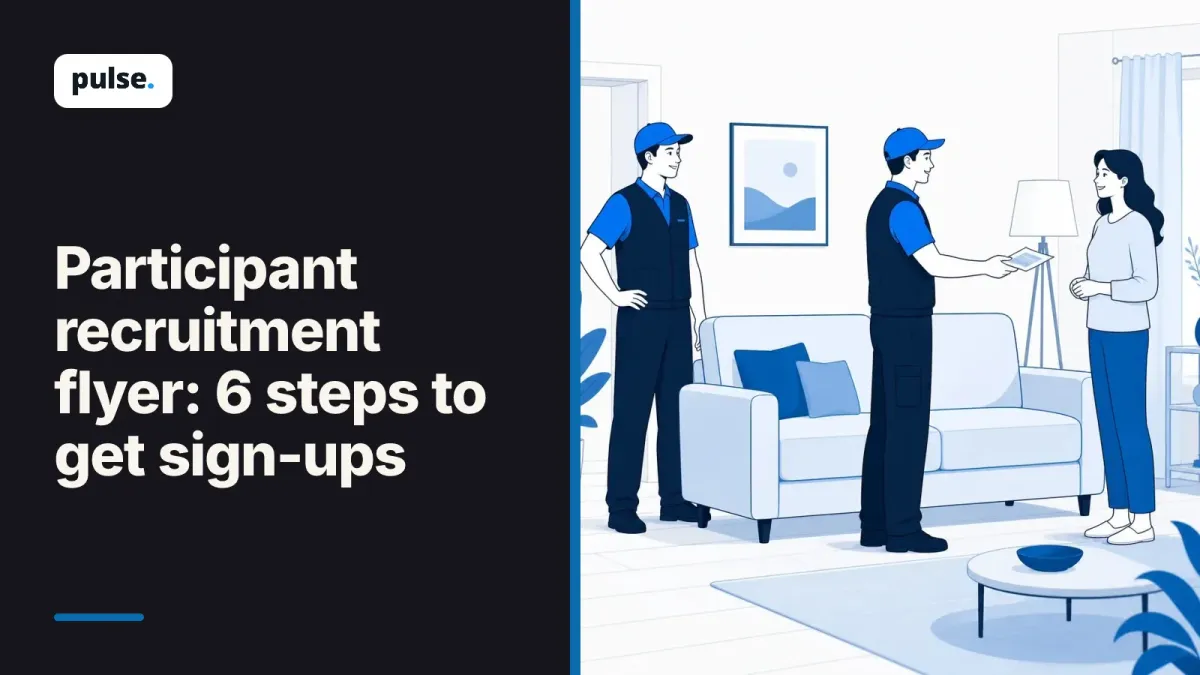
A delivery van stops outside a house. Two people carry in a new sofa and hand over a small paperwork pack.
You work on the research team at the furniture company that sold it. Your team wants to talk to buyers in the week after delivery, while it all feels fresh. But many paid in store, so they aren't on your email list. How do you reach them?
You put a participant recruitment flyer in that pack. A participant recruitment flyer is a short handout that invites people to take part in a study. It works when it reaches the right people at the right moment, and when signing up takes one scan.
So the flyer's job doesn't end when it's handed over. It ends when the buyer finishes an interview.
A recruitment flyer works when you meet your audience in person at a known moment. Buyers at a pickup counter fit. So do visitors at an event, patients in a waiting room and riders at a station. It works badly for people you only reach online, and for busy managers at other companies.
That's why the furniture company is a good fit. The delivery crew meets every sofa buyer. That includes the ones who paid in cash and never gave an email. Those are the buyers your list misses.
Handing out invites in person is a kind of field recruitment. It means you find people where they are, not through a list or an ad.
So when should you skip the flyer? If the people you want are already on your customer list, an email is faster. The post on recruiting from your own customers covers that route. And for senior people at other companies, a flyer rarely reaches them at all.
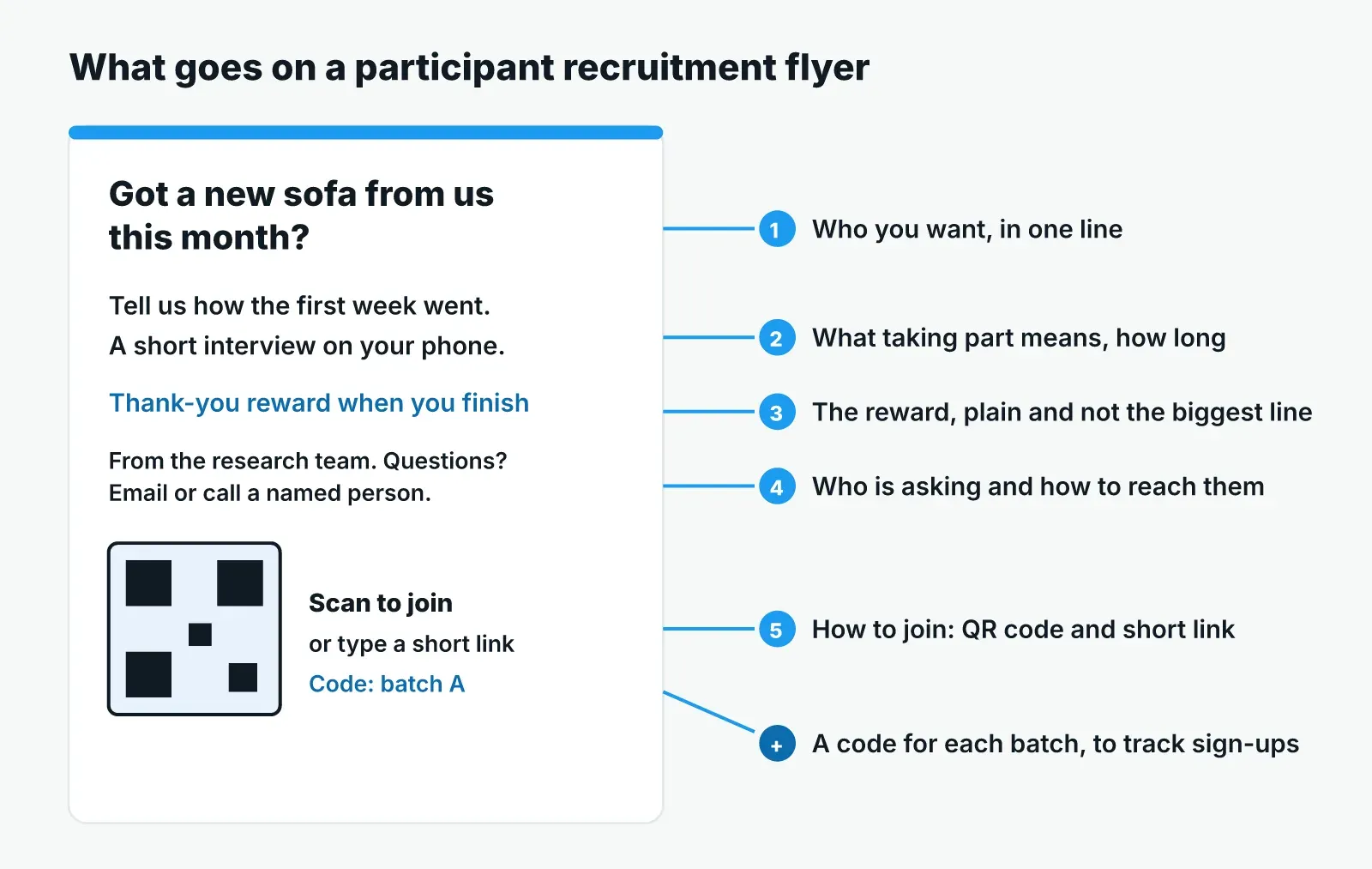
To make a participant recruitment flyer that people act on, plan it around the moment it's handed over. Pick where it goes out. Write five short lines. Add a QR code and a short link. Use a short screener that works on a phone. Test the code. Then give each batch its own code, so you learn which spots work.
Where the flyer goes out decides who replies. So start from your question. If you want people who just bought, use the delivery pack or the till. If you want people who just complained, use the service desk. If you want people who just tried something, use an event stand.
A noticeboard is a backup, because most people walk past it. A flyer handed over with a few words gets read. So ask the delivery crew to say one line, such as "We'd love to hear how the sofa is going."
Count how many flyers go out at each point. You'll need that number later.
A passer-by reads a flyer in a few seconds. So it carries five things and nothing else:
Start with a line that speaks to the reader. "Got a new sofa from us this month?" works better than "Research study". Keep the reward easy to see, but not the biggest line. And never promise anything the study doesn't give. If you're not sure what reward is fair, the incentive calculator helps you work it out.
A QR code is a small square that a phone camera opens as a link. It's often how people sign up. In a 2025 study by Mayo Clinic researchers, routes that carried a QR code, on paper flyers, screens and social posts, brought in 140 responses, or 64% of all responses. The study recruited women aged 18 to 40.
Some people won't scan, though. So print a short link under the code that anyone can type.
The code should open a short, phone-friendly screener. A screener is a few questions that check if someone fits your study. On a phone, three to five questions is plenty. For the sofa study, you might ask when the sofa arrived and which room it's in.
A long form on a small screen loses people before they finish.
Print one flyer first. Scan it with two different phones, in the light where it will be handed out. Fold it into a delivery pack and scan it again. Then check that the code opens the screener, not your home page.
Give each hand-out point its own code or link tag. Then compare sign-ups with the number of flyers each point handed out. If the delivery packs bring sign-ups and the till brings none, move the rest of the print run to the packs.
Watch who signs up, too, not only how many. Check the screener answers against the people you need. A short log helps: the point, the date, how many went out, scanned, qualified and finished.
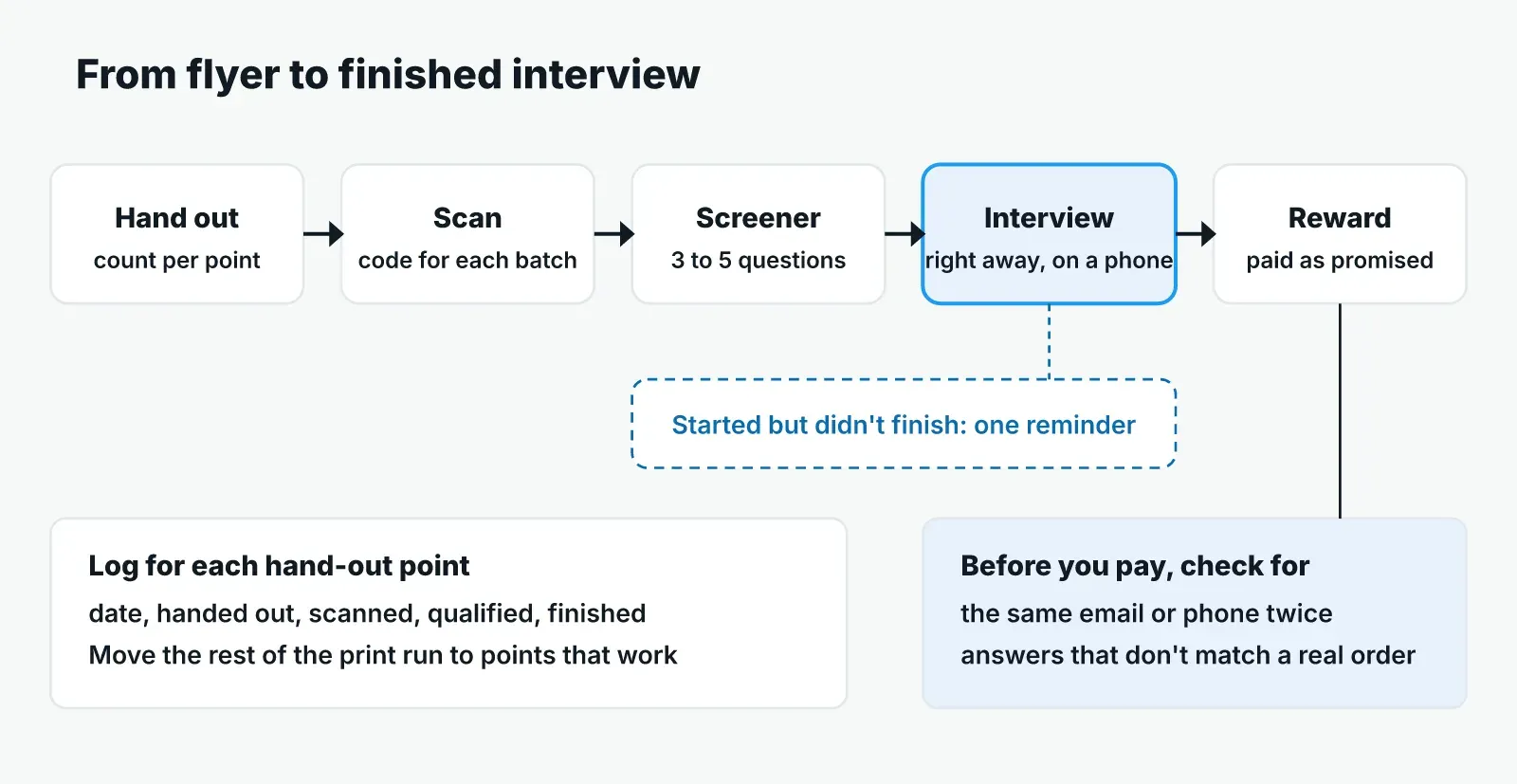
After the scan, move fast. The gap between the scan and the interview is where people drift away. A call booked for next week gives them time to forget, lose interest or change their mind. So let people who qualify take part right away, or pick a time that suits them that day.
Say a buyer scans the code on Saturday morning, answers four questions and starts the interview on the new sofa. Nobody has to call them back.
Send one reminder, and only to people who started and didn't finish. Then pay the reward on the timeline the flyer promised.
Check every sign-up before you pay. An open QR code can travel beyond your buyers. Someone might post a photo of the flyer online, and strangers sign up for the reward. Look for the same email or phone number twice, and for answers that don't match a real order. The post on fake and duplicate sign-ups shows what else to check.
If your audience meets you in person at a clear moment, use a flyer and track every batch. If they're already on your customer list, send an email instead.
The weak spot in flyer recruiting is the wait between the scan and the interview. Pulse removes that wait. You can invite people by QR code or a public link, so the code on the flyer opens the study itself.
Participants take an AI-moderated interview on their phone or laptop, when it suits them, with no call to book. The AI moderator asks everyone the same questions from one guide. It follows up on what each person said and asks again when an answer is vague. Fraud checks run on every participant. And when the flyers don't fill a group, Pulse can also recruit people to the profile your study needs.
To try it with your own flyer, book a demo, start on the $0 Explorer plan or ask for a free study.
There's no standard number. It depends on where the flyer goes out, the moment it's handed over, the reward and how easy sign-up is. That's why batch codes matter. After the first week, you know what each point brings and can plan the rest of the print run from real numbers.
To work out how many people you need in the first place, see how many interviews you need.
Yes, in most cases. People decide fast, and a clear reward helps them decide. Write the amount plainly, in normal-sized text, after the line that says what taking part involves. Some review teams, such as an ethics board, have rules on how a reward is shown, so check with them first.
No. Some people can't or won't scan a code. A short link they can type and a name or email for questions catch those people. The contact line also tells readers a real team is behind the study, which makes people more willing to sign up.
Rarely. A B2B participant is someone who takes part because of their job, such as a buyer at another company. You seldom meet them at a counter or a delivery. Trade events are the exception: a flyer at your stand can work there. Otherwise, your customer list or a recruited panel reaches them faster.
A research participant recruitment flyer must pass review and still bring people in. What to include, what to leave out, and a before-and-after example.
What quota sampling is, how to set quotas for 20 to 40 interviews, what to do when a group fills slowly, and why interview results aren't weighted.
Qualitative research sampling: 6 methods with examples, how to choose who to interview next, keep a sampling log, and know when to stop.