
How to analyze survey and interview data together
Data analysis for research teams: how to read survey numbers and interview themes as one answer, in what order, and what to do when they disagree.
Qualitative research sampling: 6 methods with examples, how to choose who to interview next, keep a sampling log, and know when to stop.

Imagine you work on the research team at a bus company. The company just started charging passengers to choose their seat. Your first few interviews are done. Some passengers shrugged at the fee, and others were angry. But you can't yet tell why. So who should you talk to next?
Deciding who to interview is called qualitative research sampling. And it doesn't stop once the first interviews are booked.
In qualitative research, you choose people on purpose, for what they can explain. Start with a small first batch and read it. Then add people who can answer what that batch left open. Write down each choice, so you can explain the sample later.
After each batch, three questions tell you who to add. A one-page log keeps the reasons on record.
Qualitative research sampling is how you choose who to interview or watch. Surveys and interviews ask different questions. So they need different samples. A survey estimates how many people feel a certain way. So it needs a random sample, or one that's adjusted to match everyone. Interviews explain why people feel that way. So you choose each person for the experience they can describe.
Choosing people this way is called non-probability sampling. It means people are picked on purpose, or because they're easy to reach, not at random. So you can't work out each person's chance of being picked.
That shapes what a qualitative sample can and cannot claim. The table shows the difference.
| What a qualitative sample can claim | What it cannot claim |
|---|---|
| The range of reasons people give | How common each reason is among all passengers |
| How each reason works | A percentage you can apply to everyone |
| Which groups a reason shows up in | That a reason is missing from groups you didn't ask |
If your manager needs a percentage, that comes from a survey later.
So the bus company doesn't need twenty random passengers. It needs people who met the seat fee in different ways. Think of commuters, families, people booking at the last minute, and people who paid without a second thought.
Your first batch needs a plan, because you can't change a sample you haven't started. Interview studies often use purposive sampling, which means choosing people for what they can tell you. The first four methods below are kinds of it. The last two are shortcuts, and each has a cost.
Everyone meets one rule. For the bus company, the rule might be "booked a ticket since the seat fee started." Use it when you know exactly who the question is about.
You spread people across the things that could change their answer. At the bus company, that means different kinds of trips and different ways of booking. It also means people who paid the fee and people who didn't. Use it when you want the full range of reasons.
You pick people whose experience is common and ordinary, like a commuter who books online every week. Use it when you need to explain the usual path.
You pick people at the edges, like someone who rides every day, or someone who stopped riding. Use it to see a problem at its worst.
Snowball sampling asks each person to suggest the next one. It helps with groups that are hard to find. But the sample can end up as one circle of friends.
You take whoever is easiest to reach, like passengers waiting at one station. It's fine for a first look. But it leans toward your keenest customers.
Many teams mix the first two: one rule for who qualifies, and a wide spread inside it. Keep the first batch small enough to read before the next one starts. For a fuller comparison, see how to choose a sampling method.
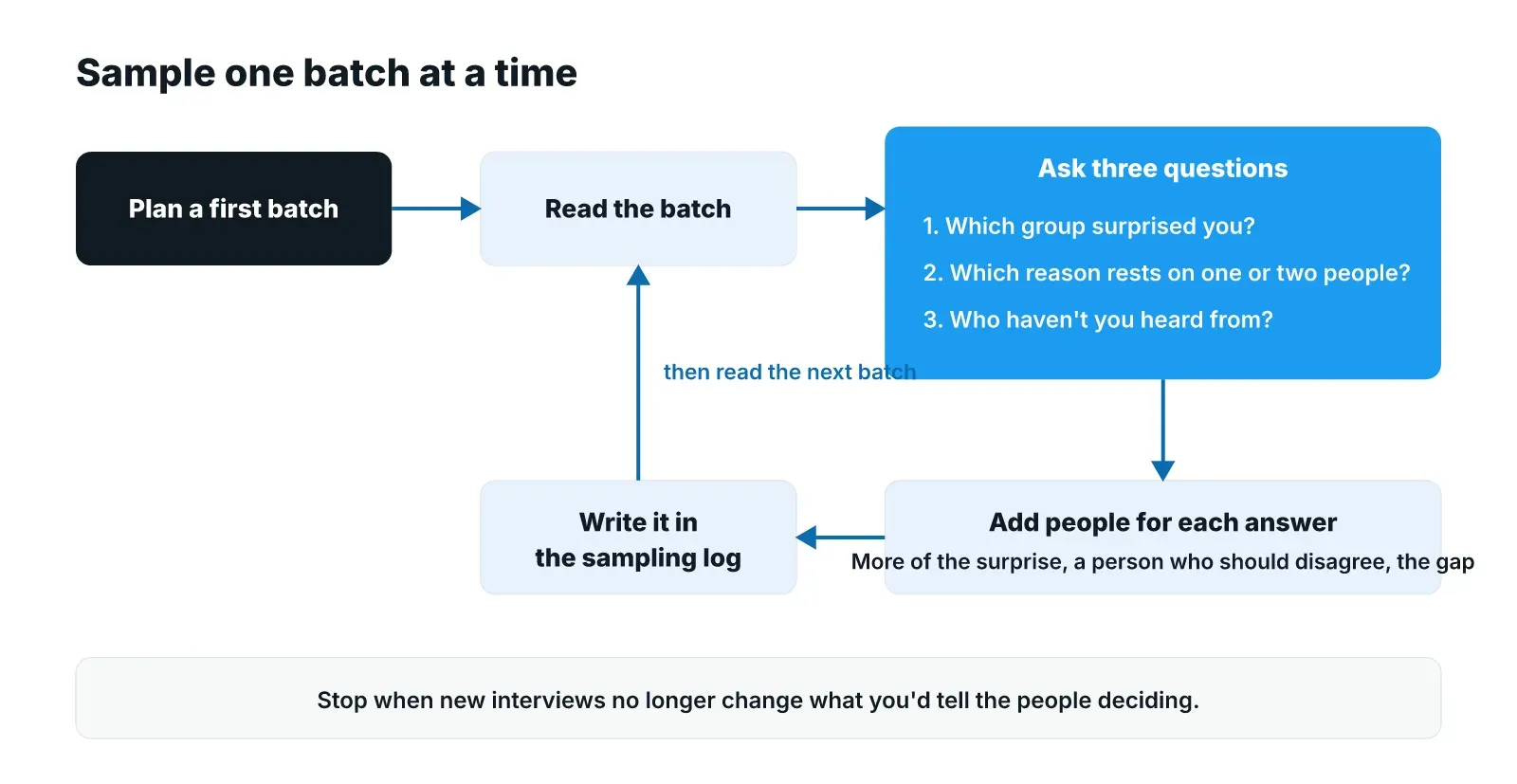
After the first batch, three questions tell you who to add. Which group surprised you? Which reason rests on only one or two people? And who haven't you heard from at all? Each answer points to a kind of person the next batch needs.
Using early interviews to pick who comes next is called theoretical sampling.
Say the first interviews show that families booking together see the seat fee very differently from solo commuters. Families want to sit together. So the fee feels like a charge for something they used to get free. Adding more families tests whether that reason holds.
Next, add a disconfirming case. That's someone who should see things differently if your finding is right. Say your finding so far is "families resent the fee." Then add two families who paid it without complaint. If their reasons fit the finding, it gets stronger. If they don't, you've learned where it stops.
Then look for gaps. Maybe nobody in the first batch booked at the station counter. If counter buyers might feel differently about the fee, the next batch needs some.
Change the rules for who can take part only for a stated reason. Keep the first rules where people can see them. A reader should be able to see what you planned and what you changed.
A sampling log is a one-page record of every choice you made about who to interview. It makes "why isn't this sample random?" an easy question to answer, because each choice has a written reason.
Write one row per batch. Here's what the bus company's log might look like after two batches.
| Batch | Who was added | Why | Where from | What changed |
|---|---|---|---|---|
| 1 | Commuters, families, last-minute bookers | A planned spread of trip types | Customer list | Families see the fee differently |
| 2 | More families, two who didn't mind paying, counter buyers | Test the family reason and fill a gap | Customer list, station staff | Fill in after reading |
Also note who said no or dropped out in each group. That's where sampling bias creeps in, because the people who never answer may have the reason you're missing.
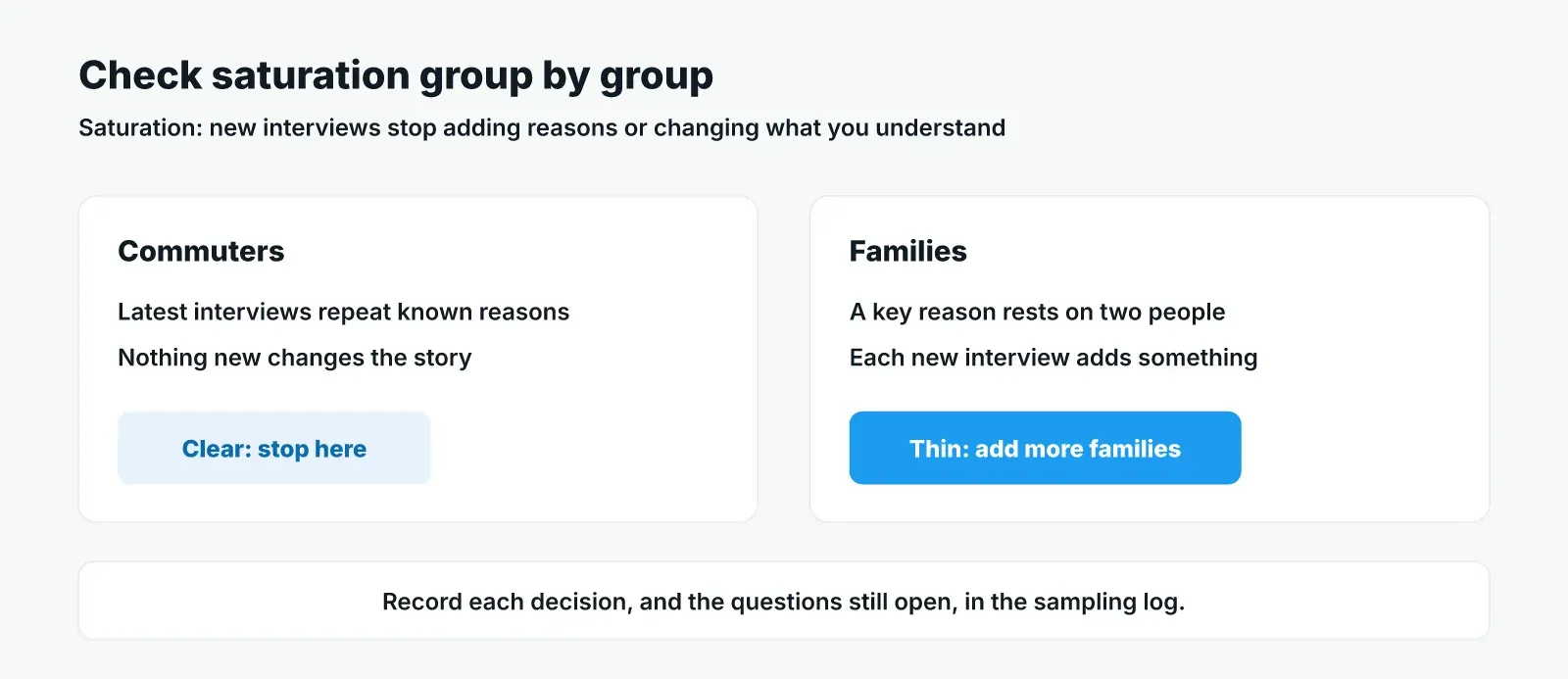
You stop when new interviews stop teaching you anything that would change your decision. Researchers call this saturation. It means new interviews stop adding reasons. They also stop changing how well you understand the ones you have.
Check it group by group, not for the whole study. In the seat-fee study, the commuters' reasons may be clear while the families' reasons are still thin. So the commuters can stop, and the next batch adds more families.
The most useful rule is plain. Stop when new interviews no longer change what you'd tell the people deciding. Then name the questions that are still open.
Before you share the findings, run through the signs a theme isn't ready to show leadership.
Choosing people batch by batch only works if you can read one batch before you pick the next. Pulse delivers each AI-moderated interview as a full transcript with its recording, while the rest of the study is still running. So your team can read the first families before deciding who comes next.
Pulse groups what people said into themes with the quotes behind them, and every quote links to its transcript. That makes it quicker to spot a reason that rests on one or two people. You can recruit people who match the profile in your brief, or invite them from your own customer list. Everyone goes through fraud checks.
The researcher still decides who to add and when to stop, and keeps the log. To see it on your own study, book a demo, start on the $0 Explorer plan, or ask for a free study.
Both are non-random, but they choose people for different reasons. Purposive sampling picks people because of what they can tell you, such as families who paid the seat fee. Convenience sampling picks people because they're easy to reach, such as whoever is at the station today. Purposive is the safer choice when one group's reasons matter most.
You can, inside a group you've already chosen on purpose. For example, you might pick ten families at random from everyone who paid the fee. That stops you from always calling your keenest customers. But with so few people, random picking still won't let you turn the results into reliable percentages.
There's no fixed number that works for every study. It depends on how many groups you need to hear from, and how different their reasons turn out to be. Plan a starting number for each group, then let saturation tell you when to stop. The post on how many interviews you need shows how to pick that starting number.
Data analysis for research teams: how to read survey numbers and interview themes as one answer, in what order, and what to do when they disagree.
Qualitative grounded theory explained with one gym example: when to use it, how interview rounds and coding work, and how to know when you can stop.
How to use affinity mapping for user interviews: one idea per note, sort by meaning, count people not notes, and check themes against quotes.