Participant recruitment methods: 5 ways to find people
Participant recruitment methods compared by who you need: your own list, panels, referrals, networks and recruiters, plus a check before you set a date.
How to validate qualitative research findings: test each theme for 11 signs it isn't ready, from one loud segment to half-fitting quotes, with a fix.
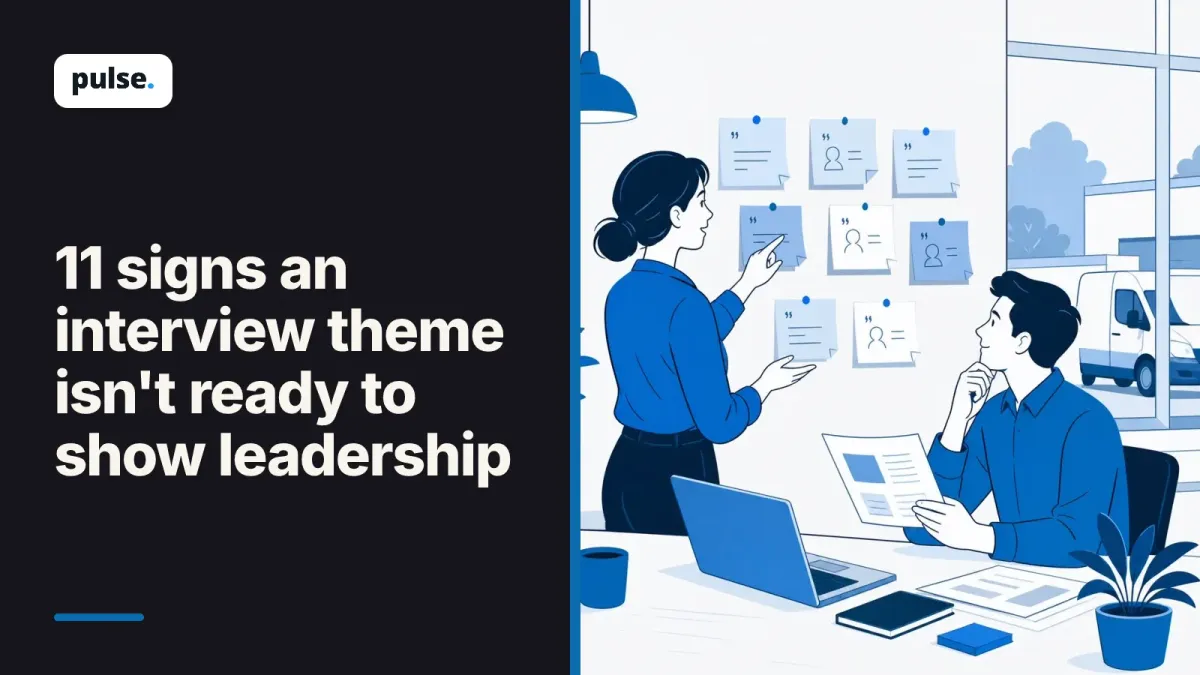
Say you work on the research team at a supermarket chain. You ran interviews with customers who get their groceries delivered, and one theme keeps coming up: the delivery comes late. Next week you show it to the people who decide where the delivery money goes. So is the theme ready?
A theme is a pattern you hear again and again across interviews. Checking that it holds up before anyone acts on it is how you validate qualitative research findings.
A theme is ready when different kinds of customers raise it in their own words, the quotes say what the theme claims, and you looked for proof against it and it held.
So ask three things of every theme: who said it, what the quotes say, and how you built it.
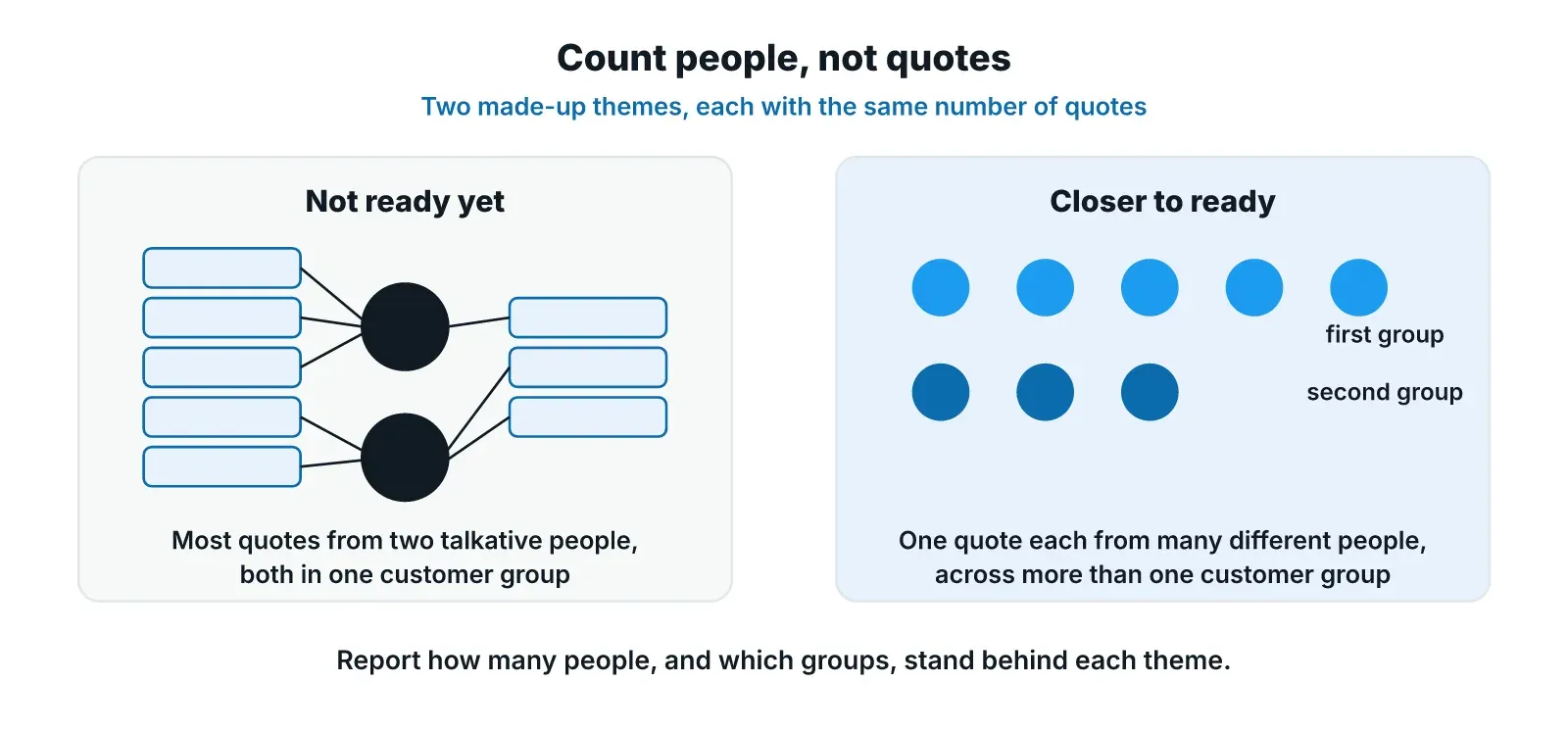
Your late-delivery theme has 14 quotes behind it, which feels strong. But the number that matters is how many different people said it, and which kinds of people. A theme from many customers in several groups can speak for the company. A theme from a few people in one group speaks only for them.
One customer who loves to talk can fill a theme alone. So count the different people behind the theme, not the quotes. Then put that count next to the theme, so nobody mistakes one long interview for a pattern.
Say all the late-delivery quotes come from customers who live far out of town. The vans may take longer to reach them. Either say the theme holds for that group, or check whether customers in town feel the same.
If the theme comes only from interviews in one country, present it as a finding for that country. Your company may run delivery very differently in the next one.
Someone with a stake is a person who cares how the answer comes out. If the delivery team chose which customers to interview, they may have picked the friendliest ones, or the angriest. Say how people were chosen, so the people deciding can judge for themselves.
There's no fixed number of interviews that makes a theme reliable. It depends on how many different groups the decision covers. The idea of data saturation, the point where new interviews stop adding new themes, helps you judge it one group at a time.
A quote can sound right on a slide and still say something else. So before the meeting, read every quote under the theme and ask what it really supports. Read each one on its own, as if you'd never seen the theme.
Say a customer tells you, "The van came on time, but the milk was missing." That's about missing items, not a late delivery. It belongs to a different theme.
Read each quote and ask, "Would I write this theme from this quote alone?" If the answer is no, split the theme into two, or drop the weak quotes.
"It was annoying" tells you how a customer felt. It doesn't tell you what caused it. Present it as what happened, and say the reason is still open.
A leading question pushes people toward an answer. So read the question just before each quote in the transcript, the written record of the interview. If the interviewer asked, "Was the van late?", a yes doesn't count for much. The post on auditing AI interview themes back to the exact quote shows how to trace each one step by step.
"Customers hate our delivery" is a big claim if people said the van was "a bit late." Reword the theme to match how strongly customers spoke.
Sometimes the problem is how the team got to the theme. Say the delivery team expected late vans to be the problem before a single interview ran. That's when a theme is most likely to show up, because people were looking for it.
If the team had the answer in mind first, someone needs to push back. Ask a colleague who wasn't in the study to argue against the theme. This guards against confirmation bias, the habit of noticing what fits what you already believe.
Search the transcripts for customers who praised the delivery times, or never mentioned them. Then report them next to the theme.
Say the van records show most deliveries arrive on time. Then the theme and the records disagree. Explain the gap, or hold the theme until you can.
One common check is to have two people sort the interviews into themes and see if they agree. That's called inter-rater reliability. Another is member checking, where the people you interviewed confirm your reading. But these checks don't fit every method. In a 2024 review of 31 articles in Health Promotion International, Virginia Braun and Victoria Clarke state that participants checking the "accuracy" of transcripts and researchers establishing inter-coder reliability are not congruent with reflexive thematic analysis. That's an approach where the researcher's own reading is part of the method.
In plain words, two people agreeing shows they read the interviews the same way. It doesn't show the theme is true.
Before the meeting, take each theme in turn and run the quick test for each sign. Then decide whether to show the theme as it is, show it with a limit, or hold it back. This table puts every sign, its test and its fix on one page you can print.
| Sign | Quick test | Fix |
|---|---|---|
| 1. One or two talkative people | Count the different people, not the quotes | Report the count |
| 2. One customer group | List the groups behind it | Name the group, or check the others |
| 3. One country or language | List the countries behind it | Present it as a finding for that country |
| 4. Picked by someone with a stake | Ask who chose the people | Say how they were chosen |
| 5. Quotes half support it | Would this quote alone give you the theme? | Split the theme or drop the quote |
| 6. What happened, not why | Does any quote give a reason? | Say the reason is still open |
| 7. Leading question | Read the question before the quote | Drop or flag the quote |
| 8. Label too strong | Compare the label with the words people used | Reword it to their strength |
| 9. Named before the interviews | Was this the team's guess going in? | Ask a colleague to argue against it |
| 10. Nobody looked for the opposite | Search for praise or silence | Report the customers who disagree |
| 11. Clashes with other data | Compare with records or survey scores | Explain the gap, or hold it |
Once the late-delivery theme passes, it reads very differently.
Before: "Customers say our grocery delivery comes late."
After: "Customers who live outside town, in both countries we studied, said the van often came after the time they booked. Customers in town rarely raised it. Two customers said the text telling them the van was on its way helped."
The second version says who, where, in whose words, and what pushed against it. Each part answers a question the people deciding will ask.
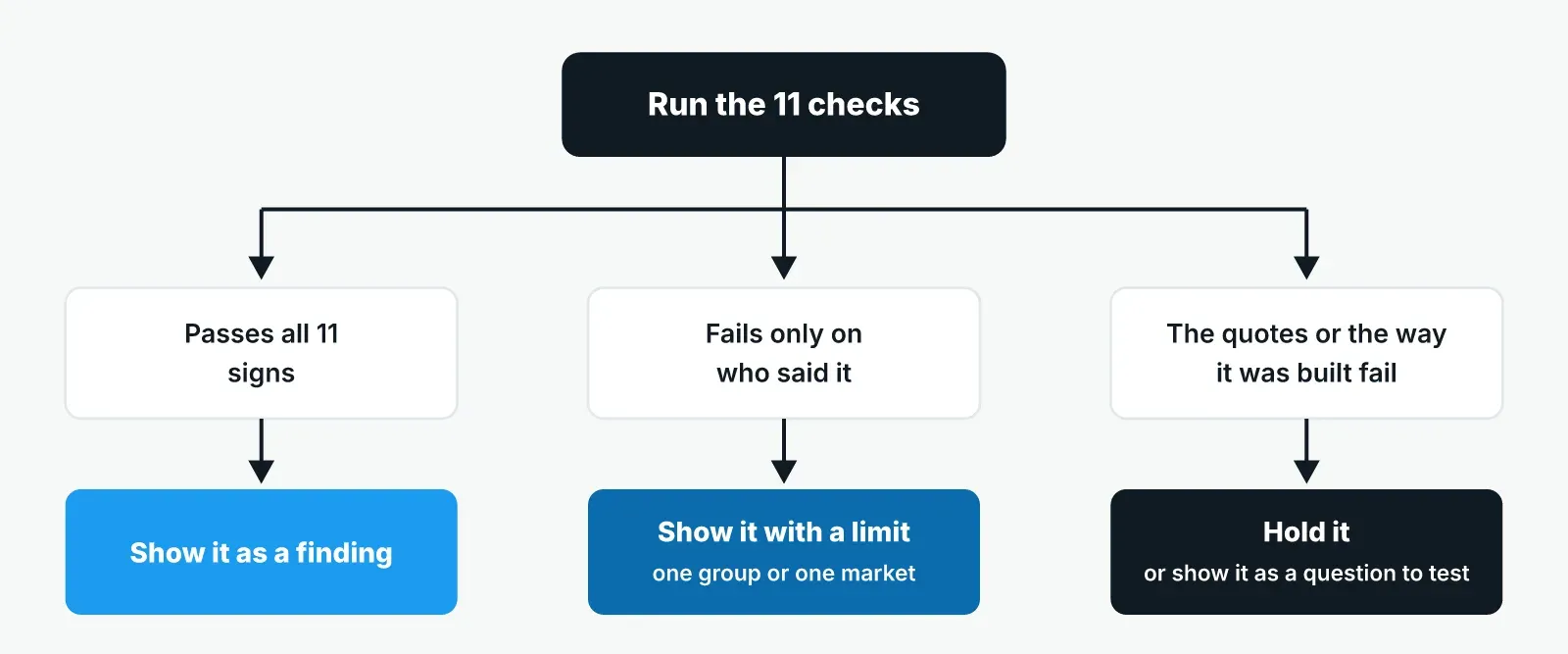
Show a theme as a finding when it passes all 11 signs. Show it with a stated limit, such as one group or one country, when it fails only on who said it. Hold it, or show it as a question to test next, when the quotes or the way it was built fail.
A theme you hold back costs a week. A wrong theme costs the budget.
These checks need every quote traced to its transcript, and every theme split by group and country. That's slow work by hand. Pulse groups what people said into themes, each with the quotes behind it, and every quote links to the transcript it came from. One study can run in several countries from one discussion guide. So a difference between countries comes from customers, not from how the study was run. Every person gets the same well-formed questions, so answers compare fairly.
The insight repository keeps earlier studies' themes, quotes and transcripts in one place you can search. So you can check whether the late-delivery theme came up before. You still decide which themes are ready and how to word them. Pulse gives you the time to do it.
If you'd like to see how Pulse traces a theme back to the interviews behind it, book a demo.
There's no single number. You need enough different people in each group the decision covers. So a theme about customers outside town needs several of those customers behind it. When new interviews in a group stop adding anything new, you've likely heard the main themes for that group. Check each group on its own, rather than counting the whole study.
Show three things with it: who said it, what they said in their own words, and what you checked against it. When the people deciding can see the range of customers, read the quotes and see the customers who disagreed, they can judge the finding themselves. They don't have to take it on trust.
Validity asks whether a theme shows what customers really meant. Reliability asks whether the same process would give the same result again. In interview research, start with validity. A theme can be reliable and still wrong, if everyone reads the quotes the same mistaken way. So check the meaning first, then the consistency.
Show it as a question to test next. Say what you heard, from whom, and what's still missing. Then suggest a short follow-up study or a survey to check it. That keeps a useful early signal in front of the people deciding, without asking them to spend money on it yet.
Participant recruitment methods compared by who you need: your own list, panels, referrals, networks and recruiters, plus a check before you set a date.
Semantic vs latent themes, from Braun and Clarke's paper "Using thematic analysis in psychology", shown on real-life quotes, with when to use each.
How to choose a transcription service for research interviews: test each option on your own audio with five simple checks, from accuracy to data safety.