Where sampling bias enters an interview study, and how to catch it
Sampling bias enters an interview study at the recruit source, the screener, the incentive and the calendar. Here are the checks to run first.
Purposive sampling picks B2B participants on purpose. Set criteria tied to the decision and explain the choice to stakeholders who expect random.

Purposive sampling selects participants because they hold the information a decision needs. In B2B interviews, that means choosing by written criteria which accounts to include and which roles inside each account to interview. This guide maps purposive strategies to B2B questions, sets the criteria, and gives you the rationale to bring to a stakeholder who expected a random sample.
Purposive sampling is a non-probability method, also called judgmental or selective sampling, in which the researcher picks participants for what they can tell the study. In B2B the choice happens twice: first the accounts, then the people inside them, because a buying decision is spread across several roles at each company.
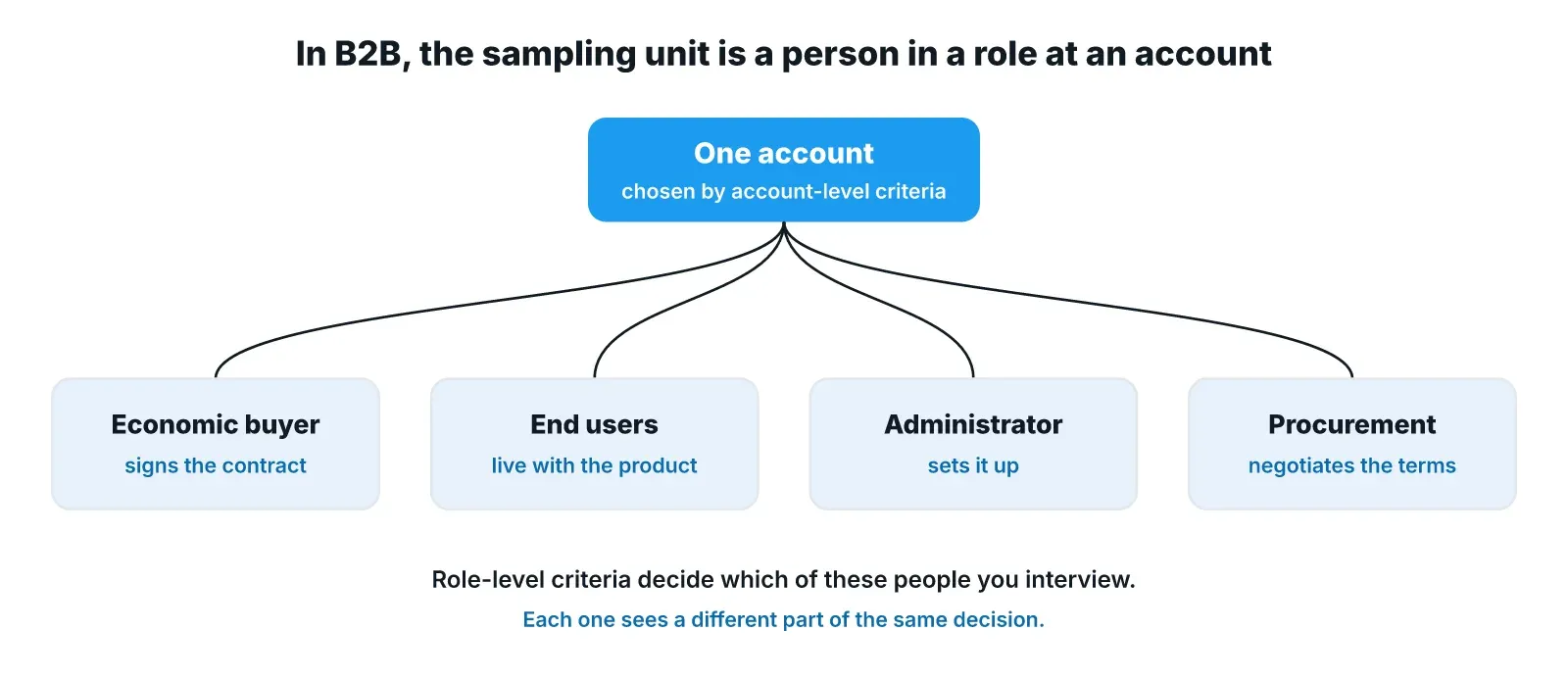
An enterprise software purchase can involve an economic buyer who signs, end users who live with the product, an administrator who sets it up, and procurement, which negotiates the terms. Each sees a different part of the decision. Interview only the champion who bought, and the study hears the reasons for buying while it misses why the admin team stalled the rollout.
So in B2B the sampling unit is a person in a role at an account. A list of company names tells you little until you know who at each company you spoke to, and why that person.
Pick the strategy from the question. Maximum variation fits questions about how experience differs across segments, homogeneous sampling fits a deep question about one group, extreme cases fit questions about failure or outsized success, and expert sampling fits questions only specialists can answer. The table maps each strategy to a B2B example.
| Strategy | B2B question it answers | Who you pick | What findings can claim |
|---|---|---|---|
| Maximum variation | How does onboarding differ across segments? | Admins from small, mid-market and enterprise accounts | The range of experiences, and where they diverge |
| Homogeneous | Why do enterprise admins in one region abandon setup? | Admins at enterprise accounts there who stopped setup | That group's reasons, in depth |
| Typical case | What does an ordinary renewal look like? | Accounts the account team rates as routine renewals | How the usual process runs |
| Extreme or deviant case | Why did our largest accounts churn? | The largest churned accounts, and the largest that expanded | What separates the outliers |
| Critical case | Will procurement accept the new contract terms? | The account with the strictest procurement process | A hard test of the terms |
| Expert | How will a rule change affect payment workflows? | Compliance leads and integration specialists | Informed judgment from people closest to the problem |
The choice also changes how you plan the number of interviews. A 2025 review of purposeful sampling in business and management research, published in the Review of Managerial Science, says the more sampling is directed toward homogeneity, the fewer participants or cases are needed to reach saturation. A maximum variation design spreads interviews across more groups, so plan for more in total.
Start from the decision, then set criteria at two levels. Account-level criteria decide which companies qualify, and role-level criteria decide who inside them you talk to. Write both as inclusion and exclusion rules, and turn them into screener questions before anyone suggests a name, so the criteria choose the participants and no one's contact list does.
Choose the account traits that could change the answer: segment, contract value tier, region, contract status and product line. Active, renewing and churned accounts can describe the same product very differently, so contract status belongs on most lists. Each criterion should trace back to the decision. If contract value tier would not change what you do, drop it.
Then decide whose view the decision needs: the role in the buying committee, time in that role, and whether the person uses the product hands-on or signs off on it. A finance head who approved a purchase and an operations lead who runs the product daily will describe two different products.
Write each rule as a screener question with a qualifying answer, and list the exclusions as plainly as the inclusions. Then invite from the list that matches the criteria. Names hand-picked by account managers bring in the accounts with the warmest relationships. Pulse turns the research question into a brief with an audience and screener, then recruits participants to that profile or invites a company's own customers from a list it supplies.
This example is illustrative. A payments provider's insights team supports the merchant acquiring and product business units, and needs to understand how mid-market merchants choose payment rails. The decision is where to put product investment in the next planning cycle, so the sample is built around who makes the rail decision at a merchant and on what grounds.
| Role | Mostly card payments | Mostly bank transfers | Switched rails in the last year |
|---|---|---|---|
| Finance head | 2 | 2 | 2 |
| Operations lead | 2 | 2 | 2 |
| Developer | 1 | 1 | 2 |
The grid uses maximum variation across rails and expert selection within each merchant. The switchers get extra developer interviews because at these merchants a rail change runs through an integration, and the team wants to hear that work described firsthand.
Two groups are excluded on purpose. Micro-merchants are out because the decision in scope is the mid-market one. Merchants still in onboarding are out because they have not yet made a rail decision they can explain.
The readout may claim the factors each role weighs, and how those factors differ between merchants who switched and merchants who stayed. It may not claim what share of mid-market merchants prefers each rail. The steering committee signs off the grid and the exclusions before fieldwork, so the debate about who was in the sample happens before any findings exist.
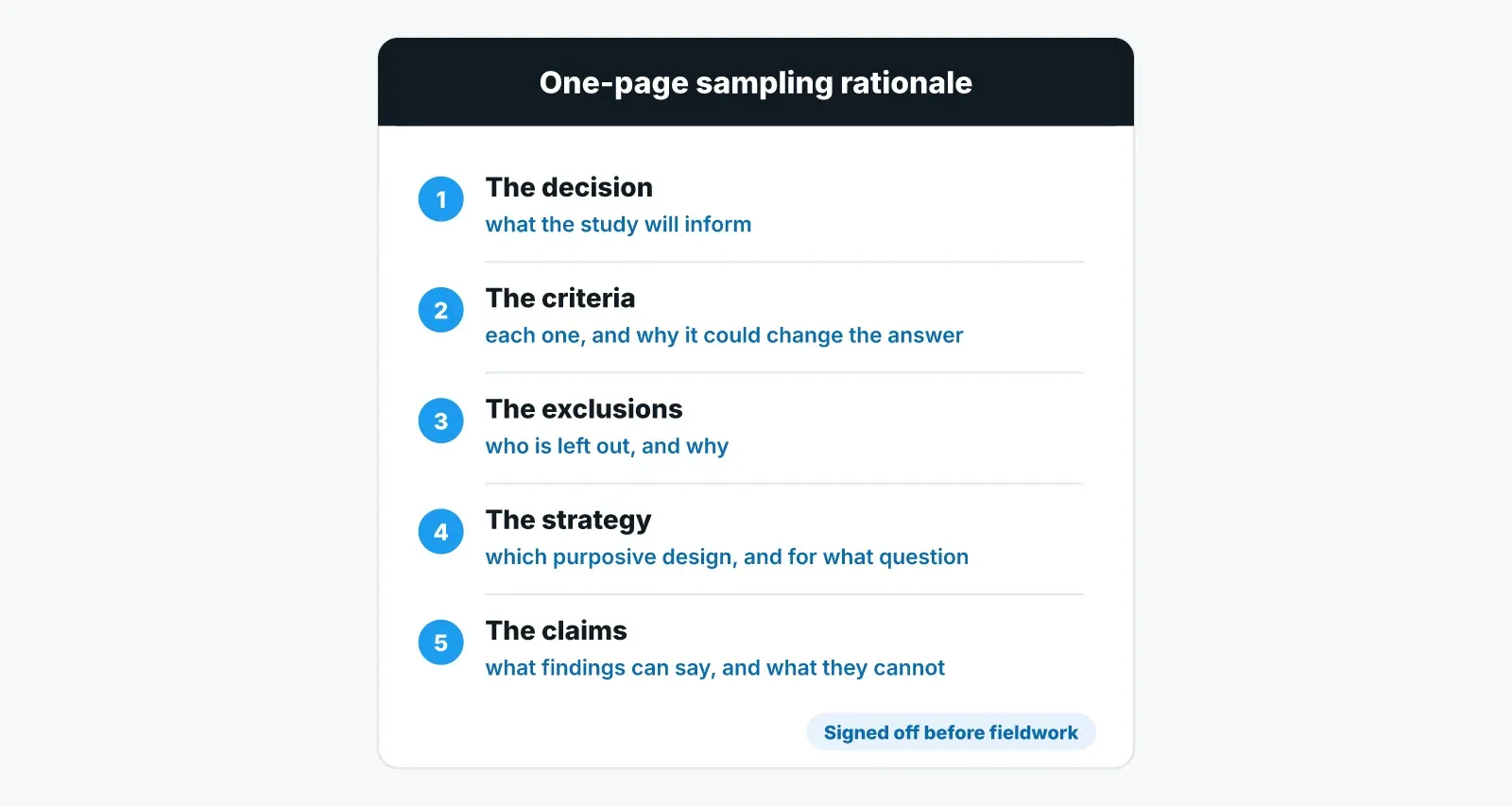
Make the argument in one sentence: random selection answers how many, and purposive selection answers why and how. A small random draw of business customers can miss the rare roles, such as procurement, that decide the deal. Then put the rationale on one page, so the stakeholder approves the logic before fieldwork starts.
| Objection | Answer |
|---|---|
| "It is biased." | The selection is deliberate and written down, so anyone can check it against the criteria. An undocumented choice is the bias to worry about. |
| "It is not statistically significant." | Interviews estimate no proportions, so significance tests do not apply. The findings claim reasons and differences, and a survey can size them afterward. |
| "You picked people who agree with you." | The criteria were set before any names, and the sample includes accounts likely to disagree, such as churned or downgraded customers. |
When leadership needs prevalence, the next study is a survey built from the interview themes and sent to a sample drawn by random sampling from the customer base. The post on pairing a survey with interviews covers how the two fit together.
Purposive sampling goes wrong when the purpose slips during recruiting. The usual failures are convenience sampling relabeled as purposive, criteria that drift as deadlines approach, and a sample so similar that it cannot show the difference the decision turns on. Each one has a check you can run while the study is still recruiting.
Interviewing whoever the sales team can reach this week is convenience sampling, whatever the plan calls it. The test is whether each participant meets a written criterion that was set before recruiting began.
Hard-to-reach roles, such as procurement or senior finance, get quietly replaced by easier ones as the deadline nears. Track filled cells against the plan every day, and report any cell you could not fill instead of backfilling it with a different role.
A homogeneous sample suits a deep question about one group. If the decision turns on a difference, such as switchers against stayers, both sides need to be in the sample.
Select accounts on purpose, then use snowball referrals inside each account to reach the admin or procurement contact your first participant works with. Where account segments are large and well defined, stratified sampling can choose accounts within each segment, with purposive selection of roles inside them.
Whichever methods you combine, the readout should show which roles each theme rests on, the practice set out in auditing themes back to the exact quote. Pulse traces every theme to the quotes in the transcripts behind it, so a reviewer can make that check. Book a demo to see it on a live study.
Random sampling gives every member of the population a known chance of selection, so results generalize to that population with a measurable margin of error. Purposive sampling picks people for what they know, so results generalize to the reasons and patterns in the groups chosen. Use random sampling to count, and purposive sampling to explain.
The common types are maximum variation, homogeneous, typical case, extreme or deviant case, critical case and expert sampling. A B2B study often blends two of them, such as maximum variation across accounts and expert sampling within each account. Name the strategy in the study plan so reviewers know what the findings can claim.
Use it when the question is about reasons, processes or decisions, and when the people who can answer are a small or specific group, such as buying committee members at enterprise accounts. Use a probability method when the question asks what share of customers think or do something, because only a probability sample supports that claim.
The main challenges are reaching the rare roles the criteria call for, keeping recruiters from swapping them for easier participants, and persuading stakeholders who expect randomness. All three get easier when the criteria and rationale are written and signed off before fieldwork, and filled cells are tracked during it.
Yes. One useful sequence is purposive interviews first, to find the reasons, then a survey to a random sample of customers, to size them. Within an interview study, purposive account selection pairs with referrals inside each account, which reach roles your first contact can introduce you to.
Sampling bias enters an interview study at the recruit source, the screener, the incentive and the calendar. Here are the checks to run first.
Build an empathy map from interview transcripts so every note points to a real quote. What goes in each quadrant, and how to label your guesses.
Monadic pricing shows each respondent one price. See when that beats price laddering, what it costs in sample, and how interviews explain the result.