
Qualitative research sampling: 6 methods, with examples
Qualitative research sampling: 6 methods with examples, how to choose who to interview next, keep a sampling log, and know when to stop.
Qualitative grounded theory explained with one gym example: when to use it, how interview rounds and coding work, and how to know when you can stop.

Nobody on your team at the gym chain can say why so many members quit around their third month. Sales blames the price. Trainers blame motivation. Nobody has a real answer, so how do you study a problem when you don't even have a guess to test?
That's the job qualitative grounded theory was made for. It builds an explanation from what people tell you, instead of testing one you already have.
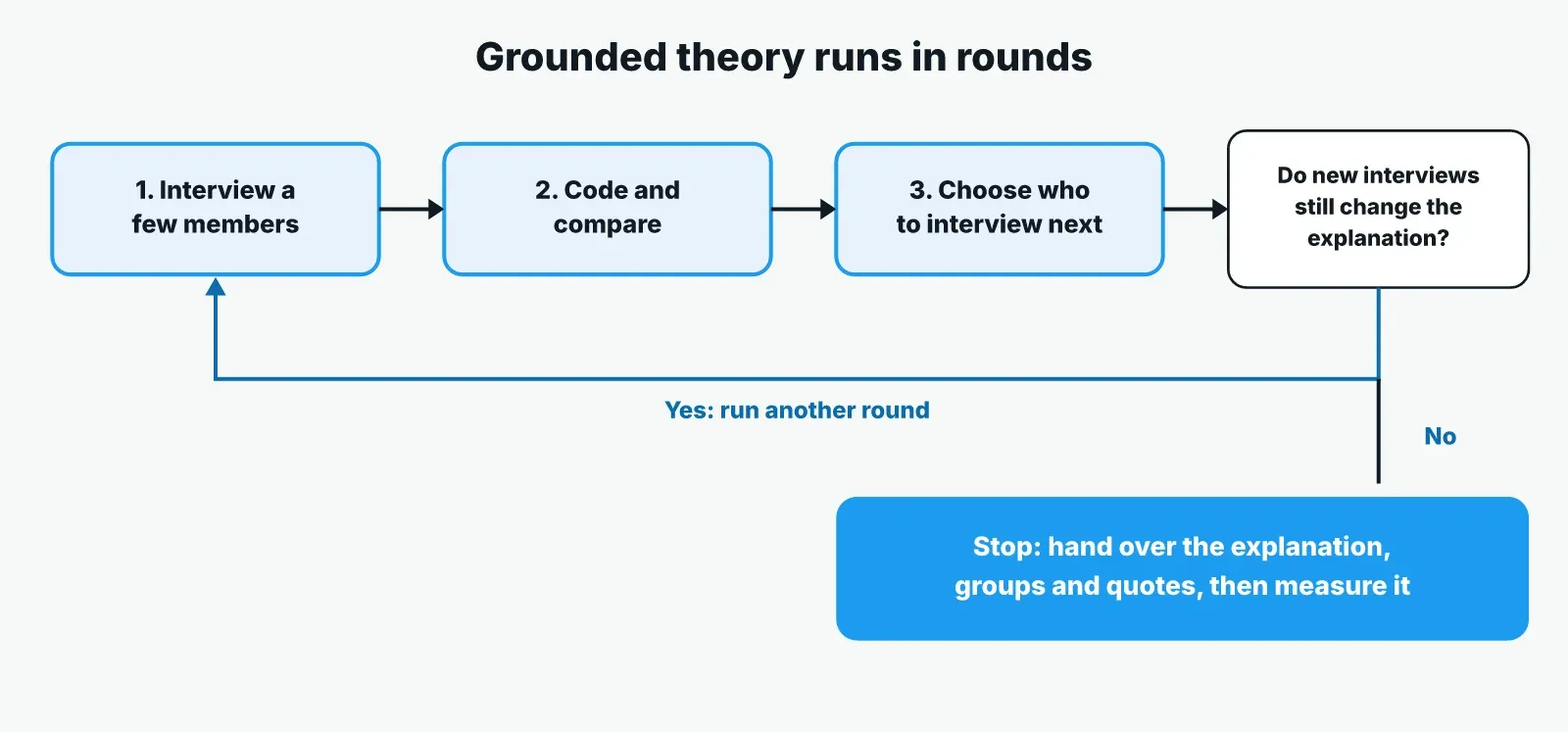
You interview a few members, then study what they said straight away. What you learn decides who you talk to next. You stop when new interviews no longer change the explanation.
Each of those moves is simple enough for the gym team to start this month.
Use qualitative grounded theory when the problem is new, nobody agrees on the cause, and your decision depends on knowing that cause. It's a way of doing qualitative research that builds an explanation from interview data. You don't start from a hypothesis, which is a guess you plan to test.
The gym problem fits well. Members leave, the team has three different stories, and none of them comes from members. If the team picks one story and runs a survey on it, the survey can only confirm or reject that story. It can't find a fourth reason nobody thought of.
Grounded theory fits less well in two cases. If you already know the likely reasons and need to know how common each one is, run a survey. If you only need reactions to a fixed idea, like a new class timetable, run a concept test, which means showing people the idea and asking what they think.
The method is older than most business research. Two sociologists, Barney Glaser and Anselm Strauss, described it in the 1960s. Anselm Strauss and Juliet Corbin later wrote a more step-by-step version. Kathy Charmaz then added a version that says the researcher's own view shapes the explanation too. The versions mostly differ on how much the researcher brings in. A business team can follow the core they share.
Start with a few open interviews, then study each one before you run the next. Label what is happening in each passage, then compare each new interview with the earlier ones. Labels that keep showing up join into bigger groups, and those groups start to explain the problem.
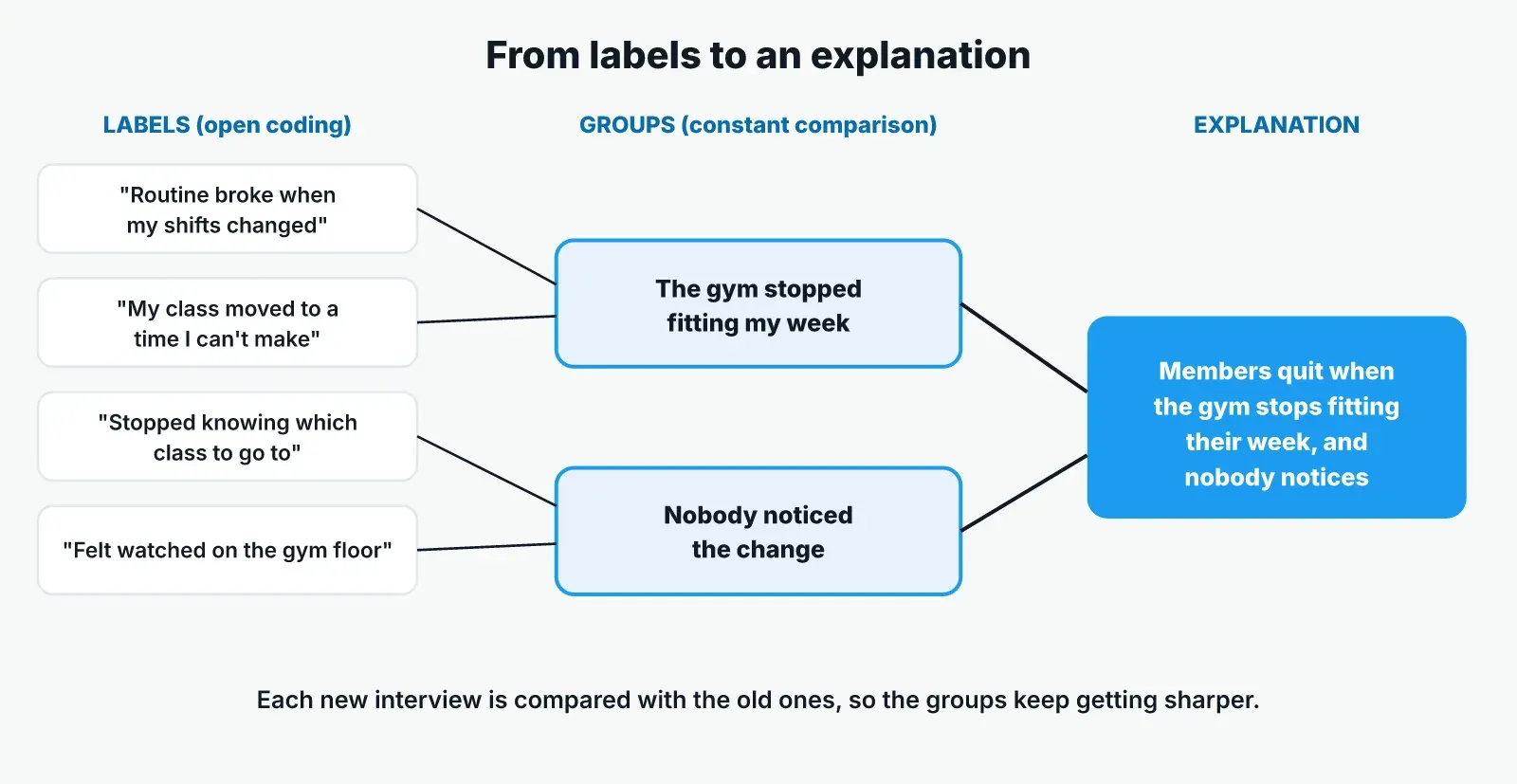
Say the gym team talks to six members who quit. Before the second interview, someone reads the first transcript line by line. Each passage gets a short label in plain words. "Felt watched on the gym floor." "Routine broke when my shifts changed." "Stopped knowing which class to go to." Researchers call this open coding: breaking an interview into small pieces and naming each one.
Because the team studies each interview first, the next interview can ask about what they just heard. If the first member talked about shifts, the second can be asked how their week changed. The posts on running the interviews and writing an interview guide help with this part.
Next, the team holds each new passage up against the old ones. "Routine broke when shifts changed" and "my class moved to a time I can't make" turn out to be the same kind of thing. They join into a bigger group: "the gym stopped fitting my week." Researchers call this constant comparison, because you keep comparing as long as the study runs.
Over a few rounds, the groups start to connect. Members quit when the gym stops fitting their week, and nobody at the gym notices the change.
These steps aren't a business invention. A 2019 guide for new researchers, by Tie and colleagues at two Australian universities, sets out the same core methods. It describes collecting and studying data at the same time, constant comparison, and theoretical sampling.
Theoretical sampling means you choose the next people to interview based on what you've learned so far. You don't pick everyone at the start. Each round, you ask who could test or fill a gap in the explanation, and you go and find those people.
Back at the gym, the first round points at shift changes. So the team now looks for members who changed shifts but stayed. If they kept coming, something held them. Maybe a trainer moved their sessions, or a friend kept them going. Those people can show what the gym could do for the members who left.
This is the big difference from most studies. In a normal study, you set the sample at the start, then interview everyone on the list. In grounded theory, the sample grows as the explanation grows. You can't write the full list on day one, because you don't yet know what you're looking for.
That doesn't mean picking people at random. Every new person is there for a reason you can write down. If you'd like a rough idea of numbers for planning, this guide on how many interviews you need explains what drives the count.
You stop when new interviews no longer add groups or change the explanation. Researchers call this saturation. There's no fixed number of interviews for it. It depends on how different your people are, so a mixed group of members takes longer to reach than a similar one.
The gym team knows they're close when the last few interviews only repeat what they've heard. A member says the class moved and they drifted away. That fits "the gym stopped fitting my week" without changing it. When several interviews in a row do that, the explanation is ready.
Then the team hands over three things:
The explanation isn't the end. Other teams can now count it. A survey can ask all members whether their week changed and whether that changed how often they come. That tells the gym how big each reason is.
Use grounded theory to find the explanation. Then measure it.
Grounded theory needs quick rounds, with time to study each one before the next. Pulse builds an AI-moderated interview from your brief: the research question, the areas to cover, the audience and the screener. Members take it by link on a phone or laptop, so there are no calls to schedule. You can invite your own members from a list, or have people recruited to the profile your brief describes.
Every interview arrives as a full transcript while the rest of the study is still running, so you can code round one as it comes in. Pulse groups what people said into themes, and every quote links to its transcript. Each round sits in the insights library beside the last one, and you can query across studies, so the team can compare rounds.
Your team still picks who to talk to next and builds the explanation. To see it on your own question, book a demo, start on the $0 Explorer plan, or ask for a free study.
Grounded theory is a qualitative research method that builds an explanation from data, usually interviews. You collect and study data at the same time. You compare new data with old data, choose new people based on what you learned, and stop when nothing new appears. The result is an explanation grounded in what people actually said.
Grounded theory asks why something happens and builds an explanation of it. Phenomenology asks what an experience is like for the people living it. So a gym team using grounded theory explains why members quit. A phenomenology study would describe what quitting a gym feels like, without building a cause.
There's no single official list of seven. Lists often name grounded theory, phenomenology, ethnography, case studies, narrative research, interviews and focus groups. Some are ways of studying a problem, and some are ways of collecting data. This guide to other research methods shows how they fit together.
No fixed number is right for every study. You keep going until new interviews stop changing the explanation, and that depends on how varied your people are. Plan in rounds, not a single total. Book a first round, study it, then decide how many more you need and who they should be.
Qualitative research sampling: 6 methods with examples, how to choose who to interview next, keep a sampling log, and know when to stop.
Data analysis for research teams: how to read survey numbers and interview themes as one answer, in what order, and what to do when they disagree.
How to use affinity mapping for user interviews: one idea per note, sort by meaning, count people not notes, and check themes against quotes.