Participant recruitment methods: 5 ways to find people
Participant recruitment methods compared by who you need: your own list, panels, referrals, networks and recruiters, plus a check before you set a date.
How to evaluate a market research platform: turn last year's studies into requirements, check reach, depth and security, then replay one past study.

Say you work on the research team at a home appliance maker. Your survey contract ends next quarter. Your manager asks whether to renew or switch, and how you'll know you chose well.
That question is about how to evaluate a market research platform. It's hard, because every vendor demo looks good.
The answer is to test each platform on your own work. Turn last year's studies into a short list of needs and check each platform against it. Then run one finished study again on your two favorites.
Start with the studies, because they show what the new platform has to do better.
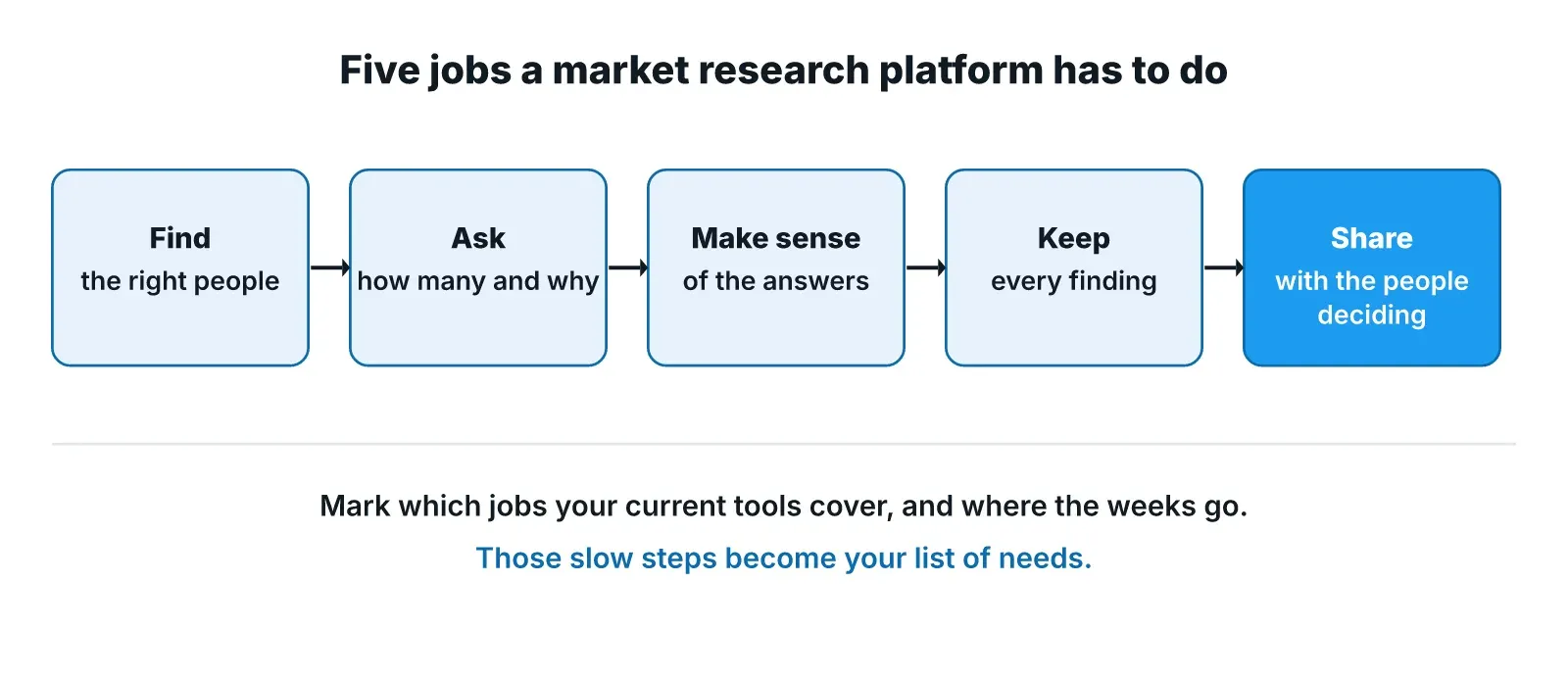
A market research platform has to cover five jobs for your team. It finds the right people, asks them questions, turns answers into findings, keeps those findings and shares them with the people deciding. Large companies often pay for separate tools to cover them, which is why the choice feels hard.
Each job answers its own question.
| Job | Tool that usually does it | Question it answers |
|---|---|---|
| Find the right people | A panel company, or your own customer list | Who can we hear from? |
| Ask them | A survey tool or an interview platform | How many feel this, and why? |
| Make sense of answers | An analysis tool | What patterns show up? |
| Keep findings | A research repository | What did customers already tell us? |
| Share findings | Reports, exports and shared links | Who needs to act on this? |
Tool lists also mix in secondary data, meaning facts someone else already collected, such as market reports. Those show what is happening in the market. To learn why your own buyers act as they do, you have to ask them.
At the home appliance maker, the survey vendor covers asking. A separate panel finds people, and findings sit in slide decks on a shared drive. So the real question is which jobs a new platform should take over.
Your needs should come from the studies your team already ran, because those show where the time and money went. Your study history shows what your company needs, and gives you something concrete to test each platform against.
Pull up every study from the last twelve months and write down four things for each one:
Say the list at the home appliance maker shows two kinds of study again and again. One is a concept check on a new product idea. The other is interviews with customers who let their extended warranty lapse. Both ran in three countries, and recruiting and analysis took most of the weeks.
That history turns into needs you can test. The platform must recruit your own warranty customers and outside buyers in all three countries. It must run a concept check as a survey and interviews in one study. It must link every finding to the quotes behind it, keep every study searchable, and pass the company's security review.
That list is what you score each platform against.
With your list of needs in hand, check each platform in four areas. They cover who it can reach, how it gets from an answer to the reason, what happens to findings afterwards, and your security review.
The appliance team needs its own warranty customers and buyers who chose a rival brand. So ask where participants come from, your list or the vendor's panel, and whether one study can use both.
Next, ask what fraud checks run on every participant, and what happens to a flagged answer. A fake respondent is someone who joins a study only to collect the reward, often with fast, careless or made-up answers. The panel's name alone won't protect you. Rep Data tested six of the leading online sample sources in a 2025 study reported by Greenbook. Private panels and large exchanges showed similar fraud rates, and every source had the problem.
So read the open answers in any trial. A 2025 study of paid survey panels, published in Advancements in Agricultural Development, compared 94 normal and 94 low-quality responses. It found no quality gap by age, education, income or gender, but a clear one on an open question that took more effort. In plain words, careless answers show up most where a question asks people to think.
A survey tells you how many customers feel something, and an interview tells you why. The appliance team needs both for a concept check: how many buyers like the new warranty, and why the rest hold back. So check whether one study can run a survey and interviews together.
In interviews, look at the follow-up questions. A good moderator asks a second question when an answer is vague, such as "it felt expensive", and every participant gets the same well-formed questions. Ask the vendor to show you a transcript where this happens. The guide to choosing an AI-moderated research platform goes deeper on scoring the moderator.
Then check that each finding links to the quotes and the full transcript behind it. If your manager doubts a theme, one click should show who said it and in what context.
A study keeps paying off only if the next team can find it. So ask whether findings from every study are kept together and searchable, so anyone can check what customers already said before starting something new.
Ask how findings reach the people who decide: shared links, exports, or a connection into tools the company already uses.
Security and legal teams tend to ask every vendor the same questions, so write them down before the first demo. They cover data protection law such as GDPR, single sign-on and user roles. They also ask where recordings are stored and whether customer data trains AI models.
Ask each vendor for written answers, and send them to legal early so the choice doesn't stall at the end. Greenbook's 2025 GRIT Business Outlook reports that many research suppliers now build generative AI into client work. So add one more question: how does the platform use AI on your data?
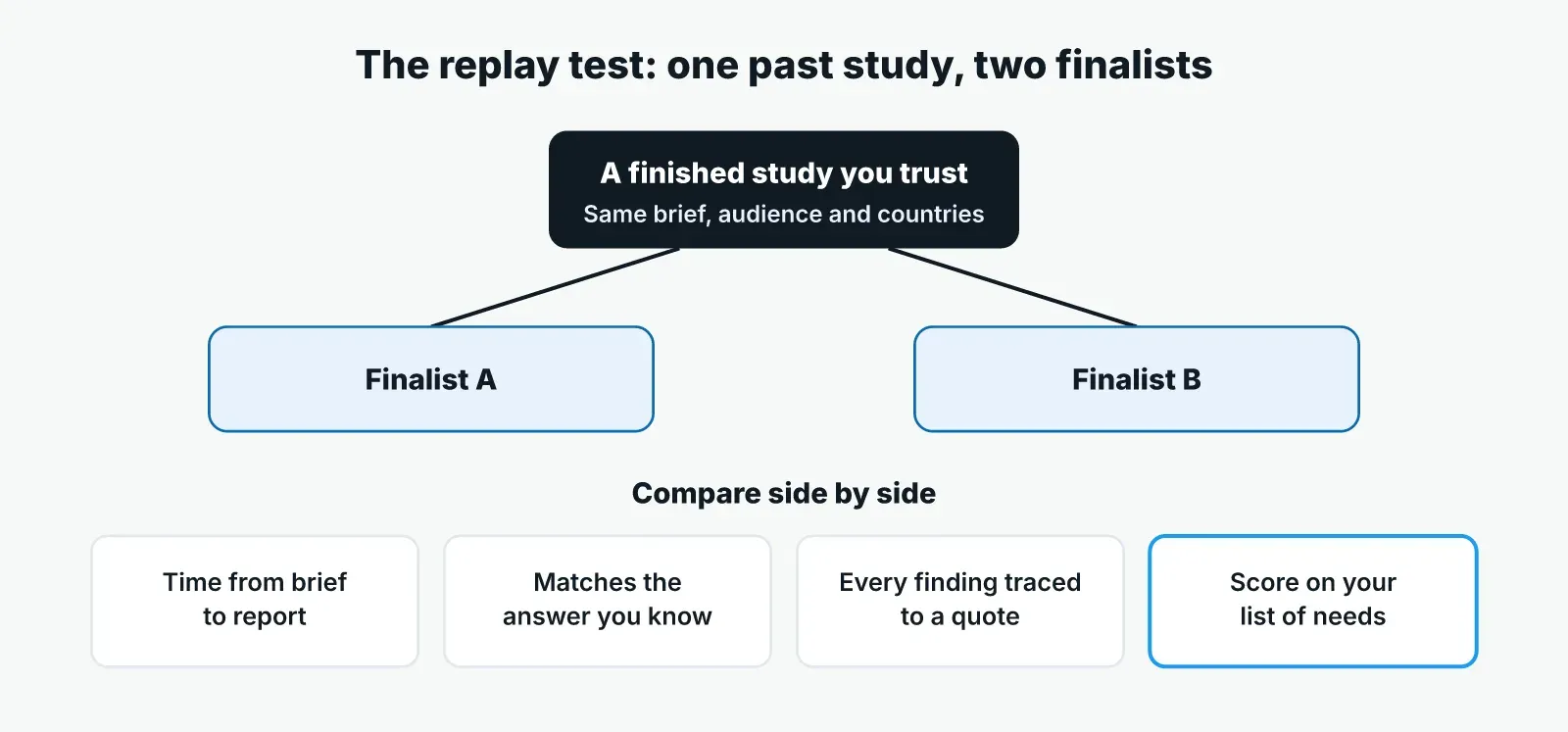
The strongest test of a market research platform is a study whose answer you already know. Pick one finished study your team trusts, and run the same brief on your two finalists with a small, similar audience. The platform that reaches the known answer, with every finding traced to a participant's words, has earned its place.
Choose the study that took longest, because that is where a new platform has the most room to help. At the home appliance maker, that's the warranty study: why customers let the extended warranty lapse after the first year.
Write the same market research brief for both finalists, with the same questions, audience and countries. Then compare the results side by side.
| What to compare | What a good result looks like |
|---|---|
| Time from brief to report | Shorter than last time, on the steps that were slowest |
| The findings | They match what you know, and may add something new |
| The trail behind each finding | Every theme links to quotes and full transcripts |
| Your list of needs | Most needs met, scored the same way for both |
Score both finalists against your list of needs. Give the most weight to recruiting and analysis, since that's where the appliance team lost the most weeks. Then take the scores to the people who approve the budget.
If one finalist reaches the known answer and wins on your slowest steps, choose it. If both reach it, choose the one where every finding traces back to a participant's words, because that's the one your manager can check.
Pulse is built for the jobs this test checks: reaching the right people, asking them, and tracing every finding back to what they said. It runs surveys beside AI-moderated interviews in one study.
You can invite your own customers from a list, or recruit to your profile from more than 200 million people globally. Fraud checks run on every participant. The AI moderator asks everyone the same questions from one guide. Its follow-ups build on what each person said earlier, and a vague reply gets a second question.
Themes link to their quotes and transcripts, and the report is ready minutes after the last interview. Every study stays in the insight repository, queryable across projects. One study can run across several markets, in 240+ languages, enabled on request.
For your security review, Pulse is GDPR compliant and never uses customer data to train AI models. It redacts personal data from transcripts. The enterprise plan adds data residency options and SAML and OIDC single sign-on on request.
There is a free trial and a free study, so you can run the replay test on one of your own past studies. Book a demo to set it up.
The tool depends on the job. Survey tools count how many people think something, and interview platforms explain why. Panel companies supply the people, and research repositories keep what you learned. A platform that covers several of these jobs means fewer findings get lost between tools.
Market research is usually split into two pairs. Primary research collects new data from people, while secondary research uses data that already exists. Qualitative research looks at words and reasons, while quantitative research looks at numbers. The guide to qualitative market research covers the reasons side in depth.
A free survey tool can handle a quick poll among staff or a small group of customers. For a study that shapes a product or a price, check where participants come from and what fraud checks run on them. Then check that the tool will pass your security review.
Some can, and the replay test is the way to find out. Run your past study in two of your countries, in each local language, from the same guide. Then check that recruiting worked in both places and that the findings compare in one report.
Participant recruitment methods compared by who you need: your own list, panels, referrals, networks and recruiters, plus a check before you set a date.
Semantic vs latent themes, from Braun and Clarke's paper "Using thematic analysis in psychology", shown on real-life quotes, with when to use each.
How to choose a transcription service for research interviews: test each option on your own audio with five simple checks, from accuracy to data safety.