How to choose a sampling method for customer research
Choose a sampling method by the claim your customer study has to support, with a decision table for probability and non-probability sampling.
Qualitative market research explains why buyers choose, pay and switch. Match methods to pricing, positioning and market-entry decisions.
A pricing team asks for a survey of what buyers would pay, and nobody in the room can say what buyers compare the price against. Qualitative market research answers that first. A small set of interviews, group discussions or visits finds the options buyers weigh and the words they use, so the survey that follows measures real choices.
Skip that step and the survey counts the team's own guesses. A large company can then reprice a whole product line on a number that looks precise and measures the wrong options.
The table and steps below show when a decision needs qualitative work first, which method fits it, and which studies to keep in-house or give to an agency.
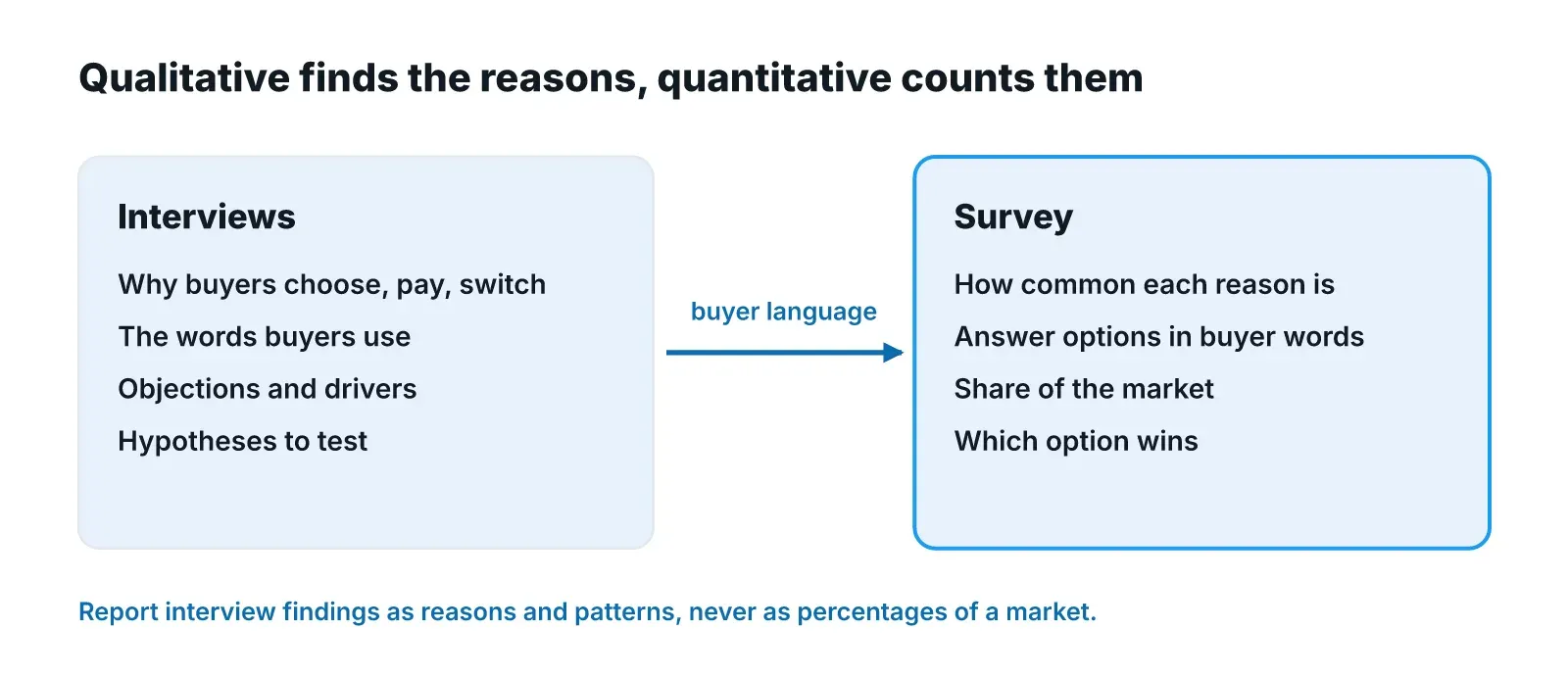
Qualitative market research studies buyers' reasons in their own words, with a small sample chosen on purpose. It belongs before any commercial decision where your team cannot yet list the options buyers weigh: entering a market, positioning, pricing, a new product, churn or a rival's move. Once the options are known, go straight to measurement.
The sample is small and picked for what each person can tell you, so the findings cannot be scaled up to a market. They show that a reason exists and how it works. A survey then tells you how many people hold it.
| Decision | What qualitative work finds | Method that usually fits | What a survey then measures |
|---|---|---|---|
| Entering a market | How buyers solve the problem today | Depth interviews, shop-alongs | How many buyers fit the profile |
| Positioning | The words buyers use, and the claims they believe | Group discussions | Which message wins |
| Pricing | What buyers compare the price against | Depth interviews | What share would pay each price |
| A new product | The job it does, and what stops people using it | Interviews with projective tasks, online communities | Purchase intent |
| Churn | The chain of events behind a cancellation | Depth interviews with recent leavers | How common each reason is |
| A rival's move | How the move changed the way buyers compare | Interviews with recent switchers | How many buyers may switch |
A depth interview is a one-to-one talk that traces one buyer's decision from the first trigger to the purchase. Use it for money and other topics people avoid in front of others. For illustration, a bank's card team interviews people who closed a card in their first year, to learn what they moved to and when they made up their minds.
A moderated group of buyers shows how people talk about a category and where they disagree. Use it for reactions to names, packs and claims, where the debate is the data. Keep prices out of groups. People hear each other's answers before they give their own.
Ethnography means watching buyers where the purchase happens: a store aisle, a desk where someone compares suppliers, a procurement review. In a shop-along, the researcher walks the store with the shopper. Both find habits people do not report because they do not notice them, such as the comparison site a buyer opens first.
An online community is a private board where a group of buyers answers tasks over days or weeks. It suits questions about change, such as how a new product fits into a team's routine after the purchase.
Projective techniques are short exercises: finishing a sentence, sorting pictures, describing a brand as a person. They help buyers voice what they find hard to say outright, such as the status a premium card signals. Run them inside interviews or groups, and have a researcher read the results.
A consumer purchase usually has one decision-maker. A B2B purchase runs through a buying committee, so a B2B study interviews the user, the budget holder and procurement separately. The user talks about workflow, the budget holder about risk, procurement about terms. A finding that holds for one role and fails for another is a finding in its own right.
Senior B2B buyers are hard to reach, so screen on their role in the purchase and set an incentive that fits their seniority. Consumer studies reach more people for the same effort and gain most from context: where, when and with whom people buy. The guide to qualitative research methods and when to use each covers each format in more depth.
Illustrative example: a payments company's merchant team must decide whether to offer a bundled plan to mid-sized retail chains. The pricing team assumes merchants pick a provider on fees. It has four ways to find out, and the choice turns on one thing: whether the team can already list what merchants weigh. Here it cannot.
The business question is what goes into the bundle, and at what price.
| Option | What it can show | What it cannot show |
|---|---|---|
| A pricing survey now | How many merchants accept each price, for the options the team wrote | Whether those are the options merchants weigh |
| Group discussions | How merchants talk about providers, and where they disagree | Each merchant's own trade-offs on money |
| Depth interviews with finance heads and store operations leads | What each role weighs, in its own words | How common each reason is |
| Synthetic answers from a language model | Quick answers where a model matches real data | Which questions it gets wrong, without real answers to check |
Synthetic answers are responses a language model writes in place of real people. A Chilean benchmark of synthetic survey responses, a working paper posted to arXiv in September 2025, generated 189,696 synthetic profiles across 128 prompt-model-question triplets. It checked them against real answers from a Chilean public opinion survey.
The authors report that synthetic responses achieved F1-score and accuracy above 0.90 on trust items. (F1 scores how well predicted answers match real ones.) They also report substantial item-level heterogeneity: results varied a lot from one question to the next. The study measured Chilean public opinion and did not test business buyers. For the payments team, the lesson is practical. A synthetic panel can match real answers on one question and miss the one the price turns on, and only real answers show which.
So the team weighs the options by what the decision needs first: the list of things merchants compare. Depth interviews give that most directly, one role at a time. For illustration, suppose finance heads weigh how fast money lands in their account beside the fee, and store operations leads care most about checkout downtime.
The next decision follows. The pricing committee writes two bundles from the interview language, one built around fast payouts and one around uptime, and tests both in a pricing survey. The report says "finance heads raised payout speed" and gives no percentage, because a count from a small sample describes that sample only. The post on how qualitative and quantitative research differ covers the wider comparison.
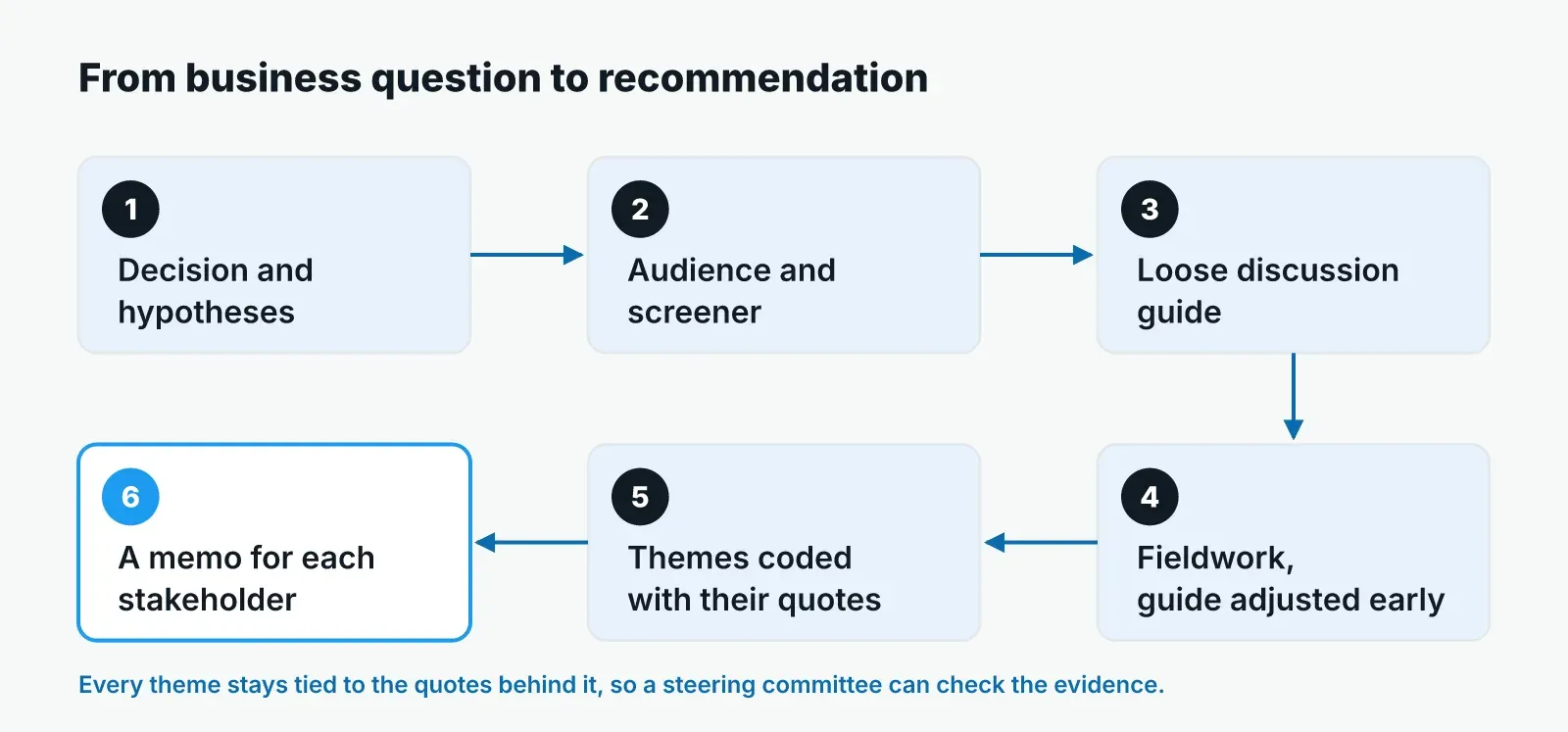
Run the study in six steps: write the decision and the team's guesses, define the audience, draft a loose guide, check the first interviews, code themes with their quotes, and write a memo for each stakeholder. Each step keeps the work tied to the decision, so the findings arrive in a form someone can act on.
Write one sentence naming the decision, and two or three guesses the team holds today. "Merchants choose on fees" is a guess the study can confirm or break. Without one, the study drifts into a tour of the category.
Decide who can speak to the decision, then write a screener: the short set of questions that lets people into the study. Screen on what people did recently, such as "chose a payments provider in the last year". Job titles alone let in people who were never part of the purchase.
A discussion guide lists the topics and questions for each session. Order it by the decision: what buyers do today, what they compare, what would make them change. Leave room to follow the unexpected. The guide to writing an interview guide covers question order and follow-up probes.
Read the first few interviews as soon as they are done. If a question confuses people, or buyers keep raising a topic the guide skips, fix the guide now. Once fieldwork ends, the only fix is a second study.
Group what people said into themes, and keep each theme linked to the quotes and interviews behind it. A steering committee that can open those quotes can test the claim for itself.
Write a short memo for each team that has to act, with the evidence for its own decision first. In the payments example, the pricing committee gets the two bundles to test, and the product team gets the payout problems, each with its quotes.
Most large companies need both. Keep fast, repeated commercial questions in-house, where the team that owns the decision writes the guide. Give an agency the studies that need an outside view, specialist moderators or hard-to-reach audiences. Full-service projects already make up most of the sector, so the real choice is which studies to bring in-house.
ESOMAR's Global Market Research 2024 report puts the market research sector at US$54 billion in 2023. It estimates that around 65% of that is full-service research, including fieldwork. ESOMAR built the figures from data sent in by national research associations, companies and analysts.
| Factor | In-house team | Agency |
|---|---|---|
| Speed to start | Faster, with no buying or briefing cycle | Slower, since briefing and contracts come first |
| Control of the question | The decision owner writes the guide | The agency shapes the guide from the brief |
| Independence | Closer to internal assumptions | An outside view that is easier to defend to a board |
| What the company keeps | Findings stay and build across studies | Part of the knowledge stays with the agency |
| Specialist reach | Limited to the team's own skills and contacts | Specialist moderators, markets and audiences |
The decision rule is short. If the question repeats every quarter and the owner needs the answer within weeks, run it in-house. If a board needs an independent read, or the audience needs specialist reach, brief an agency. When one team asks both kinds of question, split the work study by study.
Pulse is built for the in-house side of that split: repeated commercial questions a team wants answered in days, with every finding traced to what buyers said. It covers the steps above from the business question to the themes, and leaves the decision and the memo with your team.
Pulse turns a business question into a study with an audience and screener, then recruits to that profile or invites your own customers. It runs AI-moderated voice interviews that ask a follow-up question when an answer is thin, so every person gets the same well-formed questions. It groups answers into themes and ties each one to its quotes and transcripts. Surveys run alongside the interviews, so buyer language can go straight into the survey that sizes it.
The researcher still frames the question, spots the tangent that turns out to be the finding, and makes the call. To see a study run on one of your own commercial questions, book a demo.
One common way to sort market research uses two pairs. Primary research is data you collect yourself, and secondary research is data others have published. Qualitative research explains reasons, and quantitative research measures how common they are. The pairs overlap: customer interviews are both primary and qualitative, as the guide to primary and secondary research explains.
Yes. Interviews with buyers who chose a rival, or switched to one, show how buyers compare offers, which claims they believe and what tipped the choice. Desk research on a rival's website shows what the rival says. Interviews show how that offer lands with the buyers you both want. Recruit people who decided recently, while the reasons are fresh.
Yes, when the data shows a change you cannot explain. Sales and usage data show what customers did and when. They do not record what the customer was trying to do, what they compared or what they gave up on. Interview the people behind the change, such as customers who downgraded last quarter, and read their reasons beside the numbers.
Choose a sampling method by the claim your customer study has to support, with a decision table for probability and non-probability sampling.
A representative sample of 20 interviews covers the segments a decision turns on. See what that lets you claim, and what only a survey can.
Design and run questionnaires that answer a real decision: set the objective, pick a mode, order and pilot questions, then analyze the results.