How to run patient interviews for digital health research
Patient interviews for digital health research: how to word consent, skip health details you don't need, and ask about missed doses without blame.
How to choose an AI-moderated research platform for enterprise: the criteria, the questions to ask each vendor, and a pilot scorecard your team can use.
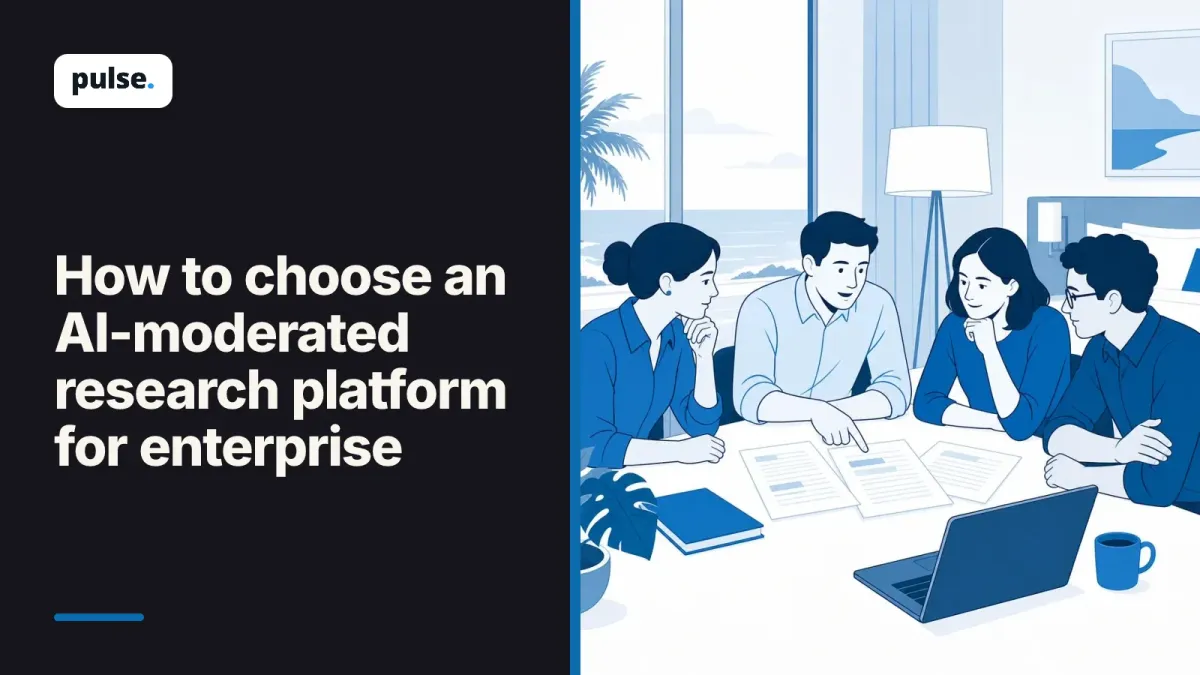
Your manager just sent you demos from a handful of AI interview vendors. You work on the guest research team at a hotel chain, and she wants a shortlist the buying team can approve this month. Every demo looked good. So how do you choose?
Choosing an AI-moderated research platform for enterprise means judging the interviews it runs, the evidence it hands back and how it treats your data. A demo shows you very little of any of them.
So test each platform on a real study from your own team. Read the full transcripts, trace one finding back to its quotes, and send your security questions in writing before the pilot starts.
Each of those tests turns into a question you can put to every vendor, and a line you can score on one page.
A demo is built to show a platform at its best, on a study the vendor picked. So before you talk to anyone, write down the next few studies you expect to run, and judge every platform against that list.
At the hotel chain, say your list has three studies: a test of a new loyalty offer in several countries, a study of why business travelers stopped booking direct, and a brand check in two markets after a refresh.
You need interviews in more than one language, a way to reach your own loyalty members, and a way to recruit travelers who never joined. A platform that can't do those things drops off, however good its demo looked.
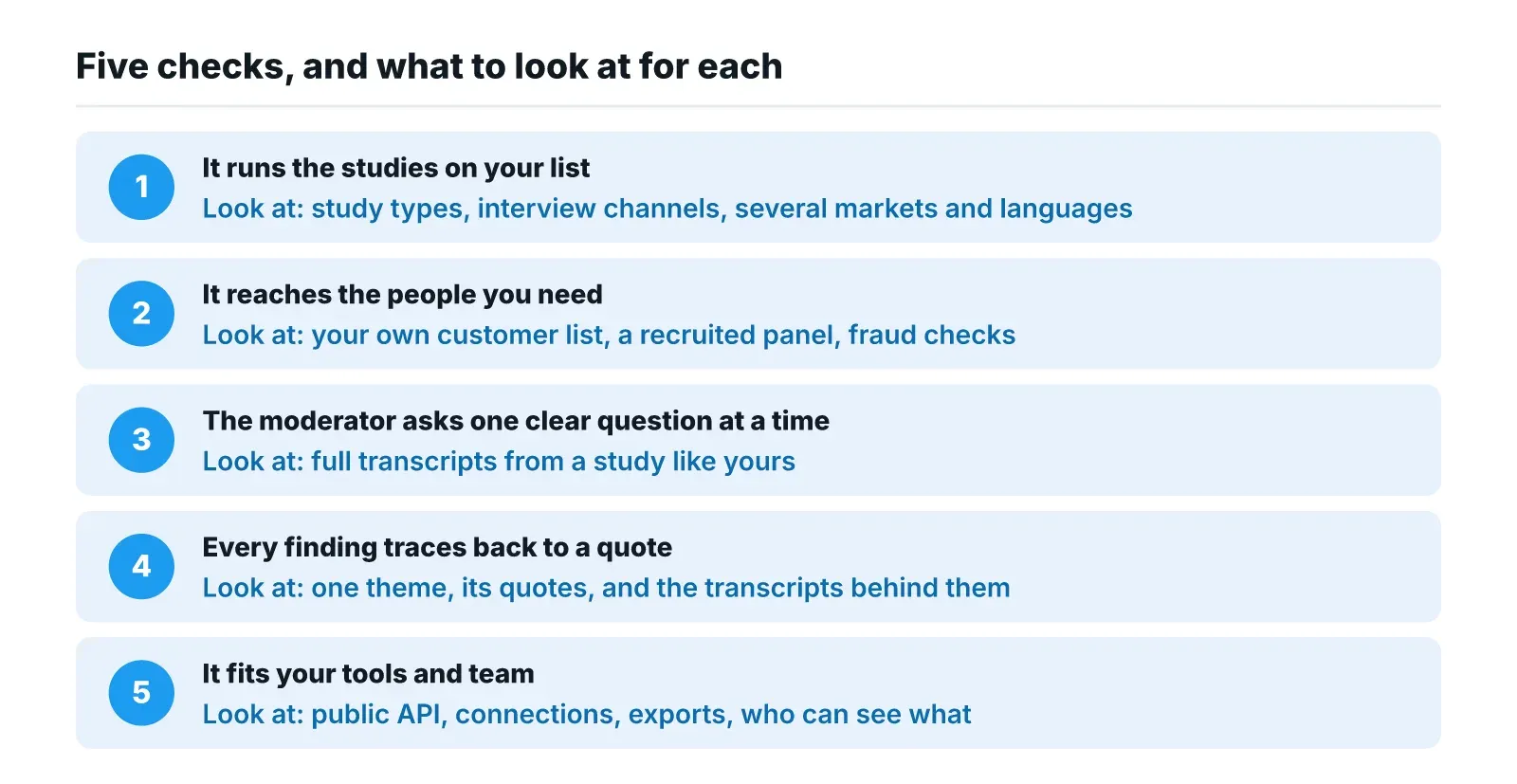
Each check below is something you can see for yourself, with a question to ask each vendor. Write down what each vendor shows you, not what they tell you.
Ask each vendor which study types they run: interviews, surveys alongside interviews, usability tests, repeat studies over time. Ask which interview channels people can use, such as voice, video, text chat or phone. Then ask whether one study can run across several markets and languages at once, from one brief.
Enterprise studies often need your own customers and people you don't have yet. Ask whether you can invite your own customers from a list, recruit to a profile you describe, and reach business buyers or experts. Ask what fraud checks every participant goes through, how big the panel is in your markets, and who handles incentives.
The AI moderator is the part that runs the interview. Ask each vendor for full transcripts from a study like yours, or run one. Good moderation asks one question at a time, builds follow-ups on what the person said earlier, asks a second question when an answer is vague, and never suggests the answer.
A general-purpose AI model can miss these habits. In an August 2026 arXiv study by Zhang and colleagues, 15 people each took an interview run by an off-the-shelf multimodal AI model. Across 428 interview turns, deeper follow-up questions made up 4.9% of turns, and 28.7% of question turns packed several questions into one, even though the model was told to ask one at a time.
Digging deeper and asking one thing at a time are the habits you're reading the transcripts for. The live post on how to judge AI interview quality in one transcript walks through the check step by step.
Pick one theme in a sample report and follow it to the quotes behind it, then to the transcripts those quotes came from. If you can't do that, the people deciding can't either. Ask whether every quote links to its transcript and recording, whether you can see how many people a theme rests on, and whether findings stay searchable across studies.
This matters more in a large company, because several teams act on one study. When the revenue team challenges a finding about direct booking, someone has to show where it came from. The post on auditing AI interview themes back to the exact quote shows how.
Ask whether there's a public API, which of your tools it connects to (your customer database, your document tools), and what you can export: PDF, slides or spreadsheets. Ask who can create studies, who can review and edit the questions before a study starts, and who can see results. Then ask how soon a report is ready after the last interview.
Your security and legal teams will ask these anyway, so send them in writing to every vendor before any customer data goes in. Ask for documents rather than answers on a call.
Participants' data needs care too. In a June 2026 study of 17 interviewers by Zhang and colleagues at Penn State and Tsinghua University, participants raised privacy, disclosure and compliance risks when AI listens to, records or transcribes sensitive answers.
The table pairs each question with what a good answer contains.
| Ask the vendor | A good answer contains |
|---|---|
| Is our customer data used to train AI models? | A clear no, written into the contract |
| Which single sign-on standards do you support? | Named standards such as SAML or OIDC, and how they're set up |
| Who can see what? | Roles that control who creates studies and who sees results |
| Where can our data be held? | The regions on offer, and which plan includes them |
| Is personal data removed from transcripts? | How names and personal details are redacted, with an example |
| Which data protection laws do you comply with? | The laws named, plus the data processing agreement, the list of sub-processors and any certification reports the vendor holds |
| How are participants told about recording? | The consent wording participants see before the interview |
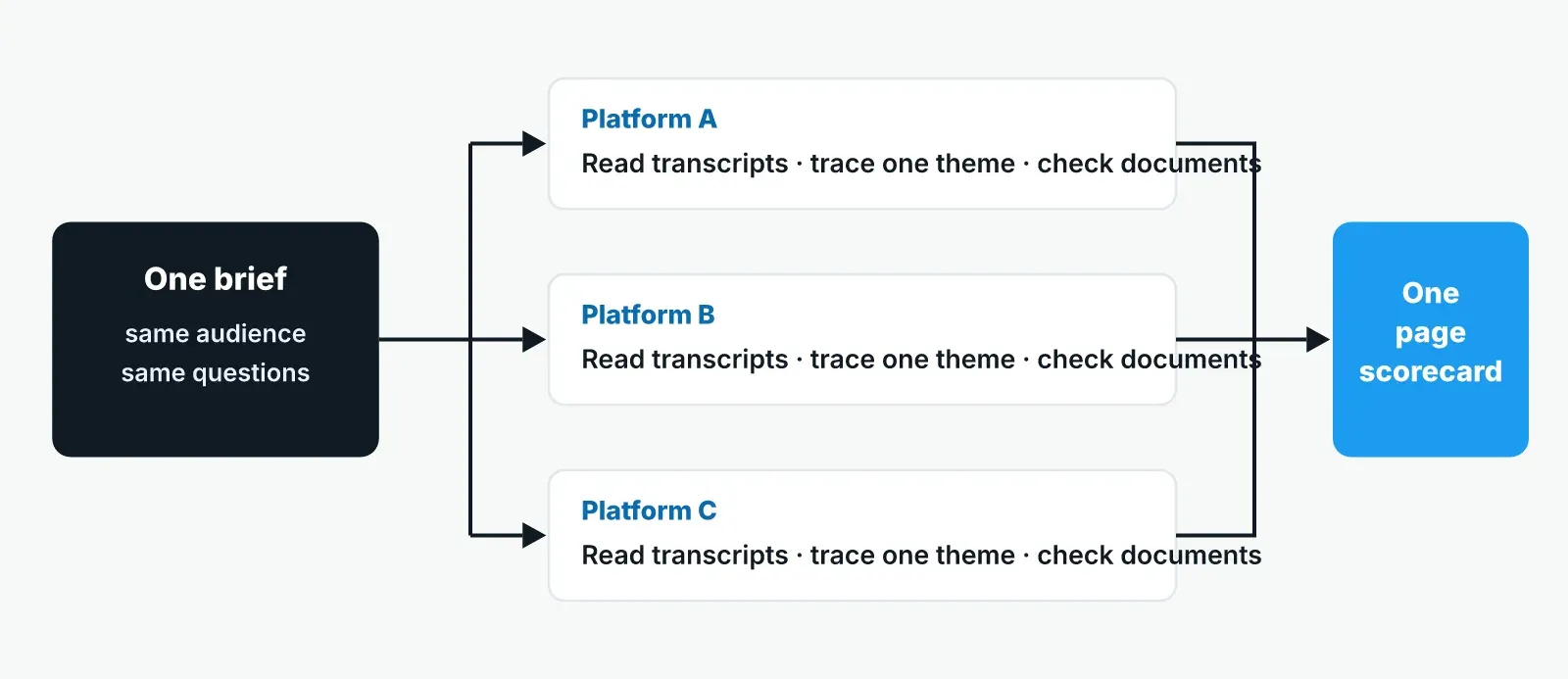
Once you have two or three platforms left, run the same short study on each one. Use the same brief, the same audience and the same questions, so any difference comes from the platform. Then score each one from transcripts and documents, never from memory of the demo.
Careful research comparisons are set up the same way. An arXiv study by Deng, Liu, Toubia and Jain (September 2026) compared AI-moderated, human-moderated and fixed-question interviews in a pre-registered study of 317 people with three industry partners. Pre-registered means they wrote down how they would judge the results before they saw any. You can borrow that habit: agree on the scorecard before the pilot.
At the hotel chain, say you pick the direct-booking study and run it with the same small group of lapsed business travelers on each platform. You read the transcripts side by side, follow one theme on each to its quotes, and check the security answers your team got back.
Copy this scorecard, and score each row from 1 to 5 with the evidence you saw beside it.
| Criterion | What good looks like | Evidence you saw | Score |
|---|---|---|---|
| Studies and reach | Runs your listed studies, in your markets, with the people you need | ||
| Moderator | One question at a time, follow-ups that build on earlier answers, no leading | ||
| Traceability | Every theme links to quotes, and every quote to its transcript | ||
| Security and data | Written answers and documents for every question in the table above | ||
| Tool fit | Connects to your tools, exports what your team uses, clear roles |
If a platform fails the moderator or traceability rows, drop it, whatever it scores elsewhere. If two platforms tie, choose the one whose security answers your team could check fastest.
The hardest checks above are the moderator, traceability and security rows. Pulse runs AI-moderated interviews by voice, video, text chat, phone call or WhatsApp. The AI moderator builds follow-ups on what each person said earlier, and asks a second question when an answer is vague. You can invite your own customers or recruit from more than 200 million people globally, with fraud checks on every participant. Themes come with the quotes behind them, and every quote traces to its transcript.
For the security table, Pulse is GDPR compliant, offers SAML and OIDC single sign-on on request, and has data residency options on the enterprise plan. Personal data is redacted from transcripts, and customer data is never used to train AI models. A public API and 1,500+ connectors through MCP link it to the tools your team already uses.
If you'd like to run your own pilot study with Pulse, book a demo.
Look at five things: whether it runs your studies and reaches your people, how its moderator asks questions, whether every finding traces to a quote and transcript, how it handles security and data, and whether it fits your tools. Judge each from transcripts and documents, then compare platforms in a short pilot.
Voice lets people talk freely and suits most studies about reasons and decisions. Video adds facial reactions and lets people show you a screen or a product, which helps when you test a design or an ad. If your list includes design or ad tests, make sure video is on offer.
You need one if you'll study people who aren't your customers yet, such as lapsed buyers or a new market. If you only study your own customers, inviting them from a list may be enough. Over a year of studies you may need both, so check that one platform can do each.
Keep it short enough to finish in a week or two, with a small group and one real question from your list. The pilot tests the platform, so you need enough interviews to read transcripts side by side and follow a few themes to their quotes.
Yes. Hiring tools screen job candidates and score their answers. Research platforms talk to customers to learn their reasons, and group what they said into themes with quotes. When you search for vendors, many "AI interview" results are hiring tools, so check that each vendor runs customer research before you add it to your list.
Patient interviews for digital health research: how to word consent, skip health details you don't need, and ask about missed doses without blame.
Checkout abandonment interviews show why shoppers leave at payment: who to invite, when to ask, and the questions that point to a fix.
Before a large company approves AI-moderated interviews, legal, privacy and security ask about consent, data, training and fraud. What to answer.