Participant recruitment methods: 5 ways to find people
Participant recruitment methods compared by who you need: your own list, panels, referrals, networks and recruiters, plus a check before you set a date.
Map your customer insights tech stack by job, find the gap your tools leave, and see where a customer insights platform fits beside agencies and panels.
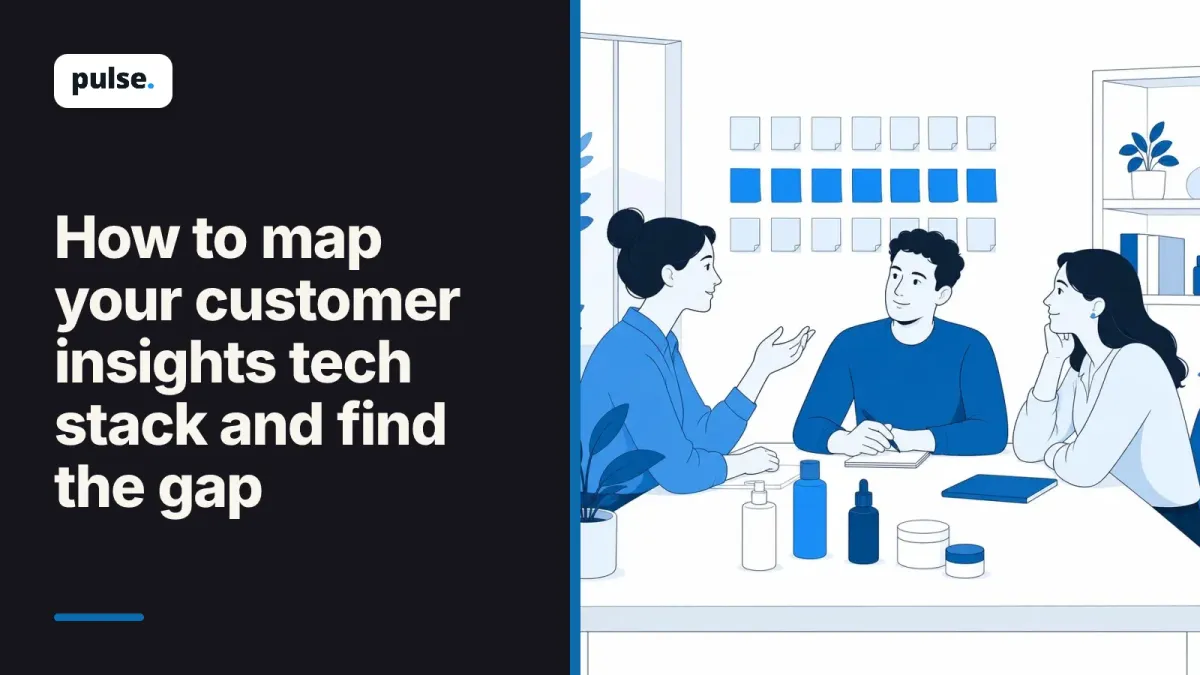
Imagine you work on the research team at a skincare company. The team already pays for a survey tool, an online panel, an agency for big studies and a shared drive full of old reports. Now someone suggests adding a customer insights platform. Where would it fit, and what would it replace?
Everything your company uses to learn about customers, tools and partners alike, is its customer insights tech stack. A new platform only helps if it fills a gap in that stack.
So list the jobs your stack must do, and mark which tool does each one. Buy for the job nobody does well. Then check that the new platform connects to the tools on either side of it.
Five jobs cover almost every stack, so that's the place to start.
Most teams describe their stack by the tools in it. It's easier to see the gaps when you describe it by the jobs it does instead, because two tools can do the same job and one job can have no tool at all. Five jobs cover what a large company needs to learn from its customers.
This is sales, subscriptions, site visits and app use. At the skincare company, it shows which customers buy the fragrance-free range and how often they buy again. Large companies already move a lot of this data: over the past year, Twilio customers synced nearly 10 trillion rows of data to cloud data warehouses, according to Twilio's 2025 Customer Data Platform report. For most teams, this job is the best covered.
Reviews, star ratings, support tickets and short surveys all land here. They tell the skincare team that something feels off, such as a dip in ratings for the new face cream, without saying much about why.
This job needs a conversation, in interviews or open-ended studies. It's how the team learns that shoppers switched because the new formula stung their skin, or because the new pump bottle kept jamming.
Every study should leave something the next team can find. If old reports sit in folders nobody opens, the company keeps paying to learn the same thing twice.
Findings only help when they reach the people choosing formulas, packs and prices, in a form they will read.
Agencies and panels belong in the stack too. An agency often does jobs 2 and 3 for you, and a panel supplies the people for job 3.
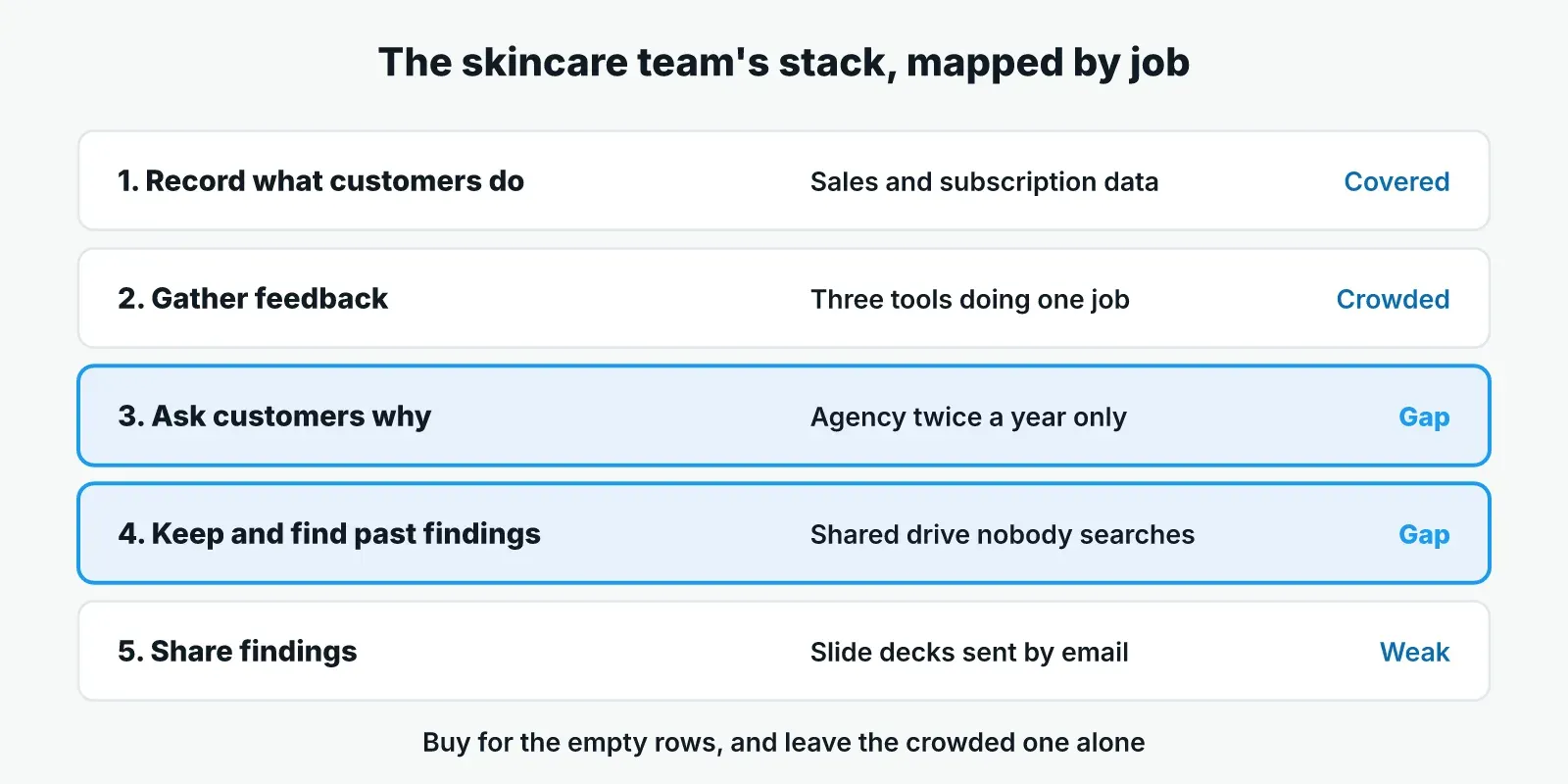
Once you know the five jobs, you can put your own tools against them in one table. Write down what you use for each job, who looks after it and how well it answers the questions your team gets. Gaps and overlaps show up quickly, and they tell you what a new platform should do.
Here is how the skincare team's table might look.
| Job | What the team uses today | Who looks after it | How well it answers the team's questions |
|---|---|---|---|
| Record what customers do | Sales and subscription data | Data team | Well: clear on who buys what, and when |
| Gather feedback | Survey tool, store reviews, support tickets | Marketing and support | Three sources, little shared view |
| Ask customers why | An agency, booked twice a year | Research team | Deep, but nothing between projects |
| Keep and find past findings | Shared drive of old reports | Nobody | Hard to search, so rarely used |
| Share findings | Slide decks sent by email | Research team | Read once, then lost |
Reading down the last column, two gaps stand out. Between agency projects, the team has no way to ask customers why. And past findings are hard to find. Meanwhile, three sources overlap on feedback, so a fourth would add little.
Buy for the empty row, and leave the crowded one alone.
Many teams worry that a platform means dropping the agency or the panel. It usually doesn't. A customer insights platform lets your own team run the frequent, smaller studies that today wait months for an agency slot. The agency stays valuable for large, complex work, and panels and your own customer list still supply the people.
Say the skincare team splits its year this way. Each month, it runs a short study in-house on whatever the sales data raises, such as why repeat buys of the sensitive-skin range dipped. Once a year, the agency runs the big segmentation study that sorts shoppers into groups by how they choose skincare.
The in-house studies answer this month's questions quickly. The agency study sets direction for the year. Neither replaces the other, and the team no longer waits half a year to ask a simple why.
If the job you need to fill is asking customers why, the guide to choosing an AI-moderated research platform goes deeper on that one choice. It pairs well with the basics of running customer interviews.
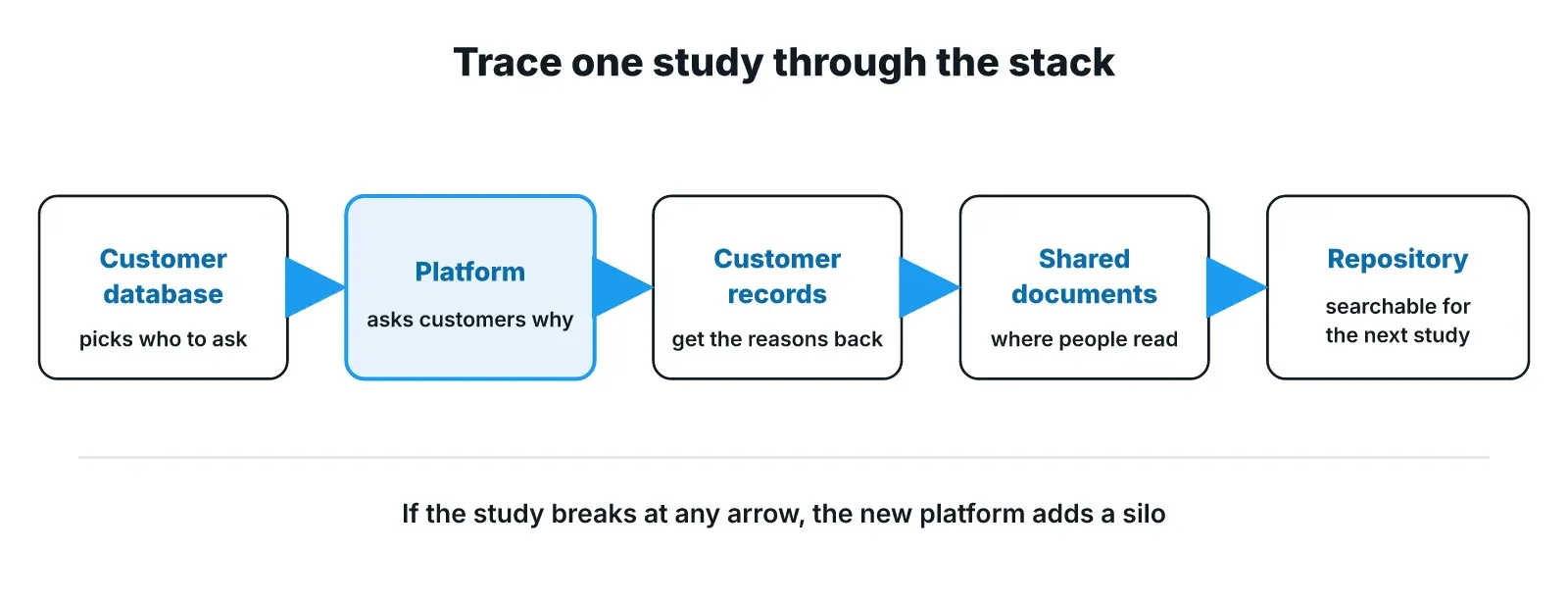
A new platform that doesn't connect to the rest of the stack becomes one more silo, which means one more place where findings sit unseen. The simplest test is to trace one real study end to end, from choosing who to ask to the moment someone acts on the result, and see where it breaks.
Run these checks with the skincare team's next question in mind.
If sales data shows who stopped buying again, you should be able to invite those shoppers without exporting and cleaning a list by hand each time.
When the study ends, the reasons should sit beside each customer's record, so the next team doesn't have to ask again.
That might be shared documents, slides or spreadsheets. If people must log in to one more tool to see a finding, many won't.
An insight repository is a library of past studies that anyone can search. It's what fixes the shared-drive row in the table.
The pack design team and the pricing team need different slices of the same study, from one source.
Any new tool in the stack raises the same questions. Who can sign in, and how? Can access be limited by role? Where is the data stored? Is personal data removed from transcripts? Is customer data used to train AI models? How do participants give consent? Collect the answers before the trial, so a good result isn't stuck waiting for approval.
If a platform passes the trace and these checks, it fills a gap. If it fails them, it adds a silo, however good its demo looks.
The skincare team's gap is job 3 between agency projects, plus job 4. It needs to ask customers why every month, and keep what it learns where people can find it. Pulse is built for that job, and for connecting it to the rest of the stack.
Pulse runs AI-moderated voice interviews that customers take by link, with no calls to schedule, and surveys in the same study when the team also needs a count. You can invite your own customers from a CSV list, a public link, a QR code or WhatsApp, or straight from your customer database through a connector. It connects through MCP, with 1,500+ connectors, and can write interview results back to customer records. Findings export to PDF, PowerPoint, CSV, Excel and Word, and into Notion and Confluence through MCP. Every study is kept in the insight repository, where the team can query findings across projects.
For your security and legal teams: SAML and OIDC single sign-on on request, Owner, Admin and Member roles, GDPR compliance, personal data redacted from transcripts, and customer data never used to train AI models.
The agency keeps the big strategic studies, the data team keeps the dashboards, and your team gets a way to ask why in between. You can start with a free trial and a free study, or book a demo to trace one of your own studies through it.
A customer insights platform is software a company uses to learn about its customers in one place. Some platforms join behavior data, some collect feedback, and some run interviews and surveys to explain why customers act as they do. Before buying, check which of the five jobs a platform does, because the same name covers very different products.
Yes. Problems start when two tools do the same job or when tools don't share data. Map each tool to one job, cut the overlaps, and make sure each tool can pass customers and findings to the next one. That way each tool adds a job instead of a copy.
A global team needs one study to run across several countries and languages from one setup, so results compare fairly. It also needs findings everyone can search, and clear answers on where data is stored. Test those three things in a trial with real customers from at least two markets before deciding.
Usually, yes. A platform lets your team run frequent, smaller studies itself, so you stop waiting for an agency slot to ask a simple question. Agencies stay useful for large, complex or strategic projects, where their method and outside view add the most. Agency time then goes to fewer, bigger projects.
Participant recruitment methods compared by who you need: your own list, panels, referrals, networks and recruiters, plus a check before you set a date.
Semantic vs latent themes, from Braun and Clarke's paper "Using thematic analysis in psychology", shown on real-life quotes, with when to use each.
How to choose a transcription service for research interviews: test each option on your own audio with five simple checks, from accuracy to data safety.