How to choose an AI assistant for research
Choosing an AI assistant for research? Match it to the evidence your question needs, then test whether every finding opens to the source behind it.
Before a large company approves AI-moderated interviews, legal, privacy and security ask about consent, data, training and fraud. What to answer.
Your team just got the go-ahead to interview customers who left the phone company where you work. An AI moderator will ask the questions. Then the privacy team emails you a list of its own. What do they need to hear before they say yes?
That list starts your AI moderated interviews compliance review. It's the check that a study follows the rules before it begins.
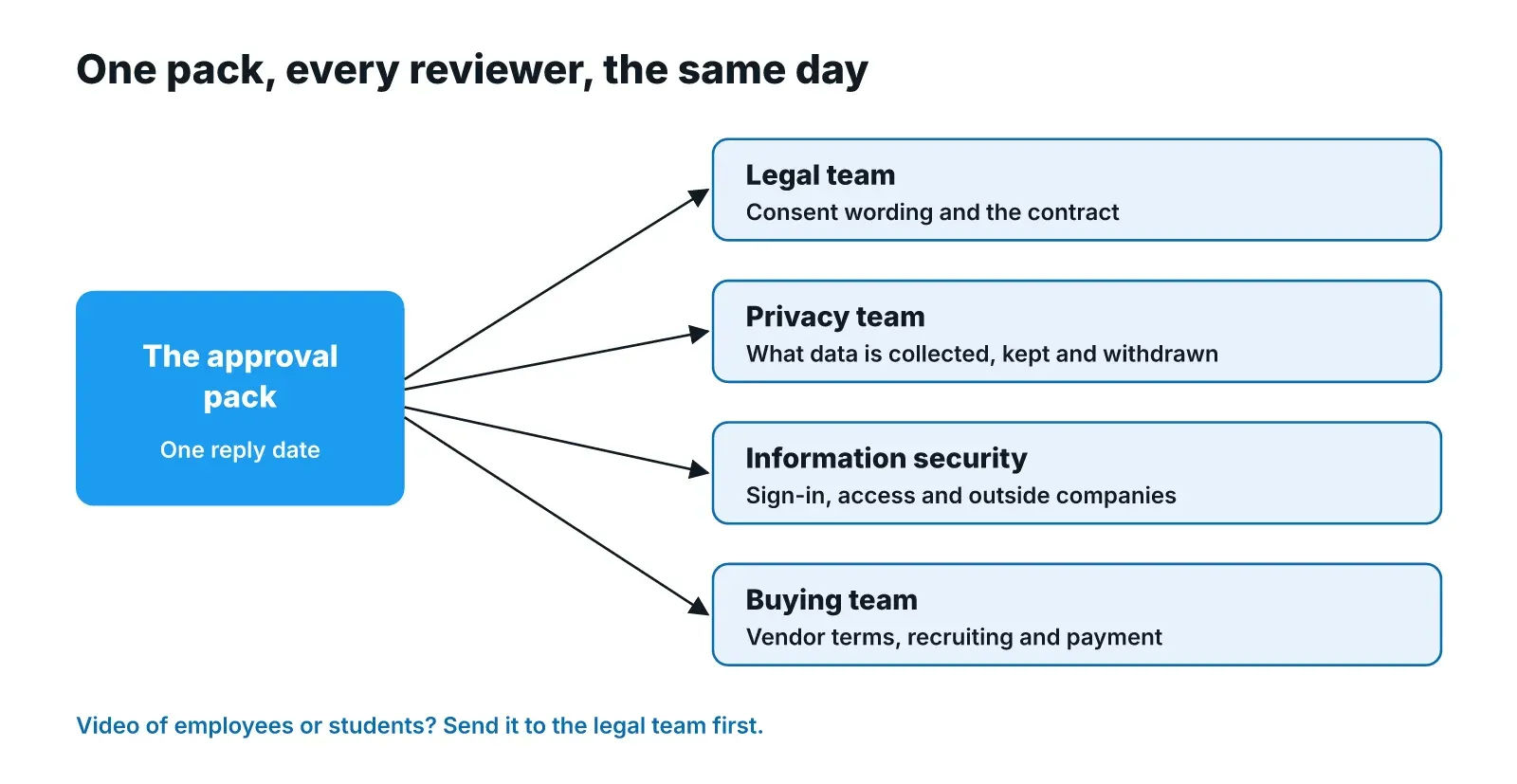
The answer is one pack, sent to every team on the same day. It says what people are told and where the data lives. It says who sees the data, whether it trains AI and where people come from.
To build that pack, start with who reads it. Each team looks for something different.
At the phone company, the privacy team wrote first. But other teams will follow, and each one has its own form. So it helps to know who they are.
Five people or teams usually review the study: the legal team, the privacy team, information security, the buying team and the research lead.
You can fit every answer on one page. Your one-page approval pack can be a single table. Each row is one reviewer, what they ask and what you send them.
| Reviewer | What they ask | What to put in the pack |
|---|---|---|
| Legal team | What people agree to, the contract, the data processing agreement | The consent screen text and the draft contract |
| Privacy team | What personal details you collect, where they are kept, how people pull out | A one-page map of the study's data |
| Information security | How staff log in, who opens recordings, which other companies touch the data | The vendor's written security answers |
| Buying team | The vendor's terms, participant sourcing and fraud checks, how people are paid | The vendor's terms, where participants come from and how each one is checked |
| Research lead | Whether an AI moderator fits the question | The interview guide and the screener |
Two words in that table need a plain sentence each. A data processing agreement is a contract. It says what the vendor may do with people's personal details. Think of it as the house rules you leave for a house sitter.
A screener is a short quiz people answer before the interview. It makes sure you only talk to the right people.
These worries are common, and researchers share them too. A preprint is a study shared before other experts have checked it. In a 2026 preprint accepted to the CHIWORK '26 conference, 17 interviewers tried AI-written follow-up questions. One of the five worries they raised was privacy, disclosure and compliance risk "when AI listens, records, or transcribes sensitive content".
So send the pack to everyone at once. If you answer one team at a time, the last team starts long after the first.
Say a former phone customer opens the interview link. Before the first question, they should know who is asking and what happens to their words. Then they choose whether to say yes. That yes is called consent. It's like asking before you take someone's photo.
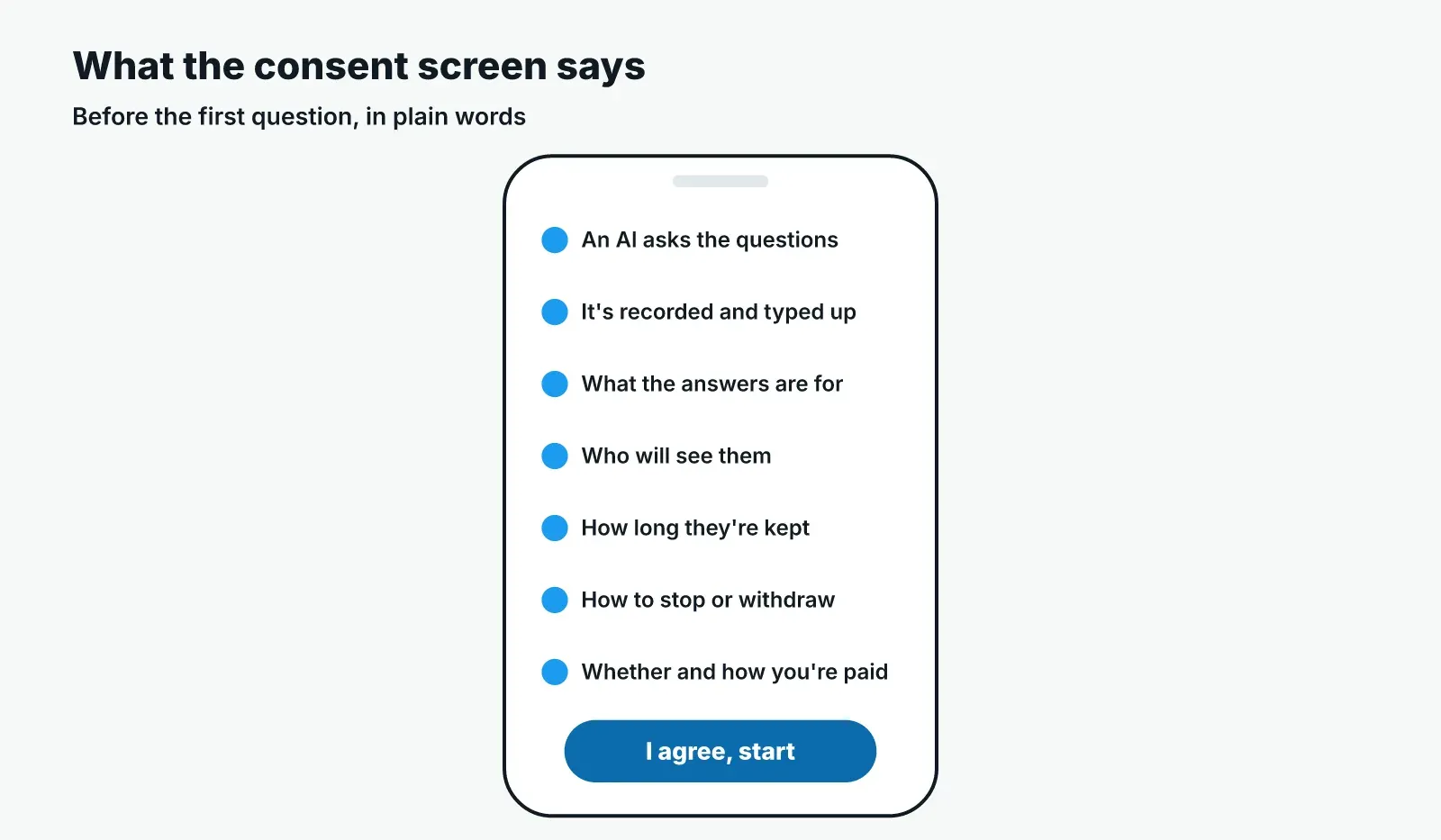
The consent screen should cover eight things. They are the AI moderator, recording, transcription, use, access, retention, withdrawal and payment. Retention means how long the answers are kept. In plain words, the screen says:
The phone company wants to invite its own former customers. So the privacy team will ask about consent to contact. Did those customers agree to be contacted for research? It's like checking that a friend is happy to be called before you pass on their number. So write down who checks the company's own customer list, and when.
Teams in Europe will also hear about GDPR. GDPR is the EU's law on how companies handle personal details. This post explains what reviewers ask, and it isn't legal advice.
Your legal team decides what the law requires in each country where you run the study.
The buying team then asks about participant sourcing and fraud checks. Participant sourcing means where the people you interview come from. Fraud checks are how the vendor makes sure each participant is real.
If the phone company doesn't give you a list, participants often come from a panel. A panel is a group of people who signed up to join studies for pay.
That pay is why fraud checks matter. Some people join studies with false details just to get paid. It's like someone with a fake ticket at a concert. So ask the vendor, in writing, how it checks that each participant is real and fits the study.
Reviewers also want to know who reads the transcripts. A researcher can judge interview quality in one transcript, which is good practice for any study.
Information security wants to know where the phone company's recordings will sit. They also ask who at the vendor can open them. And they ask whether the data trains AI. So ask every vendor the same six questions in writing. Then each answer can go straight into the reviewer's file.
Data residency means the country or region where your data is stored. It's like choosing which city your storage locker is in. A good answer names the region, such as the EU. It also says whether you can choose it.
A subprocessor is another company the vendor uses to handle your data, such as a cloud company. It's like a builder who brings in a plumber. You want to know who else is in your house. A good answer is a published list, and a promise to tell you when it changes.
Single sign-on lets staff log in with their work account. It's like one key that opens every door at the office. When someone leaves the company, that one key stops working. Roles decide who can see what. Think of a school. A teacher sees every student's grades, but each student sees only their own.
Redaction means removing personal details, such as names and phone numbers, from the transcript. It's like covering an address with a black marker before you share a letter. Ask whether it happens on its own, every time.
Deletion means the recordings and transcripts are wiped for good. Ask how long the vendor keeps them, and how you delete them when the study ends. It's like asking a shop when it shreds your old receipts.
Training means using data to teach an AI model. It's like a student learning from old exam papers. You want to know whether your customers' words become someone's study notes. Ask about the vendor's own models and any AI company it works with.
Then put the answer in writing and in the contract. A sentence on a website can change overnight, but a contract can't change without you.
Say the research lead at the phone company wants video. They want to see faces as well as hear voices. The legal team may then ask whether reading feelings from faces is allowed. In the EU, one part of a law called the AI Act bans some uses of this.
A March 2026 analysis by the Future of Privacy Forum explains Article 5(1)(f) of the EU AI Act. This rule is about emotion recognition, which means AI guessing how someone feels. It prohibits AI systems that infer a person's emotions from biometric data in the workplace and in education institutions. Biometric data is data about a person's body, such as their face. There are exceptions for medical and safety reasons.
The same analysis says emotion recognition outside those settings isn't covered by this ban. Instead, it counts as high risk under Annex III of the Act. High risk brings its own duties, and your legal team will want to read them.
In plain words, the ban names two places: work and school. So interviews with the company's own staff, or with students, go to the legal team first. For customer studies, the legal team still decides. Bring them what the study is for and how the video will be used.
If your study is a voice interview with customers, send the full pack to every team on the same day. If it records video of staff or students, go to the legal team first. Send the rest once they answer.
Pulse states its answers to the core questions above plainly, which keeps the pack short. It is GDPR compliant and offers data residency options on the enterprise plan. It supports SAML and OIDC single sign-on on request, with Owner, Admin and Member roles. Personal data is redacted from transcripts, and customer data is never used to train AI models.
Participants take the interview on a phone or laptop by opening a link, which is how Pulse runs AI-moderated interviews. Every interview arrives as a full transcript alongside its recording. Fraud checks run on every participant. The privacy notice for interview participants is public, so the privacy team can read it before the first call.
Your legal team still decides what each study needs, and these facts give them something concrete to work from. To walk your reviewers through a study, book a demo.
Tell them plainly, before the first question. One line can do it: "An AI will ask you the questions, and this call is recorded." People are agreeing to share their views. Who is asking is part of that. Your legal team decides what the law requires where you run the study. That one line on the consent screen answers this for every reviewer.
Yes. Taking part is always the participant's choice, and they should be able to stop at any point. The consent screen should say how to stop and how to withdraw later. Some topics suit a person better. The guide to when a human moderator is the better fit shows how to choose.
Research integrity means the findings are honest and can be checked. It comes from the same steps as any study. You need a clear guide, a screener and checked participants. Then a researcher reads the transcripts before trusting a theme. You can audit themes back to the exact quote to test any finding.
An AI-moderated interview is a one-to-one research interview led by an AI moderator. It asks questions from a guide and listens to each answer. When a reply is vague, it asks a follow-up. A researcher still writes the guide and reads the results. To learn more, see the guide to AI-moderated research.
Choosing an AI assistant for research? Match it to the evidence your question needs, then test whether every finding opens to the source behind it.
Jobs to be done interviews at scale: how to keep hundreds of interviews on track, sort what buyers say and check each reason across groups.
How to write a screener survey that lets the right B2B buyers into your interviews: role checks, hidden criteria, quotas and a test run.