AI-Moderated Interviews vs. Human-Moderated Interviews: What's the Difference?
AI-moderated interviews offer speed and scale, while human moderation provides deep, exploratory insight. Learn the key differences and how to choose the right method.
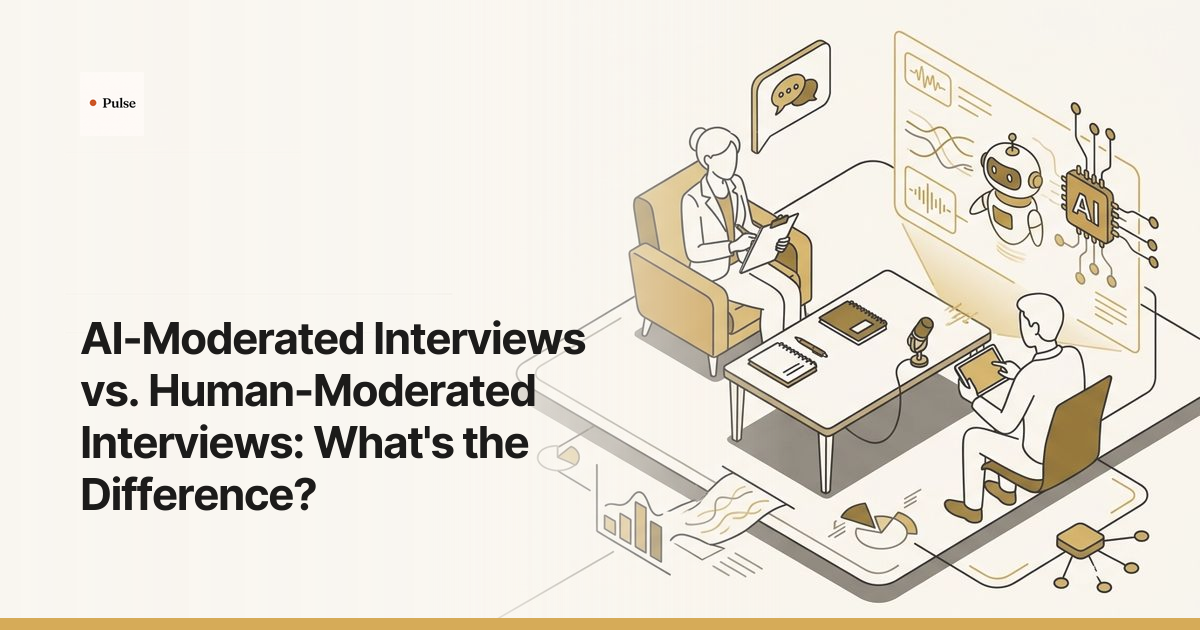
The choice between research methods is rarely about which is better, but which is right for the question at hand. For decades, the gold standard for qualitative insight has been the human-moderated interview. Today, AI-moderated interviews offer a new way to understand customers, creating a critical choice for research teams: do you prioritize the nuanced depth of a human conversation or the speed and scale of an automated one?
Understanding the specific strengths and limitations of each approach is the key to designing better research. This is not a contest between human and machine, but a guide to choosing the right tool for the job.
AI vs. Human Moderation: The Short Answer
Human-moderated interviews excel at deep, exploratory research where building rapport and probing on unexpected tangents is critical. They are best for uncovering unknown unknowns and understanding complex emotional context. AI-moderated interviews excel at speed, scale, and consistency, making them ideal for validating known hypotheses across large samples and turning qualitative feedback into structured data overnight.
How AI-Moderated Interviews Work
An AI-moderated interview uses conversational AI to conduct a structured voice interview with a participant. The AI follows a pre-defined script and question logic, ensuring every participant is asked the same questions in the same way. This approach eliminates interviewer effects, a source of error where subtle differences between moderators can influence participant responses and reduce the precision of the findings.
Because the interviews are asynchronous, hundreds can run in parallel without a human in the loop. The system automatically transcribes and structures the conversational data, identifying themes and patterns. This method is built for speed and consistency, compressing fieldwork from weeks to days. Research shows AI-led interviews can also elicit more detailed responses than static surveys, with one study finding AI interviews generated 142% more words from respondents than open-text fields.

How Human-Moderated Interviews Work
A human-moderated interview is a live conversation guided by a trained researcher, either in-person or remotely. The moderator’s primary role is to build rapport, listen actively, and probe for deeper insights based on a participant's verbal and non-verbal cues. This allows for the flexibility to deviate from the script to explore promising topics that arise organically.
This method is unparalleled for its depth. An experienced moderator can navigate sensitive topics with empathy, interpret sarcasm, and understand the cultural context behind a statement. This human element, however, is also a source of variance. While often small, interviewer effects can become significant; a 2022 study on pain assessment in BMC Geriatrics found the interviewer accounted for almost a quarter of the total variance in patient reports. The primary challenges are time and cost. A full-service study with 15-20 interviews can cost between $25,000 and $75,000 and typically takes six to twelve weeks to complete.

Where Each Method Wins: A Side-by-Side Comparison
The choice between AI and human moderation comes down to a series of trade-offs. Based on current industry benchmarks, the differences in speed, cost, and scale are substantial. The right method depends entirely on the goals, timeline, and budget of your study.
| Dimension | AI-Moderated Interviews | Human-Moderated Interviews |
|---|---|---|
| Speed to Insight | 2–5 days | 6–12 weeks |
| Cost Per Interview | $30–$150 | $800–$1,500+ |
| Typical Sample Size | 20–100+ interviews | 8–15 interviews |
| Interviewer Effects | Eliminated; perfect consistency | Present; requires training to minimize |
| Exploratory Probing | Structured and logical | Adaptive and intuitive |
| Data Structuring | Automated and immediate | Manual and time-consuming |
How to Choose the Right Method for Your Study
The best research plans often use both methods for what they do best. Use the specific needs of your study to guide your decision between the depth of human moderation and the scale of AI moderation.
Choose human moderation for:
- Early-stage discovery: When you do not yet know what you do not know and need to explore a problem space broadly.
- Foundational research: For developing personas, journey maps, and deep understanding of user motivations.
- Highly sensitive topics: When discussing trauma or deeply personal experiences where human empathy is essential.
- Complex B2B interviews: When interviewing senior executives or technical experts who require a conversation with a peer.
Choose AI moderation for:
- Concept and message testing: When you need to get reactions to ideas from hundreds of people in specific segments quickly.
- Feature validation: To confirm that a proposed solution meets a user need at a scale that gives you confidence.
- Voice of the Customer (VoC) programs: To run continuous, structured interviews that track customer sentiment over time.
- Quantifying qualitative findings: When you have a hypothesis from a small human study and need to see if it holds true across a larger sample.
For example, imagine you have a new feature concept. You might start with five human-moderated interviews to explore the initial problem and refine the concept's value proposition. Once you have a clear concept, you could use an AI-moderated study to run 100 interviews to validate its appeal across different customer segments. Platforms for AI-moderated research allow teams to run these large-scale studies and get research-grade insights by the next morning.

Frequently Asked Questions
Does the quality of insight suffer with an AI moderator?
The quality is different, not necessarily worse. AI moderation captures consistent, structured feedback at scale but can miss nuance like sarcasm or cultural context. A 2024 study found participants reported significantly different mental health states to human interviewers versus self-administered surveys, showing how the moderator's presence shapes the data. AI provides candid data, while humans provide deep, interpretive insight.
How do participants react to being interviewed by an AI?
Participants often disclose more information on sensitive topics to an AI because they feel less judged. A comprehensive literature review on self-disclosure to AI confirms that the perceived anonymity can lead to more honest reporting. For building deep emotional connection, human interviewers remain superior.
Can AI moderation handle complex or sensitive research topics?
Yes, but with limitations. For sensitive topics where fear of judgment is high, AI can increase candor. For emotionally complex topics like grief, a human’s ability to respond with genuine empathy is irreplaceable. The choice depends on whether the topic requires anonymity to be discussed honestly or empathy to be explored deeply. A look at the cost of qualitative research shows why teams might test concepts with AI before committing to more expensive, human-led studies on complex topics.
Is AI moderation just for qualitative data, or can it be quantitative?
AI moderation bridges the gap between qualitative depth and quantitative scale. By conducting hundreds of structured interviews, you can collect rich, open-ended responses and then analyze them quantitatively. This allows you to report that "42% of participants mentioned 'ease of use' unprompted," a powerful finding that combines the 'what' with the 'why'.