Participant recruitment methods: 5 ways to find people
Participant recruitment methods compared by who you need: your own list, panels, referrals, networks and recruiters, plus a check before you set a date.
Virtual focus groups save travel but change how people talk. The pros and cons, what a session needs, and when interviews answer better.
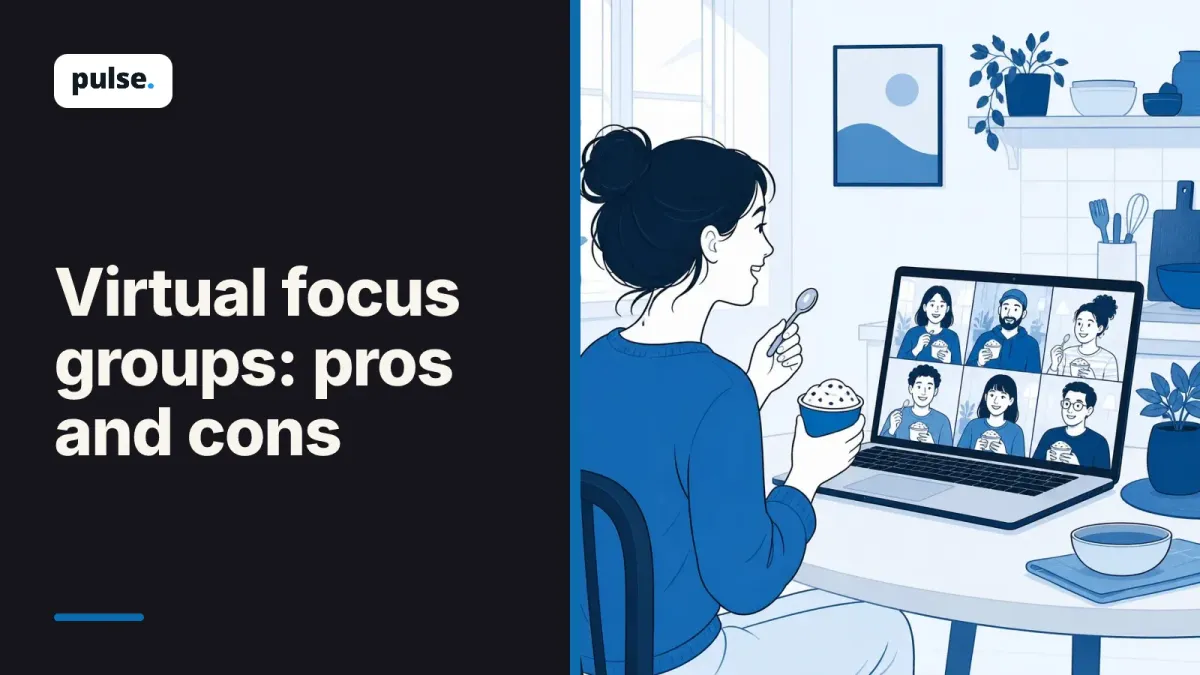
Your manager wants customers to taste some new flavors before launch. You work on the product team at an ice cream brand. The customers you want live in different cities. So your manager asks: can we do this as a group on a video call, or do we need a room?
What your manager is describing is a virtual focus group. It's a small group discussion, led by a moderator, held on a video call.
A virtual focus group works well when you want quick reactions from people in many places. It saves travel and is easy to record. But people talk over each other on video, and the quiet ones fade out. So keep the group smaller and the session shorter. If you need each person's own reasons, run one-to-one interviews instead.
The ice cream study shows where each choice fits.
A virtual focus group is a group discussion that a moderator runs on a video call. A moderator is the person who asks the questions and keeps the talk on track. People join from home, see each other on screen, and react to a topic or to something you show them. They also build on each other's comments.
It differs from a group in a room. In a room, people sit around a table, and the team often watches through a one-way mirror. Online, everyone sits in their own kitchen or office.
It also differs from an online bulletin board. On a board, people post answers over several days, whenever it suits them. A virtual focus group happens live, at one time, with everyone talking.
For the ice cream brand, that means a handful of customers from different cities on one call. Each one has the new flavors in their freezer. The glossary entry on remote focus groups covers the term in more detail.
The main pro of a virtual focus group is reach. You can bring together people from many cities without anyone traveling. The main con is control. On video, it's harder to read faces and body language, people interrupt each other, and home life gets in the way. The table below sets them side by side.
| Virtual focus group | Focus group in a room | |
|---|---|---|
| Who can join | People from many cities in one session | People who can travel to the room |
| Travel and venue | None needed | A room, travel and snacks |
| Recording | Built into the video call | Needs cameras in the room |
| Watching | The team watches from their desks | The team sits behind a mirror |
| Body language | Faces only, and often small | The whole person |
| Talking over each other | Worse, because of delay on the call | Easier to manage |
| Distractions | Pets, children, doorbells | Few |
| Showing material | Sent ahead or shown on screen | Handed over on the day |
The last row matters for the ice cream study. In a room, you scoop the flavors on the day. Online, you have to post samples ahead, packed cold, and trust that each person keeps them frozen. If you only show photos on screen, people react to the look of the tub, not the taste.
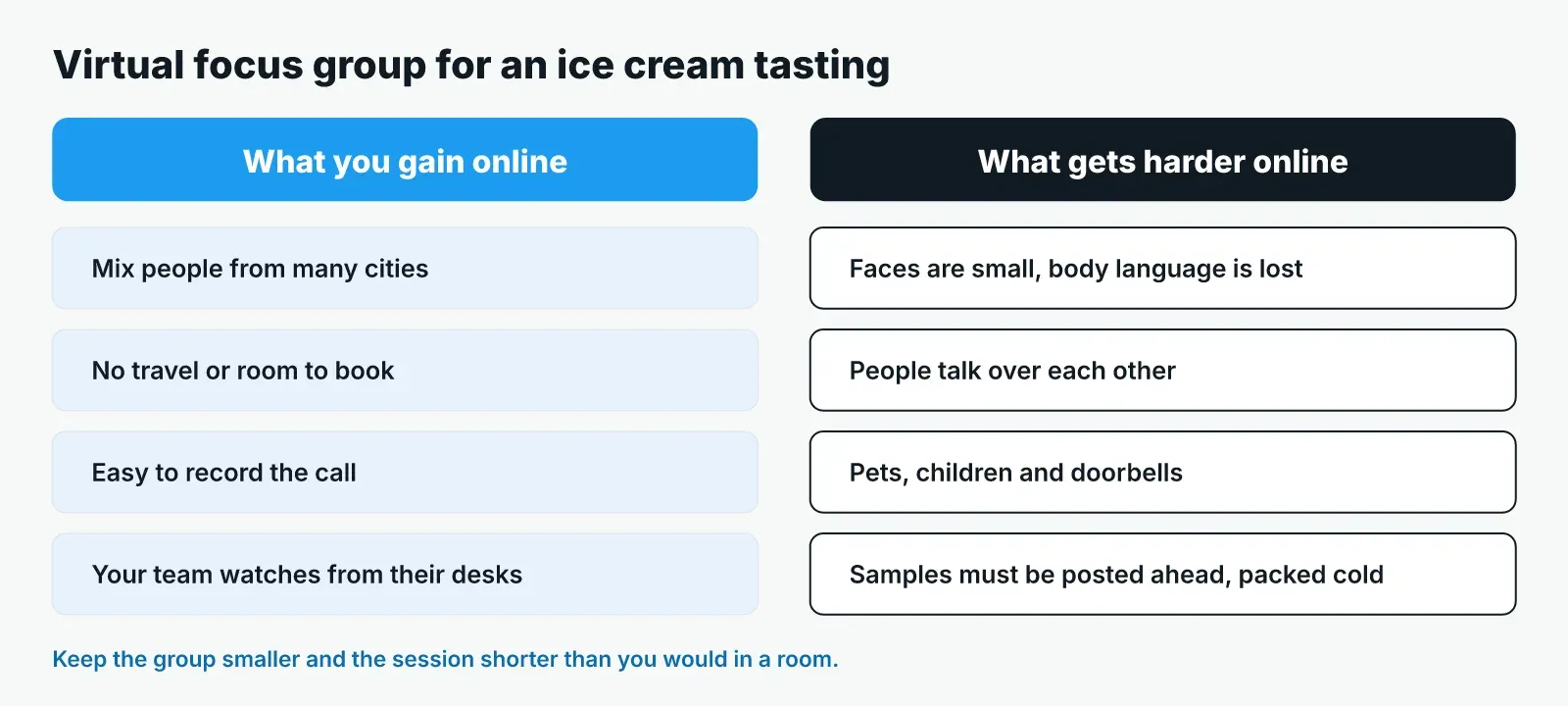
A virtual focus group needs the same core people as one in a room: a moderator, a note taker and a plan for the team who watch. It also needs more setup before the call, because you can't fix a broken camera or a missing sample once the session starts. Here is what to plan.
Online groups work better with fewer people than you would seat at a table. On video, only one person can speak at a time without a mess. With too many faces on screen, quieter people stop talking. A smaller group gives each person more turns.
Some people won't show up, or their internet will fail. Invite one or two more than you need, so the group is still big enough.
Use a screener to check each person fits. A screener is a short quiz that checks someone matches the study. For the ice cream study, that might be people who buy ice cream at least once a month. Ask each person to agree to be recorded before the call.
Do a short tech check with each person a day or two before. Make sure their camera and sound work. Send any samples or files ahead, with clear notes on when to open them.
The moderator asks the questions and calls on quieter people by name. A note taker writes down who said what. People from your team who want to watch should stay off camera and out of the chat. If they appear on screen, the customers start talking to them.
Keep it shorter than a session in a room, and add a short break. Use a discussion guide, which is the list of questions and topics for the session. Afterward, get the recording and a transcript, and hold a quick team chat while it's fresh.
Before you pick a video tool, check four things. Can it record? Can watchers sit in a separate room? Can you share your screen? Where are the recordings stored?
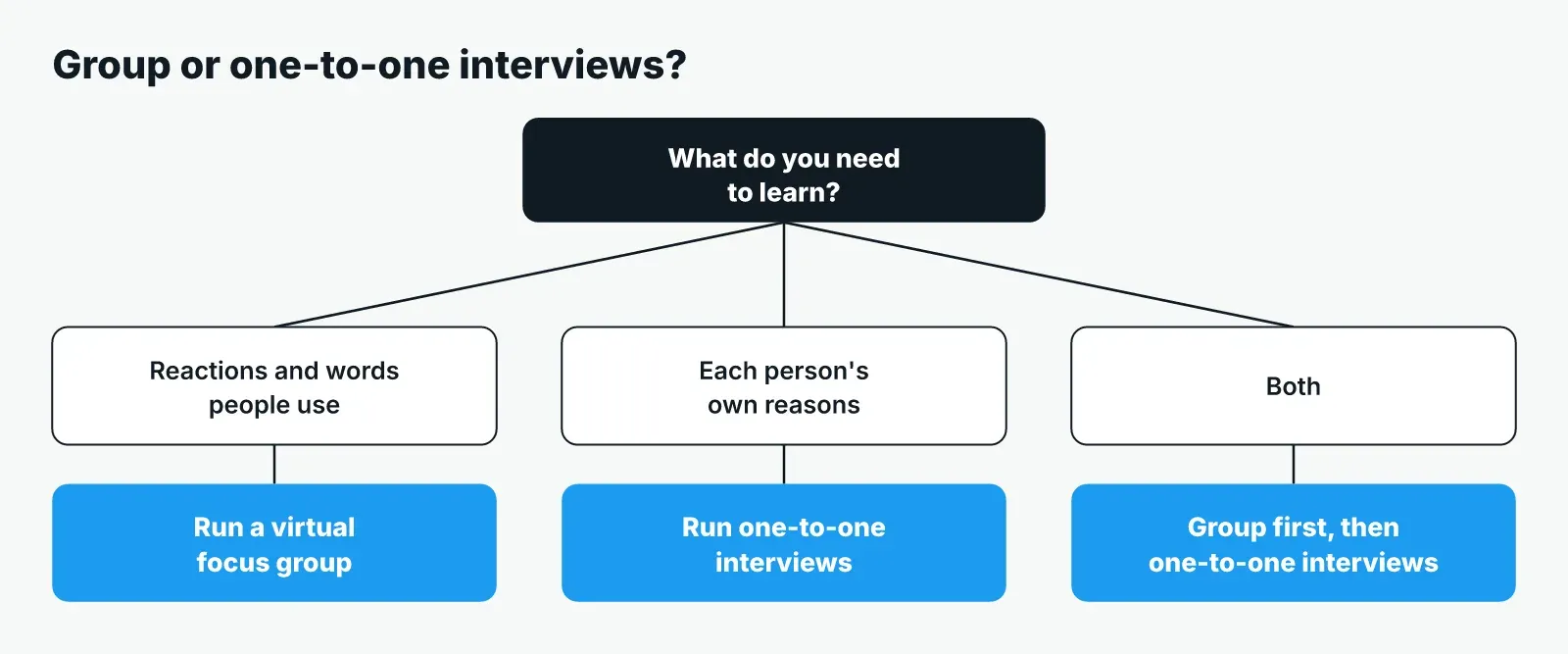
Run one-to-one interviews instead of a focus group when you need each person's own reasons. A group is good for hearing how people react and build on each other's words. But louder people steer a group, and others start to agree with them. So private reasons and personal stories often stay hidden.
Back to the ice cream study. A group is a good way to hear first reactions to three flavors. You hear the words people use, like "too sweet" or "tastes like a birthday cake". You see which flavor gets the room excited.
But say you want to know why customers stopped buying your brand's tubs. That's personal. One person might be cutting back on sugar, and another might find the price too high. They may not say that in front of strangers. One-to-one interviews let each person explain without the group listening.
The post on why focus groups miss quieter people looks at this problem in more depth.
So here is a simple rule. Use a group to hear reactions and the words people use. Use one-to-one interviews to learn each person's reasons. If you need both, run the group first, then interview people one by one.
Pulse runs AI-moderated interviews, one person at a time, rather than group sessions. So it fits the part of a study where you need each person's own reasons. In the ice cream study, that's the question of why customers stopped buying.
People take a Pulse interview by voice or video, on a phone or laptop, from a link. There is no call to schedule. You can show them material during the interview, such as a new tub design, and video insights capture how they react. The AI moderator asks every person the same questions from one guide. It builds follow-ups on what each person said earlier, and asks again when an answer is vague.
You can recruit people who match your profile, with fraud checks on every one, or invite your own customers. One brief can run across several markets. Every theme comes with the quotes behind it, and each quote links to its transcript.
To try it, start on the $0 Explorer plan or ask for a free study. You can also book a demo and talk through the one-to-one part of your study with the Pulse team.
They are good for different things. A virtual group reaches people in many places and costs less to set up. A group in a room makes it easier to read body language and to hand people real products. If what you show needs to be touched or tasted, a room is simpler. If reach matters more, go online.
Plan it shorter than a session in a room, and add a short break halfway. People at home tire of a screen faster than people at a table. They also have more things pulling them away. Cut any question that doesn't link to your decision, so the time goes to what matters.
Thank them, then turn to someone else by name. Give each person a turn on every main question before the talk opens up. If the same voice keeps coming back, ask the group a direct question such as "Does anyone see it differently?" That makes room for a second view without shutting anyone down.
From the researcher's side, check the people who sign up. Use a screener, check that each person is who they say they are, and watch for the same person signing up twice. Someone who answers every screener question "yes" may be guessing to get in.
Participant recruitment methods compared by who you need: your own list, panels, referrals, networks and recruiters, plus a check before you set a date.
Semantic vs latent themes, from Braun and Clarke's paper "Using thematic analysis in psychology", shown on real-life quotes, with when to use each.
How to choose a transcription service for research interviews: test each option on your own audio with five simple checks, from accuracy to data safety.