How to analyze five second test results
How to read five second test results: sort recall answers, judge whether your main message landed, when to use ten seconds, and what to do next.
The types of participant recruitment in research, in plain words: six ways to choose people, when to use each and what each lets you claim.
The first people to sign up for your study all came from the newsletter. And all of them order flowers every month.
You work on the research team at a florist delivery service. Your team wants to know why so many people order once and never come back. But those people aren't on the sign-up list. So who should you talk to, and how do you find them?
That choice is about the types of participant recruitment in research. Each type is a rule for choosing who takes part.
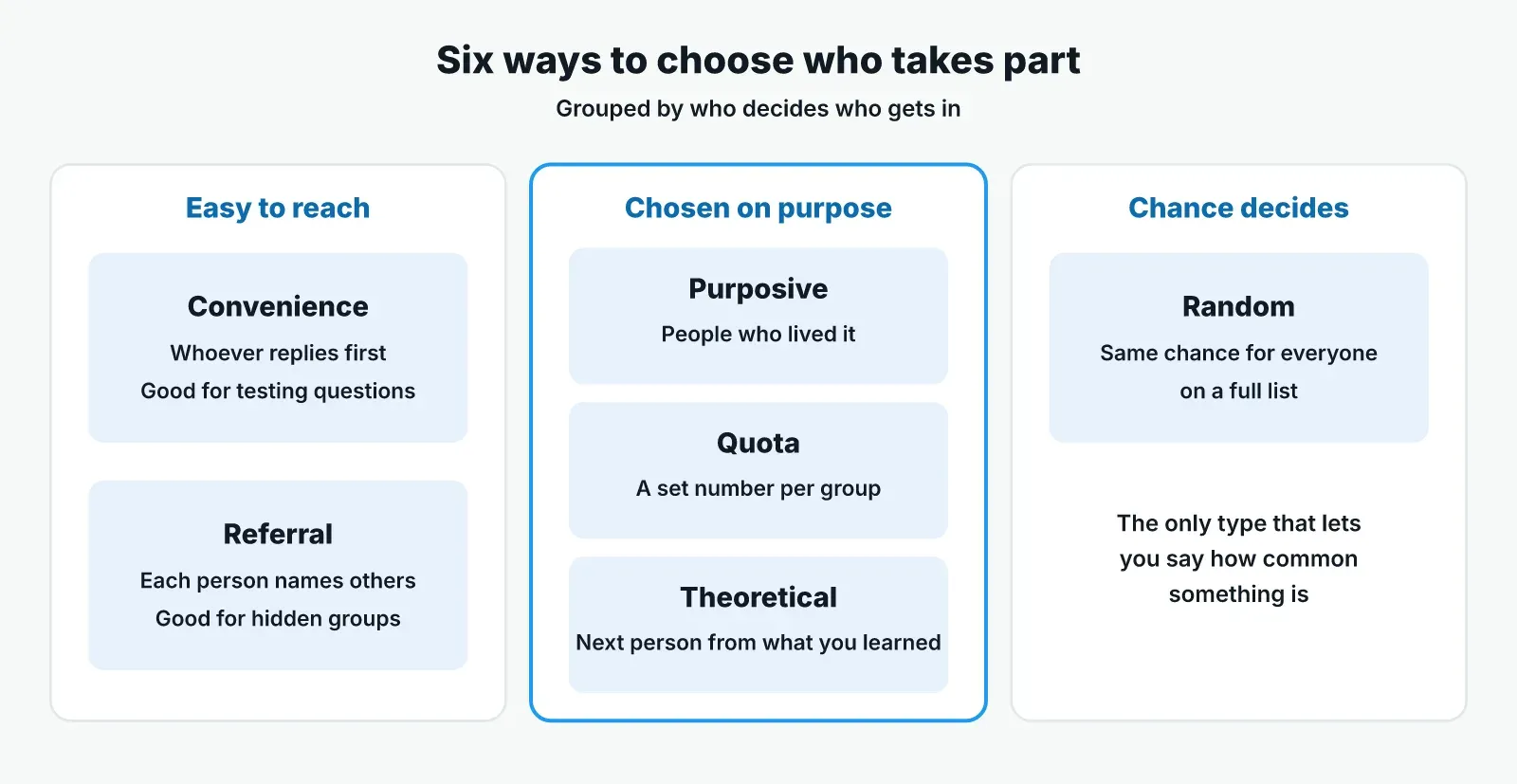
There are six common types: convenience, purposive, referral, quota, theoretical and random. Pick the one that fits what you need to say at the end. If you want to understand why one-time buyers leave, choose people who lived it. If you want to estimate how many leave for each reason, pick people at random from the full order list.
The trick is knowing what each type lets you say, and who it leaves out.
Recruitment types sort studies by how you choose people. Some pick whoever is easy to reach. Some pick people on purpose. Some let chance decide. Each one changes who ends up in your study. So each one changes what you can say about your customers at the end.
Here is what each type does, and who it can miss:
| Type | How you choose people | Best for | Who it can miss |
|---|---|---|---|
| Convenience | Whoever is easy to reach first | Testing your questions | People who don't reply to you |
| Purposive | People who lived the thing you study | Learning why something happens | People outside the groups you chose |
| Referral (snowball) | Each person names others who fit | Small or hidden groups | People outside the first few people's circles |
| Quota | A set number from each group | Hearing from every group | Slow repliers inside each group |
| Theoretical | The next person depends on what you just learned | Building an explanation step by step | Groups your early talks never pointed to |
| Random | Everyone on a full list has the same chance | Saying how common something is | People missing from the list |
A type is different from a channel. A channel is where you find people: an email, an ad, a panel or a sign-up page. A type is the rule you use to choose among them. You can send a random sample an email, or a convenience sample the same email. The channel is the same, but what you can claim is not. The post on recruiting from your own customers covers channels in more detail.
Convenience sampling is where most teams start. It means taking whoever is easiest to reach, like the newsletter readers at the florist. That's fine for a first look, such as checking that your questions make sense. But easy-to-reach people are often your keenest customers.
So a convenience group can't tell you what one-time buyers think.
Some groups are hard to find because you have no list for them. At the florist, people who ordered once and now buy from a local shop are a good example. Referral sampling, also called snowball sampling, is one way in. You find a few people who fit. Then you ask each of them to name others.
Say two one-time buyers agree to talk. One says her office now orders from a shop near work. She offers to ask two coworkers who switched too. Your group grows with people you could never have found on your own.
The catch is that people refer people like themselves. Friends and coworkers often shop alike and think alike. So a referral group can hear one circle's story many times over. This is a kind of sampling bias, which means the people in your study differ from the people you missed.
So start from a few people who don't know each other. And write down who referred whom, so you can see if one circle takes over.
Your one-time buyers aren't all the same. Some ordered for a birthday, some for a funeral, and some used a discount code. If you take whoever replies first, one group can fill the whole study. Purposive and quota sampling fix this.
Purposive sampling means choosing people because they lived the thing you study. At the florist, that's people who placed one order in the last three months and never ordered again. They can still remember why.
Quota sampling means setting how many people you need from each group. When a group is full, it closes. Say the birthday buyers reply fast. Their group fills first and closes, while invites keep going to the other two groups.
Write the groups down before any invite goes out. If you set them after people reply, the groups tend to match whoever turned up.
Theoretical sampling goes one step further. You choose the next person based on what the last talks showed. Say three birthday buyers mention that the flowers arrived a day late. Next, you look for people who ordered for a date that mattered, to see if late delivery explains most of the losses. The post on choosing a sampling method shows how to pick which traits to split by.
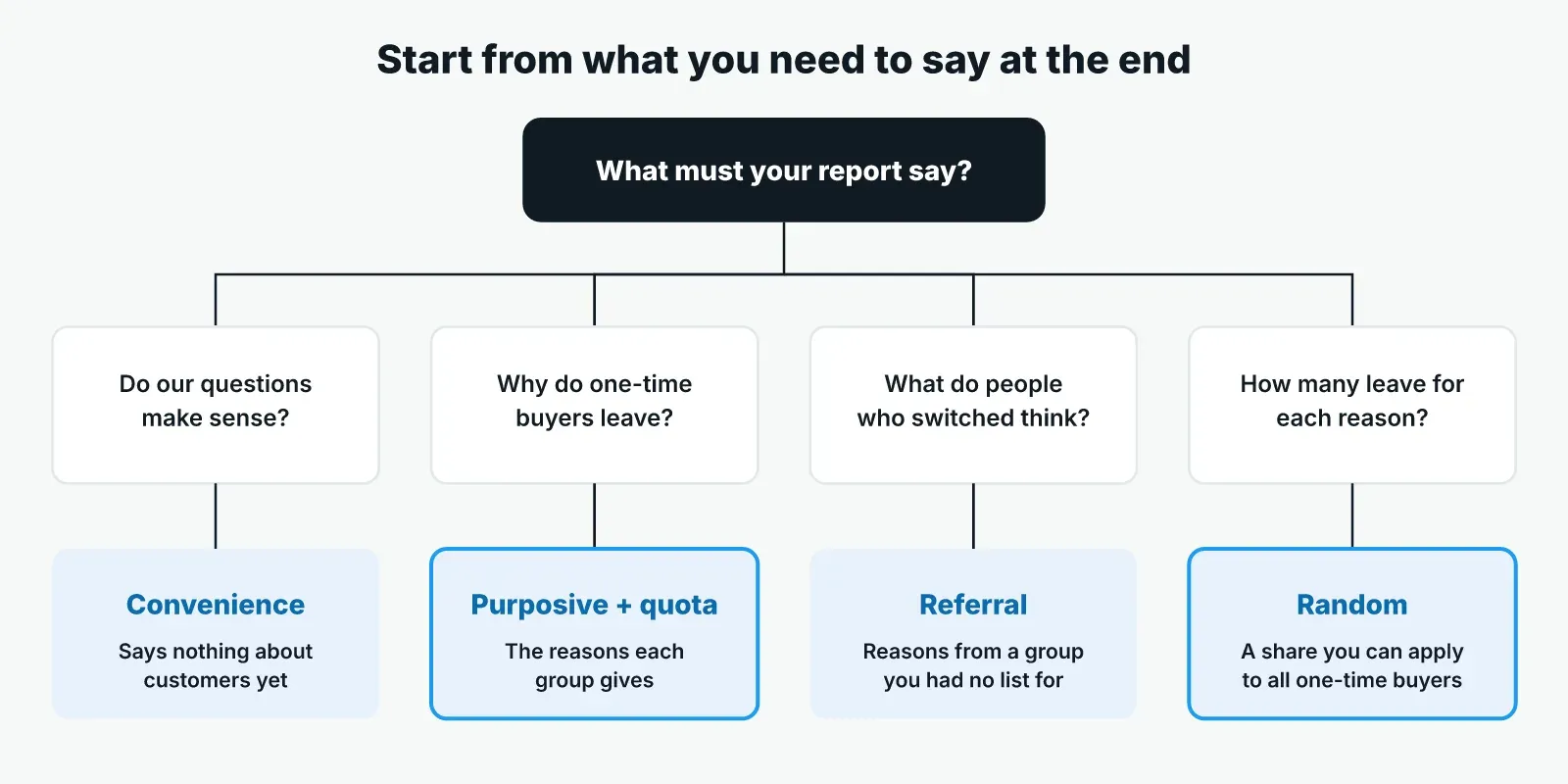
Start from what you need to say at the end. If you want to understand why customers leave, choose them on purpose. If you want to estimate how many leave for each reason, pick them at random. Many studies mix two types: talks with a chosen group first, then a wider survey to count what you heard.
Each thing you might need to say points to one type:
| What you need to say | Type to use | What you can claim |
|---|---|---|
| Do our questions make sense? | Convenience | Your questions work, nothing about customers |
| Why do one-time buyers leave? | Purposive, with quotas | The reasons each group gives |
| What do people who switched think? | Referral | Reasons from a group you had no list for |
| How many leave for each reason? | Random | A share you can apply to all one-time buyers |
Random sampling means everyone on a full list has the same chance of being picked. At the florist, that list is every one-time order from the past year. A computer picks the names, and you invite those people. It's the only type here that lets you say how common a reason is.
Where you find people matters less than how you choose them. In 2024, a review called RE-MIND looked at 97 published mental health trials. It found no evidence that offline or mixed recruitment did better at reaching each trial's target number of people. That's a medical finding, but the same idea helps here. Pick the type first, then the channel.
So the florist team can decide with one rule. To learn why one-time buyers leave, talk to a purposive group with a quota for each kind of buyer. To learn how many leave for each reason, follow up with a survey sent to a random sample of one-time buyers.
Mixing two types is easier when both sit in one study. With Pulse, you can invite your own customers from a list you upload, such as a random pick of one-time buyers. Or you can have people recruited to the profile in your brief, from more than 200 million people worldwide. Every participant goes through fraud checks.
Surveys run beside AI-moderated interviews in the same study. So your chosen interview group and your wider survey sample report together. Each theme links back to the quotes behind it, so you can check which group said what.
Your team still picks the recruitment type and the groups. To try it on your own study, book a demo, start on the $0 Explorer plan, or ask for a free study.
No single number is right for every study. What matters is how many groups you need to compare, and how different their reasons might be. Seven people from one narrow group can show you the main reasons that group gives. Seven people spread across three groups leaves each group too few voices to compare. The post on how many user interviews you need walks through the choice.
A participant is a person who takes part in your study. At the florist, a participant might be someone who ordered a birthday bouquet in March and never ordered again. She answers your questions, and her answers become part of what you find. Before the study starts, she's often called a recruit.
Yes, and many good studies do. A common mix is purposive talks to learn the reasons, then a random survey to count them. Keep a note of which type each person came from. If answers differ by source, you'll spot it, instead of blending two groups into one result.
It can, but it rarely pays off. Random picking shines when you want to count, and a set of interviews is too small to count. With a small group, chance alone can leave out a whole kind of customer. For interviews, choosing people on purpose with a quota for each group usually teaches you more.
How to read five second test results: sort recall answers, judge whether your main message landed, when to use ten seconds, and what to do next.
How to write a usability test report: what goes in it, five example findings with severity and fixes, and how to share it so the team acts on it.
The three types of participant recruitment, active, passive and third-party, explained simply, with who each one reaches and who it misses.