When a concept test says yes and the launch still fails
Concept test results overstate demand when a yes costs the respondent nothing. How to read them, what to check before launch, and what to ask after.
Targeted consumers are the people a business chooses to serve. Define yours as testable criteria, then check them against real customer interviews.
Targeted consumers are the specific people a business chooses to design, price and market for, described by their need, behavior and context as well as their demographics. Treat that description as a hypothesis. Write it as criteria a screener can check, interview people inside the line and one criterion outside it, and narrow, widen or split the target based on what they say.
Targeted consumers are the people a company decides to serve first, defined by a need they hold, the behavior that shows it and the context it happens in. Demographics describe them; the need explains why they choose you. Three groups sit close together and are easy to confuse, and the gaps between them are what research finds.
| Group | Who they are | Where the definition comes from |
|---|---|---|
| Targeted consumers | The people the company chose to serve | Strategy, brand and launch plans |
| Actual buyers | The people who chose the company | Transaction and CRM data |
| The category | Everyone who buys this kind of product from anyone | Market sizing and panel data |
Targets drift when they are written once, from demographics and a launch-era assumption, and then checked only against data that cannot show why people buy. The consumers a team targets and the consumers who choose the product can separate without anyone noticing, because the dashboards keep reporting conversions.
A target set for a launch carries the assumptions of that moment: the price point, the competitor set, the channel mix. Each of those moves; the written target does not.
Acquisition and ad data record who clicked and who converted, not the reason. A target can look confirmed by conversions while the reason people buy has changed underneath it.
The brand team, the acquisition team and the product team can each hold their own definition of who the product is for. When nobody reconciles them, media, messaging and roadmap pull toward different people.
A target defined only from third-party behavioral data rests on collection practices that regulators are questioning. A September 2024 Federal Trade Commission staff report examined nine social media and video streaming companies. It found they "engaged in vast surveillance of consumers in order to monetize their personal information", and cited targeted advertising as a main motivator for the data collection.
The report grew out of an investigation the FTC launched in December 2020. The agency sought detailed information from the companies about their data gathering and ad targeting practices.
For a research team, this is a question of provenance. Consented interviews with your own customers and recruited consumers produce evidence you collected, can explain and can defend. Use behavioral data to find patterns, and use interviews and voice of customer research to learn whether the need behind the pattern is the one your target assumes.
A target becomes testable when each part of it can be checked with a screener question. Write it in four parts: the need, the behavior that shows the need, the context it happens in, and who is excluded. Then turn each part into a question with a qualifying answer, so the same definition drives recruitment, media and product decisions.
This example is illustrative. A card issuer's brand plan targets "young salaried professionals". That line names an age band and an income type, and it says nothing about why someone would pick this card. The insights team rewrites it.
| Original target line | Rewritten criterion | Screener question |
|---|---|---|
| Young | Switched card or bank in the last two years | When did you last change your main card or bank? |
| Salaried | Pays for most everyday purchases by card or mobile wallet | How did you pay for your last five everyday purchases? |
| Professional | Carries a balance at least occasionally | In the last year, have you carried a balance from one month to the next? |
| (not stated) | Excludes people who hold the issuer's card today | Which cards do you hold now? |
The rewritten target can be recruited against, and it can be wrong in ways an interview will show. A research plan is the place to write these criteria down before fieldwork.
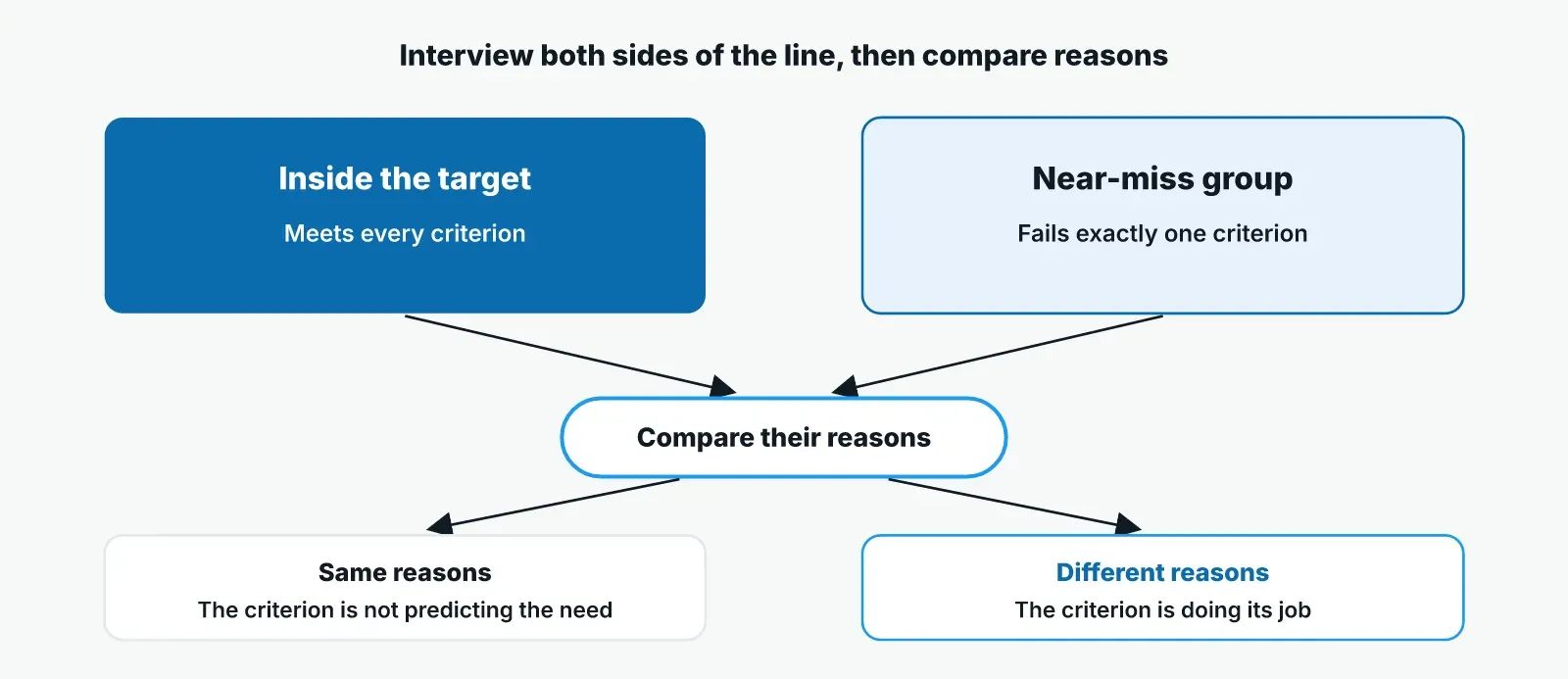
Check a target by interviewing two groups: consumers who meet every criterion, and a near-miss group who fail exactly one. If both groups give the same reasons for choosing, the criterion that separates them is not predicting the need. If their reasons differ, the criterion is doing its job.
Ask what they chose, what they compared and what nearly stopped them. Never ask whether they fit the target. Build the discussion guide around one recent purchase, so answers describe behavior instead of self-image. The guide to running the interviews covers probing and moderation.
Compare the reasons each group gives, criterion by criterion. A reason that appears in both groups belongs to a wider population than the target describes. A reason that appears only inside the target is the one the target should be built on.
Pulse builds the brief with an audience and screener, recruits participants to that profile or invites your own customers, and returns themes with quotes traced to each transcript, so the comparison between groups rests on what people said.
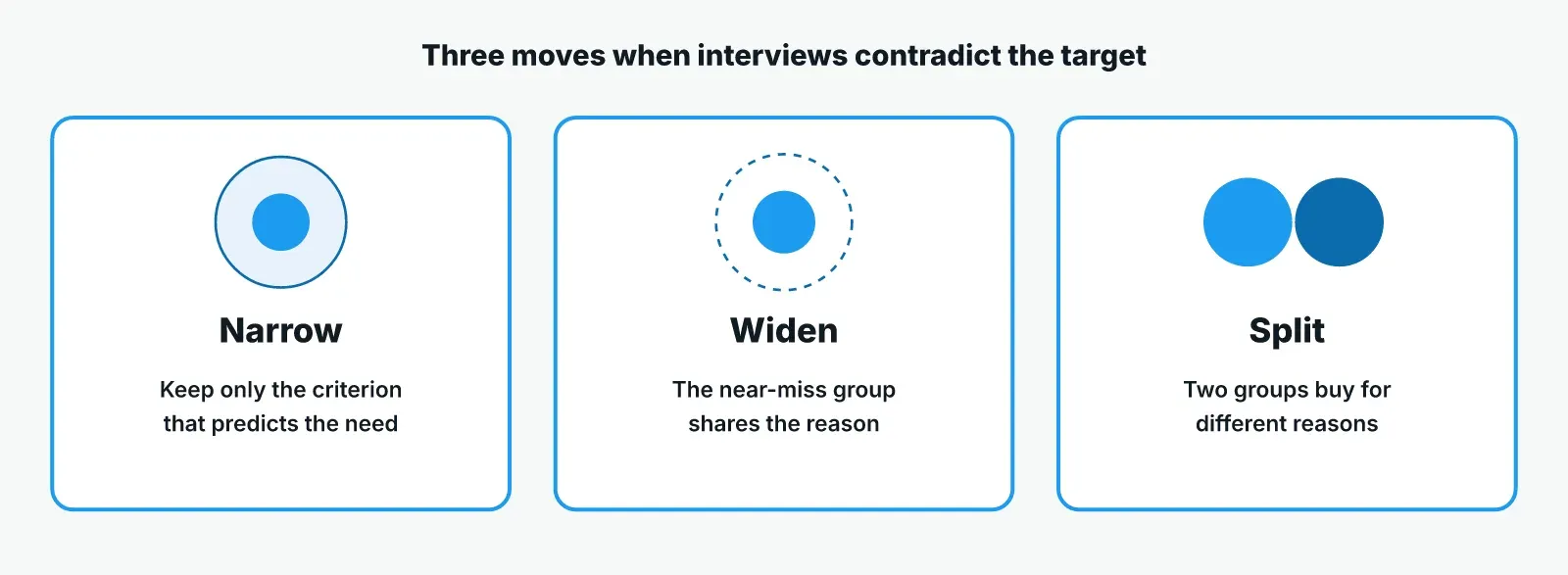
When interviews contradict the target, make one of three moves. Narrow it to the criterion that predicts the need, widen it when the near-miss group shares the reason, or split it when two groups buy for different reasons. Then present the change with the evidence that produced it.
Stakeholders defend old targets with campaign results, so bring quotes tied to transcripts and the screener that selected each speaker. Deloitte's 2025 Consumer Products Industry Outlook drew on a global survey of 250 consumer products executives. It found companies seeking more data-driven proof points that their marketing spend is delivering genuine return on investment. A tested target gives the team that kind of proof point for the people its spend is aimed at.
Set a trigger for the next check: a new product line, a pricing change, or a shift in who converts.
Four mistakes make a target unusable, and each one is visible in the written definition before any money is spent.
A consumer target is the group of people a business chooses to serve first, described by a need, the behavior that shows it and the context it happens in. Demographics help describe the group, but the need is what makes the target useful for product, pricing and media decisions.
Advertising platforms match ads to people using data they collect about behavior, interests and context, along with demographic signals. The FTC's September 2024 staff report examined how nine social media and video streaming companies collect that data and named targeted advertising as a main motivator for the collection.
Marketers group consumers by demographics (age, income, location), psychographics (values and attitudes), purchase intent (people actively shopping a category) and behavior (what they buy and how). Most working targets combine several. The groupings are conventions, so no fixed number of types applies.
Targeted consumers are the people a company chose to serve; actual buyers are the people who chose the company. The two overlap to different degrees. Interviews with buyers inside and outside the target show which part of the definition explains the choice.
Re-check at each trigger: a new product line, a pricing change, a new competitor, or a shift in who converts. A target that has not been tested against interviews since launch is due now. To run that check with your own customers and a recruited near-miss group, book a Pulse demo.
Concept test results overstate demand when a yes costs the respondent nothing. How to read them, what to check before launch, and what to ask after.
How do AI interviews work in customer research? Follow one session from screener to follow-up question to a theme traced to its transcript.
Jobs to be done research gets harder when one account has many roles and business units. How to recruit, interview and merge jobs across them.