When a concept test says yes and the launch still fails
Concept test results overstate demand when a yes costs the respondent nothing. How to read them, what to check before launch, and what to ask after.
How do AI interviews work in customer research? Follow one session from screener to follow-up question to a theme traced to its transcript.
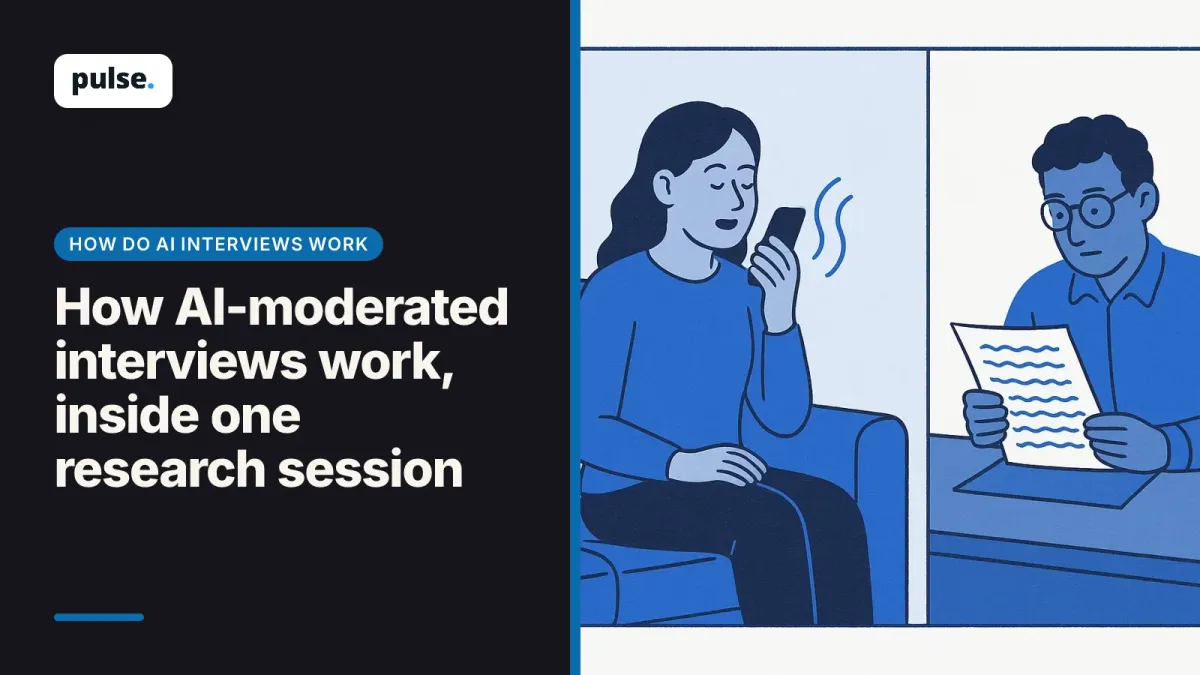
In customer research, an AI interview is a voice conversation run by an AI moderator from a researcher's discussion guide. The participant opens a link, answers aloud and gets a follow-up question when an answer is thin. The conversation becomes a transcript that feeds themes a researcher reviews. Nobody is scored; the study collects the participant's reasons.
An AI-moderated research interview runs in six steps, from a guide the researcher writes once to themes the researcher checks against transcripts. The moderator handles the conversation in between. An AI job interview scores a candidate against a rubric. A research interview collects reasons and scores no one, so the steps are built for depth.
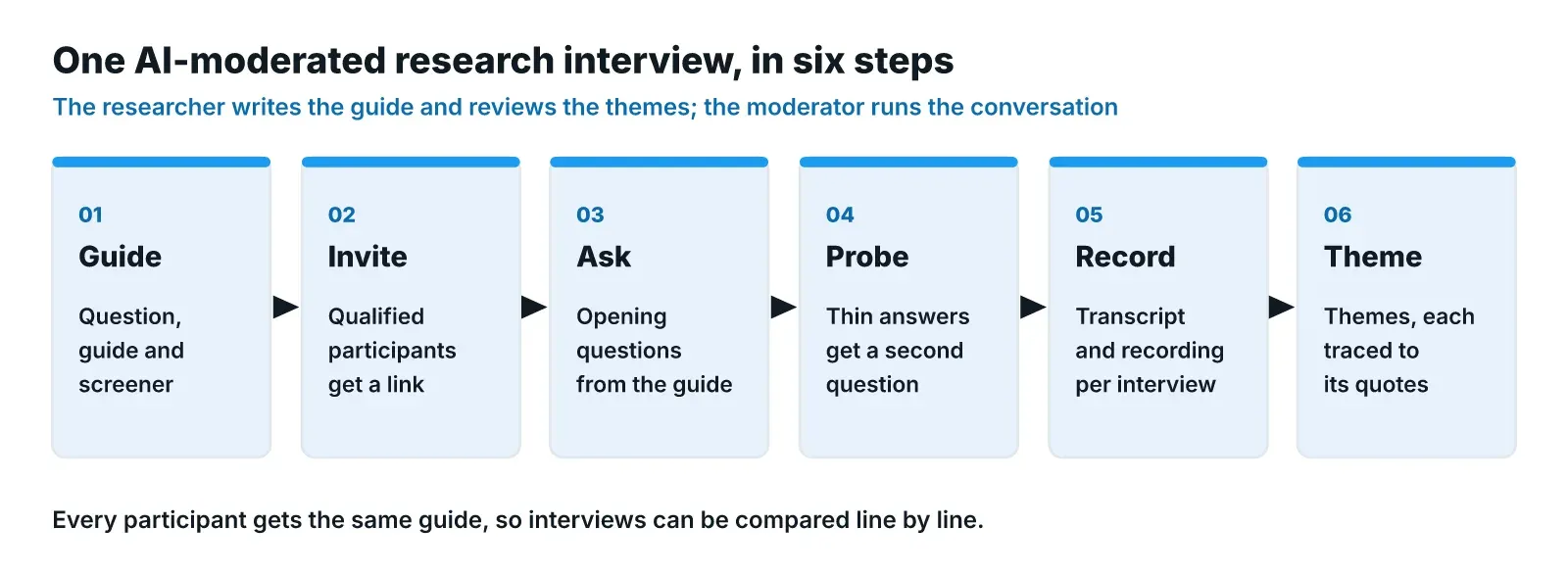
Before fieldwork, the researcher writes three things once: the business question, the discussion guide and the screener. The moderator then works from that guide with every participant, so each interview covers the same ground in the same order.
At enterprise scale, a study that spans several business units or markets gets the same well-formed questions in every interview, and the differences between interviews are differences between participants.
Here is an illustrative setup, invented for this guide. An insights team at a large retail bank wants to know why customers stopped using a savings feature. The screener admits customers who closed it in the last quarter. The guide opens with the decision itself ("Tell me about the day you closed it"), moves to what they did with the money, and ends with what would have kept them.
The participant opens a link and takes the interview when it suits them, on a phone or a laptop, with no call to schedule. They speak their answers aloud, and the moderator asks one question at a time. No researcher has to be free at the same moment.
Voice matters to the method. A participant who talks through a decision tends to give the sequence and the reason together, which is the argument in why spoken answers carry more of the reason.
Good practice for any study is to tell participants up front that an AI moderator runs the conversation, how the recording will be used and how to stop at any point.
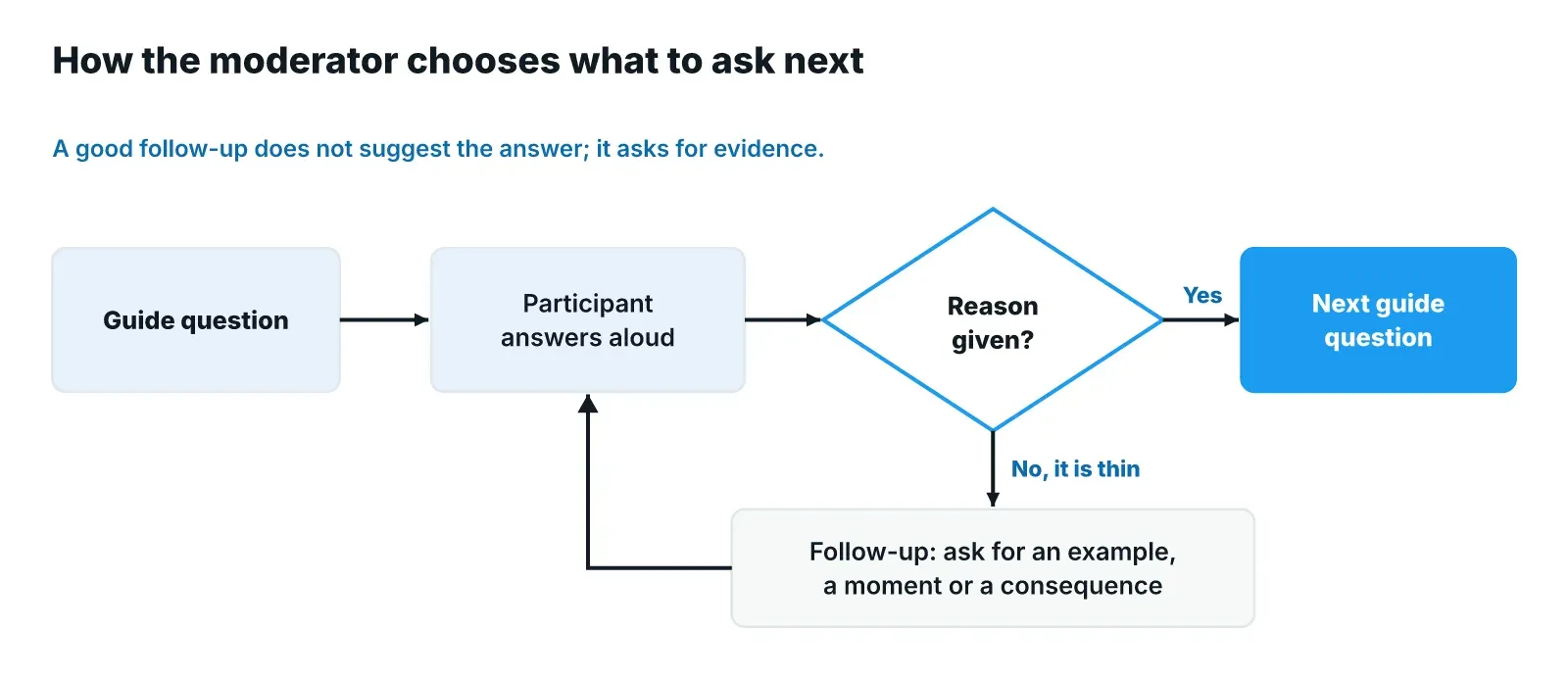
A complete answer moves the conversation to the next item in the guide. A vague or thin answer gets a second question, asked the way a researcher in the room would ask it: for an example, a moment or a consequence. A good probe does not suggest an answer, so what comes back is the participant's own reason.
The exchange below is illustrative. It is invented for this guide and does not come from a Pulse transcript.
| Turn | What was said | Why it was asked |
|---|---|---|
| Guide question | "Tell me about the day you closed the savings feature." | Anchors on a real, recent decision |
| Participant | "It just wasn't worth it." | Thin: a verdict with no reason |
| Follow-up | "What made it feel not worth it?" | Asks for the reason without offering one |
| Participant | "Every time I needed the money it took two days to come out. Twice I put a bill on my credit card instead." | The reason, with a consequence |
| Follow-up | "Tell me about one of those times." | Asks for a specific instance |
Probing of this kind is a studied method. In a web survey experiment by Barari and colleagues (arXiv, April 2025, revised December 2025), 1,800 participants were randomly assigned to AI chatbots that probed for elaboration and coded open answers live. The chatbots coded moderately well, with slightly inflated false positives that the authors attribute to respondent acquiescence bias. The practical lesson for probe writing is to ask for an example, because a probe that invites agreement collects it.
A 2026 three-way comparison found that AI-moderated interviews drew longer, broader and deeper answers than static questions and matched human moderators on content depth, with enjoyment and comfort similar to static questions. Smaller studies show the method running with students and with larger online panels.
That comparison is a between-subjects study by Deng, Liu, Toubia and Jain (arXiv, September 2026). It randomly assigned 317 home-improvement decision-makers recruited from Prolific to one of three conditions, all using the same interview guide. The human condition was the smallest group, because conditions were matched on cost.
| Static questions | AI-moderated | Human-moderated | |
|---|---|---|---|
| Participants | 154 | 139 | 24 |
| Answer length, breadth and depth | Baseline | Longer, broader and deeper than static | Similar to AI in content depth |
| Tone of voice | No difference from AI | No difference from static | More positive, activated and assertive |
In a small pilot with university students (six human-led and five AI-led interviews), Wuttke and colleagues reported longer average answers with the AI interviewer than with human interviewers, and the authors note the sample limits how far that generalizes. A later study by the same group (arXiv, June 2026) shows the method at larger scale. It ran AI-led conversational interviews on migration policy in Germany beside a standardized survey, with 571 respondents in the final sample recruited through Prolific and Payback Panel.
Each interview is saved as a full transcript, so the researcher can read conversations while the rest of the study is still in the field. Responses are then grouped into themes, and each theme carries the quotes it came from, linked to their transcripts. A researcher reads the themes against the transcripts before any decision rests on them.
In the bank example, a theme such as "waiting for money to come out" would carry every quote behind it: the participant who put a bill on a credit card, and anyone else who described waiting for money to come out. A stakeholder who doubts the theme opens the quotes and reads them in context.
The review step is good practice for any synthesis, human or AI. The full method is in the guide to how to audit each theme back to the exact quote.
The AI runs the conversation and the first synthesis. The researcher owns everything that decides whether the study was worth running: the question, the guide, the moments when an off-script tangent is the real finding, the reading of culture and contradiction, and the decision about what the organization does next.
Pulse is built on that division of labor. It runs AI-moderated voice interviews in which every participant gets the same well-formed questions and a thin answer gets a second question, and it traces every theme back to the interview it came from. How the Pulse moderator probes is set out on its product page. The researcher's time goes to the question and the decision.
For the choice between moderators, see when to choose an AI or a human moderator. For the wider method, see what AI-moderated research covers end to end.
An AI job interview screens candidates: it asks set questions and scores the answers against a hiring rubric. An AI research interview collects a customer's experience and reasons for a study. Nobody passes or fails, and the output is a set of themes, not a ranking of people.
A research interview run by an AI moderator is a recognized method, studied in published work on AI-assisted interviewing. Participants should always be told that an AI moderator runs the conversation, what the recording is used for and how to stop. A legitimate study also names who is running it and how to contact them.
The team receives a full transcript of each interview, and the responses are grouped into themes with the supporting quotes linked to their transcripts. That lets a researcher read a single conversation, compare answers to one guide question across participants, and check every theme against what people said.
Concept test results overstate demand when a yes costs the respondent nothing. How to read them, what to check before launch, and what to ask after.
Jobs to be done research gets harder when one account has many roles and business units. How to recruit, interview and merge jobs across them.
B2B concept testing research has to reach every role that signs off. Who to recruit, what to ask each role and how to read a split verdict.