How AI-moderated interviews work, inside one research session
How do AI interviews work in customer research? Follow one session from screener to follow-up question to a theme traced to its transcript.
Concept test results overstate demand when a yes costs the respondent nothing. How to read them, what to check before launch, and what to ask after.
Here's a familiar story, told as an illustrative example. Your team's new product idea scores well in its concept test, the steering committee says go, and a few months after launch hardly anyone is buying. Concept test results record what people say when a yes costs them nothing. So treat a strong score as a ceiling on demand, and check what buyers would pay and stop using before you decide.
Below, you'll find why that gap opens, six checks to run before a go decision, and what to do if a launch has already missed.
A concept test shows people a description of a product and asks how likely they are to buy it. A launch asks for much more. People have to find it, pay for it, set it up and stop using what they had.
It's a bit like asking friends whether they'd come to your party. Saying yes over coffee is easy. Turning up on a rainy Tuesday is a different decision.
Many concept tests use a five-point purchase-intent scale. That's a question with answers running from "definitely would buy" to "definitely would not buy". The headline number is often the top-box score, which is the share of people who picked the top answer. Some teams add the top two answers together.
Either way, the number sums up a reaction on a day when nothing was asked of anyone. Read it as a forecast and the cost lands later, when build and launch budgets go to a product the market didn't want in that form.
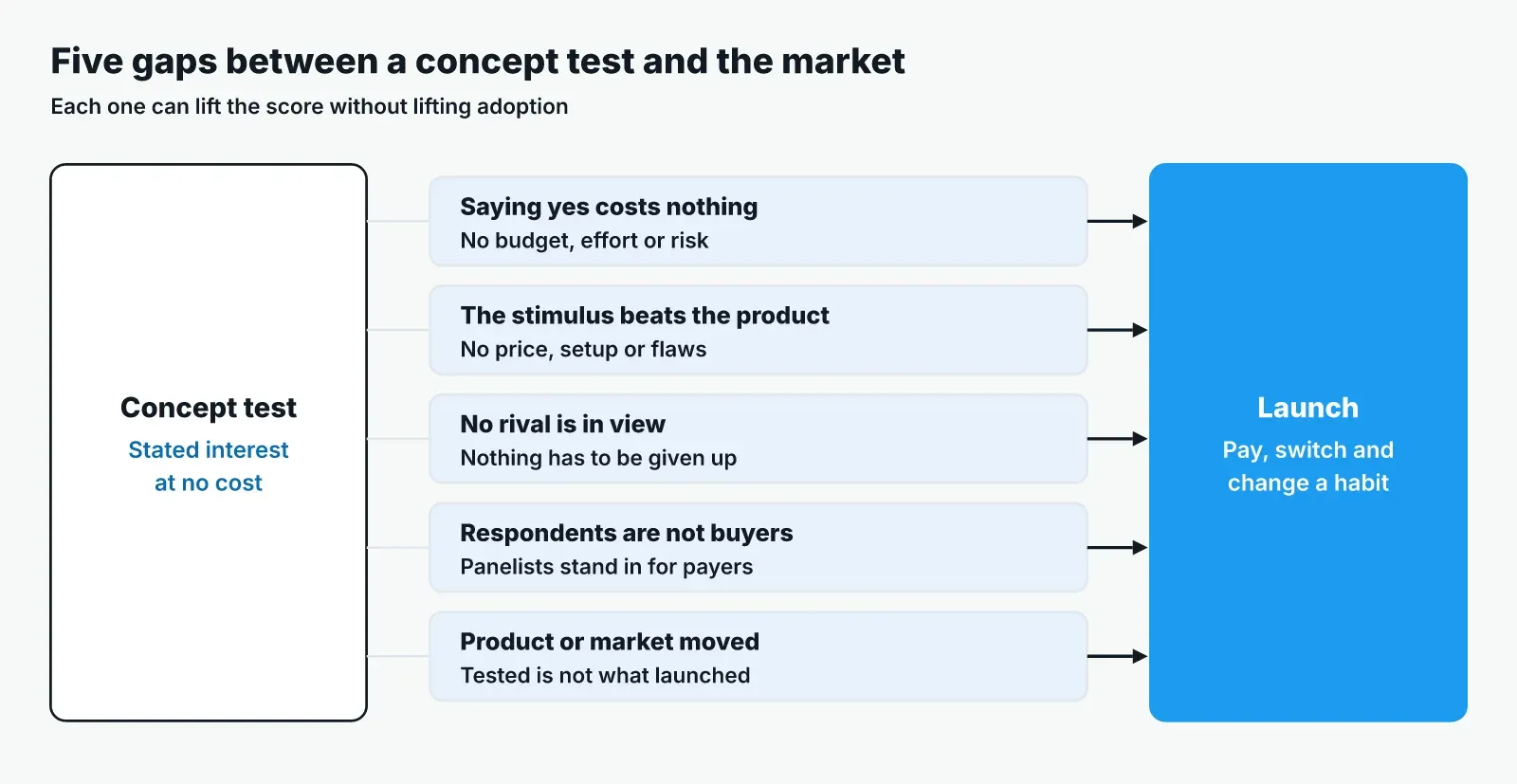
A yes in a concept test is easy to give, and five gaps push the score above what the market will do.
A purchase-intent question asks for no money, no time and no risk. Ask the same person to pay and to spend an afternoon on setup, and you're asking a different question.
The concept board is the description or mock-up people react to. It shows the benefit and leaves out the price, the setup steps and the flaws. The product that launches has all three.
In the market, people weigh a new product against what they use now, or against doing nothing. Most concept tests leave that choice out, and how much they leave out depends on the test design.
Panel members, meaning people who sign up to take surveys, are often the easiest to recruit. So are fans of the category. If the people who pay, approve or switch are a small part of the sample, you get a precise reading of the wrong group.
What launches often differs from what was tested. A feature gets cut, the price goes up or the sales channel changes. The need can shift too. When that happens, the old score describes a different product.
The four common concept test designs are monadic, sequential, proto-monadic and comparison. Each one answers a slightly different question, and each has a blind spot that can lift the score above what buyers will do.
| Test design | How it works | Its blind spot |
|---|---|---|
| Monadic | Each person sees one idea on its own and rates it | Nothing to compare against, so the idea is never weighed against what the buyer uses today |
| Sequential | Each person sees several ideas, one after another | Later ideas are judged against earlier ones in the test, not against the market, and the order shifts the scores |
| Proto-monadic | One idea alone first, then a choice between ideas | The choice is only between new ideas, so the current tool and doing nothing are still missing |
| Comparison | The idea sits beside another option and people pick one | Closest to a real choice, but only if the other option is what buyers actually use today |
A comparison test against today's option comes closest to the decision a buyer makes after launch. The guide to how concept tests are designed covers how to set up each format.
A bigger sample makes the same skewed number more precise. A z-test between two concept scores checks whether the difference between them is more than chance. It can show that one idea beats another and still rank them on the wrong question.
More scale points or a stricter top-box cut change the number without changing what you asked. Retesting with the same panel repeats the same gaps. All of these measure what people say more sharply. None of them measures what people do.
Before you say go, test the yes. The six checks below turn a score into evidence a steering committee can weigh against the forecast.
A top answer with no concrete use is a soft yes. For illustration, here's a soft yes beside a firm one:
| Soft yes | Firm yes |
|---|---|
| "It looks useful." | "I'd use it for month-end reporting with my two analysts." |
Code the reasons, which means sorting each answer into a labelled group. Then count how many name a real use.
Ask which product, process or budget the new one would replace. Someone who can't name one hasn't pictured switching yet.
For illustration, "How likely are you to buy this?" invites a polite yes. "What would you stop paying for to make room for this?" asks the person to picture the switch.
Ask when they last bought or tried something like it, and what happened next. What people did before is firmer ground than what they say they'll do.
Put the price and the setup effort into the concept, or test them as a separate step before launch. An idea that keeps its score with its costs in view is a stronger bet.
Read the results for the segment that matches the real buyer before you read the total. A segment is a group of respondents who share a trait, such as their job or what they buy today. Then read the people who chose the middle answers. Their doubts are the ones the top box hides.
Include a past concept whose launch you know, or a benchmark concept. A score means more next to one your team has already seen play out in the market.
These patterns in concept test results hint at a gap between the test and the market. None proves the launch will miss, but each tells you which check to run first. Use the diagnostic table below when the results come back.
| Pattern in the results | What it often signals | What to check before launch |
|---|---|---|
| High intent, vague reasons | People like the idea but have no use for it yet | Code the reasons and count concrete uses |
| High intent, nothing named to replace | Interest without a switch | Ask what it replaces and which budget pays |
| Strong in the total, weak among category buyers | The wrong people carried the score | Read by buyer segment and recruit more real buyers |
| People like it but can't say what it does | Appeal without understanding | Fix the description and test understanding again |
| Strong score on a concept shown without a price | Demand measured without its main cost | Test with the price and effort in view |
The table has no cut-offs or benchmark figures on purpose. A threshold borrowed from another category's tests would give a false sense of precision. Your own past concepts, with launches you know, are the reference point to use.
Here's a simple go rule. Say go when most top answers come with a real use, a named replacement and a price the buyer has seen. If any of the three is missing, treat the score as a ceiling and size the forecast to match.
Illustrative example: a large retail bank tests a budgeting feature for its mobile app. The top-box score comes back high, the steering committee approves it, and after launch few customers turn it on. The team must decide whether to fix the feature, promote it harder or stop spending on it.
The team has four ways to look into it.
| Option | What it can tell the team | What it can't tell the team |
|---|---|---|
| Re-run the concept test with a bigger sample | Whether the stated interest still holds | Why customers didn't turn the feature on |
| Read the app's usage data | Where people stopped, if they started | Why the rest never started |
| Survey customers who saw the launch | How many pick each listed reason | Reasons the team didn't think to list |
| Interview customers who saw it and didn't use it | Which assumption broke, in their own words | How common each reason is across all customers |
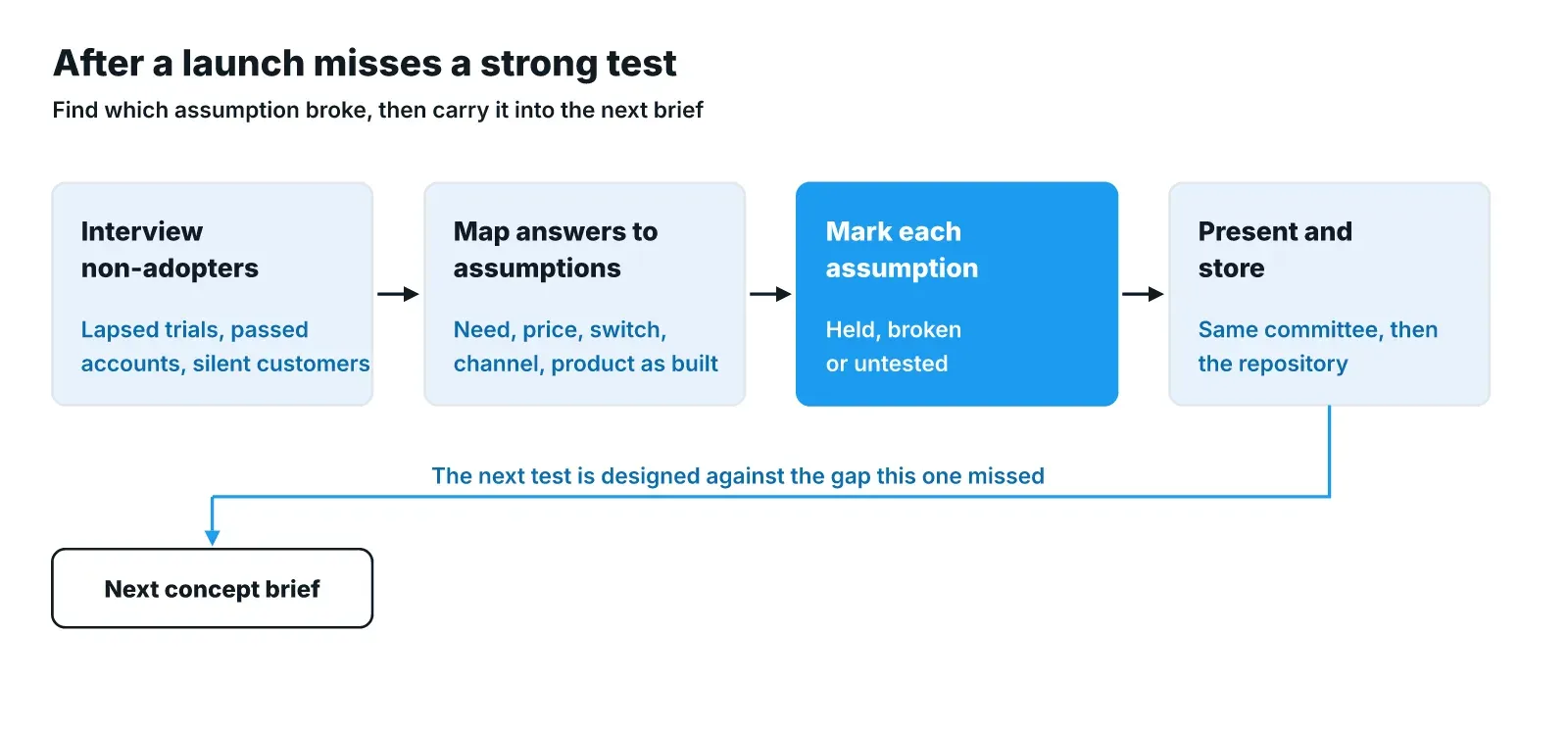
The team needs the reason before it can pick a fix, so the interviews come first. It invites three groups:
Each interview walks through the moment the person decided, and the concept board stays out until the end. That way, people describe their own decision instead of reacting to the idea again.
Next, the team marks each assumption behind the concept as held, broken or untested. The list covers the need, the price, the switch, the channel and the product as built. It shares the list with the committee that approved the launch and stores it where the next concept brief will start.
The next decision depends on which assumption broke. Suppose many customers say they already budget in a spreadsheet they trust. Then the switch broke, and a bigger campaign won't fix it. A better next step is a version that imports the spreadsheet, plus a survey to size how many customers budget that way. If most people never saw the feature, the channel broke, and promotion is the right fix.
Pulse runs AI-moderated voice interviews with your own customers or with recruited participants. Each interview follows the same guide and asks a follow-up when an answer is vague. Each theme links to the quotes behind it. For the bank, that means every broken assumption arrives with the customer words that show it.
Each study is kept in a searchable insight repository, so the next concept brief can start from what this launch taught. Your researcher still decides which assumptions to test and what the committee should do next. Pulse runs the interviews and the first pass at the themes, so their time goes to the decision.
To see how a post-launch study like this runs, book a demo.
Run a concept test before you commit build or media budget, and use it to choose between ideas. It works best for ranking ideas against each other and for collecting the reasons behind people's reactions. Treat the score as a ceiling on demand. Add behavior and replacement questions before it feeds a forecast.
Trust them more for ranking ideas than for forecasting demand. A question like "If the product were available today, how likely would you be to buy it?" measures interest that costs nothing to state. The answers get more useful beside what the person would stop using, when they last bought something similar, and their reasons in their own words.
Plan those interviews before launch and run them soon after, while people still remember the moment they decided. The longer you wait, the more people rebuild their reasons from memory, and a tidier story is less useful to you. Recruit from the groups the concept test said would buy.
How do AI interviews work in customer research? Follow one session from screener to follow-up question to a theme traced to its transcript.
Jobs to be done research gets harder when one account has many roles and business units. How to recruit, interview and merge jobs across them.
B2B concept testing research has to reach every role that signs off. Who to recruit, what to ask each role and how to read a split verdict.