
Sentiment analysis methods for interviews, quote by quote
Sentiment analysis methods compared for interview data, and how to keep every label next to its quote so anyone can check a theme before you report it.
Your target market customers may not be who you planned for. Check sign-up and payment records, then interview the people who stay and who leave.
Imagine you run a fitness app. Your team built it for people who already train hard at the gym. But when you look at who signs up and keeps paying, many are beginners doing short workouts at home. So who are your target market customers, really?
They are the people who sign up, stay and pay. To find them, compare your records with your plan, then talk to the people who stay and the people who leave.
Your records show who those customers are. Interviews explain why they stay, and a short survey estimates how many customers share each reason.
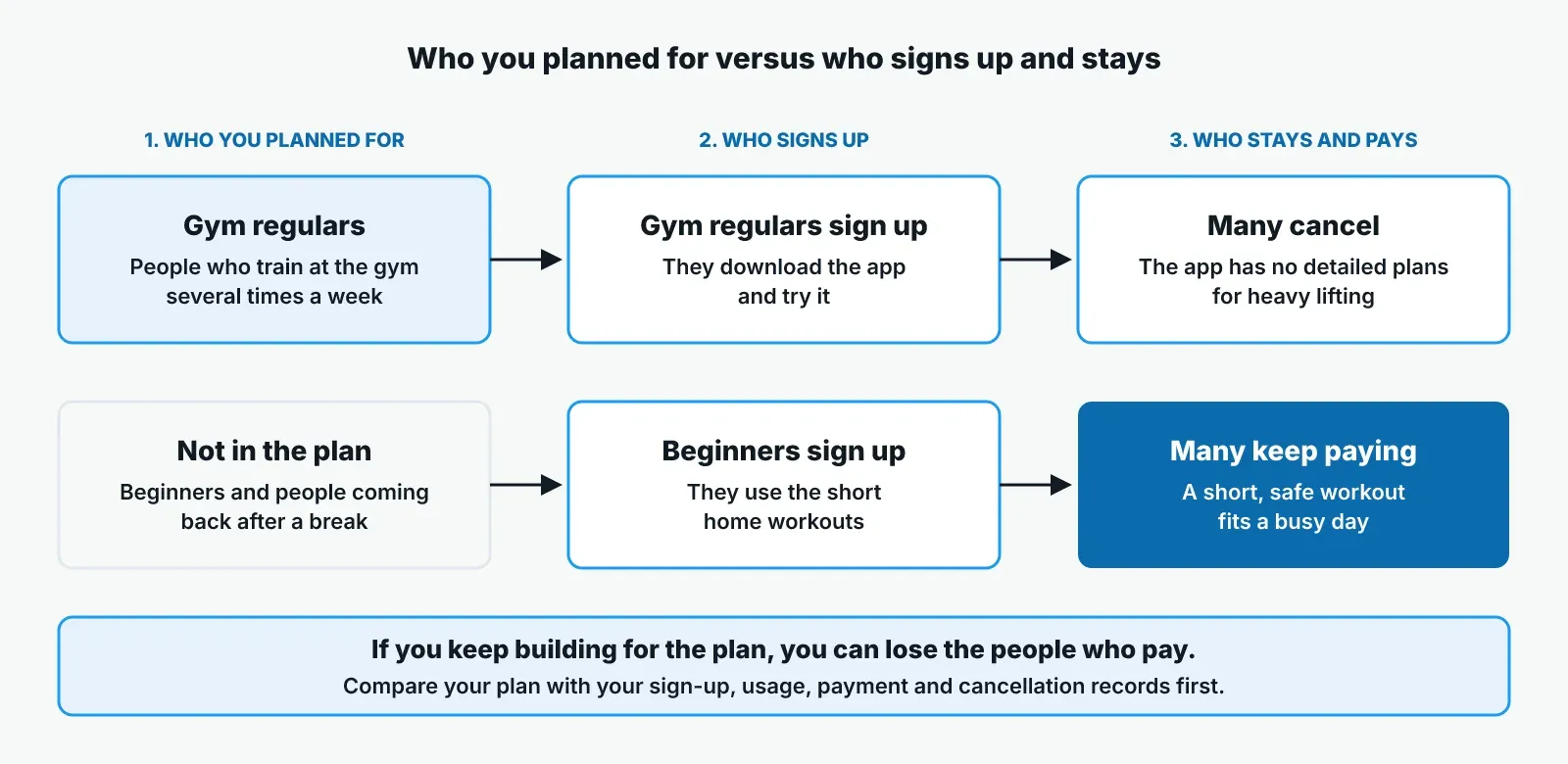
Your plan describes the customers you hoped for, and your records show the customers who came. These are often different people. So before you change your ads or your next feature, compare the plan with your sign-up, usage, payment and cancellation records.
Your fitness app team wrote its plan before launch: "people who train at the gym several times a week." That one sentence shaped a lot. It decided which features got built, what the ads said and how the price was set.
But a plan is a guess. Your records show what happened next: who signed up, who still opens the app after the first few weeks, who pays and who canceled.
Say your team checks those records. The people who keep paying are mostly beginners and people coming back after a break, and they mostly use the short home workouts. Many of the gym regulars the plan described sign up, try the app and cancel.
If you keep building for the plan, you can lose the people who pay.
Many plans describe customers by age, place and income. These are called demographics. But two people of the same age can join a fitness app for very different reasons. So a description built only on target market and demographics tells you little about what to build next.
Before you talk to anyone, your records can split customers by two questions: did your plan describe this person, and did they stay? This comparison is the first step in an analysis of the target market, and it uses records you already have. The answers give four groups, and each one teaches you something different.
| Group | Who they are in the fitness app | What you want to learn from them |
|---|---|---|
| Planned for, stayed | Gym regulars who still pay | What keeps them, so you don't break it |
| Planned for, left | Gym regulars who canceled | What the app didn't give them |
| Not planned for, stayed | Beginners doing short home workouts | Why they chose an app built for someone else |
| Not planned for, left | Beginners who tried the app and canceled | What almost worked, and what made them stop |
Records show who did what, and when, so they tell you where to look. But they can't tell you why a beginner stays or why a gym regular leaves. For that, you need to ask them.
The way to learn why customers stay or leave is to ask them, one person at a time. Invite a few customers from each of the four groups, picked from your own customer list, where you already know each person's group. Then ask about real moments from their past, such as the week they first went looking for a fitness app.
But records can be out of date. Someone marked as active may have stopped training last week. So before each interview, ask a few short questions to check that the person really belongs to the group you want. That set of questions is called a screener.
Say you want beginners who stayed. Your screener might ask where the person usually works out and how often they go to a gym. Anyone who trains at a gym most days belongs in a different group.
Questions about the past give you stories you can compare across people. A question like "Would you use a nutrition feature?" gets you a guess about the future. A question like "What was going on the week you downloaded the app?" gets you something that happened.
These five questions work for every group:
Say one beginner tells you she joined after a visit to her doctor. She stays because a workout fits into her lunch break. Your gym-focused ads never mentioned either of those things, so without the interview your team would not know why she pays.
The craft here is the same as in how to run customer discovery interviews: you ask for real stories before you decide what to build.
How many people should you talk to in each group? Keep going until new interviews stop bringing new reasons. The right number depends on how alike the people in a group are, and how many interviews you need explains how to judge it.
After the interviews, your team has a pile of stories. The useful part is the reasons that repeat across people in the same group. A reason that many customers share describes your target market customers better than their age or income, because it tells you what they need from you.
So listen for four things in each story: the moment that made the person start looking, the need behind it, what they compared your app with, and what keeps them paying. The moment that starts a search is called a trigger. The thing the customer wants to get done is their need.
Suppose the beginners in your fitness app share one need: short, safe workouts that fit a busy day. Their triggers differ, such as a doctor's advice, a new baby or a new job with long hours. The gym regulars who left share a different need, detailed training plans for heavy lifting, which the app never offered.
Those two needs tell your team more than any age range could, because one explains why people stay and the other explains why people leave.
Once you know the reasons that repeat, you can group customers by them. That step is called customer segmentation, and customer segmentation built on what customers tell you shows how to build those groups from interviews.
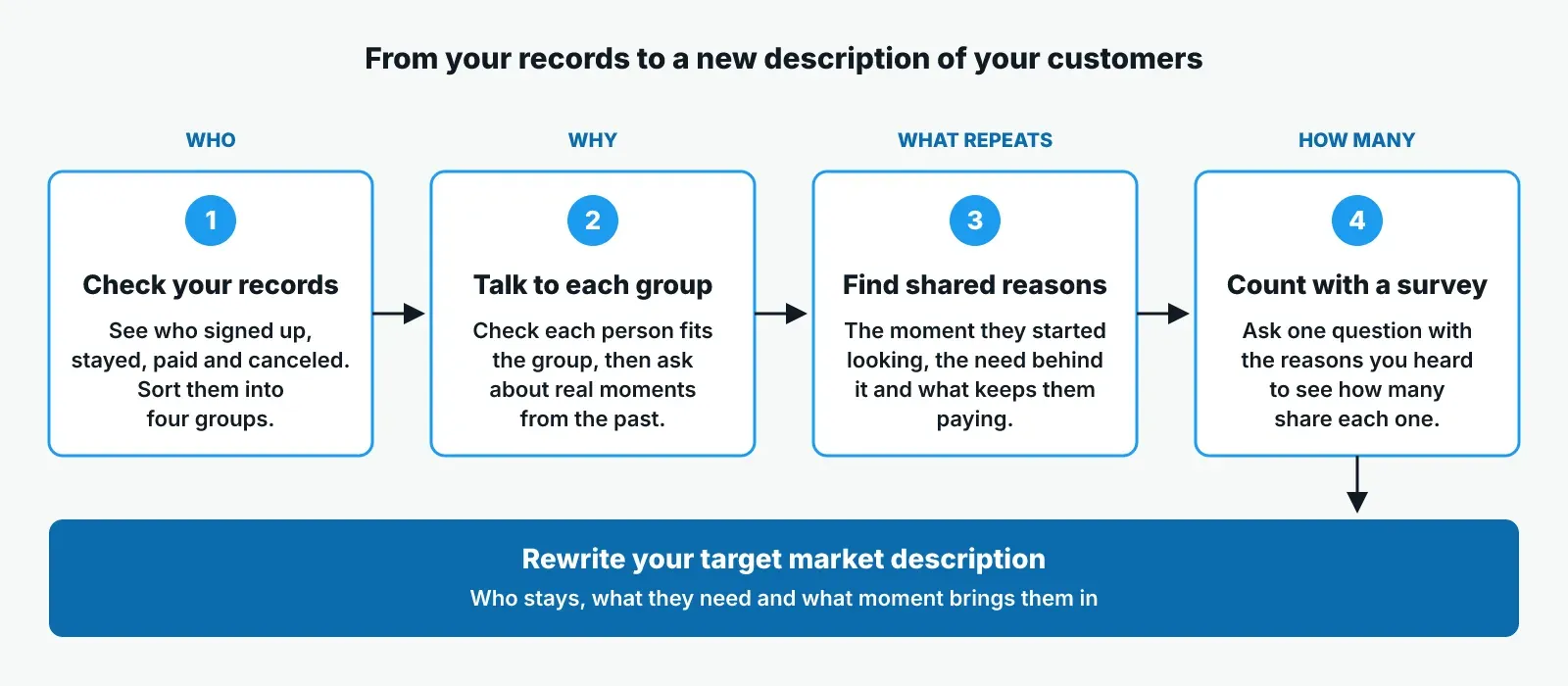
Interviews explain why customers stay, but they can't estimate how many customers share each reason. If you want to understand why customers stay, talk to them. If you want to estimate how many customers share that reason, ask a larger group the same question in a short survey.
Suppose your team sends one question to every active customer: "Which of these best describes why you use the app?" The answer choices are the reasons you heard in interviews, written in the customers' own words. The results show whether the short-workout need belongs to a few people or to most of the people who pay.
Write the survey after the interviews, because a survey can only offer the answer choices your team writes. If you write it first, the choices are your team's guesses.
Your old description said who the team hoped for. The new one says who stays, what they need and what moment brings them in. In the made-up fitness app, that change reaches the features, the ads and the places the team looks for new customers.
| The plan | What customers said | |
|---|---|---|
| Description | People who train at the gym several times a week | Busy beginners who want short, safe workouts at home, often starting after a health worry or a big change in their life |
| What to build next | Detailed training plans for the gym | Short guided workouts that need no equipment |
| What the ads say | Train harder | Fit a workout into your lunch break |
| Where to find new customers | Gyms and sports clubs | Parenting groups and workplace health programs |
A description is true for the customers you have today. So check it again when something big changes, such as a new market, a new price or a new kind of customer showing up in your records.
If you want to know who your target market customers are, start with your records. If you want to know why they stay, talk to them, then count how many share each reason.
Pulse runs AI-moderated interviews with your customers for the middle step of this method: learning why each group stays or leaves. You can upload a list of your own customers, set a screener for each group and run several groups in one study.
Customers take the interview by opening a link on a phone or laptop, so there are no calls to schedule. The AI moderator asks a second question when an answer is vague, so a short reply turns into a fuller story.
Pulse groups what customers said into themes, each with the quotes behind it, and every quote links to the transcript it came from. Because surveys run alongside your interviews, your team can hear the reasons and then check how many customers share them. To see how this would work with your own customer list, book a demo.
Your target market customers are the people who sign up, stay and pay, whoever your plan described. You find them in your sign-up, usage, payment and cancellation records. Then you interview people from each group to learn why they stayed or left.
In the fitness app example, a target customer is a busy beginner who wants short, safe workouts at home, often after a health worry or a big change in their life. That description names a need and a moment, so the team knows what to build and when to reach that person. Age and income alone would tell them neither.
In practice, a target market is the group your plan describes, and a target customer is a real person you can find in your records and talk to. The plan is a guess made before launch, so when the two disagree, update the plan to match what customers tell you.
Sentiment analysis methods compared for interview data, and how to keep every label next to its quote so anyone can check a theme before you report it.
First-time investor research for investing apps: why surveys get polite answers, who to recruit, and how interviews find the real hesitation.
What a market research brief must say before the study starts, so everyone who asked for it agrees on the decision, the audience and the result.