First-time investor research: what surveys miss
First-time investor research for investing apps: why surveys get polite answers, who to recruit, and how interviews find the real hesitation.
Sentiment analysis methods compared for interview data, and how to keep every label next to its quote so anyone can check a theme before you report it.
Your team just finished interviews with travelers about the airline's new boarding process. The summary says most of them felt positive. Your manager asks two things: is that true, and what did the unhappy travelers say?
Reading feelings from words is called sentiment analysis, and sentiment analysis methods differ in how far you can trust their labels.
To check whether the summary is true, compare a sample of labels with the quotes behind them. To find what the unhappy travelers said, score each topic on its own and read every negative quote.
Whichever method you pick, keep every label next to the quote it came from, so anyone can check it.
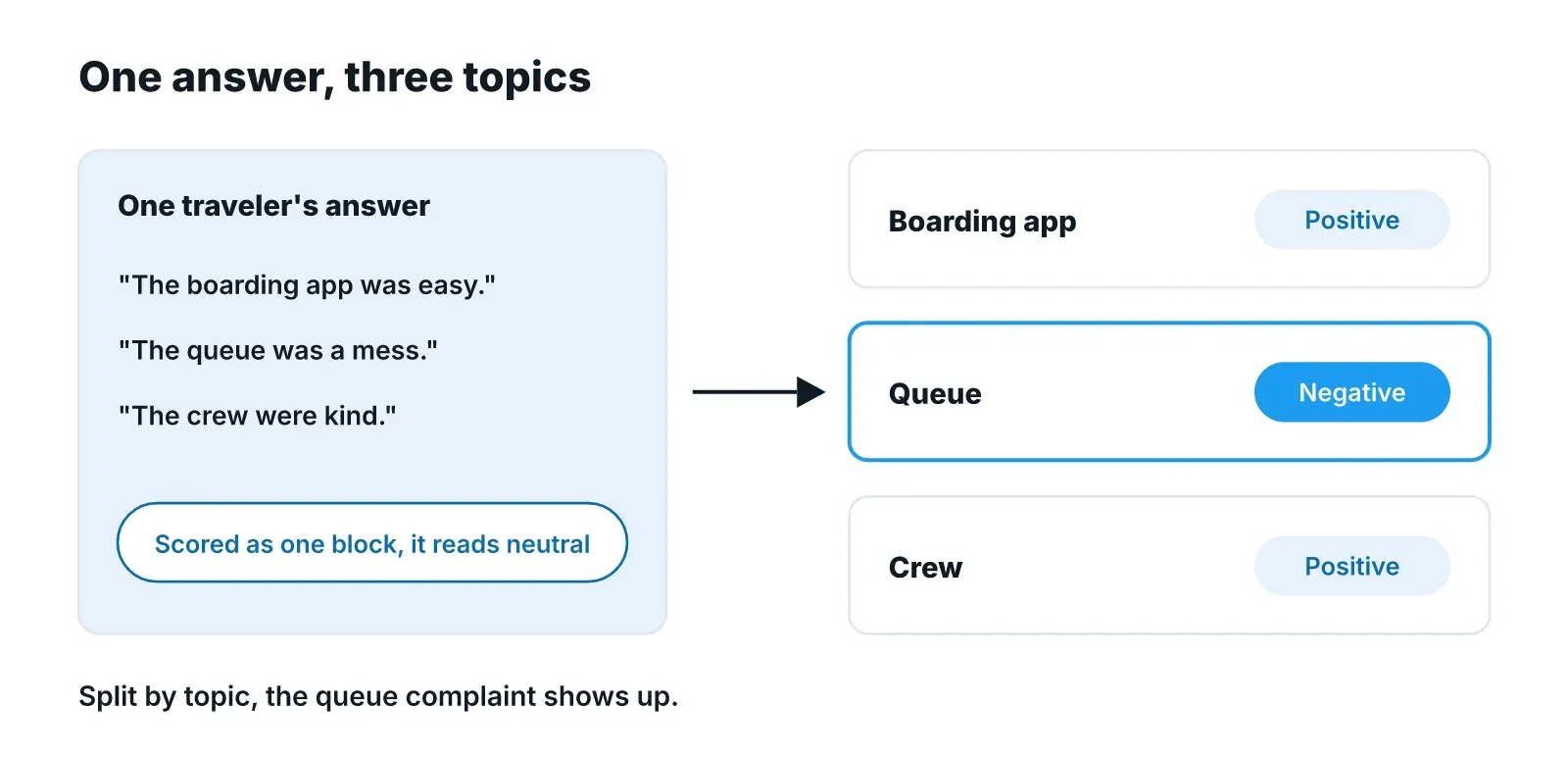
A review might say "great flight" and stop there. A traveler in an interview talks for two minutes. She says the boarding app was easy, the queue was a mess and the crew were kind. Give that whole answer one label and it comes out neutral, so the queue complaint is lost.
Spoken answers are hard to score. People mix feelings in one answer. People are polite, so "it was fine, I guess" can hide a complaint. And people use sarcasm, such as "oh, great, another queue", which only the voice gives away.
So cut each answer into topics, such as the boarding app, the queue and the gate staff, and label each part. Researchers call this aspect-based sentiment analysis. "Aspect" means topic.
Averages hide splits too. If half the travelers love the new gate process and half dislike it, the average sentiment score lands near neutral.
A neutral average can be two groups who disagree.
You want a method you can trust with long spoken answers. Each method reads feelings differently, so each slips in a different place. Each row shows where one method helps with interviews, where it slips and the check that catches the slip.
| Method | How it works | Where it helps | Where it slips | The check to run |
|---|---|---|---|---|
| A researcher with a codebook | A person labels each passage with a short list of labels and rules | Catches politeness, sarcasm and mixed feelings | Slow on many interviews, and two people can disagree | Have a second person label a sample |
| Word lists (rule-based) | Counts positive and negative words from a fixed list | Fast, cheap and consistent | Misses "not bad", polite talk and sarcasm | Read the passages it calls positive |
| A trained machine learning model | Learns from examples that people already labeled | Works well on text like its training examples | Interview talk may differ from its training text | Test it on a hand-labeled sample |
| Deep learning and large language models | Reads each passage in context and labels it | Handles long, mixed answers better than word lists | Can give plain statements a positive or negative label | Compare its labels with a hand-labeled sample |
| Tone of voice (tonality analysis) | Reads pitch, pace and stress in the recording | Hears sarcasm and doubt that the words hide | Tone shows a feeling, but the words name the topic | Listen where the tone and the words disagree |
| Facial expression (facial coding) | Reads expressions in the video | Shows surprise or doubt as someone reacts | A face shows a reaction, but the words give the reason | Watch the moment, then read what was said |
One common trained model, Naive Bayes, guesses a label from how often each word showed up in positive and negative examples.
A 2023 University of Washington study shows how far methods can differ on interviews. Alex Liu and Min Sun tested sentiment analysis techniques on 24 interviews with people working in education policy. They split the interviews into about 1,400 paragraphs. GPT-4 matched human labels more closely than a word-list method, which overstated positive feeling. Even so, the authors report that GPT-4 agreed with human judgment on 58% of the text.
So a model can beat a word list and still disagree with a person on a large part of your interviews.
For most interview studies, let a language model or a researcher label first, then have a person check a sample. Word lists alone are the wrong tool for spoken answers.
Your manager sees "boarding queue: negative" and asks, "Says who?" A label on its own cannot answer that. So store each label with its quote, the person who said it and the moment in the transcript. Then anyone can read the words and judge the label.
Say the airline keeps its labels in a simple record like this one.
| Topic | Label | Quote | Who said it | Where to find it |
|---|---|---|---|---|
| Boarding app | Positive | "I had my pass on my phone before I got to the gate." | Traveler 4, flies monthly | Transcript 4, minute 3 |
| Boarding queue | Negative | "Nobody knew which line was ours." | Traveler 9, family of four | Transcript 9, minute 7 |
| Gate staff | Mixed | "They were kind, but they kept changing the order." | Traveler 12, first trip | Transcript 12, minute 5 |
Now the manager can read the queue quote and see who said it.
In a 2026 study by Sherri Weitl-Harms and John Hastings, language models labeled 106 groups of words that people chose to describe products, from two datasets. Their labels matched the experts' labels closely, with correlations up to 0.97 and accuracy up to 94%. A correlation that high means the model's scores rose and fell almost in step with the experts'.
Set that beside the 58% from the policy interviews, and agreement depends on the data. The quote is how you check your own case.
If no one can see the words behind a label, the label is an opinion.
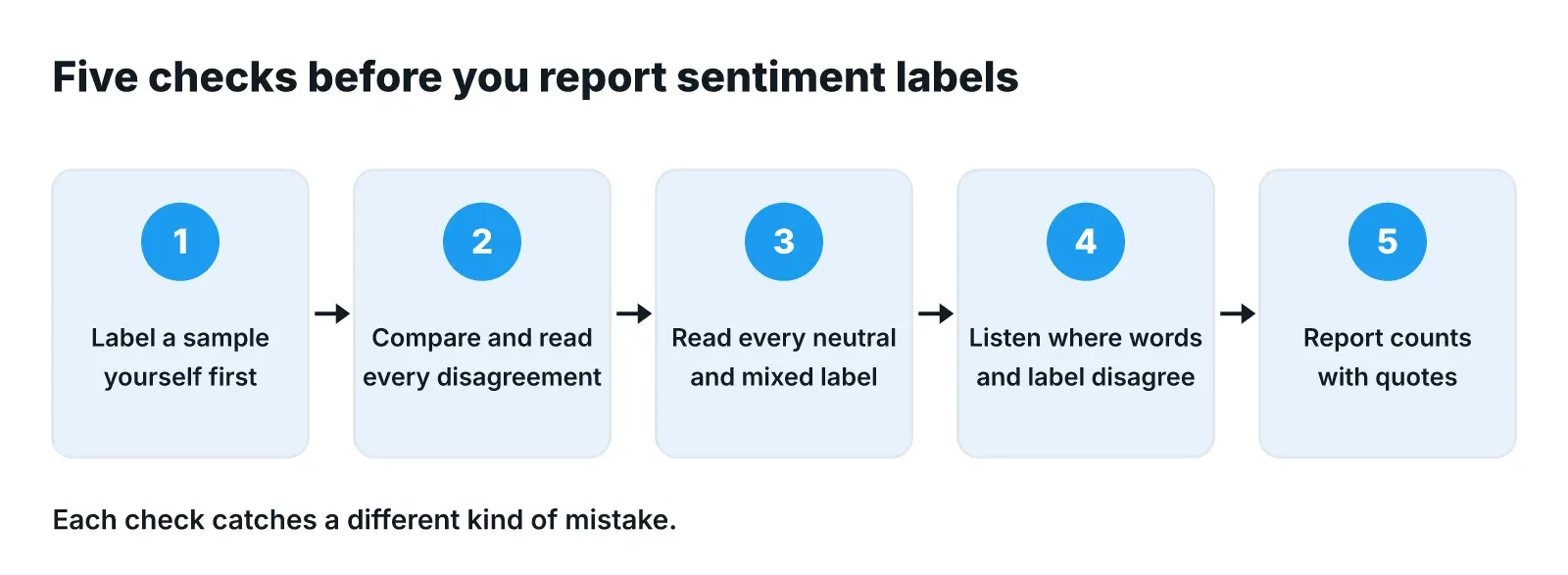
Your manager will act on these labels, so they need to hold up. A sentiment result is ready to report when another person can trace each label to its quote and make the same call. Each of these five checks catches a different kind of mistake.
Pick a handful of interviews and label each topic by hand before you see any tool's labels. If you look first, the tool's answer steers yours.
Put your labels beside the tool's and read every passage where they differ. A 2026 study by Xiomara Gonzalez and colleagues did this with 151 written student reflections. Where the researcher and the model disagreed, the researcher reread the quote and made the call.
Polite and mixed answers hide in the neutral pile. The same study found the model tended to give a positive or negative label to statements the researcher read as neutral. So read both kinds.
When a passage reads as positive but feels wrong, play the recording. "Oh, great, another queue" looks happy on paper, and only the voice shows the complaint.
Write "several travelers described the queue as confusing", then show their words. Interviews tell you which feelings exist and why. To learn how many travelers feel that way, run a survey next, which is the idea behind mixed methods research. Later, audit AI interview themes back to the exact quote the same way.
The label-beside-quote check is quick when quotes, transcripts and recordings sit together. Pulse groups what participants said into themes with the quotes behind them, and every quote links to the transcript it came from. Every interview arrives as a full transcript alongside its recording.
A researcher can jump from a negative label to the moment a traveler said it, then listen. On video interviews, Pulse also reads faces with facial coding and voices with tonality analysis. So emotion that a transcript misses sits beside what participants say.
Pulse runs the interviews and the first grouping of themes. Your time goes to the hard cases and to deciding what the airline should change. If a label can show its quote, report the count and the words together. If it cannot, check it before it goes in the report.
To see an interview study read this way, book a demo.
Yes. You can paste interview passages into a chat model and ask it to label each one as positive, negative, neutral or mixed. Treat the result as a first draft. Remove names and personal details before you paste anything, and check the labels against a sample you labeled by hand.
The three common types are polarity, emotion and aspect-based. Polarity sorts text into positive, negative or neutral. Emotion analysis names the feeling, such as anger, joy or worry, or rates how strong it is. Aspect-based analysis labels each topic inside the text on its own.
It can, but check each language on its own. A word list is built for one language, so an English list misses feelings said in Hindi or Spanish. Label each passage in the language it was spoken in, then ask a native speaker to check a sample. Speech that mixes two languages, such as Hindi and English, needs the same check.
First-time investor research for investing apps: why surveys get polite answers, who to recruit, and how interviews find the real hesitation.
Your target market customers may not be who you planned for. Check sign-up and payment records, then interview the people who stay and who leave.
What a market research brief must say before the study starts, so everyone who asked for it agrees on the decision, the audience and the result.