Where sampling bias enters an interview study, and how to catch it
Sampling bias enters an interview study at the recruit source, the screener, the incentive and the calendar. Here are the checks to run first.
Customer segmentation from interviews groups customers by the needs and triggers they describe, then sizes each group with data you already hold.
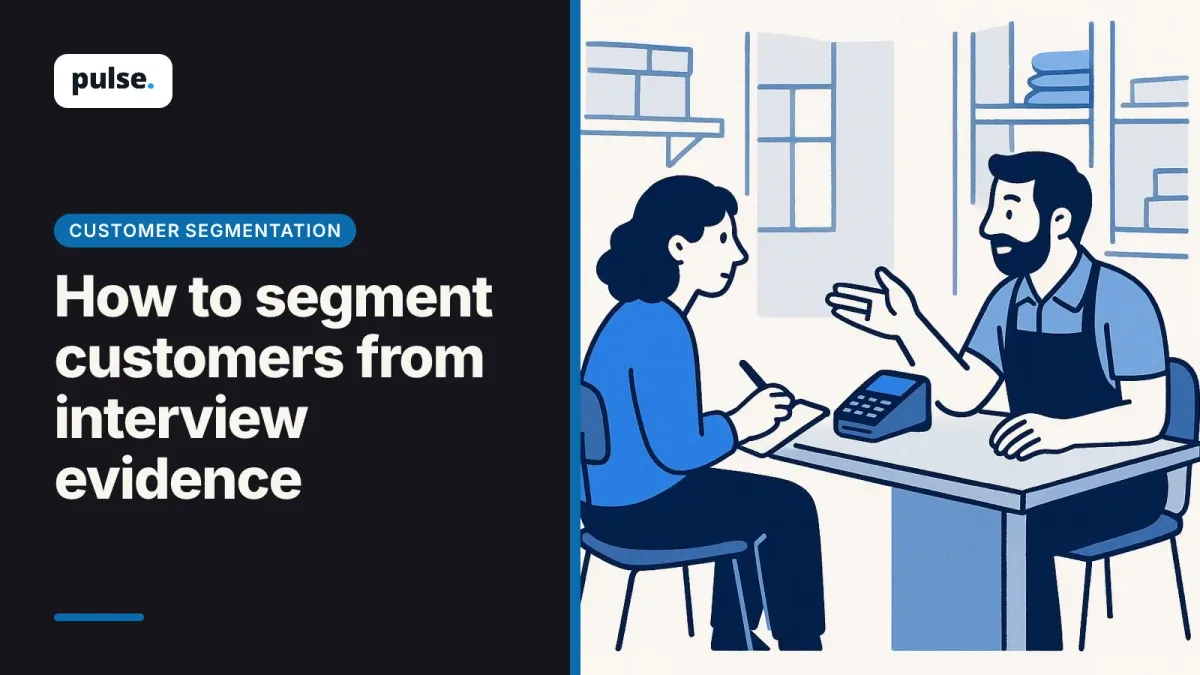
Illustrative example: two business customers sit in the same CRM segment, with the same size, region and balance. One renews, the other leaves, and the segment can't tell you why. Customer segmentation that explains behavior starts in interviews. Group customers by the need and trigger they describe, then find and size each group with data you already hold.
Below, you'll get the five things to listen for, a worked example from a payments company, and six steps to segments your teams can trust.
Data segments group customers by who they are and what they did. They're good for targeting and reporting. They can't show why two customers who look the same choose differently. That reason lives in the customer's situation, and no CRM field records it.
It's a bit like a doctor with only your height and weight on file. Useful numbers, but someone still has to ask where it hurts.
When the segment is wrong, the fix is wrong too. For illustration, a retention offer built for "mid-market accounts in the north" reaches customers who left over a missing integration and customers who left over price. It answers neither.
Needs-based segments fill the gap. They group customers by the problem they're solving and what pushed them to act. You find those in interviews. Here's how that compares with the usual types:
| Type | Where the data comes from | What it tells you | What it leaves open |
|---|---|---|---|
| Demographic (firmographic in B2B) | CRM records, account data | Who the customer is: age and income, or industry and company size | Why two similar customers choose differently |
| Geographic | Billing address, market, store | Where the customer is | Whether location drives the choice or only travels with it |
| Psychographic | Attitude surveys, panels | Values, attitudes and lifestyle | Which attitude mattered in a specific purchase |
| Behavioral | Product analytics, transactions | What the customer did and how often | Why they did it |
| Needs-based | Interviews, then a survey to size | The problem being solved and the event that started the decision | How many customers share it, until you size it |
In B2B, the demographic layer becomes firmographic, meaning facts about the company: industry, headcount, revenue and number of sites. One account also holds several people with different needs.
| B2C | B2B | |
|---|---|---|
| What you segment | One person | An account with several people in it |
| The "who" data | Age, income, location | Industry, headcount, revenue, sites |
| Who to interview | The customer | The buyer, the daily user and whoever approves the purchase |
Interviews separate customers on five things: the core need, the trigger, the constraint, the success measure and the decision path. Code every transcript for the same five. Coding here means tagging each answer with a short label, so you can compare people side by side. Customers who share two or three of the five form a candidate segment, whatever their size or region.
Write the need in the customer's words. "Settlement data our finance team can trust" is a need. "Better reporting" is a category. For illustration, an insurer's broker portal may serve brokers who need fast quotes and brokers who need clean renewal paperwork. The two want different screens.
Triggers often split customers more cleanly than size does. An outage, a new finance director, an audit finding and a price rise each start a different buying conversation. Ask what happened in the week before they started looking.
Budget, approvals, current tools and rules decide which options a customer can consider. A bank's compliance sign-off, for example, can rule out a product the customer would otherwise prefer.
One customer counts hours saved. Another counts audit findings closed. The same product can please one and disappoint the other, so each needs different proof in a sales conversation.
Ask who decided, who could say no and how long it took. In enterprise accounts, a purchase led by procurement needs a different sales approach from one led by a product team.
Illustrative example: a payments company's insights team works for its sales, product and partnerships units. The business question is how merchants choose payment rails, meaning the networks a payment runs on, so each unit knows where to focus next year. The CRM already splits merchants by processing volume and region.
The team has three options.
| Option | What it can establish | What it can't establish |
|---|---|---|
| CRM volume bands | How many merchants sit in each band, and what they process | Why merchants in one band choose differently |
| A survey with preset reasons | How many merchants pick each listed reason | Reasons nobody listed, and how reasons combine |
| Interviews coded for the five things | Which needs and triggers exist and how they group | How many merchants share each group, until it's sized |
The decision needs both the why and the how many. So the team interviews merchants across every volume band and region. Each interview covers the last time the merchant added or changed a payment method, and the team codes the five things.
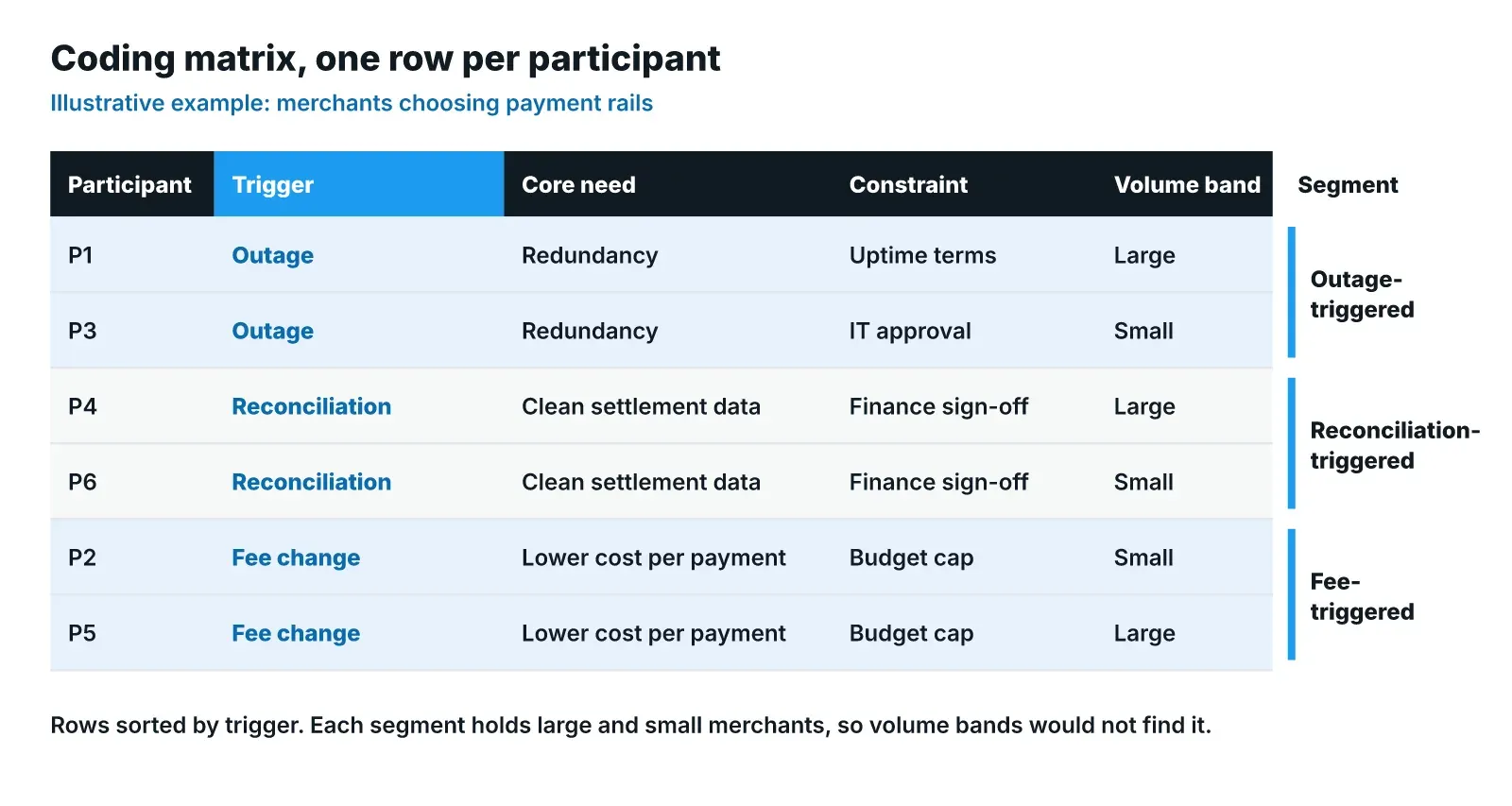
For illustration, suppose the trigger column splits merchants into three groups more cleanly than volume does:
Each group mixes large and small merchants. That reshapes next year's plan. The reconciliation group's champion sits in finance, so sales opens with a different person and a different message. Product weighs a settlement export.
Before anyone commits budget, the team sizes each group. Merchants who added a second processor flag the outage group in the CRM, and a short survey counts the rest. A group too small for its own plan stays in the findings as a theme.
The first three steps make your interviews easy to compare. The last three turn them into segments leadership can act on.
Spread participants across account size, tenure, product line, region and, in B2B, role. That way, a need-based group can cut across your data segments if one exists. Recruit only large accounts in one region, and every segment you find will be a slice of that group. Covering each existing segment on purpose is called stratified sampling.
Anchor each interview on one recent decision, such as switching provider, renewing, adding a product or cutting seats. Ask what triggered it, what else they considered, what they did before, who was involved and how they judge success now.
General questions get general answers. For illustration, "What matters to you in a payments provider?" gets a wish list. "Tell me about the last time you changed how you take payments" gets the trigger and the constraint. These interview questions about the last decision help, and the guide to customer discovery interviews covers keeping people on past behavior.
Use one discussion guide, the script every interview follows, with fixed core questions. Then follow up on each answer for detail. Fixed questions let you compare answers across the study. When interviewers improvise different questions, the matrix ends up with empty cells.
Give each participant a row and each of the five things a column. Think of it as a spreadsheet of who said what. Write a short code in each cell, with a reference to the transcript line behind it.
Add your data segments as extra columns. Then you can see whether the need-based groups follow them or cut across them. Linked codes let you audit each theme back to the quote when a stakeholder doubts a segment.
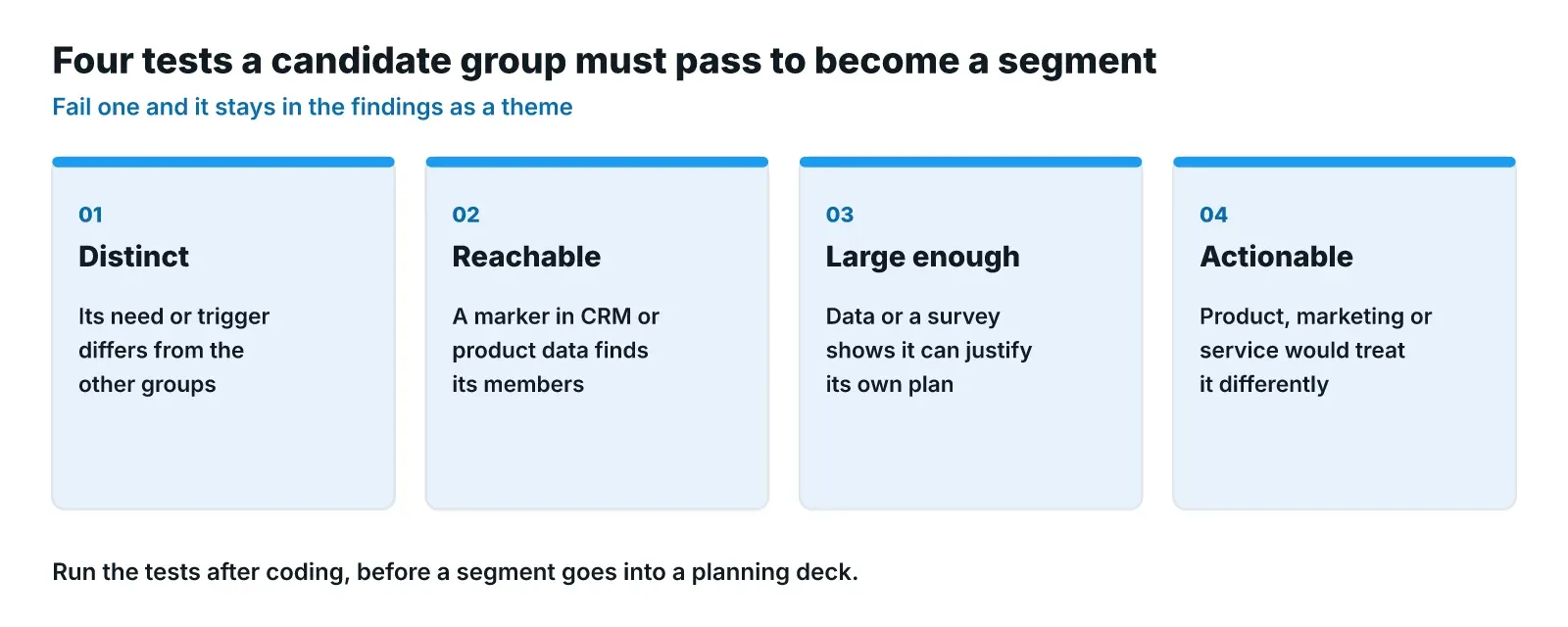
A group becomes a segment when it passes four tests:
Assign every participant to one segment. Leftovers mean you're missing something to code. Name each segment by its need, such as "outage-triggered merchants", so the label carries its evidence.
Map each segment's marker to a CRM field or product event, then count the accounts that carry it. A marker is a stand-in, so check a sample of flagged accounts against the interview evidence.
Where no marker exists, turn the five things into closed survey questions, the kind with fixed answer options. The interviews tell you which options are real, and the survey counts them. That's the split in surveys count, interviews explain.
Here's the decision rule for each candidate group. If it has a distinct need and a marker you can count, plan for it as a segment. If it has the need but no marker, size it with a survey first. If it has neither, report it as a theme.
Steps 2 to 4 need interviews you can compare and trace back. Pulse runs AI-moderated interviews that ask every participant the same core questions and follow up when an answer is thin. So each transcript can be coded against the same five things.
Pulse groups what participants said into themes, with every quote traced to its transcript. It also runs surveys beside the interviews, so the study that finds the segments can also count them. Your researcher's time goes to choosing what to code, testing the groups and deciding what each team does next.
To see a study go from interviews to themes you can size, book a demo.
The four usual types are demographic, geographic, psychographic and behavioral segmentation. Needs-based is often added as a fifth. The first four can come from data you hold or from surveys. Needs-based segments come from interviews, because a need and a trigger are things customers describe and no system records.
No fixed number applies. Sample across the differences you suspect, such as size, region, tenure and role. Keep interviewing until new transcripts stop changing the matrix. That point depends on how varied your customers are, and the guide to how many user interviews you need covers it.
Yes. Interview more than one role per account where you can, because the buyer, the daily user and the approver often hold different needs. Code each person separately. Then decide whether the segment is the account or the role. In some B2B studies, the role that drives the decision defines the segment.
Refresh a segment when its size or behavior shifts in your data. Run a short round of interviews inside that segment to learn whether the need changed or the marker stopped tracking it. Then update the matrix. You only need a full rebuild when new triggers appear that no existing segment explains.
Sampling bias enters an interview study at the recruit source, the screener, the incentive and the calendar. Here are the checks to run first.
Build an empathy map from interview transcripts so every note points to a real quote. What goes in each quadrant, and how to label your guesses.
Monadic pricing shows each respondent one price. See when that beats price laddering, what it costs in sample, and how interviews explain the result.