Participant recruitment methods: 5 ways to find people
Participant recruitment methods compared by who you need: your own list, panels, referrals, networks and recruiters, plus a check before you set a date.
Sharing research findings with stakeholders: plan each team's question in the brief, tag themes to decisions, and hand each team its evidence.
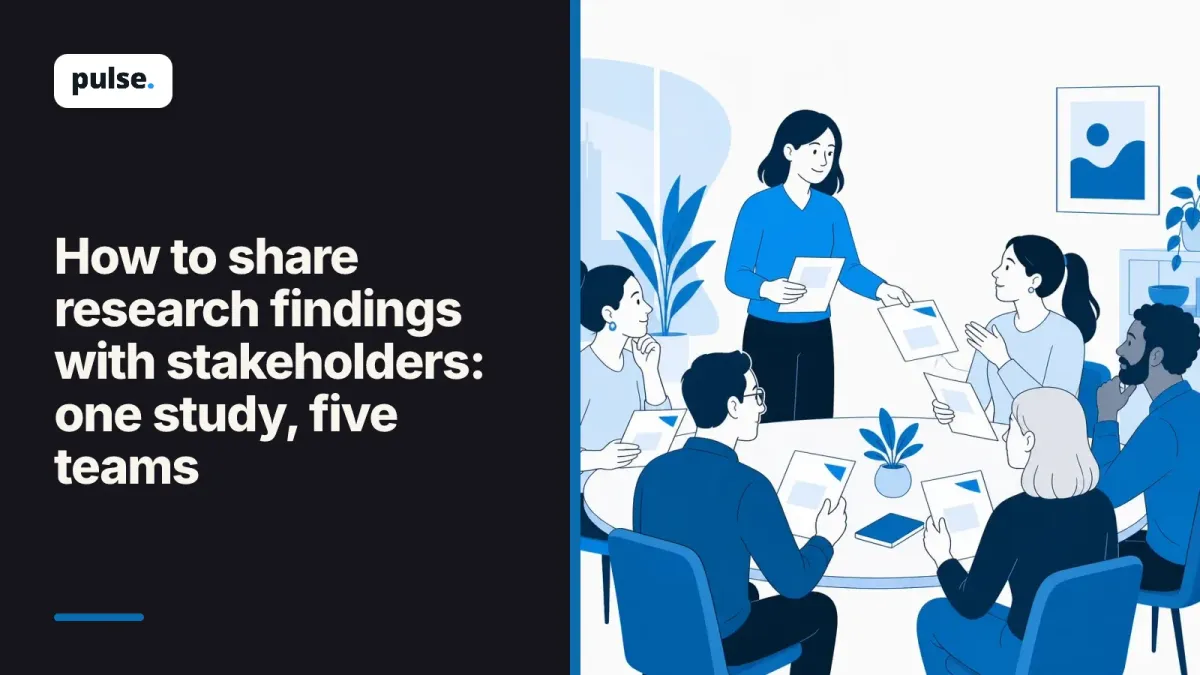
Say you're on the research team at a snack food company that is launching a lower-sugar range. Product, marketing, the regulatory team, sales and your director each want a different answer from the same customer interviews. So how do you give each team an answer it will use?
Sharing research findings with stakeholders, the teams who will act on them, works best when you plan each team's cut before the study starts. Write each team's question into the brief, tag each finding to the team it serves, and hand each team a short page with the quotes behind it.
It comes down to three steps, plan, tag and hand over, plus one rule that keeps every team on the same evidence.
One long deck fails because each team reads it looking for its own question, and most of the slides answer someone else's. People skim, find a line that agrees with them and repeat it. A finding that matters to one team gets lost under a heading written for another.
Say the snack company's deck has a section called "Messaging". The finding about how shoppers read "less sugar" sits there, deep in the deck. The regulatory team never opens that section, because nothing tells them it's theirs.
A quote out of context causes a second problem. Marketing reads "it tastes like the old one" as good news for the launch. Product reads the same line as a sign nobody will notice the change. Both are guessing, because neither can see what the shopper said next.
Both problems have the same fix. Decide what each team receives before the first interview, not after the last one.
The best time to decide what each team gets is before the study starts. Ask each team one thing: what will you decide, and what would change your mind? Their answers tell you which questions the interviews must cover, so no team ends up with a finding it can't use.
Write the answers into the brief as a short table. For the snack company, it looks like this.
| Team | What they will decide | Question for the study | What they need to see |
|---|---|---|---|
| Product | Keep the recipe or change it | Does the lower-sugar taste hold up against the old one? | Taste reactions, in shoppers' own words |
| Marketing | How to describe the range | What words do shoppers use for it? | Phrases shoppers repeat, and ones that put them off |
| Regulatory | How to word the health claim | How do shoppers read "less sugar"? | What shoppers think the claim promises |
| Sales | What to prepare for store buyers | What will buyers ask before they stock it? | Buyers' questions and doubts |
| Director | Launch now or wait | Is there a reason not to launch? | The few findings that could change the plan |
Then check the interview questions against every row. If a team's question has no matching interview question, it will get no answer, so add one now, while it's still cheap.
Some teams need different people. Sales cares about store buyers, while the other teams care about shoppers. Recruit them as separate groups inside one study, so both sets of answers sit side by side. There's more on how to write each team's question into the research brief and on building a full research plan.
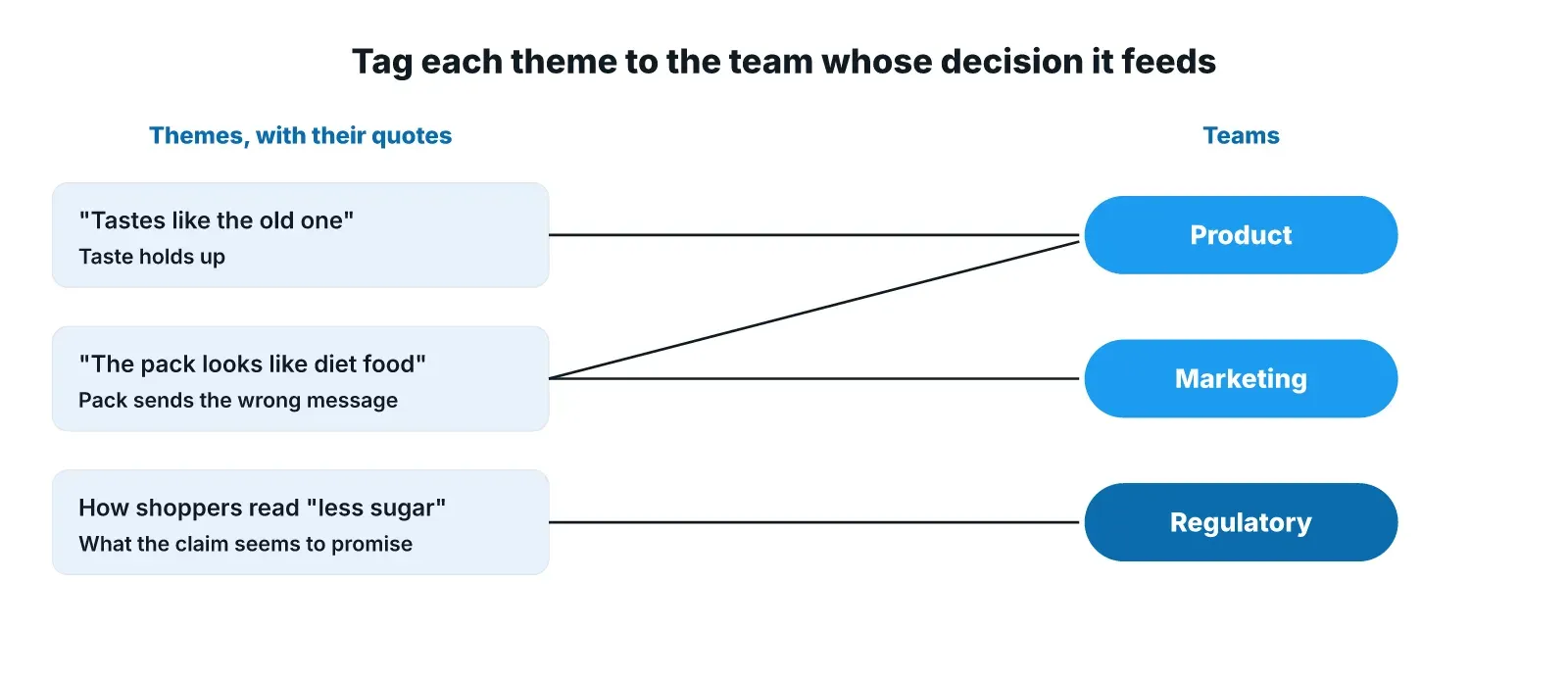
As the interviews come in, the answers group into themes, which are ideas many people raise in their own words. Tag each theme with the team or teams whose decision it touches. One theme can serve two teams, and the tag tells you where to send it.
Say several shoppers say, "It tastes like the old one, but the pack makes it look like diet food." Tag that theme to product, because the taste works, and to marketing, because the pack is sending the wrong message. How shoppers read "less sugar" goes to the regulatory team.
Keep the quotes with the theme, so the tag carries the evidence with it.
Then mark what each finding can't tell a team. Interviews show why people hesitate, but they can't tell you how many shoppers feel that way. If marketing needs the number, a short survey adds it, because a survey shows how many. A note like that stops a team from reading a strong quote as a market share.
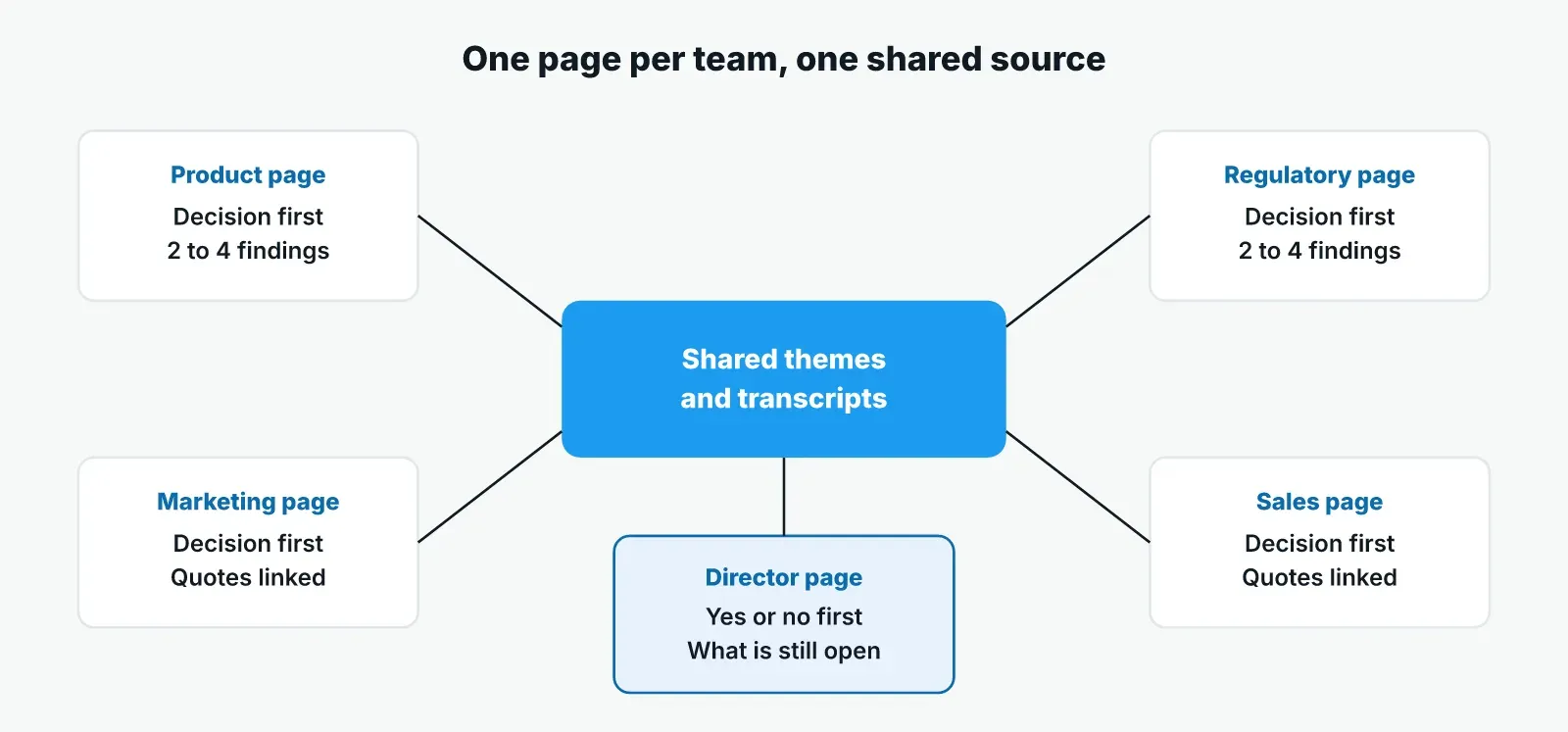
Each team needs one page, not the whole deck. Put the team's decision at the top, then two to four findings, each with two or three quotes and a link to the transcript. The answer comes first and the support follows, so a busy reader gets the point in the first lines.
Your director gets a different page. It starts with the yes or no, then the three findings behind it, then what is still open. For the snack launch, that might read: "Launch, but change the pack first. Shoppers like the taste, and the current pack makes it look like diet food."
Use the format each team already reads, whether that's a slide, a document or a page in the team's own wiki. The format changes from team to team, but the findings and quotes stay the same.
Every page links back to one shared set of themes and transcripts. So when marketing and product disagree about a quote, they open the transcript and read what came next, instead of arguing over two versions of the deck.
Store the study where the next team can find it. Six months later, when marketing plans a second range, it starts from what shoppers already said instead of paying for the same interviews twice.
Plan the cuts before the study, and every team gets an answer it can check.
Sharing findings this way depends on two things: recruiting the right groups for each team, and keeping every finding tied to its source. Pulse runs AI-moderated interviews, and one brief can recruit several groups, such as shoppers and store buyers, each with its own profile and screener.
As interviews finish, Pulse groups what people said into themes with the quotes behind each one, and every quote links to its transcript. The report builds as interviews finish and is ready minutes after the last one. Findings export to PDF, PowerPoint, Word, CSV or Excel, and into the tools each team already uses, such as Notion and Confluence through MCP.
Every study's findings stay in the insights library, where teams can keep every study's findings in one place and query across projects before they start the next brief. Pulse runs the interviews and the first pass at the themes, so the research team's time goes to deciding what each team needs to hear.
Pulse offers a free trial, and it also offers a free study. To try it with your own brief, book a demo of Pulse.
Inside a company, the stakeholders in research are the teams who will act on the findings and the people who approve the decision. In a product launch, that often means product, marketing, regulatory or legal, sales and a senior manager. Each one has a different decision, so each needs a different part of the evidence.
Dissemination means getting findings to the people who will use them, in a form they can act on. In academic research, that usually means the public or funders. Inside a company, it means each team that has a decision riding on the study, which is why one page per team works better than one deck for everyone.
Lead with the decision, on one page. Say yes, no or wait in the first line, then give the three findings behind it, each with a quote, and end on what is still unknown. Keeping it to one page puts everything the decision needs in one place.
Link every quote to its transcript, and keep one shared set of findings that every team page points back to. When a team quotes a line, anyone can open the transcript and read what came before and after it. That makes a disagreement a quick check of the source, instead of a debate between two decks.
Participant recruitment methods compared by who you need: your own list, panels, referrals, networks and recruiters, plus a check before you set a date.
Semantic vs latent themes, from Braun and Clarke's paper "Using thematic analysis in psychology", shown on real-life quotes, with when to use each.
How to choose a transcription service for research interviews: test each option on your own audio with five simple checks, from accuracy to data safety.