AI for Qualitative Research: How AI Is Changing Interviews, Analysis & Synthesis
AI is now a core part of qualitative research, automating interviews, analysis, and synthesis. Learn how it works and where human judgment remains essential.
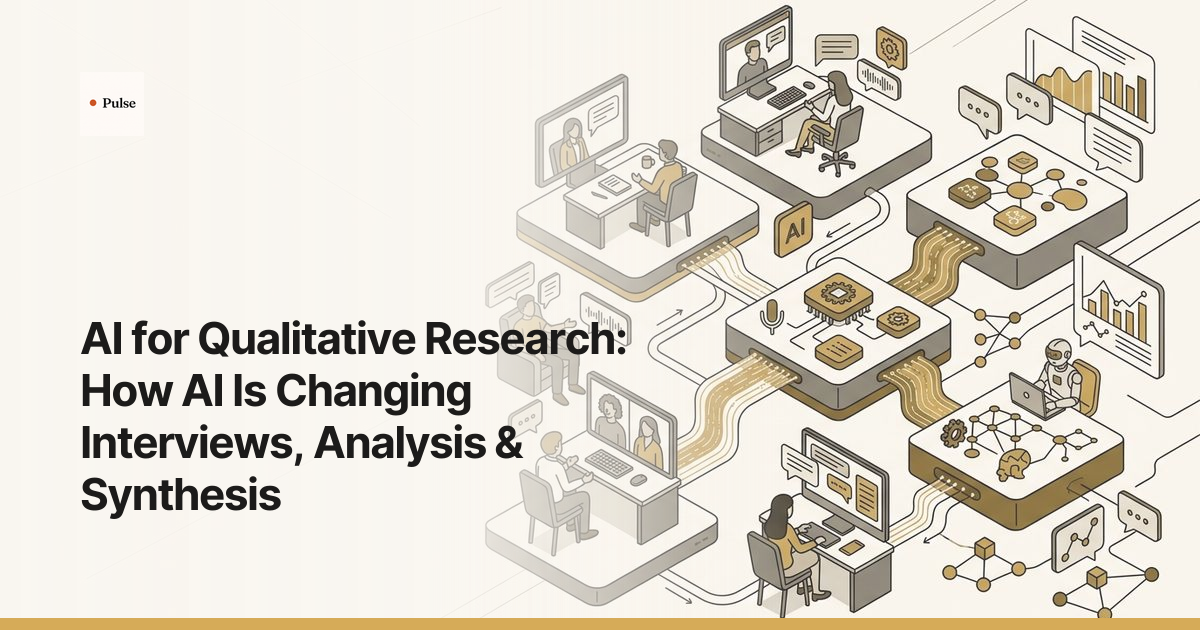
The adoption of artificial intelligence in qualitative research has moved from a niche experiment to a core component of the modern insights toolkit. This isn't about replacing researchers; it's about automating the most time-consuming parts of the workflow to focus on what matters: asking the right questions and delivering strategic recommendations. This post explains how AI is practically applied to interviews, analysis, and synthesis today, and where human judgment remains essential.
What Is AI for Qualitative Research?
AI for qualitative research is the application of machine learning to automate or assist with specific tasks in the research workflow. It is a category of capabilities, not a single tool, ranging from conducting AI-moderated interviews to performing initial thematic analysis. The core value is enabling research at a speed, scale, and consistency that is impractical with purely manual methods. This allows teams to run larger studies more frequently, turning what was once a multi-week project into an overnight process.
How AI Is Changing Qualitative Interviews
AI is changing qualitative interviews by enabling moderation at a scale that was previously impossible. Platforms using an AI moderator can run hundreds of voice interviews concurrently, compressing fieldwork timelines from weeks into a single day. This approach ensures every participant is asked the exact same questions in the same way, eliminating the risk of human interviewer drift or unintentional leading questions.
The primary benefit is scale and consistency. For example, industry analysis citing Greenbook’s 2025 GRIT report notes that the median sample size for AI-moderated qualitative studies has reached 312 participants, a dramatic increase from just 17 in 2022. This allows teams to gather deep, open-ended feedback with the confidence of a much larger sample.
However, the technology has clear limits. While some AI moderators can ask adaptive follow-up questions, they follow a defined logic. They cannot yet replicate a skilled human researcher's ability to probe on a genuinely unexpected tangent or interpret deep cultural nuance, irony, or contradiction in real time.

How AI Is Changing Qualitative Analysis
AI dramatically accelerates qualitative analysis by automating the most labor-intensive tasks: transcription and initial thematic coding. This can reduce the analysis time for a 20-interview study from over 80 hours of manual work to just a few hours of AI processing followed by researcher review. Models can identify recurring topics, sentiment, and keywords directly from unstructured audio or text, providing a strong starting point for deeper work.
A crucial element for maintaining rigor is traceability. Every AI-generated theme must be linked directly back to the source quotes that support it. Specialized platforms like Pulse are built to address this, ensuring that the speed of AI analysis does not come at the expense of research-grade evidence. While AI can show high consistency with human coders in inductive (emergent) coding, some studies have found its performance drops when applying a pre-existing deductive framework. A 2024 study, for example, found 71% theme consistency for inductive analysis but only 50-58% for deductive.
Worked Example: Time Savings on a 20-Interview StudyManual Process: A researcher conducts 20 hour-long interviews. Transcription, manual coding, and theme development typically take 80–120 hours.AI-Assisted Process: The same 20 interviews are automatically transcribed and coded by an AI platform. This initial pass takes 4–8 hours, leaving the researcher to focus on validation, interpretation, and synthesis.

How AI Is Changing Research Synthesis
AI helps researchers synthesize findings by identifying patterns across large qualitative datasets that would be difficult for a human to spot manually. When you have transcripts from hundreds of interviews, an AI can quickly surface how frequently different themes appear and how they correlate with specific customer segments. This capability moves synthesis from anecdotal evidence to structured, quantifiable insight.
Generative AI can also create initial drafts of findings, executive summaries, or pull the most representative quotes for each theme. This acts as an accelerator, not a replacement, for the researcher's final narrative. The researcher’s job shifts from the mechanics of organizing data to the strategic work of interpreting it. However, this process requires careful validation; a February 2026 UC San Diego study found that LLM-generated summaries changed the sentiment of original text in over 26% of cases, often by introducing a more positive framing.
Where Human Judgment Remains Essential
AI augments the researcher; it does not replace them. The most effective approach is a "human-in-the-loop" framework where the technology handles mechanical tasks and the researcher provides critical oversight and interpretive judgment. This sentiment was formalized in late 2025, when an open letter signed by over 400 qualitative researchers argued that generative AI is methodologically inappropriate for reflexive thematic analysis, an interpretive practice they state is uniquely human.
Human judgment is irreplaceable in several key areas:
- Framing the Business Problem: Deciding what question is worth asking and designing a study to answer it is a strategic human skill.
- Interpreting Nuance and Contradiction: AI struggles to understand sarcasm, cultural context, and the revealing contradictions in what people say. A human researcher is needed to interpret this latent meaning.
- Mitigating Bias: AI models can inherit and even amplify societal biases from their training data. An August 2026 study analyzing interviews with Rohingya refugees found that LLM-based coding introduced systematic biases that could lead to misleading conclusions. Researchers must actively review AI outputs for these distortions, as models can introduce subtle framing issues or fail to capture the intended meaning of participant statements.
- Formulating Strategic Recommendations: The final step of turning validated findings into actionable business recommendations requires a deep understanding of the organization's goals and context, a task that remains firmly in the hands of the research team. A recent review of studies in health research also highlighted ongoing concerns about the methodological rigor and interpretive capacity of AI in complex fields.

Frequently Asked Questions about AI in Qual Research
Does AI replace qualitative researchers?
No, AI augments the researcher by automating repetitive, time-consuming tasks like transcription and initial coding. This frees up researchers to focus on higher-value work like study design, deep interpretation, and strategic recommendations. The industry standard is a "human-in-the-loop" model where researchers guide and validate the AI's output.
How reliable are AI-generated themes and analysis?
The reliability of AI-generated themes depends entirely on the human validation process. While AI can quickly surface patterns, its accuracy can vary significantly. It is essential to treat AI output as a "first pass" that a human researcher must review, refine, and validate by tracing every theme back to the source data. A comparative study is currently underway to better evaluate consistency and reliability.
What is the difference between using a general AI tool versus a specialized research platform?
General AI tools like chatbots can perform tasks like summarization but lack the specific guardrails needed for rigorous research. Specialized research platforms are designed for the entire workflow, offering features like structured data collection, consistent moderation, and crucially, the ability to trace every insight back to the original participant quote. This traceability is essential for defending the validity of the findings.
How does AI handle issues of data privacy and participant confidentiality?
This is a critical consideration. Reputable, enterprise-grade AI research platforms are designed with privacy and security in mind, often using anonymization techniques and operating within secure data environments. Using a general-purpose consumer AI tool for sensitive interview data is risky, as that data could be used for model training. Always verify a platform's data handling and privacy policies before starting a study.
Putting AI to Work in Your Research
AI is no longer a future concept in qualitative research; it's a practical set of tools that can make your work faster, more scalable, and more comprehensive. By automating the mechanical parts of interviewing, analysis, and synthesis, it lets researchers focus their expertise on the strategic thinking that drives business decisions. The key is to embrace a hybrid approach where technology handles scale and speed, while human judgment provides the essential layers of context, interpretation, and strategic insight.
If your team is ready to run more research without compromising on quality, you can run your first study with Pulse in minutes. Run 100 customer interviews by tomorrow morning.