Participant recruitment methods: 5 ways to find people
Participant recruitment methods compared by who you need: your own list, panels, referrals, networks and recruiters, plus a check before you set a date.
How AI thematic analysis turns transcripts into themes, what research says it does well, where people still decide, and what to ask in a tool demo.

You work on the rider support team at a bike-sharing company. This week, a vendor showed your team a demo. It turned a batch of rider complaint calls into a neat list of themes in under a minute. Now your manager wants to know how it got there, and whether to trust it.
AI thematic analysis follows the same path a person would, only faster. The tool splits each transcript into short excerpts. It suggests a code, a short label, for each one. Then it groups the codes into themes and names them. AI can come close to people on the big themes, but it slips more on single quotes. So trust a theme only when you can click from it to the quotes behind it.
Five steps explain where those themes came from, and five questions tell you what to check in a demo.
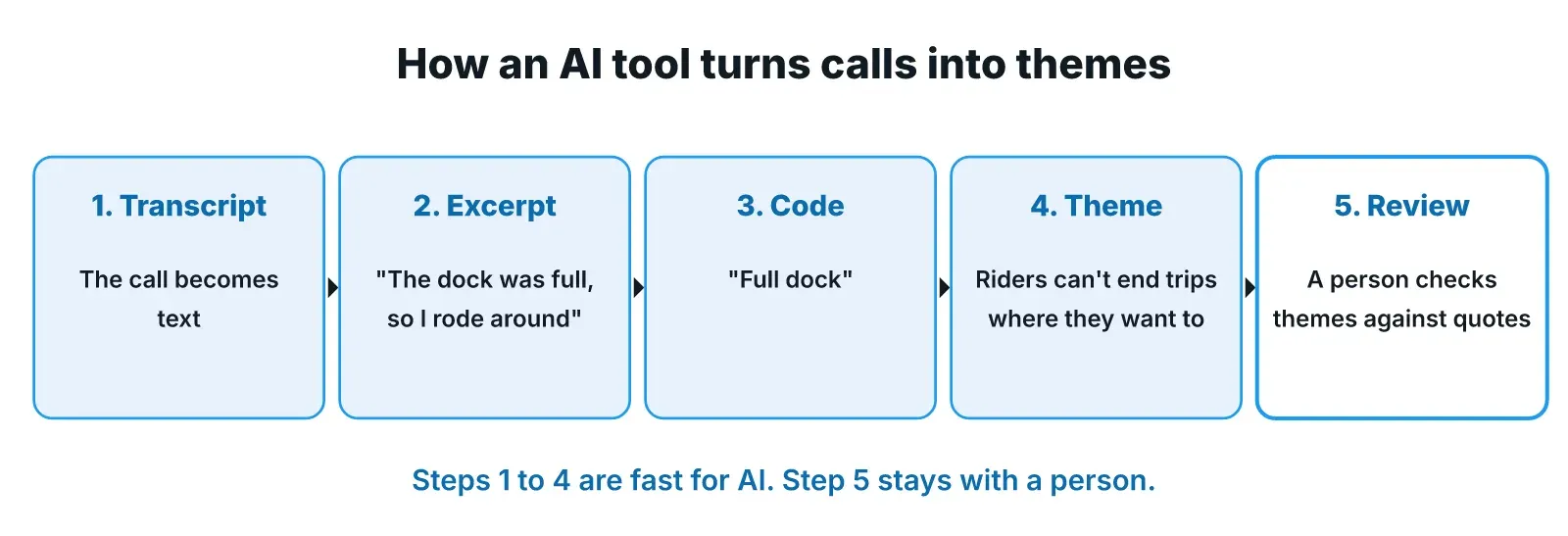
AI thematic analysis turns interviews into themes in five steps. It makes transcripts, cuts them into excerpts, labels each excerpt, groups the labels into themes, and hands the result to a person to review. Each step can go wrong, so it helps to know which one made the themes on the demo screen.
The tool turns each recorded call into text. If this step drops words or mixes up who's talking, every later step builds on the mistake.
An excerpt is a short piece of text, usually one sentence or one answer. For the bike scheme, one excerpt might be "the dock was full, so I rode around for ten minutes."
A language model reads each excerpt and suggests a short label, called a code. That excerpt might get the code "full dock." Some tools skip labels and group similar excerpts by meaning instead.
The tool groups related codes and names each group. A code labels one excerpt. A theme is a pattern across many codes, like "riders can't end trips where they want to." Good tools show sample quotes under each theme.
The researcher merges, splits and renames themes. They also drop any theme the quotes don't support. Good tools keep every quote linked to its place in the transcript, so this check is quick.
AI does the first pass of thematic analysis well. It codes and groups hundreds of excerpts in minutes, and it applies the same labels the same way every time. Research also finds AI can come close to people when you compare whole themes. That makes it useful for big piles of transcripts.
Speed is the clearest gain. In a 2025 study, 18 researchers tested an AI toolkit for thematic analysis. It sped up coding and theme building a lot, and the researchers still did the deeper reading themselves.
Agreement with people is improving too. A 2024 study compared AI coding with human researchers. With an updated model and a better prompt, the AI's results lined up more closely with the human coders, when you added up scores theme by theme.
There's also steadiness. A person coding call 200 is more tired than they were at call one. A tool applies the same codes the same way across the whole set.
No. AI can do the first pass, but a person still needs to decide what the themes mean. The same 2024 study found that while the theme totals lined up, the AI's labels on single excerpts varied more. So a theme can look right while some of its quotes are filed in the wrong place.
People also bring things a tool doesn't have:
So build in one step before anyone acts. A researcher reads each theme against the transcripts before a decision rests on it. Say the demo shows a theme called "app crashes." Open five of its quotes. If two are really about a full dock, the theme needs fixing. The post on how AI is changing qualitative analysis goes deeper on where AI helps.
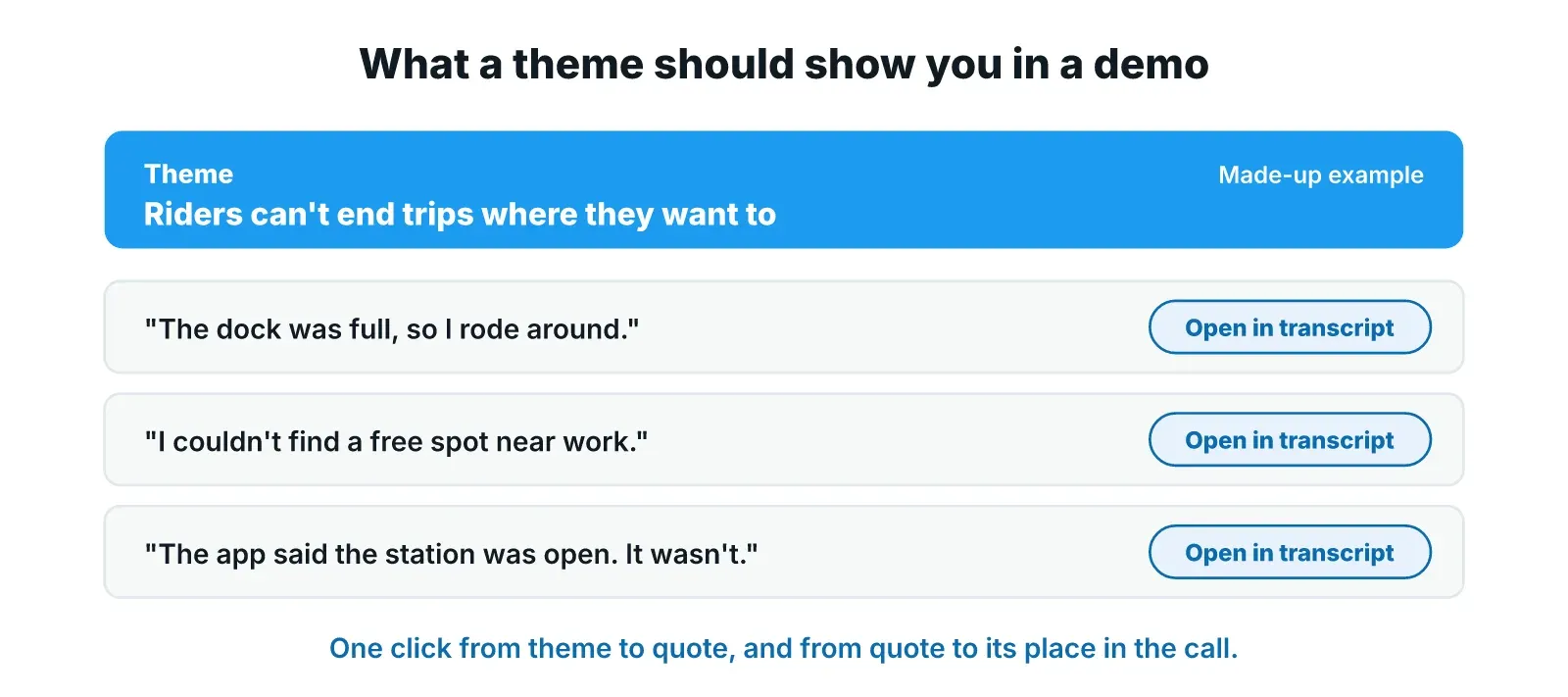
Every demo you see will now show AI. A 2025 paper in the journal Quality & Quantity reports that generative AI is built into the three best-known programs for analyzing interview data: MAXQDA, ATLAS.ti and NVivo. So the real question is how well a tool shows its work. Ask these five questions, and bring your own transcripts.
A good answer is yes, in one click. Then click from a quote to its place in the transcript. If you can't, you can't check the theme.
You should be able to merge, split and rename. The tool should keep your edits when you add more interviews.
If your riders speak several languages, ask to see themes built from more than one. Check the quotes in each language.
Ask where transcripts are stored and who can see them. Ask whether your data is used to train the vendor's AI models. Get the answer in writing.
Ask what happens when only one or two quotes fit a theme. A good tool shows how many excerpts sit behind each theme, so thin themes stand out.
If a tool passes all five with your own transcripts, it's worth testing on a real project. If it fails the first question, stop there.
Pulse runs the interviews and the analysis in one place. Pulse runs AI-moderated voice interviews, and the report builds as each interview finishes, ready minutes after the last one. Interviews run in 240+ languages, enabled on request, and one study can cover several markets.
Pulse groups what people said into themes, each with the quotes behind it. Every quote links to the transcript it came from, so the first demo question has a one-click answer. Your researcher still reads the themes and decides what they mean.
To see it on your own study, book a demo, start on the $0 Explorer plan, or ask for a free study.
It depends on your work. Ask whether you also need to run the interviews, how many transcripts you have, and who will read the results. Then test each option with the five demo questions above, using your own transcripts. The right tool is the one that lets you check every theme quickly.
They do different jobs. NVivo keeps codes, notes and sources together for a whole project. A chatbot can help with a quick first pass on a few transcripts. But it doesn't keep a project, and it won't link each quote back to its source for you.
Use a simple table. List each theme with a one-line definition and two or three quotes. Link each quote to its transcript. Add how many people raised the theme, as a count, not a percentage. That gives readers the finding and the proof side by side.
Pick a few themes and open every quote under them. Check that each quote says what the theme claims. Then open the transcript around each quote, to make sure the meaning holds in context. If many quotes don't fit, rebuild that theme by hand.
Participant recruitment methods compared by who you need: your own list, panels, referrals, networks and recruiters, plus a check before you set a date.
Semantic vs latent themes, from Braun and Clarke's paper "Using thematic analysis in psychology", shown on real-life quotes, with when to use each.
How to choose a transcription service for research interviews: test each option on your own audio with five simple checks, from accuracy to data safety.