Participant recruitment methods: 5 ways to find people
Participant recruitment methods compared by who you need: your own list, panels, referrals, networks and recruiters, plus a check before you set a date.
How to run one remote usability test across several markets in a week: one task script, local recruits, and a fair way to compare where people stall.

Your team at a travel booking company is about to launch a new checkout in several countries. The product lead wants two answers first. Can people in every market finish a booking? And where do they get stuck, and why?
What you need is one remote usability test, run the same way in every market. A remote usability test is a session where people try your product on their own phone or laptop while you watch their screen.
If you want to know whether people can finish, give every market the same tasks and success point. If you want to know why they stall, hear them think aloud in their own language.
The hard part is keeping the test the same across languages, so a market difference is real. One script, one recruiting profile and one fair way to compare get you there in a week.
To get results you can compare, keep each task's goal and success point the same in every market. Change only the local details inside it. If the tasks differ, you can't tell whether people struggled with the checkout or with your wording. So start from one brief and one task list, and adapt from there.
Say the travel company's first task is "Book a hotel for a weekend trip and pay for it." The goal and the end point stay fixed everywhere. The city, currency, date format and payment method change to what each market uses, because a traveller would notice a foreign one at once.
A word-for-word translation can give the answer away. Say the English task says "pay for your room" and the local button also says "Pay". A literal translation hands people the label to look for. So ask each translator to keep the task in the traveller's own words. Then check it against the local screen and change any word that appears on both.
Write each task as a trip someone might book, such as a weekend away. Leave the screen's labels out, because people who picture a real trip make real choices.
Before the real sessions, run the script with one person in each language and fix anything that confused them. A pilot catches the odd translation before it costs you a day of sessions.
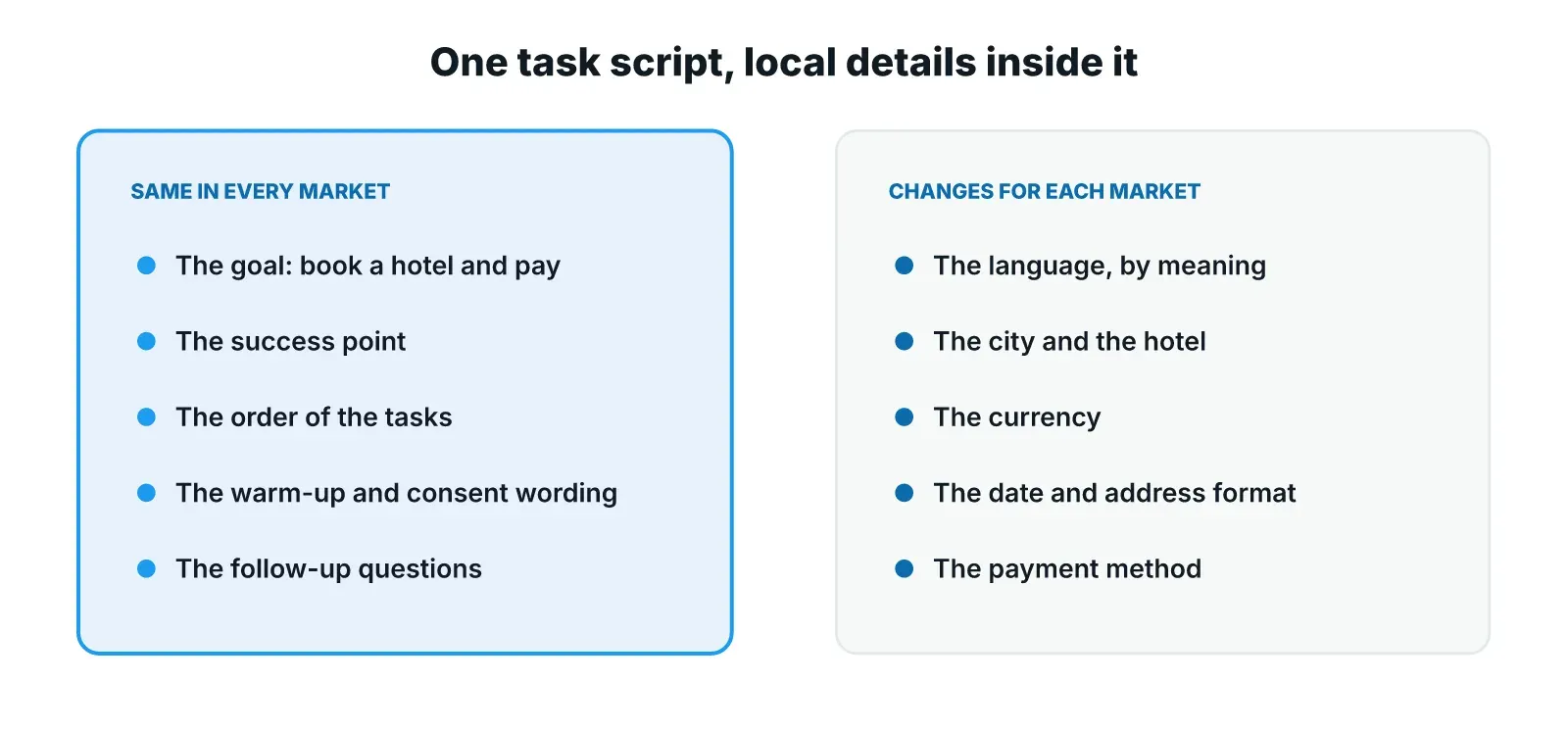
Markets are only comparable when the people and the sessions are comparable. Use one screener everywhere and set a quota for each market. Give every participant the same warm-up, consent wording and follow-up questions. Then a difference in results points at the market itself, because everything else stayed the same.
In a moderated session, a moderator joins live and asks follow-up questions when someone hesitates. In an unmoderated session, people work alone while their screen is recorded. For a launch decision that needs the reason behind each stall, choose moderated sessions. Unmoderated sessions suit checking where people stall across a larger group. Our post on what unmoderated clicks miss about the why compares the two.
A screener is the short set of questions that decides who can take part. For the travel company, it might ask for people who booked a trip online recently. Translate it with the same care as the tasks, so every market screens for the same person.
Give each market its own number of sessions instead of one pooled total. Otherwise the busiest market fills first, and a quieter market gets decided by two or three people.
Your own customers know the old checkout and may look for it. New recruits come in fresh. Pick per market on purpose, and note the choice so you read the results with it in mind.
Check that each participant is real and fits the profile, because one bad session distorts a small market group.
Thinking aloud means people say what they are doing and thinking as they go. Ask for it in their own language. Use the same warm-up and consent wording in every market, and let people join from a link on their own device.
Decide early what counts as a stall, such as going back, a long pause or asking for help. When an answer is vague, ask one neutral question: "What were you expecting to see there?" Every participant should get the same follow-ups.
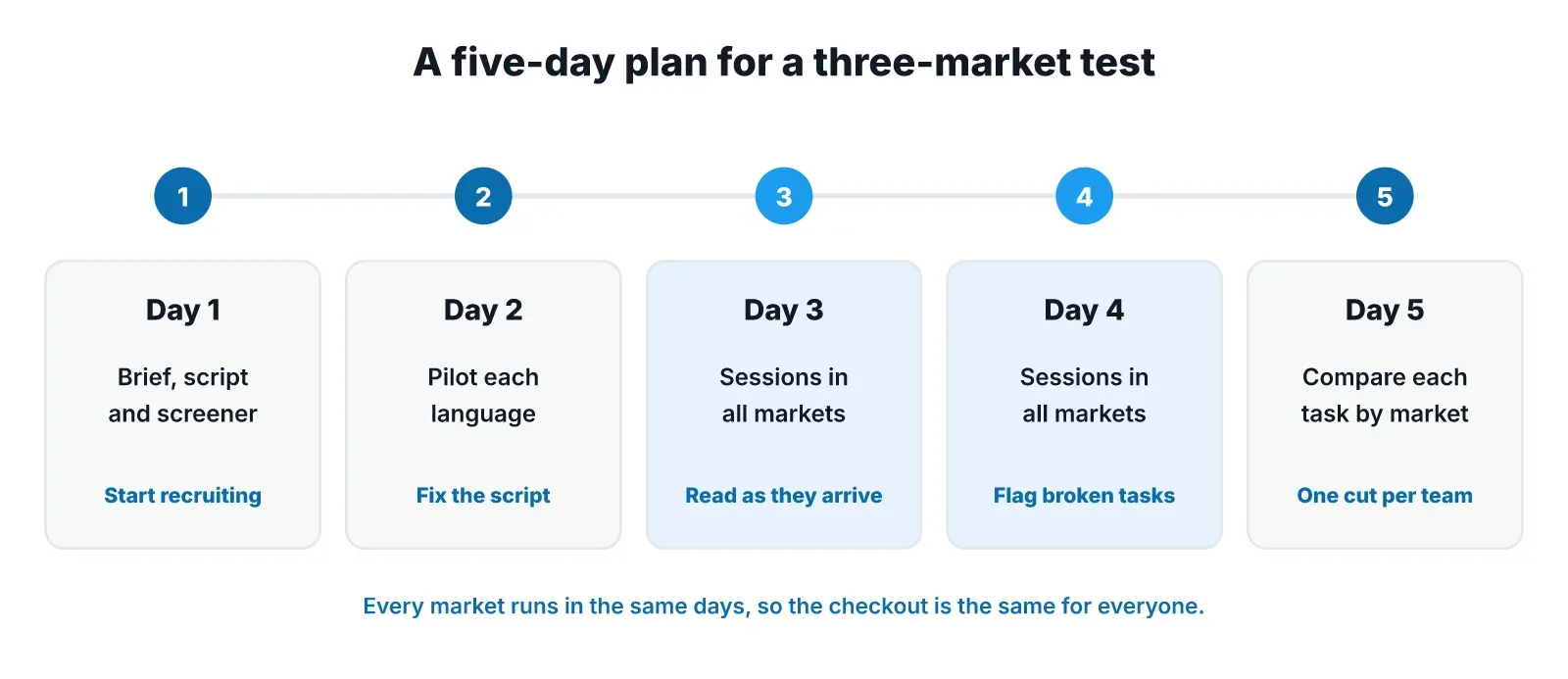
A three-market remote usability test fits into one working week when the steps overlap. Day one sets the script and screener, and day two pilots them. Days three and four run sessions in every market at once, and day five compares the results. Running markets in the same days keeps the checkout the same for everyone.
Say the travel company launches its checkout in three markets with different currencies and payment methods. The choice in front of the team is simple: launch everywhere as planned, fix something first in one market, or wait. Every day of the plan serves that choice.
Agree on the two questions, write the task script and screener, and adapt the local details. Start recruiting the same day.
Run one pilot session per language and fix the script. Open the real sessions once every market's version reads cleanly.
Sessions run in all three markets in parallel. Read transcripts as they arrive. Flag any task that fails for the wrong reason, such as an odd translation or a broken test link.
Compare each task across markets, then share one report with a cut for each market's team.
To compare markets fairly, look at the same task in each one. Did people finish, where did they stall, and what did they say at that moment? Before you call a gap a market difference, rule out a study difference. A task worded differently, a missing payment method or a different mix of devices can make a market look worse.
Each row starts from something the travel team might see on day five, then shows what to check before acting on it.
| What you see | Check first | If the check is clean |
|---|---|---|
| One market stalls at payment | Was the local payment method in the test build? | Fix payment for that market before launch |
| One market fails a task the others pass | Does the translated task still mean the same thing? | Look for a local cause, such as an address form |
| One market finishes far faster | Did that market test on the same mix of devices? | Study what that flow does differently |
| Every market stalls at the same step | Is the step the same in every build? | Fix the checkout itself |
Read each stall next to what the person said and did at that moment, because a count alone can't give you the cause. A long pause on the payment page means one thing if the person says "Where's my usual card?" and another if they say "Is this safe?"
Give each market's team its own cut of the evidence, with every quote traceable to its session, so a local lead can check it. A researcher reads the themes against the transcripts before a launch decision rests on them.
The rule for day five follows from the table. If a stall shows up in every market, fix the checkout. If it shows up in one market and survives the checks, fix it for that market. If it disappears once the task wording is fixed, it came from the test.
The hardest part of a multi-market test is running it the same way everywhere. Pulse is built for that. One study runs across several markets at once, from one brief and discussion guide, so differences reflect customers and not how the study was run. AI-moderated interviews run in 240+ languages, enabled on request.
Participants open a link on a phone or laptop, so there are no calls to schedule. The AI moderator asks every participant the same well-formed questions, and asks a second question when an answer is vague. So follow-ups don't drift between markets. Video insights capture on-screen behavior and emotion that a transcript misses.
You can invite your own customers from an uploaded list, or recruit to the brief's profile from more than 200 million people globally. Every participant goes through fraud checks. Pulse then groups what people said into themes, each with the quotes behind it and each quote linked to its transcript.
To plan your next multi-market launch test, book a demo and start with a free trial and a free study.
Test in person when people need to handle something physical, such as a printed boarding pass, a ticket machine or packaging. A remote usability test fits digital products, because people use their own phone, network and home setting. For a travel checkout, that is where real bookings happen.
Yes, and for live sessions in several languages you usually need one per language. Keep them consistent with one shared guide, the same warm-up and the same follow-up rule. Then compare their pilot transcripts on day two and fix any moderator who explains the screen or asks leading questions.
You need one task script with local details for each market, one translated screener and a quota per market. People need a way to share their screen and talk while they work. You also need agreed stall markers, a pilot in each language and a plan for who reads the results in each country.
Participant recruitment methods compared by who you need: your own list, panels, referrals, networks and recruiters, plus a check before you set a date.
Semantic vs latent themes, from Braun and Clarke's paper "Using thematic analysis in psychology", shown on real-life quotes, with when to use each.
How to choose a transcription service for research interviews: test each option on your own audio with five simple checks, from accuracy to data safety.