Data collection methods: how to pick the right one
Data collection methods compared: what surveys, interviews, observation and records each tell you, and three checks to pick the right one for you.
Qualitative research cost comes from seven lines. See how agency, in-house and AI-moderated studies move each one, and compare quotes line by line.
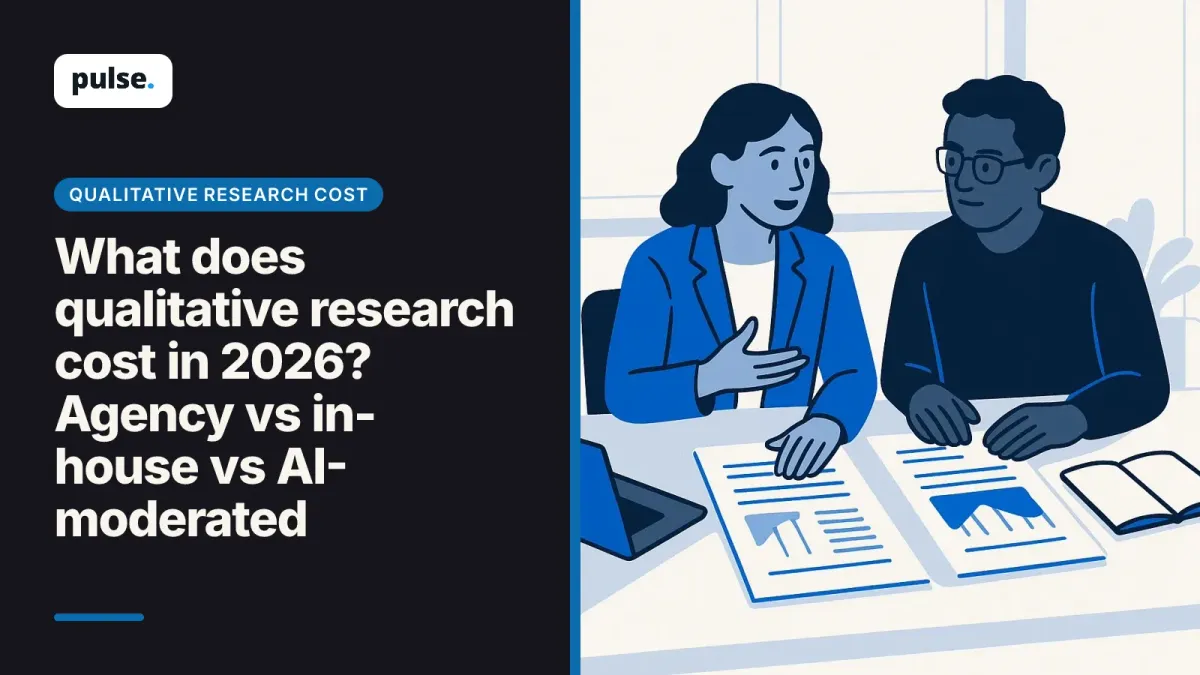
For illustration, picture an insights lead holding three quotes for the same interview study. The three totals don't line up at all. Qualitative research cost is the sum of seven lines, and agency, in-house and AI-moderated studies each move different ones. So compare quotes line by line, and judge each one by its cost per finding.
Comparing totals alone is a bit like comparing two shopping receipts without looking in the bags. Here's how to see what each quote actually buys.
Here's the short version:
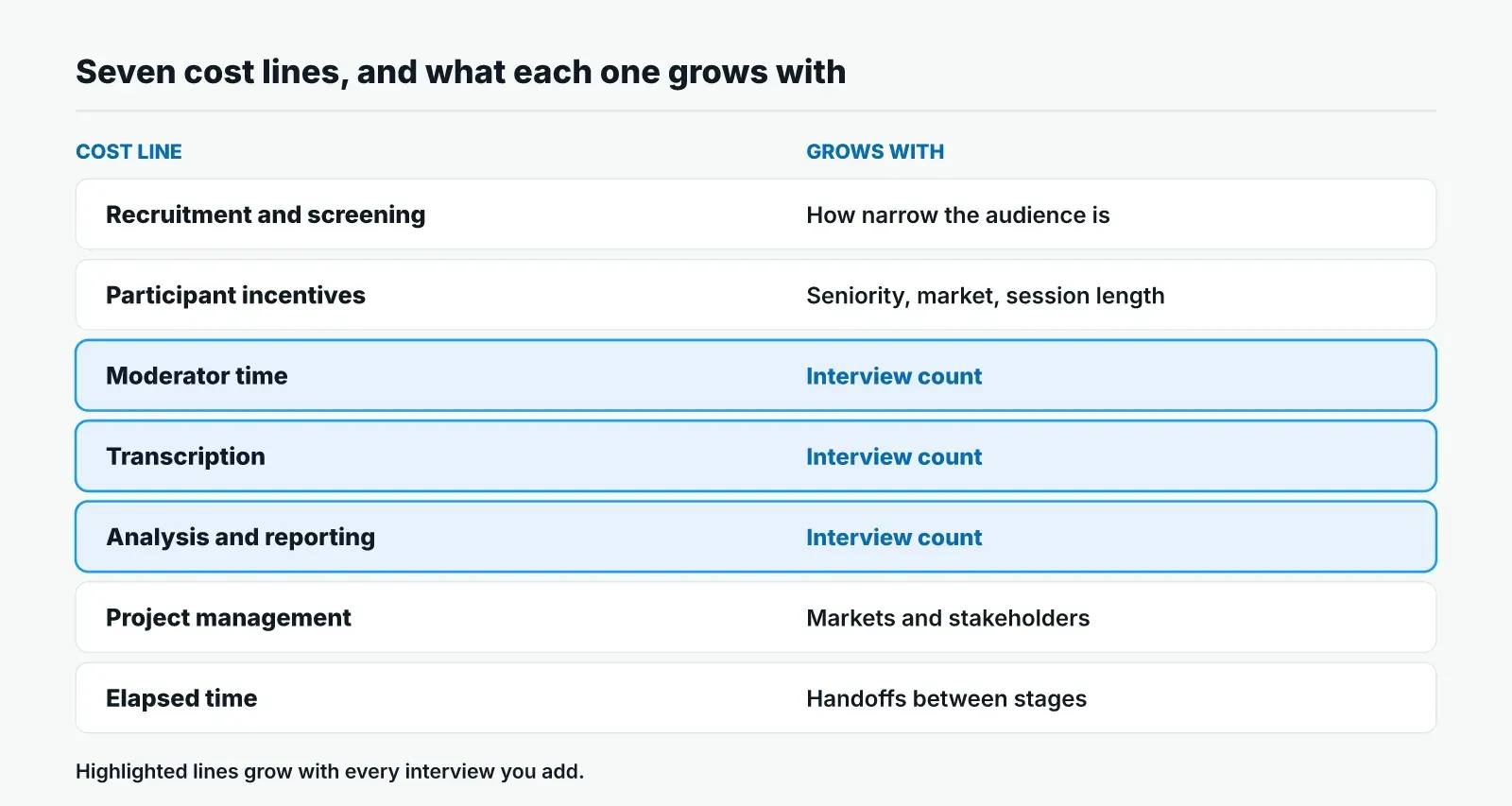
Every interview study pays for the same seven things, whoever runs it. They are recruitment, incentives, moderator time, transcription, analysis and reporting, project management, and elapsed time. Each line grows with something different. Know what drives each one, and you'll see which lines a bigger scope will move, and which ones a quote left out.
| Cost line | What it pays for | What makes it grow |
|---|---|---|
| Recruitment and screening | Finding and checking the right people | How narrow or senior the audience is |
| Incentives | A payment for each finished interview | How senior people are, the market, the length |
| Moderator time | Getting ready, running and writing up each session | The number of interviews |
| Transcription | Turning recordings into text | The number of interviews |
| Analysis and reporting | Sorting answers into themes, the report and the readout | The number of interviews |
| Project management | Keeping vendors, teams, legal and calendars in step | How many markets and teams take part |
| Elapsed time | The weeks a decision waits | Each handoff from one stage to the next |
For illustration, finding 20 heads of procurement at banks takes longer and costs more than finding 20 retail customers, because fewer people qualify. Incentives follow the same logic. An incentive calculator helps you set a rate you can defend before you compare quotes.
Moderator time is the one line with a public price guide. Human moderators can charge $200 to $400 an hour, according to a September 2026 arXiv paper by Deng, Liu, Toubia and Jain. The authors base that figure on communications with GBK Collective, one of their industry partners. It is one firm's figure, so treat it as a guide to scale.
Elapsed time never shows up on an invoice. For illustration, a retention team that waits six weeks for fieldwork walks into its next pricing review without the evidence it asked for. The time to insight calculator puts a number on that wait.
An agency charges for senior moderators, its network for finding people, and a finished report. It adds project management and margin, its profit on top of costs. An in-house team removes the margin, but your own researchers spend hours moderating, scheduling and analyzing. An AI-moderated study takes most moderator hours and transcription off the budget. Recruitment, incentives and the researcher's review stay.
| Cost line | Agency | In-house | AI-moderated |
|---|---|---|---|
| Recruitment and screening | The agency or its panel partners | Your team or a recruitment vendor | People found to your profile, or your own customers |
| Incentives | Added to the quote | Paid by your team | Paid per finished interview |
| Moderator time | Senior moderators, billed by the hour or day | Your researchers' paid hours | The AI moderator runs each session from one guide |
| Scheduling | The agency books sessions | Your team matches calendars | No moderator calendar to book around |
| Transcription | A line in the quote | A vendor or tool, plus checking | Arrives with each interview |
| Analysis and reporting | Agency researchers write the report | Your researchers' hours | First themes with quotes, checked by your researcher |
| Project management | Built into the fee | Your own time | Setting up and checking the study |
| What grows with each extra interview | Most lines | Moderator and analysis hours | Mainly recruitment and incentives |
Use an agency when you need something only an agency has. That might be senior moderators who know the category, a recruitment network you lack, or an outside name on the report. For illustration, a bank writing a board paper on a new market may want that outside name. You pay for it through margin and project management on every line.
Use your own team when the questions keep coming, sit close to the product, and your researchers already know the context. The limit is hours: each interview takes moderator, scheduling and analysis time from a fixed team.
Use an AI-moderated study when you need to cover many customer groups or markets by a fixed date. Most moderator hours, scheduling and transcription leave the budget. Study design, incentives, recruitment and the researcher's check of themes against transcripts stay. For the full sequence, see how AI-moderated research runs.
Cost per interview tells you what one session costs. Cost per finding tells you what the whole budget bought. A finding here is a distinct customer need or reason the study turned up. Finance can weigh that number against a decision. A 2026 study compared ways of running interviews on just this basis.
The 2026 arXiv study was pre-registered, which means the authors fixed their plan before collecting data. It ran with three industry partners and 317 people (N=317). It compared three kinds of interview: AI-moderated (N=139), run by a human (N=24), and static, with fixed questions and no follow-ups (N=154). The people were home-improvement decision-makers, recruited online and asked about windows and doors. The authors matched sample sizes by market cost, so each method had the same budget.
With the budget held equal, AI moderation matched human moderation in depth and covered more themes, according to the same paper. It also found significantly more customer needs than either of the other two, meaning the gap was bigger than chance would explain. Human moderators kept one edge. People who spoke to a person sounded more positive, more activated and more assertive.
Two limits apply. The study covers one consumer category with an online sample, so it doesn't settle the question for B2B buyers or regulated customers. The human group was also small. So keep human moderators where the feel of the session matters most: executive interviews, sensitive topics, and workshops where customers help design something.
For more on the trade-off, see how AI and human moderation differ in practice. To run the same sum on your own quotes, use the cost per insight calculator.
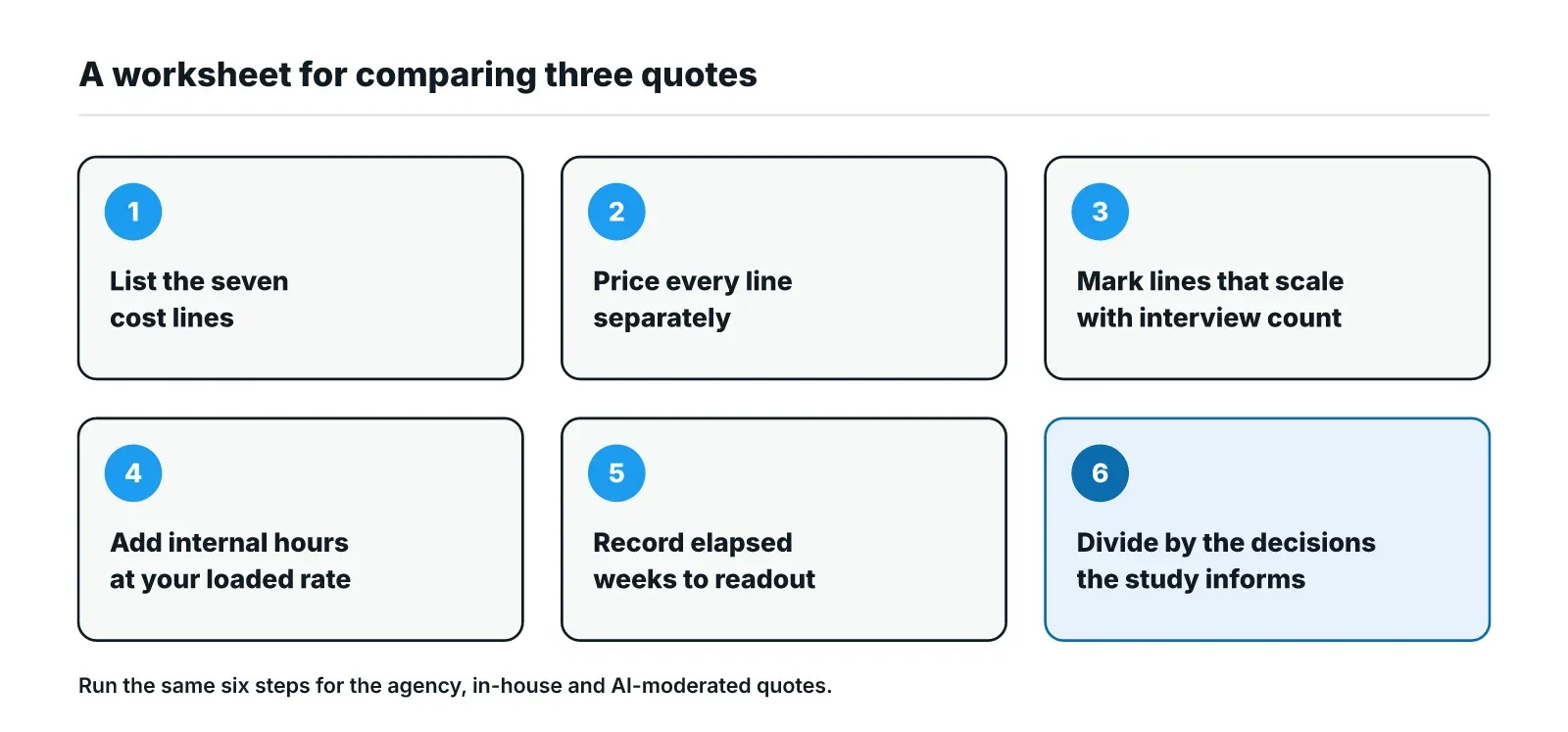
Illustrative example: an insights team at a large insurer needs 30 interviews with customers who canceled a policy, in two countries. The interviews will brief a steering committee on retention. The team asks an agency, its own research team and an AI-moderated provider to quote. Six steps put the three quotes on one sheet.
Put the seven lines down one side and the three options across the top. A line a quote doesn't mention gets a question mark until the provider prices it.
A bundled quote hides where the money goes. Here's the difference:
The price per line shows what each option assumes.
These lines change if the committee asks for more interviews or a third country.
Briefing, screener review, stakeholder meetings and reading transcripts take researcher time under every option. Price those hours at your own loaded rate, the full cost of an employee's hour including overheads.
The readout is the meeting where you hear the findings. Write the date each option would deliver it against the date the committee meets. An option that misses the meeting pushes the decision to the next one, whatever its total.
Set each total against the findings the committee needs: why customers left, at what point, and what would have kept them.
Before signing, ask each provider four questions:
Once every line is priced, the gaps show. The agency quote includes project management that the in-house option left out. The in-house analysis hours sit in nobody's budget. The team picks the option whose cost per finding and readout date fit the committee, and notes which lines it would pay again next quarter.
Pulse runs the AI-moderated option in that comparison. You set the research question, the audience and the screener, and it builds the AI-moderated interviews from that brief. Participants take the interview on a phone or laptop by opening a link, so there are no calls to schedule. Every interview arrives as a full transcript alongside its recording.
Recruitment works two ways. You can invite your own customers from a list you upload, or have participants recruited to the profile your brief describes. Every participant goes through fraud checks. Pulse then groups the answers into themes, and every quote links to the transcript it came from.
A study that took weeks can run overnight, so the decision spends less time waiting. The lines that stay with your team are the ones that need judgment: framing the question, setting incentives, and checking themes against transcripts before the committee sees them.
Whoever you buy from, apply three checks. If a line is bundled, ask for it priced. If a line grows with every interview, check what it does to cost per finding. If the decision has a date, price the weeks. To see the AI-moderated option run on your own question, book a Pulse demo.
Per person, usually yes. Each interview needs moderator and analysis time that a survey answer doesn't. Per decision, it depends on the question. A survey counts how many, and interviews explain why. If the decision only needs a count, a survey is the cheaper tool. To tell which you need, see when a survey answers the question instead.
Treat each country as its own set of lines. Recruitment, incentives and project management repeat in every market, and incentive rates differ from one country to the next. Moderator time and analysis grow with the total number of interviews. Ask each provider to price the lines per country. Then you can see what adding or dropping a market would change.
Yes, on the lines that grow with each interview: moderator time, transcription, analysis and incentives. Recruitment setup and project management barely move, so you save less than the drop in interviews suggests. The number of interviews should follow the question and how different your customers are. So narrow the question before you cut interviews.
For how to judge the number, see how many user interviews you really need.
Data collection methods compared: what surveys, interviews, observation and records each tell you, and three checks to pick the right one for you.
Concept test results overstate demand when a yes costs the respondent nothing. How to read them, what to check before launch, and what to ask after.
How do AI interviews work in customer research? Follow one session from screener to follow-up question to a theme traced to its transcript.