
How to use affinity mapping for user interviews
How to use affinity mapping for user interviews: one idea per note, sort by meaning, count people not notes, and check themes against quotes.
How to prevent customer churn: spot early signs, learn why people leave, fix the biggest reason and check it worked. What churn tools can and cannot do.

A listener opens the music streaming app less and less. First she stops making new playlists. Then she plays music once a week. A few weeks later, she cancels. You work on the customer team at that company, and you see this pattern again and again. How do you stop people before they reach the cancel button?
That pattern is called churn. Churn means customers who stop paying or cancel.
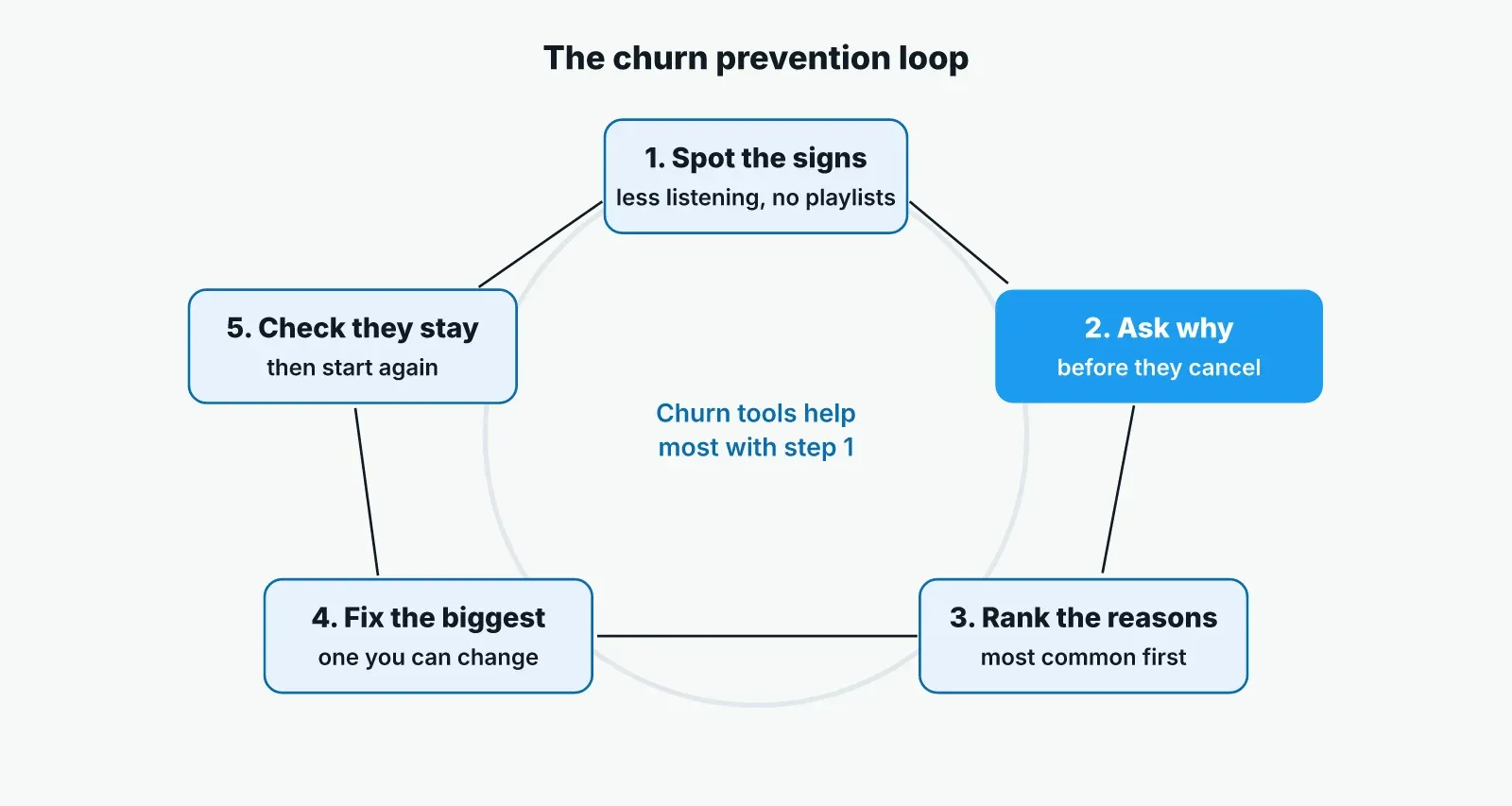
To prevent customer churn, work in a loop. Spot the early signs, ask the people showing them why, fix the biggest reason, then check that those people stay. Churn tools help with the first step. The asking is what tells you what to fix.
Each step below uses the streaming example, so you can see where the work happens.
You prevent customer churn by finding people who show early signs of leaving, learning their reasons and fixing the biggest one. Then you check if that group stays. It works best as a loop that never stops, because new reasons appear as the product and the market change.
Here are the five steps, using the streaming company.
Most people don't cancel without warning. They pull back first. At the streaming company, the signs might be fewer hours of listening, no new playlists, or a support message about a charge. Pick two or three signs your team can see in its own records.
A drop in listening tells you something changed. It doesn't tell you what. So talk to a small group of people who show the signs, while they are still customers. They remember why they pulled back, and you still have time to help.
Once you have heard from enough people, sort what they said into reasons. Some reasons will come up again and again. Others belong to one person. Put the common ones at the top.
Pick the reason that touches the most people and that your team can change. Say many listeners say the app keeps suggesting the same songs. That points to a fix in the suggestions, not a discount.
After the fix, watch the people who had that reason. Do they listen more? Do fewer of them cancel? If not, go back to step 2 and ask again.
Churn prediction means using past behaviour to guess which customers are likely to leave. It looks at things like how often people use the product, their billing history and their support tickets. Then it gives each customer a score. This is most of what churn tools do.
Teams use that score in a few ways:
All of this helps with step 1. A tool can watch thousands of accounts at once, which no person can.
But a score can't tell you the reason. Two listeners can have the same low score for very different reasons. One may have moved to a rival service with a family plan. The other may be tired of the same suggestions. A discount email might keep the first one and do nothing for the second.
So use the score to decide whom to talk to, and use their answers to decide what to fix.
Churn rate is the share of customers who leave in a period. Retention is the share who stay. They are two sides of the same number, so if retention goes up, churn goes down. Track churn rate by group, not only as one total, so a rise points you to the people who are leaving.
To work out churn rate, take the number of customers you lost in a month. Divide it by the number of customers you had at the start of that month.
Teams track both numbers for different reasons. Retention shows how healthy the business is. Churn shows where customers are slipping away.
One total can hide a lot. Say the streaming company's churn rate stays flat for a year. That looks fine. But split it by group and you might see that students leave much faster than families. Or that people who joined through a phone deal leave when the deal ends.
Useful groups to split by include:
When one group's churn rises, that group is where you start asking why. If you want to ask the same questions again later and compare, repeat the same questions over time with each group.
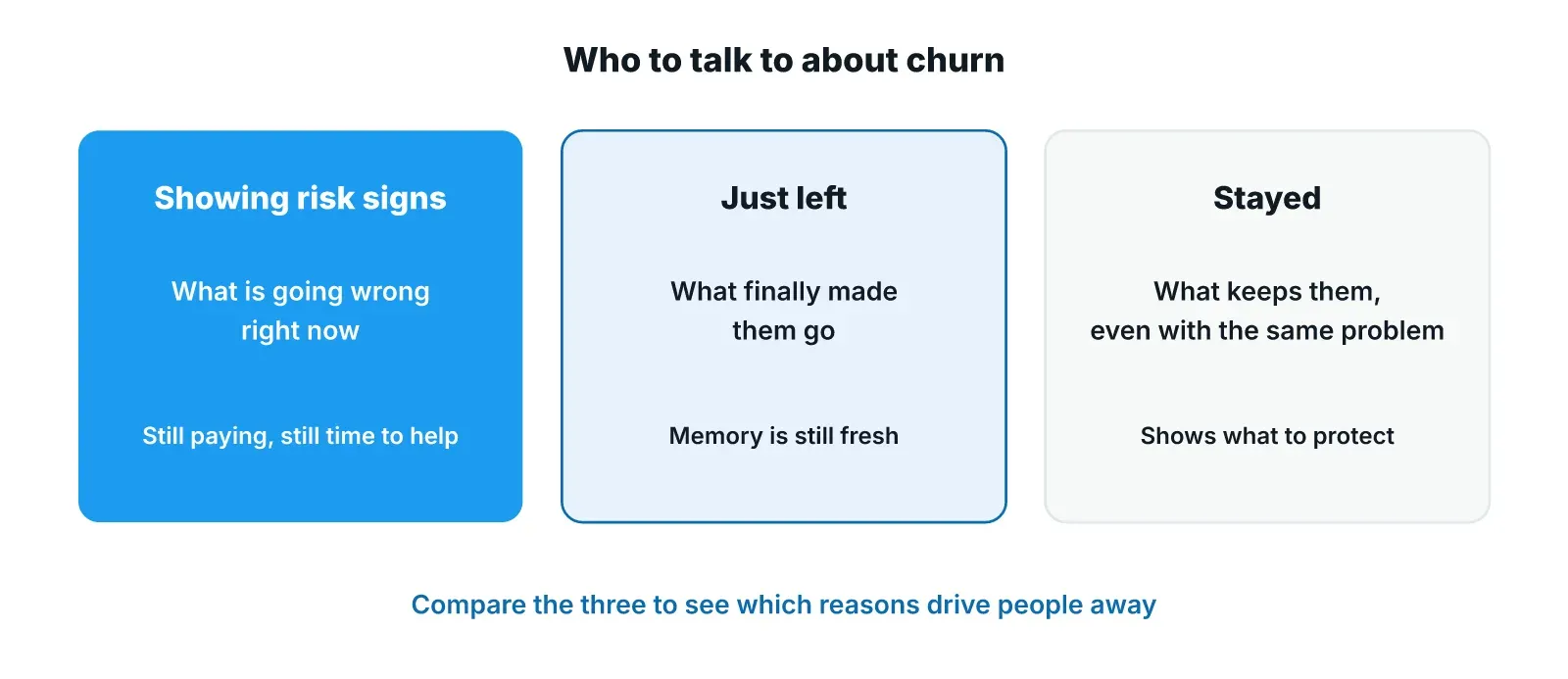
You find out why customers leave by asking them, in their own words, and by asking a follow-up when the first answer is vague. Talk to three groups: people showing risk signs, people who just left, and people who stayed. Comparing what they say shows which reasons really drive people away.
Cancel forms seem like a quick way to learn why. But most people pick the first option or type one word, such as "price" or "other." Usage data has a different gap. It shows what people did, but not why they did it.
Here is why the three groups matter:
Ask about real moments, not opinions. "What did you listen to last week?" gets a better answer than "How do you feel about the app?"
Say a listener tells you, "It's too expensive." That sounds like a price problem. A second question helps: "What made you feel that this month?" Now he says the app kept playing the same songs, so the price stopped feeling worth it. The real reason is the suggestions.
For questions to use, see the post on churn interview questions. For why short interviews often find reasons a survey misses, read interviews vs surveys for finding churn reasons.
Step 2 takes the most time, because talking to enough at-risk customers means many calls. Pulse runs AI-moderated interviews with the people the churn score flags, invited from the team's own customer list. People take the interview by link when it suits them, so nobody waits for a call.
The AI moderator asks every person the same well-formed questions. It builds its follow-ups on what each person said earlier, and asks a second question when an answer is vague, like "it's too expensive." Pulse then groups the answers into themes with the quotes behind them. Each quote links to its transcript, so the team can rank the reasons and pick the fix with confidence.
You can see how Pulse helps teams reduce churn. To try it, sign up for the $0 Explorer plan, ask for a free study, or book a demo.
Churn prediction software is used to flag customers who are likely to leave, before they do. It looks at usage, billing and support history, then scores each customer. Teams use the scores to send alerts, trigger emails or decide whom to contact. It works best when someone then asks those customers what is wrong.
Customer success teams use churn tools most, because they look after accounts and need to know who needs help. Product teams use them to see which features people stop using. Marketing teams use them to time win-back emails and offers. In many companies, all three look at the same scores.
A survey can tell you how many people pick each reason from a list. It can't easily tell you what sits behind a one-word answer like "price." So a survey is good for counting reasons you already know. Interviews are better for finding reasons you haven't thought of yet.
Contact them soon after the first signs show, while they are still paying. At that point they remember what changed, and you still have a chance to help. If you wait until they cancel, you learn the reason too late to keep that person.
How to use affinity mapping for user interviews: one idea per note, sort by meaning, count people not notes, and check themes against quotes.
What synthetic data in market research is, how accurate synthetic answers are in published tests, and 7 questions to ask a vendor before you buy.
How to measure brand equity: the four parts to ask about, a price question, the same questions for two rivals, and interviews that explain the score.