How to choose a sampling method for customer research
Choose a sampling method by the claim your customer study has to support, with a decision table for probability and non-probability sampling.
Churn interview questions for fintech teams that find quiet switchers, screen for the moment money moved, and probe trust, fees and onboarding.
Churn interview questions for fintech customers should reconstruct the moment money moved: what happened, what they compared, what made the new provider feel safe, and what would have kept them. Recruit customers who quietly opened an account elsewhere or let one go dormant, as well as those who closed an account, since many financial customers leave without closing anything.
Four questions that open the switching story:
In banking and cards, a customer can leave without telling you. They open an account with another provider, move their salary or their spending, and keep the old account open with a small balance. A churn study that recruits only from closed accounts hears from the customers who left loudly and misses the ones who drifted.
J.D. Power survey findings reported by the ABA Banking Journal in October 2025 describe customers "quietly" switching. Many new checking accounts and credit cards were additional accounts rather than replacements. Many of the checking accounts opened with a different firm became the customer's primary account.
A later J.D. Power survey was reported by the ABA Banking Journal in March 2026. It found that more retail bank customers had moved money away from their primary bank in the past three months than a year earlier.
For a research team, the consequence is a sampling decision. Define churn the way it shows up in your account data, then recruit from every version of it.
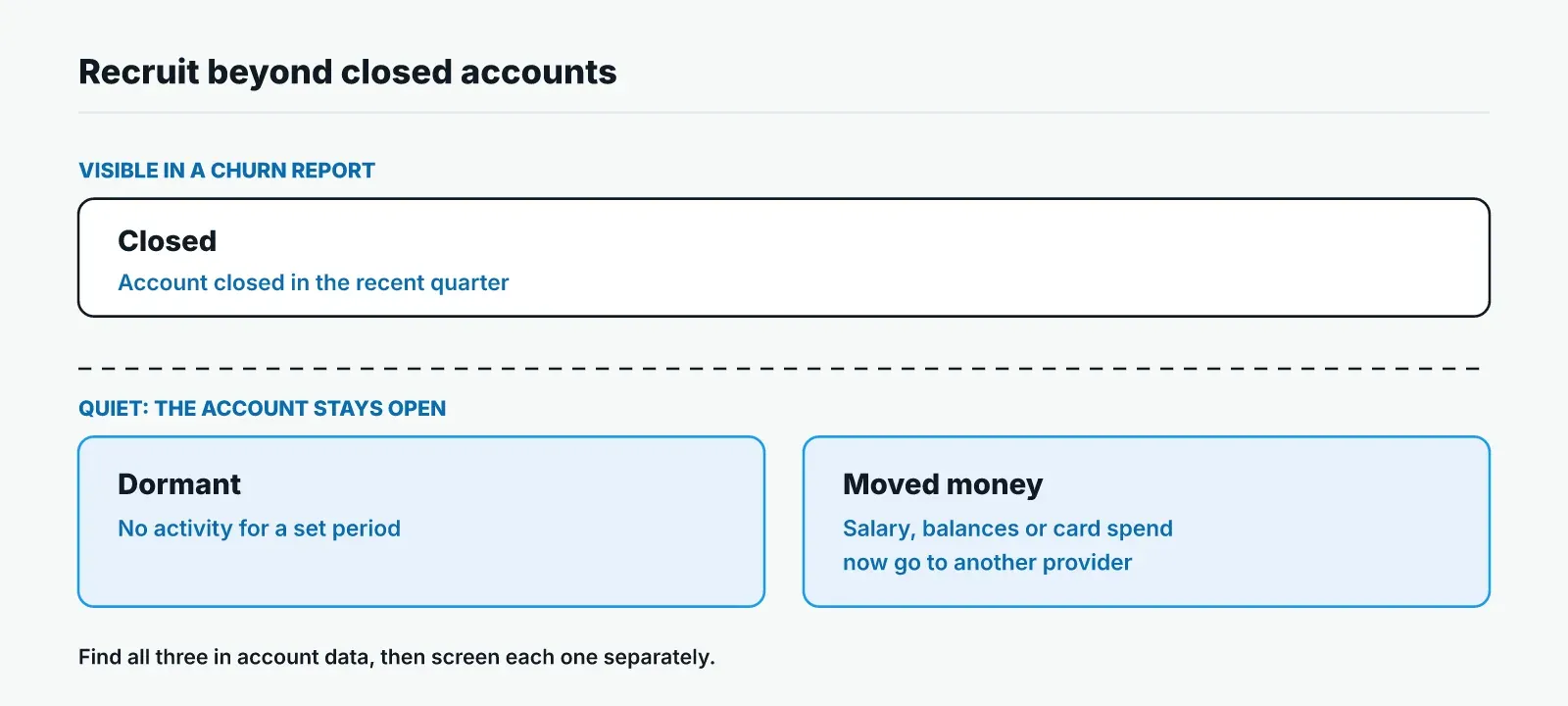
Build three segments from account data, and recruit from each. Closed accounts are the easiest to find. Dormant accounts and accounts whose money has moved elsewhere hold the quiet switchers, and they need their own screener criteria because the customer may not describe themselves as having left.
| Segment | How to find it in account data | What the interview can learn |
|---|---|---|
| Closed | Account closed in the recent quarter | The final trigger, and what the exit process was like |
| Dormant | No activity for a set period, account still open | When use stopped, and what replaced it |
| Moved money | Account open, but salary, balances or card spend have fallen sharply | What moved first, what stayed, and why |
Screen for recency. Recall of the switching moment fades, and a customer who moved money last month can still tell you which week it happened and why.
In a regulated business, agree with compliance before fieldwork how lapsed customers are contacted, what consent covers, and how recordings and transcripts are stored and for how long. Write it into the study plan so every market follows the same rules.
Good churn interview questions walk the customer back through the switch in order: when the other account was opened, what else they looked at, which money moved first, and what would have kept them. Each question is open, asks about something that happened, and comes with one probe for a thin answer.
| Stage | Question | Probe for a thin answer |
|---|---|---|
| Timeline | When did you first open the other account? | What was going on for you at that time? |
| Timeline | What was the first thing you did with it? | Why that, rather than something else? |
| Comparison | What else did you look at before choosing them? | What ruled the others out? |
| Comparison | What made them feel safe enough to try? | What did you check, and where? |
| Money movement | Which payments or balances moved first? | What did you leave behind, and why? |
| Retention | What, if anything, would have changed your mind? | When would that have needed to happen? |
Avoid yes-or-no questions such as "Were you unhappy with our fees?" They hand the customer a reason and record their agreement with it. Ask "Tell me about the last time a charge surprised you" and let the reason come from them.
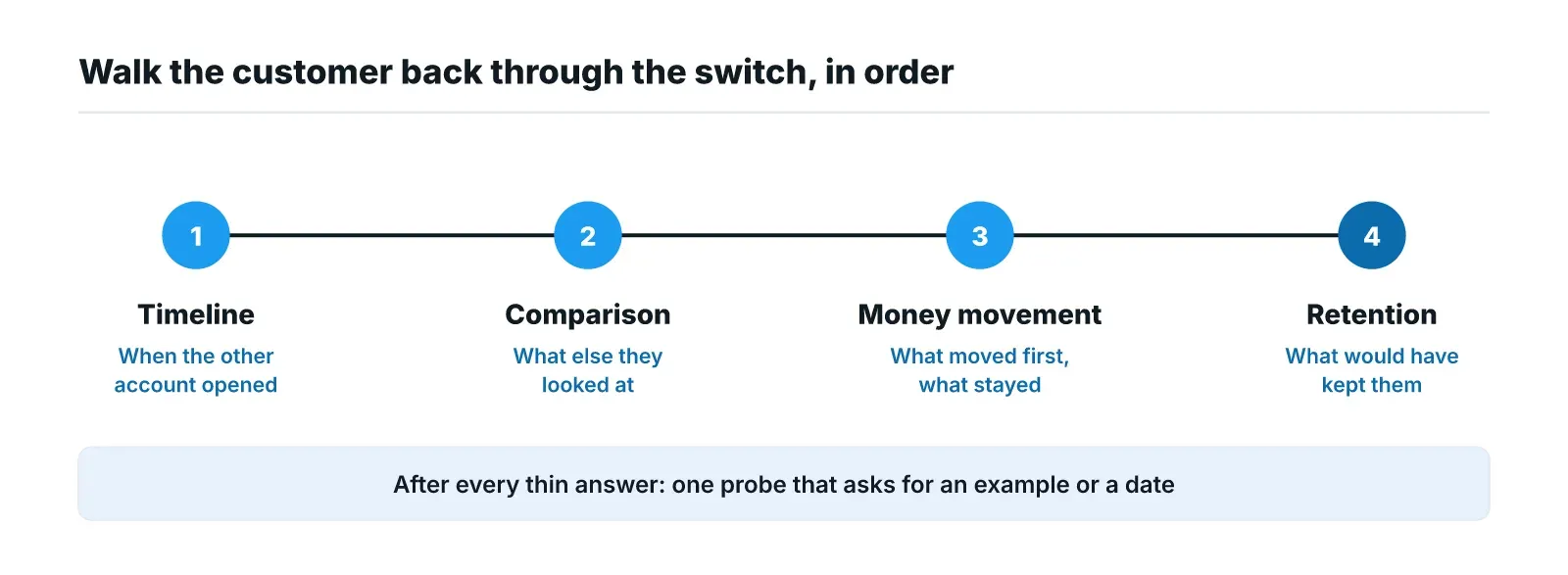
Plan probes for four themes in financial switching: trust, fees, digital experience and onboarding at the new provider. For each, the probe asks for a specific example, a date or a moment, because an example can be compared across interviews and an opinion cannot.
Digital experience belongs in the guide. In Baringa's survey of 4,000 banking customers and 400 executives in the UK and US, published in September 2025, more than a third of customers had switched banks in the last five years, putting better digital experiences ahead of competitive rates.
The excerpt below is illustrative. It is written for a large card issuer interviewing customers whose card spend has moved to another provider while the account stays open. Each part notes why it sits where it does, and the general method is in how to structure an interview guide.
| Part | What the moderator asks | Why it sits here |
|---|---|---|
| Warm-up | How do you usually pay for everyday things these days? | Opens on current behavior without mentioning the issuer's card |
| Timeline | When did you start using a different card for most purchases? | Anchors the switch to a date before any reasons are asked for |
| Comparison | What made you pick that card over the others you had? | Gets the alternatives in the customer's words |
| Money movement | Which purchases moved first, and which still go on our card? | Separates the habit that left from the one that stayed |
| Retention | What would have had to be different for you to keep using our card for those purchases? | Asked late, once the customer has described what happened |
| Close | Is there anything about that switch we have not covered? | Leaves room for the reason nobody planned a question for |
A discussion guide like this keeps the order fixed and the wording open. When an answer is thin, the moderator uses the probe from the table above before moving on.
Lapsed customers have little reason to book a call with a company they have stopped using. An interview they can take by link, on a phone or laptop when it suits them, lowers that barrier. Then read the answers by segment before merging them, because closed, dormant and moved-money customers can describe different moments.
Pulse runs AI-moderated voice interviews from one guide with every participant, follows a vague answer with a second question, and traces every theme back to the interview it came from. A study across many lapsed accounts and several markets asks every customer the same questions.
Code reasons separately for each segment, then compare. A fee reason that dominates the closed segment may barely appear among the moved-money customers, and the retention plan for each group differs. Read every theme against its transcripts before it reaches a retention plan, and check that each probe followed the customer's answer, using the guide to tell a good probe from a leading question. The case for interviews over a churn survey is in why interviews find churn reasons a survey misses.
As soon as the account data shows the change, ideally within the same quarter. The closer the interview is to the switch, the more precisely the customer can place it in time and name what triggered it. An interview months later relies on a memory the customer has had time to tidy, and the trigger can drop out of it.
By researchers or a neutral moderator. A customer talking to their relationship manager is also talking to someone who may try to win them back, and answers with that in mind. Share the findings with the account team afterwards, with quotes, so they hear the reasons in the customer's words.
It asks about something that happened, in the customer's own timeline, and leaves the reason for them to supply. "When did you first open the other account?" works. "Did you leave because of our fees?" does not, because it hands the customer an answer and records their agreement.
Find them in account data first: falling balances, salary deposits that stopped, card spend that dropped, or long inactivity. Then invite them through the channels your compliance team has approved, with a short interview they can take by link. Frame the invitation around their experience with the account.
Choose a sampling method by the claim your customer study has to support, with a decision table for probability and non-probability sampling.
A representative sample of 20 interviews covers the segments a decision turns on. See what that lets you claim, and what only a survey can.
Design and run questionnaires that answer a real decision: set the objective, pick a mode, order and pilot questions, then analyze the results.