
How to choose an AI assistant for research
Choosing an AI assistant for research? Match it to the evidence your question needs, then test whether every finding opens to the source behind it.
Multi-market message testing: keep the people and questions the same, translate for meaning, and tell a translation slip from a real difference.

A runner reads the new shoe ad on the bus and smiles. In another country, a runner reads the same line in her own language and frowns, because there it sounds like bragging. You're on the marketing team at the sportswear company behind the ad, and it goes out in several countries soon. How do you know the message means the same thing everywhere?
Checking one message with customers in each country, in their own language, is multi-market message testing.
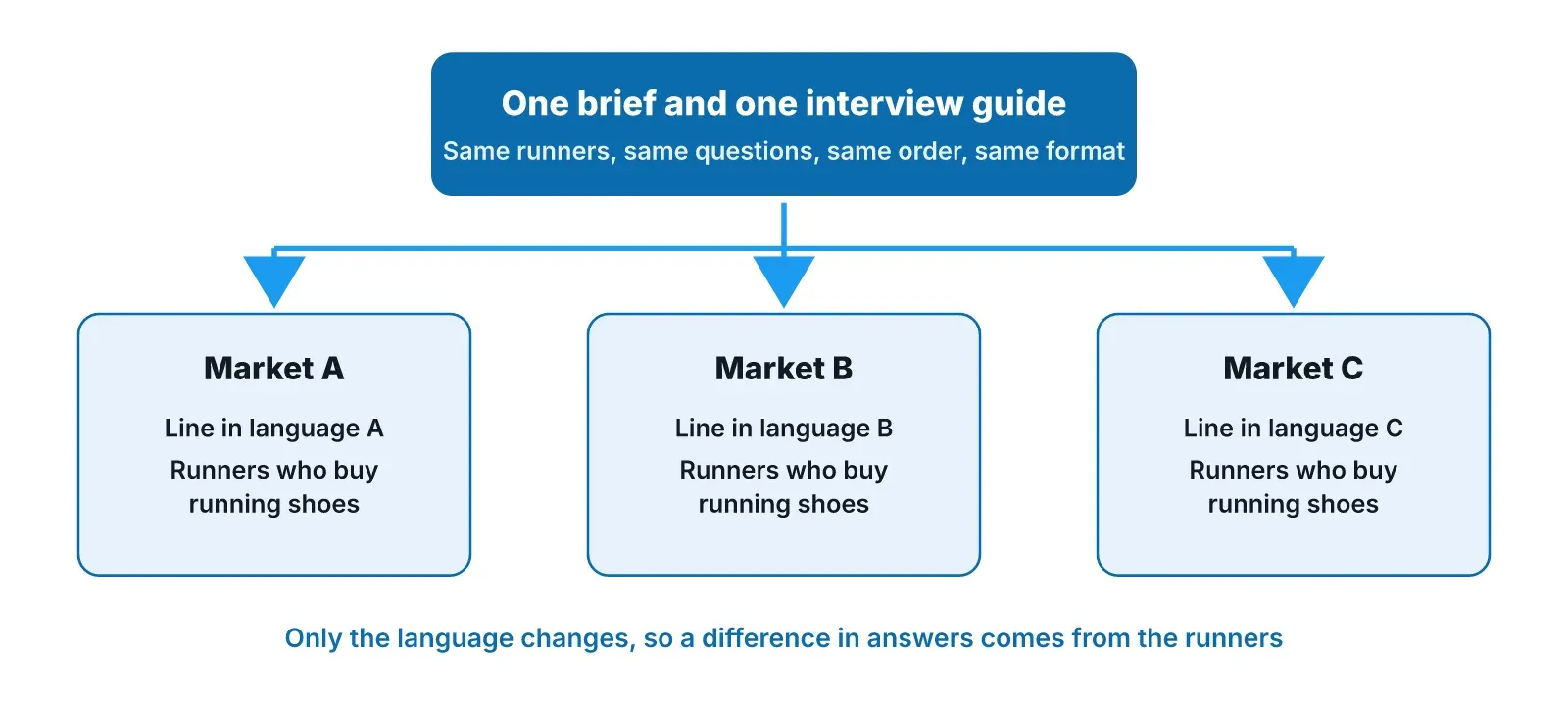
If you want to know whether the meaning travels, ask people in each market to say in their own words what the line tells them. If you want to compare markets fairly, keep the people, the questions and their order the same everywhere, and change only the language.
It starts with one decision: what must stay the same in every market, and what is allowed to change.
The same words can carry a different meaning, tone or promise in another language or culture. So a line that works at home can confuse or put off people somewhere else, even when every word is translated correctly. That's the risk the sportswear company takes with one line in several countries.
Say the line promises the shoe will help you "beat everyone". In one market, that reads as motivation. In another, it reads as showing off. In a third, most people run to stay healthy, so a promise about speed misses them.
Studying how people from different cultures see the same thing is called cross-cultural research. Testing one campaign line in several markets is a small, practical use of it.
The test feeds one decision. The company will either run one line everywhere or pay for local versions, and the answers from each market decide which.
A correct translation can still carry the wrong message.
To compare markets, hold fixed everything you want to compare, and let only the words change. If one market sees a polished video and another a plain line of text, a difference in answers may come from the format and tell you nothing about the customers.
Each row shows one part of the test, what stays fixed across markets, and what each market may adapt.
| Part of the test | Keep the same in every market | May change by market |
|---|---|---|
| The message | Its meaning and its promise | The exact words |
| Who you ask | The same customer profile | Where you find those people |
| The questions | The same questions, in the same order | The language they're asked in |
| How the line is shown | The same format and quality | Nothing |
| Examples, names, prices and units | The job they do in the message | Local versions |
Start with the people. Recruit the same kind of customer in each market: here, people who run regularly and buy running shoes. Use the same screening questions everywhere, translated with the same care. A screener is that short set of questions that checks each person fits the study.
Keep each market as its own group, with enough people in each to see its own themes. And interview people in the language they're most comfortable speaking, which may not be the country's main language.
Then use one interview guide, translated, with the same questions in the same order everywhere. Start with the open question "What is this line telling you?" and leave anything about liking it until later. When each market writes its own questions, differences can come from the questions instead of the runners.
A short survey in each market can then count how common each takeaway is.
If something changes between markets, you can't compare on it.
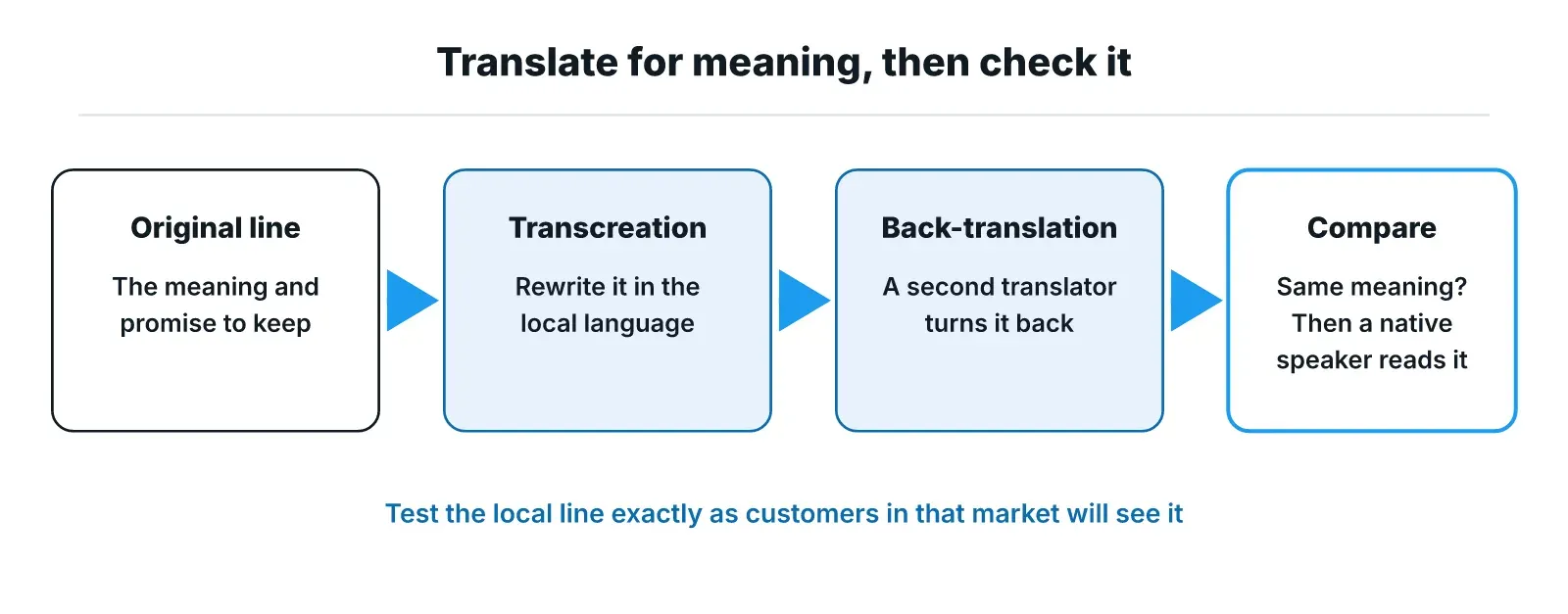
A word-for-word translation can be correct and still sound odd, flat or rude to a local reader. So translate what the line means, and test the translated line exactly as local customers will see it. That way, the test measures the line people will meet, in the words they'll meet it in.
Rewriting a line so it carries the same meaning and feeling in another language is called transcreation. It suits campaign lines, because a slogan depends on tone as much as on words.
To check the result, use back-translation. A second translator, who hasn't seen the original, turns the new line back into the original language. If the meaning that comes back is different, the team sees the gap before customers do.
Ask a native speaker who knows running to read each version too. They'll catch a word that is correct but sounds wrong.
Test the local-language line in each market, never the English original, unless the ad will run in English there. Otherwise people judge their own English, and the message gets lost.
Keep a record of each market's final wording. If one market gives a strange result, you can trace it back to the exact words.
When the answers come in, put each market's takeaways side by side. Before you act on any difference, sort it into one of three kinds: a translation slip, a change in meaning, or a real preference. Each kind has a different fix, so the sorting comes first.
The table shows what each kind of difference looks like in the answers, and the fix that goes with it.
| What you see | What it usually means | What to do |
|---|---|---|
| One market gets the takeaway wrong, and its translation used an odd word | A translation slip | Fix the words, then test again |
| The takeaway is right, but the line feels off, like the bragging reaction | A change in meaning | Write a local version |
| Takeaway and belief match, but one market likes the line less | A real preference | Keep the line, and adjust the local example or the media plan |
If a survey shows two markets' numbers differ, check the gap before you act on it. A z-test can compare two percentages and show whether the gap is bigger than chance would explain.
Suppose runners in two markets both say the line is about speed, but in one market they add "and that's a bit much". The meaning traveled, and the tone didn't. That market needs a local version with the same promise and a softer tone.
Use one global line when every market takes the same meaning from it, and write a local version wherever the meaning changes.
The sportswear team needs the same test run the same way in every market and language, so any difference comes from runners and not from how the study was run. Pulse runs one study across several markets at once, from one brief and discussion guide.
AI-moderated interviews run in 240+ languages, enabled on request, and one study can run in several languages at once. The AI moderator asks every participant the same well-formed questions from one interview guide. Its follow-ups build on what each runner said earlier, and a vague answer gets a second question.
Surveys run alongside the interviews in the same study, so each market's takeaways can be counted. Pulse groups the answers into themes, each with the quotes behind it, and every quote links to its transcript. So a strange result in one market can be checked against what people said.
If you're planning a campaign for several countries, you can book a demo to see how the study would run.
A marketing message is the main idea a campaign wants people to take away. For the running shoe, it might be that the shoe is light enough to forget you're wearing it. The slogan, the ad and the poster are different ways of saying that idea. A test checks the idea first, then the words.
Start by translating for meaning, and test the result. If people in a market take the same meaning and feel the same tone, keep the translated line. If the meaning or the tone changes, write a local version that keeps the same promise. A campaign can mix both, market by market.
Only if the ad will run in English in those markets. Otherwise people judge their own English along with the message, and you learn little about how the local line will read. Test each market in the language its ad will use, and interview people in the language they speak most easily.
Choosing an AI assistant for research? Match it to the evidence your question needs, then test whether every finding opens to the source behind it.
Jobs to be done interviews at scale: how to keep hundreds of interviews on track, sort what buyers say and check each reason across groups.
How to write a screener survey that lets the right B2B buyers into your interviews: role checks, hidden criteria, quotas and a test run.