Participant recruitment methods: 5 ways to find people
Participant recruitment methods compared by who you need: your own list, panels, referrals, networks and recruiters, plus a check before you set a date.
Why brand tracker scores drop and how to find out: a short interview plan for the weeks after a wave, tied back to the metric that moved.
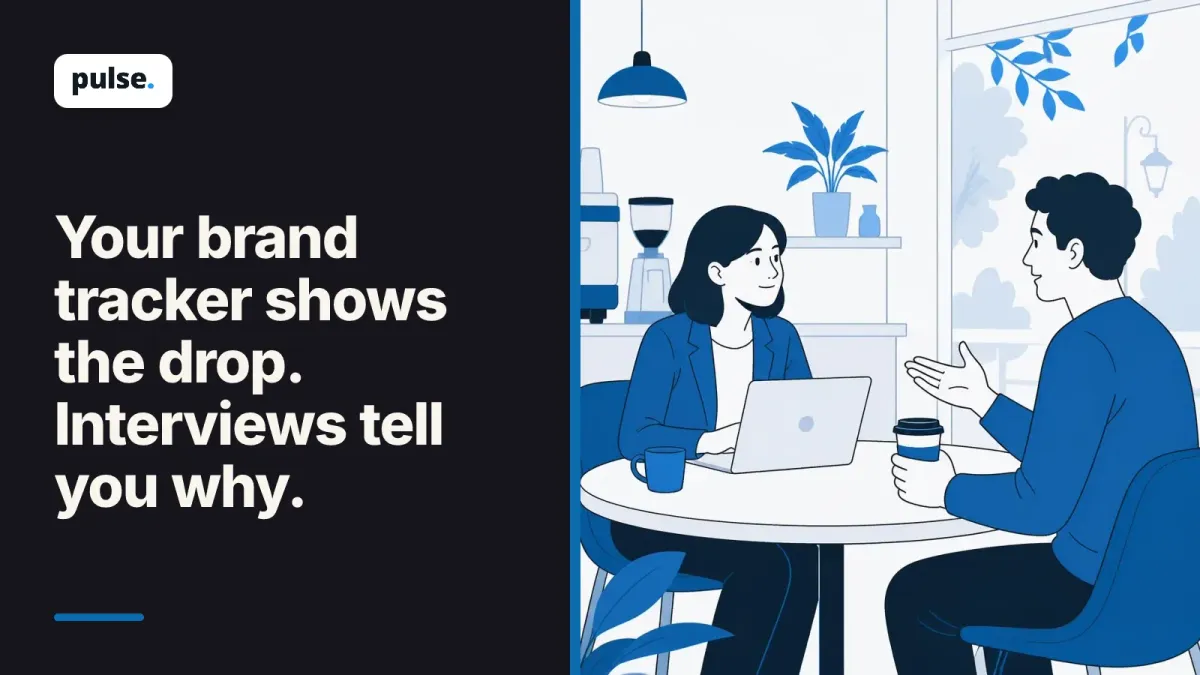
The new brand tracker results land in your inbox, and one line has turned red. You're on the brand team at a coffee shop chain, and fewer coffee drinkers now say they'd consider the chain for their morning coffee. Your manager wants to know why before the next campaign is booked. Where do you find the reason?
A brand tracker is a survey that asks the same questions every few months, so it shows what moved and for whom. Working out why brand tracker scores drop takes a different kind of evidence.
Talk to people from the group that moved, soon after the results come in, and ask about the moments behind their answer. Keep the tracker, because it tells you who to talk to and how big the change is.
Before any of that, though, make sure the drop is real.
A tracker can tell you that a number moved, for which customers, and against what starting point. It can't tell you why, because its questions were written before whatever changed people's minds happened. So the tracker gives you the question, and interviews give you the answer.
Because the tracker asks the same questions each time, the coffee team can see that consideration fell, that it fell most among younger customers in one city, and how far it fell from the last wave. That tells you where to look.
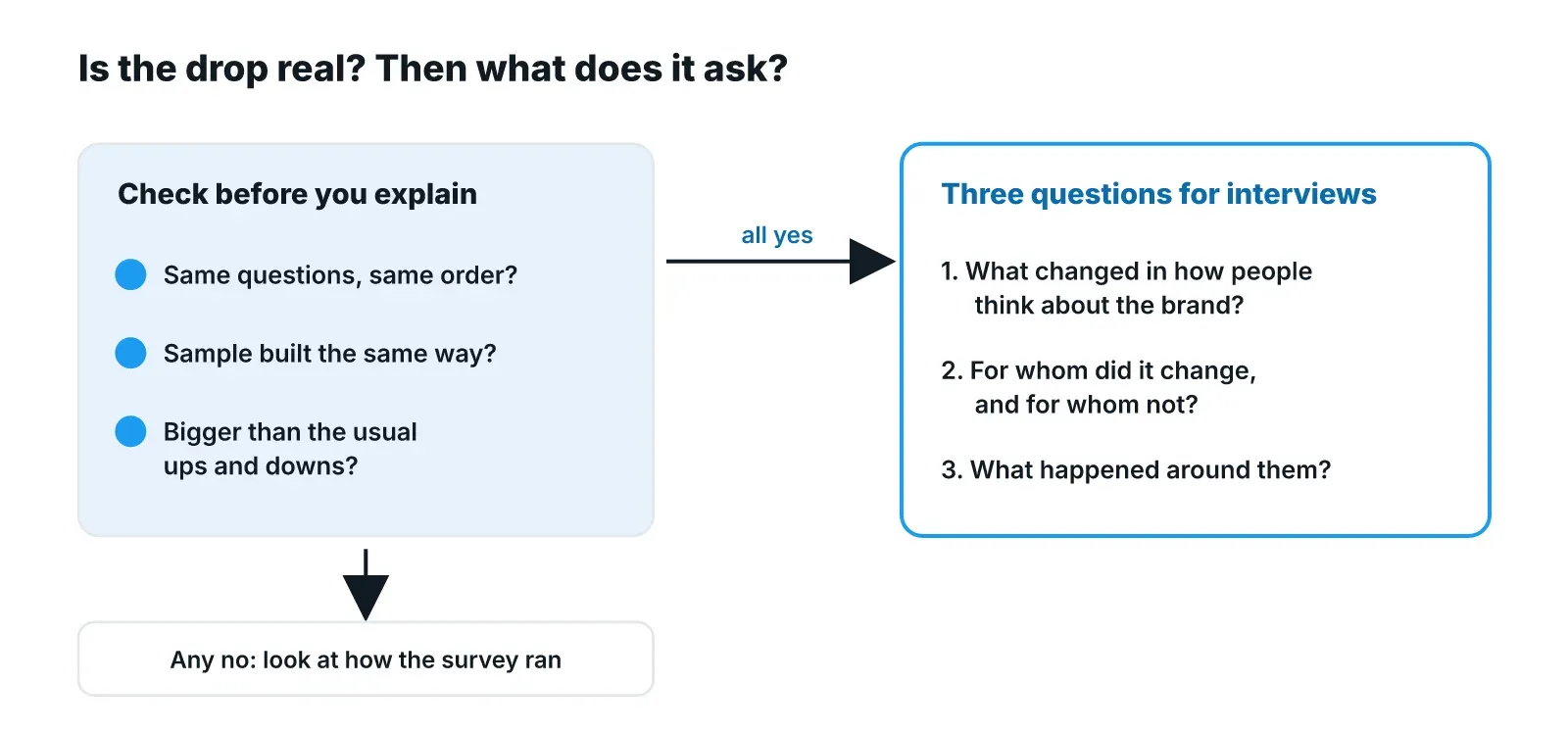
But first check that the drop is real. Ask three things. Were the questions and their order the same as last time? Was the sample, meaning the group of people who answered, built the same way? Is the change bigger than the small ups and downs you usually see between waves? If any answer is no, the drop may come from how the survey ran, and interviews won't explain it.
A real drop can have many causes: a rival opening next door, a price rise, a new cup, a story in the news, or a bad morning at the counter. The survey asked about none of them, so none can show up in its answers.
For teams that want to move away from slow quarterly waves altogether, the post on continuous brand tracking with interviews covers that choice. Here, the tracker stays.
A drop raises three questions, and each one becomes part of your interview guide:
For the coffee chain, that means asking whether the coffee now feels like worse value, whether only younger customers moved, and whether a new cup, a price change or a rival landed in the same weeks.
A drop is a question about people, so it needs people to answer it.
A between-waves study is a short set of interviews you run right after one tracker wave, before the next one. It aims to find the reasons behind one change while people still remember what shifted. These six steps keep it small, fair and easy to compare with the tracker.
Talk to people from the group whose score fell, using the same profile the tracker uses. Add a smaller group whose score held, so you can see what the first group says that the second doesn't. For the coffee chain, that's younger customers in the city where consideration fell, plus a few from a city where it held.
Run the interviews while the change is recent. People forget why they stopped doing something, and a month later they'll give you a tidy story instead of what happened.
Ask what comes to mind about the brand, where they buy their morning coffee now, and why, before you name anything. Open questions like these let people bring up the reason in their own words. The post on asking about a brand without leading people covers the wording.
Ask about the last time they chose where to buy coffee. What did they compare? What did they notice? A real recent moment gives you details a general opinion hides.
If you want reactions to a new campaign or a new cup, show it near the end. Shown early, it steers every answer that follows.
Ask every person the same core questions in the same order, so their answers can be compared. Keep interviewing until you can see whether the same reason keeps coming back.
A list of reasons only helps if each one points back to the number that fell. So for each tracker metric, write down what a drop could mean, what to ask, and what you'd need to hear to believe it. The table shows how the coffee team might set this up.
| Tracker metric | What a drop may mean | What to ask in interviews | What would confirm it |
|---|---|---|---|
| Awareness | Fewer people notice the chain | Which coffee shops come to mind near work or home? | The chain is missing from people's first answers |
| Consideration | People know the chain but rule it out | Where did you buy coffee last week, and why there? | A clear reason they now go somewhere else |
| "Good value" | The price feels wrong for what you get | What did your last coffee there cost, and was it worth it? | People name the price or the size, unprompted |
| Preference over rivals | A rival now feels like the better choice | What does the other place do better? | The same rival and the same reason, from several people |
| Trust | Something made people doubt the brand | Has anything changed how you feel about the chain lately? | A shared story, such as a news report or a bad visit |
Each reason needs the quotes behind it, traced to the interview it came from, and a count of how many people raised it. A reason two people gave is still a lead, so treat it as one until more people say it.
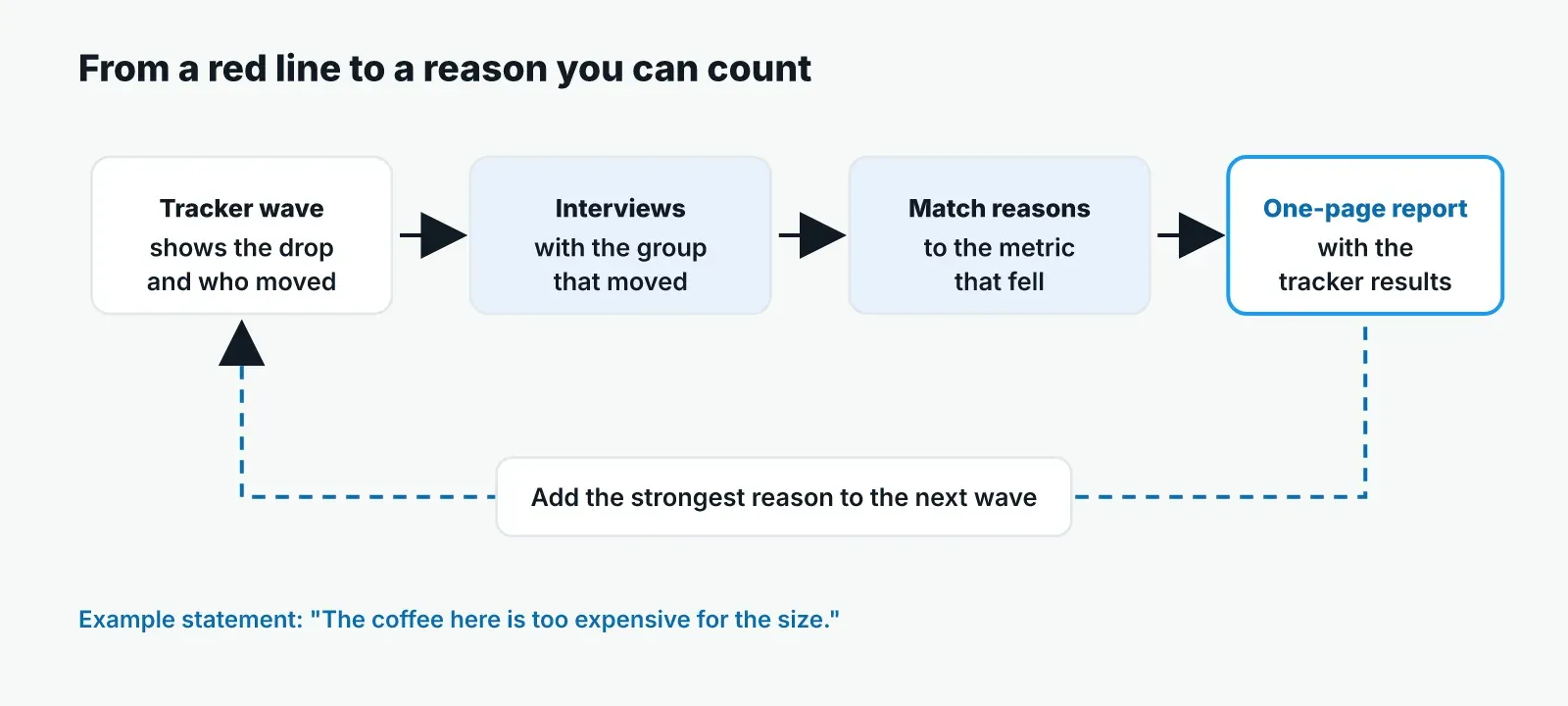
Then report on one page, sent with the tracker results rather than weeks later. Put the decision first. Then give the metric that moved, the two or three reasons with a quote each, how common each reason looks, and what to watch in the next wave. The post on which brand health metric to act on helps you pick the number to lead with.
Finally, close the loop. Add the strongest reason to the next tracker wave as a statement people can agree or disagree with, such as "The coffee here is too expensive for the size". The survey can then count how many customers share it.
A short interview wave works when the reasons are clear and point the same way. You'll need a bigger study when the reasons differ by market or by customer group, when the drop is large and people disagree, or when the reasons point at the product rather than the brand.
Say younger customers in one city blame the price, but customers in another city talk about slow service. That's two problems, and a few interviews can't tell you which matters more across the chain. A larger study across markets can.
Some teams try synthetic persona panels here, meaning AI-generated stand-ins for customer types. They can help you test how a message reads. But they aren't people who changed their minds, so they can't tell you why a real score fell.
The rule is short. If you need to know why the score moved, interview the group that moved. If you need to know how many people share a reason, add it to a survey or the next tracker wave. If the reasons split by market or product, plan a bigger study.
The plan above needs a repeat survey, interviews with the right people and reasons tied back to the number, all done quickly. Pulse is built to run those together. Trackers repeat a study's questions wave after wave, so a change shows against the baseline, and AI-moderated interviews can explore it. Surveys run alongside the interviews in the same study, so the numbers and the reasons arrive together.
Participants are recruited to the profile your brief describes, with fraud checks on every one, or invited from your own customer list. They take the interview on a phone or laptop by opening a link. The report builds as interviews finish, and it's ready minutes after the last one.
Pulse groups what people said into themes, each with the quotes behind it, and every quote links to its transcript. One study can also run across several markets, from one guide. To see a tracker wave and its follow-up interviews in one place, book a demo.
Interviews explain how people see a brand, and a tracker counts how many people see it that way. You need both. The tracker shows a change across a large group over time, and interviews show the reasons behind it. Use the tracker to spot the change and interviews to understand it.
There's no fixed number. Interview people from the group that moved until you can see whether the same reasons keep coming back, and add a smaller group whose score held for contrast. If reasons keep changing with every new person, the drop may have more than one cause.
Group what people said into reasons, keep the quotes behind each one, and count how many people raised it. A reason that shows up mainly in the group whose score fell is a stronger lead than one that appears everywhere.
As soon as you've checked the drop is real. People remember recent choices well and older ones poorly, so the sooner you ask, the closer you get to what changed. Aim to report before the next campaign is booked, so the reasons can shape it.
Participant recruitment methods compared by who you need: your own list, panels, referrals, networks and recruiters, plus a check before you set a date.
Semantic vs latent themes, from Braun and Clarke's paper "Using thematic analysis in psychology", shown on real-life quotes, with when to use each.
How to choose a transcription service for research interviews: test each option on your own audio with five simple checks, from accuracy to data safety.