Participant recruitment methods: 5 ways to find people
Participant recruitment methods compared by who you need: your own list, panels, referrals, networks and recruiters, plus a check before you set a date.
How to analyze interview transcripts: a first-read memo, open coding, quotes worth keeping and a codebook you carry into the next interview.
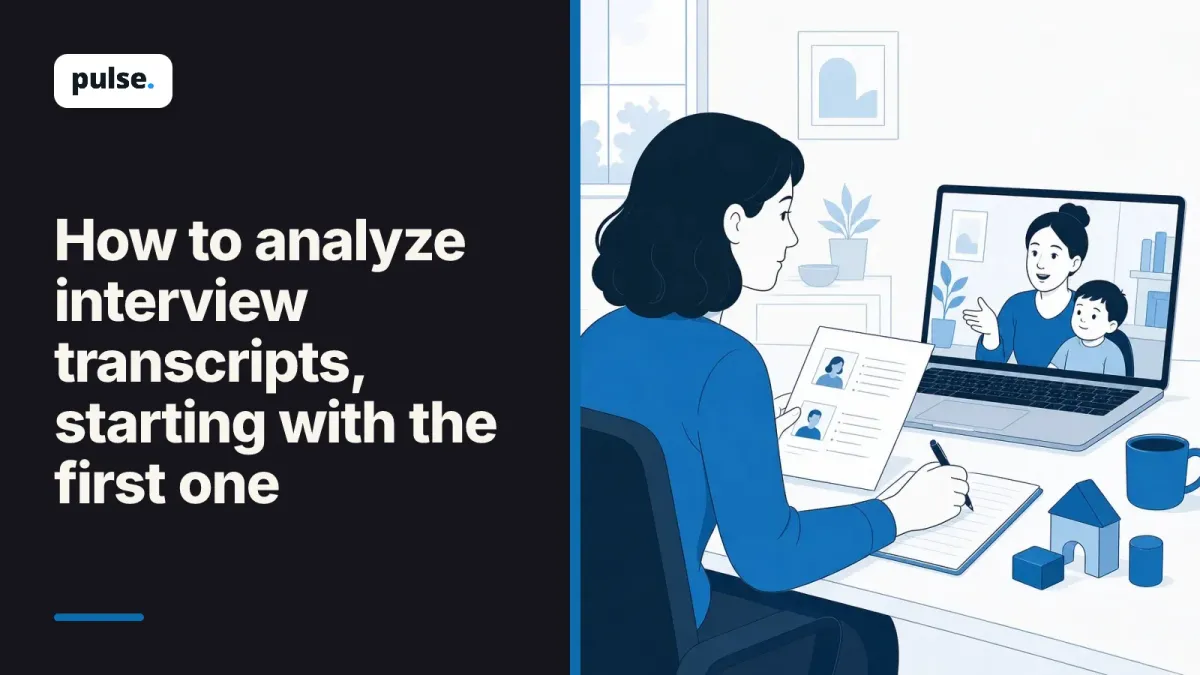
The first transcript from your parent interviews has landed.
You work on the research team at a toy maker company. The study asks why parents stop buying its building sets after the first box, and the other interviews are still running. So what do you do with this one transcript today?
How you handle it starts how you analyze interview transcripts for the whole study, because the first one sets the codes.
Read it once without marking anything, and write a short memo. Then code it line by line against your research question, tag the quotes worth keeping, and note what one interview can't tell you. Carry those codes into the next transcript.
Done well on transcript one, those four moves set up the rest of the study.
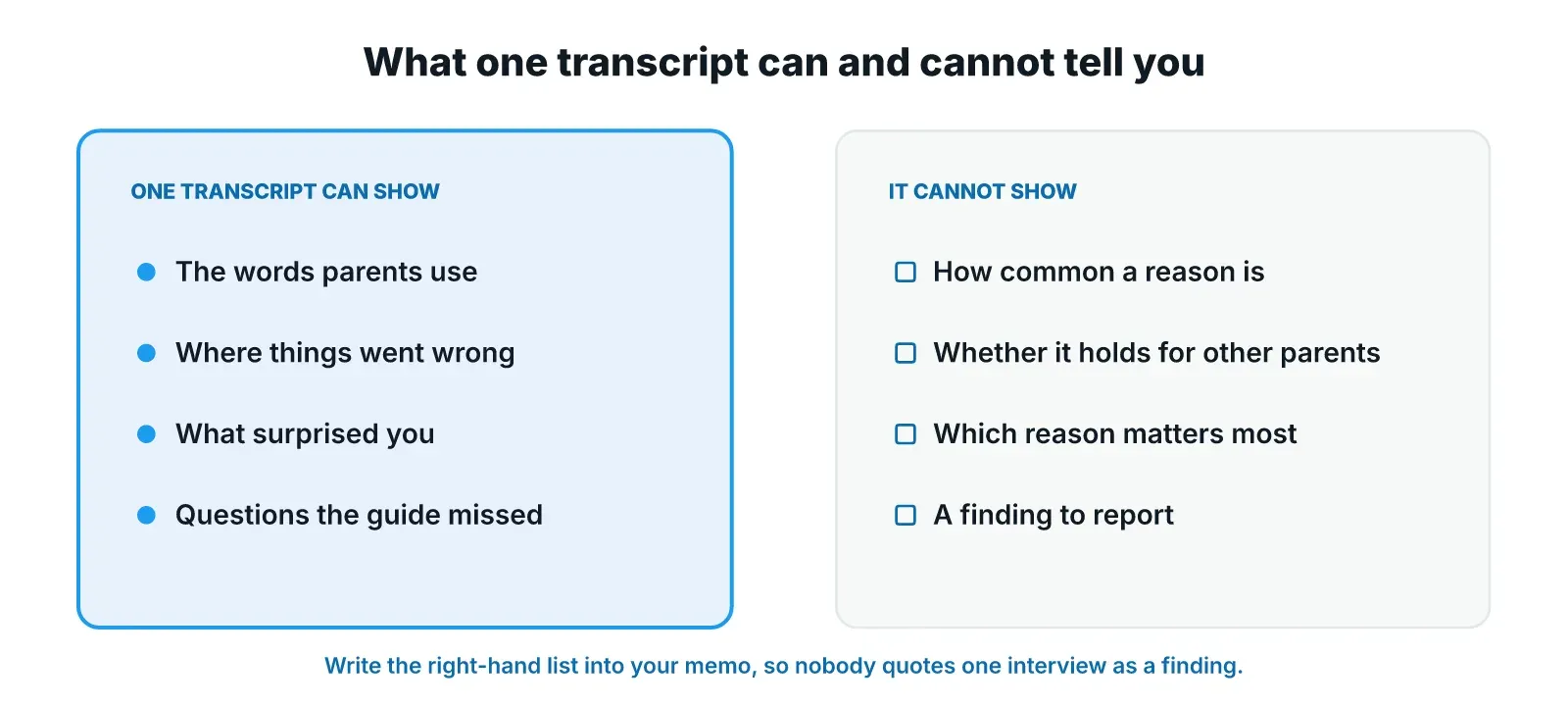
One transcript can show you the words people use, the moments where things went wrong and the questions your guide forgot to ask. It cannot tell you how common anything is, or whether a reason holds for other kinds of parents. Write that limit down, so nobody quotes one interview as a finding.
Say the first parent explains that her son finished his set in one evening and never played with it again. That is a vivid story, and it may turn out to be the main reason parents stop buying. It may also be one family's experience.
The pull of the first vivid quote is strong, because it is the only evidence you have. If it becomes the headline before the other interviews arrive, every later transcript gets read as proof of it.
So treat transcript one as a set of questions for the study. Researchers talk about data saturation, the point where new interviews stop adding new codes. In plain words, it's when the next parent tells you reasons you've already heard. You are a long way from it with one transcript, and that is fine.
To analyze your first transcript, read it through once, write a memo, code it against your research question, and pick the quotes worth keeping. Each step has one job, and doing them in order stops you from coding before you understand what the person was telling you.
Read the whole transcript without highlighting. Then write five lines. Say who this parent is, what they were trying to do and where it went wrong. Add what surprised you and what you want to ask the next parent.
Check the transcript against the recording wherever tone matters. "Oh, it was great" reads as praise on the page, but it may sound like the opposite out loud. This matters more if your transcript is intelligent verbatim, meaning the "ums" and pauses were cleaned out.
Note anything about the interview itself, such as a leading question or a skipped topic, because it changes how far you can trust that passage. Our post on judging interview quality in one transcript shows what to look for.
Open coding means labeling each passage with a short code that says what happened, in words close to the parent's own. Code against your research question, and mark passages that don't fit as "other" rather than forcing them into a code.
Say this passage comes from the first parent's transcript (a made-up example):
"He built the fire station in one evening. Then it sat on the shelf. I went to buy another one, but the shop had six boxes and I couldn't tell which ones worked with what he had. So I bought him a puzzle instead."
Each code stays close to the parent's words, while the memo note holds your question about it.
What the parent said | Code | Memo note |
|---|---|---|
"built the fire station in one evening" | Finished fast | Is fast a problem, or a sign it was fun? |
"Then it sat on the shelf" | No play after building | Ask the next parent what happens after the build |
"couldn't tell which ones worked with what he had" | Unsure what fits | Box label or shop shelf? |
"bought him a puzzle instead" | Switched to another toy | The sale was lost in the shop |
The codes describe what happened. The memo notes hold your guesses about what it means, so you can test them on the next parent instead of baking them into the codes.
Keep quotes that are specific, show a behavior or a decision, and make sense on their own. "I couldn't tell which ones worked with what he had" earns its place, because it shows the moment the next sale was lost. "It was nice" only repeats a code.
Record where each quote sits, such as the page or the time stamp, so anyone can check the context later. Then mark each quote as evidence for a code or as color, so the final report doesn't lean on color.
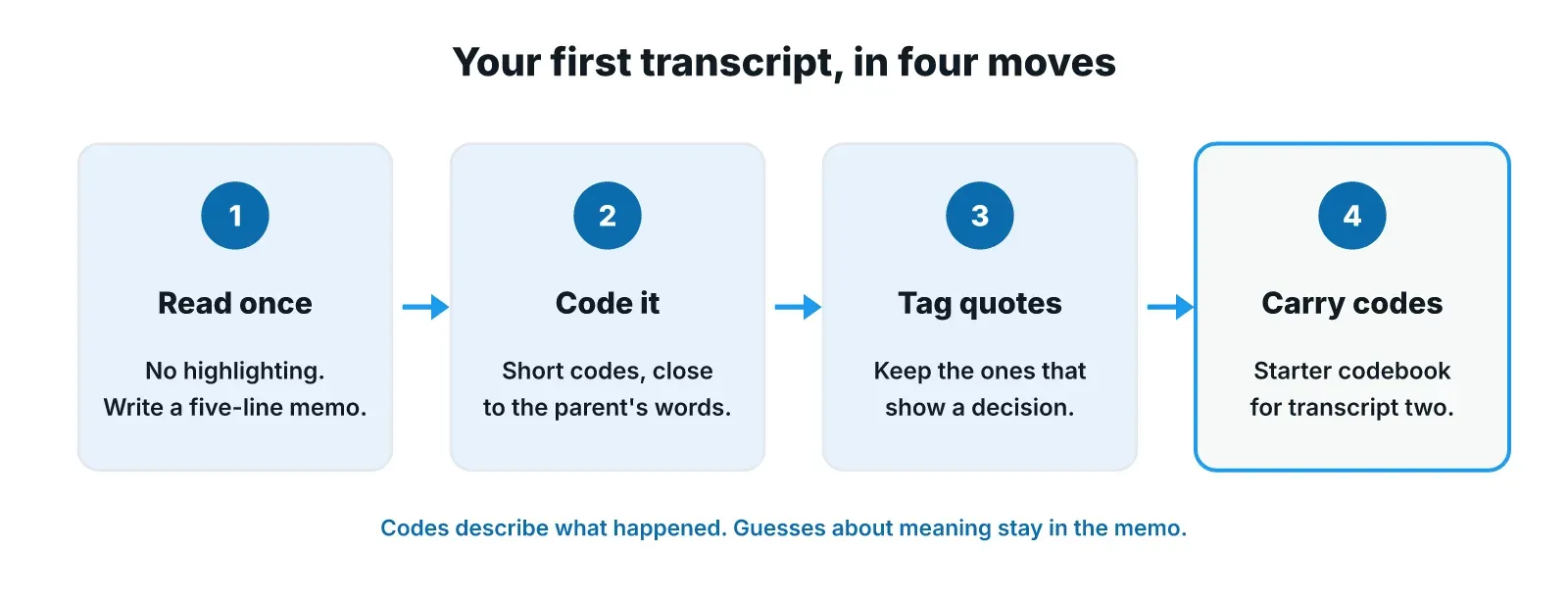
Before transcript two arrives, turn your first codes into a starter codebook: a list of codes, each with a one-line definition and an example quote. Then read transcript two against it, add codes for anything new, and note where the first parent turns out to be the odd one out.
For the toy maker, "Unsure what fits" might mean "The parent wanted another set but couldn't tell which would work with the first." That one line stops you from stretching the code later to cover price or age range.
If transcript one showed a question that confused the parent, fix the discussion guide now. Write down the date and the change, so you know which interviews heard the new version.
After a few transcripts, you'll notice fewer new codes. That is the time to start grouping codes into candidate themes. Our guide to building a full codebook covers that step, and the post on analyzing a full set of user interviews takes it to the end.
The decision rule follows from this. If "Unsure what fits" keeps coming back across parents, the fix is likely on the box or the shelf, and smaller sets won't touch it. If it fades after transcript one, it was one family's story.
AI-assisted coding helps most with the first grouping of passages across many transcripts. Close reading of the early transcripts, and the judgment about what a theme means, still sits with the researcher. One study comparing the two found close agreement on which passages to code, but less depth in the AI's themes.
That study, a 2025 proof-of-concept preprint on arXiv, compared GPT-4o with human researchers on interview transcripts from a stress-reduction trial with healthcare workers. The out-of-the-box model picked out a comparable number of excerpts to the humans, with strong agreement (a kappa score of 0.84, where 1 means perfect agreement). The authors also found its thematic analysis lacked the depth of the human analysis.
The study covers one health setting and has not been peer reviewed, so treat it as a signal worth testing. It still points to a sensible split of the work. Software can do the first pass across many transcripts, while you read the first few closely and check every theme against the quotes behind it.
Our post on how to check AI-generated themes against the exact quotes walks through that check.
The first-transcript habit works best when transcripts arrive early, one at a time. Pulse runs AI-moderated interviews and delivers every interview as a full transcript alongside its recording, while the rest of the study is still running. So your memo and first codes can start on day one.
Pulse then groups what participants said into themes, each with the quotes behind it, and every quote links to the transcript it came from. Your close reading of the early transcripts becomes the check on those themes. Tonality analysis on voice and facial coding on video also help with the moments where the words alone could mislead.
To see it on your next round of interviews, book a demo and start with a free trial and a free study.
Transcript analysis is the work of reading interview transcripts closely, labeling what people said with codes, and grouping those codes into themes that answer a research question. It turns hours of conversation into findings someone can act on, with each finding traceable back to the words that support it.
The three common types are verbatim, intelligent verbatim and edited. A verbatim transcript keeps every word, pause and "um". An intelligent verbatim transcript drops the filler but keeps the meaning and the speaker's own words. An edited transcript is cleaned up for reading, which can lose the hesitations you need for analysis.
For most research interviews, intelligent verbatim is a good default. Ask for full verbatim when hesitation or tone is part of what you're studying.
Start as they arrive. Reading the first transcript early lets you fix a confusing question in the guide and build a starter codebook while the study is still running. Keep early impressions in your memo, and hold back from calling anything a finding until you've read the full set.
Participant recruitment methods compared by who you need: your own list, panels, referrals, networks and recruiters, plus a check before you set a date.
Semantic vs latent themes, from Braun and Clarke's paper "Using thematic analysis in psychology", shown on real-life quotes, with when to use each.
How to choose a transcription service for research interviews: test each option on your own audio with five simple checks, from accuracy to data safety.