How to Analyze User Interviews: A Step-by-Step Guide to Finding Insights
A step-by-step guide to analyzing user interviews. Learn a rigorous thematic analysis process, avoid common biases, and turn raw conversations into actionable insights.
What Is User Interview Analysis?
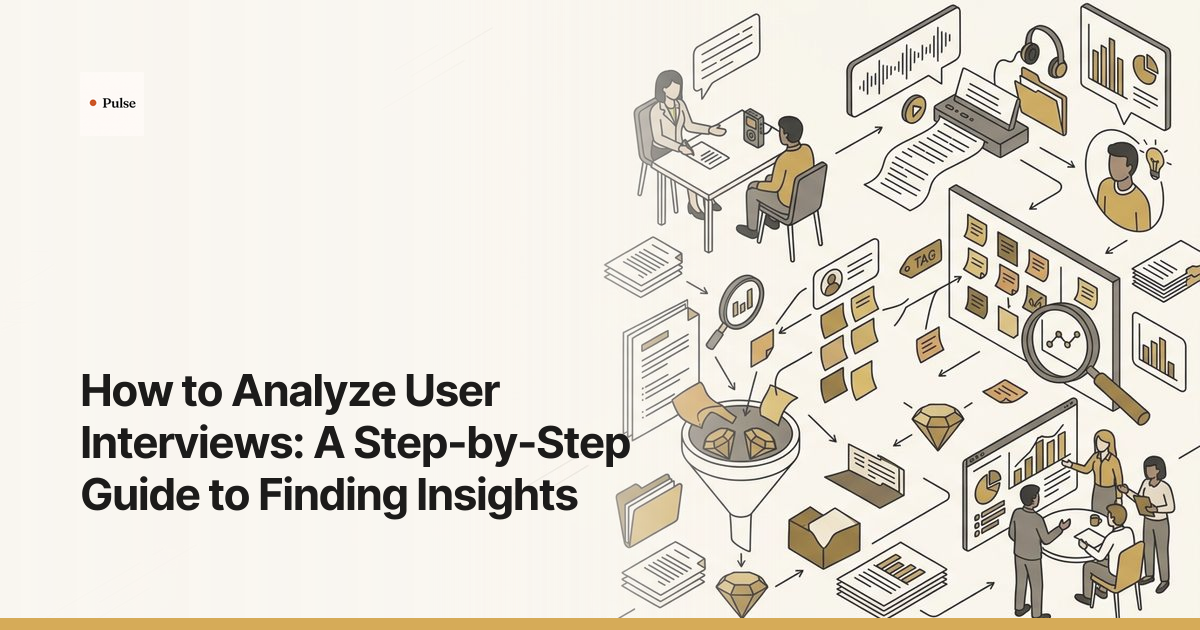
User interview analysis is the systematic process of reviewing, coding, and synthesizing qualitative data to identify patterns, themes, and actionable insights. The goal is to move beyond individual anecdotes to find credible findings that inform product, design, and strategy decisions, turning raw conversations into a coherent understanding of user needs.

A Step-by-Step Process for Analyzing User Interviews
A structured analysis process is what separates professional research from casual feedback collection. While several rigorous frameworks exist, the most widely used is thematic analysis, which involves systematically identifying and organizing patterns in the data. The six-phase process developed by Virginia Braun and Victoria Clarke provides a clear, adaptable foundation for most user research projects.
Step 1: Prepare Your Data
Analysis begins with clean, organized source material. This means converting all your audio recordings into verbatim transcripts. While time-consuming, a full transcript is essential for detailed coding and for capturing direct quotes to support your findings. Organize all files with a consistent naming convention and ensure each transcript is linked to its corresponding participant metadata, like their segment, role, or screener responses.
Step 2: Immerse Yourself in the Data
Before you start breaking the interviews down, read through every transcript from start to finish. This initial pass helps you get a holistic sense of the conversations and the overall narrative. Resist the urge to start coding or highlighting just yet. The goal of this phase is familiarization, allowing you to absorb the context before you deconstruct it.
Step 3: Develop a Coding System
Coding is the process of attaching labels or “codes” to excerpts of your transcripts to categorize the content. There are two primary approaches:
- Deductive Coding: You start with a pre-defined set of codes based on your research questions or an existing framework. This top-down approach is efficient for validating a hypothesis or answering specific questions.
- Inductive Coding: You develop codes as they emerge directly from the data. This bottom-up method is ideal for exploratory research where the goal is to discover unexpected themes.
In practice, most teams use a hybrid approach, a well-established method that combines the two. Peer-reviewed studies by researchers like Fereday and Muir-Cochrane validate this as a rigorous way to conduct thematic analysis. You might start with a few deductive codes related to your key research questions and then add inductive codes as new, unexpected patterns appear in the data.
Step 4: Execute the Coding
With your initial coding system in place, go through each transcript line by line and apply the relevant codes to phrases, sentences, or paragraphs. Consistency is critical. A well-defined codebook—a document that lists each code with a clear definition and an example—is essential, especially if multiple researchers are involved. This process is meticulous but forms the foundation of your entire analysis.
Step 5: Group Codes into Themes
Once all transcripts are coded, you will have dozens or even hundreds of coded excerpts. The next step is to find the patterns among them. Look for codes that appear frequently or seem related, and start clustering them into higher-level themes. A theme is a unifying thread or idea that captures a significant pattern in the data. For example, codes like “Navigation Confusion,” “Unclear Labels,” and “Hidden Features” might all group together under the theme “Poor Information Architecture Hinders Discovery.”
Step 6: Synthesize and Report
The final step is to build a narrative around your key themes. For each theme, articulate the core insight and state its business implication—the “so what.” Support each theme with compelling, anonymous quotes from the interviews. A good research report doesn’t just list findings; it tells a clear, evidence-based story that helps stakeholders understand the user’s reality and make informed decisions. For example, the U.S. Department of Veterans Affairs used insights from user interviews to redesign their entire website around veteran-defined tasks, not internal agency structures.
Common Mistakes in Interview Analysis (and How to Avoid Them)
Even with a structured process, common cognitive biases can undermine the quality of your insights. Awareness is the first step to avoiding them.

Confirmation Bias
Confirmation bias is the tendency to notice and favor data that supports your existing beliefs while ignoring contradictory evidence. To counter this, actively look for disconfirming evidence in your transcripts. Ask yourself, “What would prove my initial hypothesis wrong?” Having a colleague review your analysis can also help spot biases you might have missed.
The 'N of 2' Problem
This is the error of hearing the same comment twice and declaring it a “finding.” Early patterns are often just noise. The solution is rigor: set a clear threshold for what constitutes a theme. As Nielsen Norman Group notes, the number of users needed to find patterns in interviews is higher than for usability testing, where their foundational research shows five users can reveal most issues.
Confusing Quotes with Insights
A powerful quote is evidence, not the insight itself. An insight is your interpretation of what the pattern of evidence means for the business. A user saying, “I hate this onboarding flow,” is a quote. The insight is, “Our multi-step identity verification process creates significant friction, causing a high drop-off rate—say, 30% of new users—during setup, which points to a need for a more streamlined flow.”
Scaling Your Analysis Without Losing Rigor
The primary constraint of manual analysis is that it is incredibly time-consuming. Industry benchmarks show it takes an experienced professional between three and six hours to manually transcribe one hour of interview audio, with coding and synthesis adding several more hours. This reality often limits studies to a small number of interviews, increasing the risk that findings aren't representative.
This is where AI can accelerate the process without sacrificing quality. AI-powered platforms can handle the most mechanical parts of analysis, such as transcription and thematic clustering, allowing researchers to analyze much larger datasets in a fraction of the time. For example, Pulse runs AI-moderated voice interviews and automatically turns conversations into structured, themed insights, compressing the analysis phase from weeks to hours. This allows teams to focus their expertise on interpreting the findings and making strategic recommendations, which remains essential human work.
Frequently Asked Questions
How many interviews do I need to analyze to find meaningful patterns?
The number depends on the depth you need. Peer-reviewed research by Monique Hennink and Bonnie N. Kaiser distinguishes between two levels of saturation. For *code saturation* (finding most high-level themes), their work suggests this is often reached within 9 to 17 interviews for a homogenous group. For a deeper *meaning saturation* (uncovering nuance within those themes), you may need 16 to 24 interviews.
What's the difference between a theme and an observation?
An observation is a single point of data, often a direct quote or a description of a user's action (e.g., “User clicked the wrong button first”). A theme is a higher-level pattern of meaning that connects multiple observations across several participants (e.g., “Vague button labels cause frequent navigation errors”).
Can I use a spreadsheet for qualitative analysis?
Yes, especially for smaller studies. You can create columns for the participant, the quote, and one or more columns for codes. However, as the number of interviews and codes grows, dedicated qualitative analysis software can make managing, sorting, and visualizing the data much more efficient.
How do I handle conflicting feedback from different users?
Conflicting feedback is a valuable finding, not a problem. It often indicates that you have different user segments with different needs, mental models, or contexts. Instead of trying to find a single “right” answer, dig into the conflict to understand the underlying reasons. This can lead to more nuanced personas and more flexible product design.
From Conversation to Action
Turning hours of interview recordings into clear, actionable insights doesn't have to be a chaotic process. By systematically transcribing, coding, and identifying core themes, you create a reliable bridge from what your customers say to the decisions your business needs to make. The key is moving beyond a list of quotes to a synthesized understanding of the problems, needs, and motivations that drive your users. This structured approach ensures the insights you deliver are not just interesting, but trustworthy.
Ready to run a full research cycle in a fraction of the time? Pulse automates the entire interview and analysis process, from AI-moderated conversations to structured, traceable findings. Run 100 customer interviews by tomorrow morning.